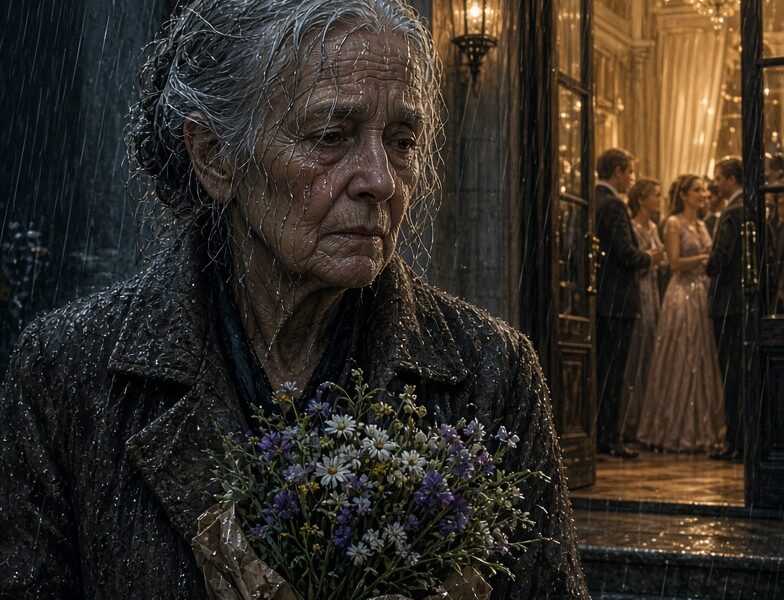
She Arrived as a Beggar at Her Own Grandson’s Engagement… And the Bride Ordered Her Thrown Out
The rain fell in sheets over the Chicago suburbs, turning the limestone drive of the Whitmore estate into a slick, gleaming mirror. An elderly woman stood at the service entrance, her coat soaked through, clutching a bouquet of hand-picked wildflowers wrapped in damp newspaper.
Her name was Eleanor Whitmore, and her family’s net worth was somewhere north of three billion dollars. But tonight, she looked like someone who had spent her last dime on a bus ticket.
Inside, the engagement party for her grandson, Daniel, was in full swing. Crystal chandeliers blazed over a hundred guests in tuxedos and evening gowns. Champagne flowed. A string quartet played something elegant and forgettable.
Then Victoria Hayes, the bride-to-be, spotted the old woman through the kitchen window and marched outside in her four-inch heels. “Get this woman out of my wedding reception right now,” Victoria snapped at the security guard.
“Please, sweetheart. I’m so sorry to disturb anyone. I only wanted to see my grandson tonight.” The old woman’s voice was soft, almost apologetic.
“Your grandson? Do you have any idea where you are? This is a private event for important people. We don’t invite beggars in off the street.”
“I understand, and I didn’t mean to embarrass you. I thought perhaps someone might tell Daniel. Tell him that his grandmother has finally arrived.”
Victoria laughed—a sharp, brittle sound. “Daniel’s grandmother? His grandmother lives in a mansion. She wears diamonds worth more than your entire wardrobe. She arrives in a chauffeur-driven car. You’re obviously confused.”
The old woman looked down at her worn shoes. “Perhaps I am getting old. That’s possible. People mistake an old woman’s appearance for the whole of her story. You’re going to marry Daniel, aren’t you?”
“Yes, and that means this family has standards. Standards that you clearly don’t understand at all.”
“I see. Then perhaps you could show me a little kindness. Even if I don’t belong here, just a little—”
“Kindness?” Victoria’s eyes narrowed. “You want kindness from me tonight? Fine. Here’s some advice. Find a shelter and ask somebody there for help. And stop pretending you know wealthy people.”
The wildflowers trembled in the old woman’s hands. “Those flowers were for Daniel. I brought them for him.”
“Then he can buy you much better ones himself.”
“I picked every single one of them myself.”
“How touching.” Victoria turned and gestured sharply. “Thomas, come over here right now.”
The estate manager appeared, his face carefully neutral. “Yes, Miss Hayes. What do you need?”
“Remove her immediately. I won’t have this tonight.”
Thomas hesitated. “Perhaps we could speak to her privately first.”
“I don’t care how you do it, Thomas. Just make sure she’s gone before anyone important notices.”
The old woman straightened her spine. “I’m standing right here in front of you. You don’t have to speak about me as if I’m invisible.”
“Then stop behaving like you belong somewhere you can’t afford.”
A voice cut through the rain from the terrace doors. “What did you just say to her?”
Daniel Whitmore stood in the doorway, his tuxedo jacket unbuttoned, his face pale. He had arrived early. He had heard everything.
Victoria spun around, her expression shifting from cruelty to practiced warmth in the space of a heartbeat. “Daniel, darling, you’re early tonight. There’s a little situation with an elderly woman. She somehow got past security, but it’s handled.”
Daniel walked past her as if she weren’t there. He knelt in front of the old woman, taking her cold hands in his. “Grandma? Is that really you standing there?”
“Hello, sweetheart. It’s so good to see you.”
“Grandma, what happened to you tonight? Why are you dressed like this? Are you hurt?”
“I’m perfectly fine, Daniel. Please don’t worry.”
Daniel stood slowly, his jaw tight. “You’re standing here while everyone stares at you. Your flowers are sitting in a champagne bucket. My fiancée is ordering security to throw you out. Tell me exactly what happened here.”
“Daniel, please. She was making a scene. I was only trying to protect the reception.”
“Protect it from my own grandmother, Victoria?”
“I didn’t know it was her. I swear.”
“You didn’t know who she was, so she deserved humiliation?”
“That isn’t fair. Just look at how she’s dressed.”
Daniel’s voice dropped to something quiet and dangerous. “Anyone in this room would have been confused. Confused about her identity, perhaps. But nobody forced you to insult her.”
“Daniel, please. I don’t want you fighting on my account,” Eleanor said softly.
“You shouldn’t have to ask anyone for basic respect, Grandma.”
Victoria threw up her hands. “I said I was sorry. What more do you want?”
“No, dear.” Eleanor’s voice was calm but firm. “You explained why you felt entitled to behave that way. That isn’t quite the same thing as being sorry.”
Daniel turned to the crowd that had gathered at the windows. “Everyone, please excuse us for a moment.”
“Daniel, we have important guests waiting for us right now,” Victoria protested.
“Then they can wait, Victoria. They’ll survive.”
He led his grandmother inside, past the staring guests, past the champagne and the string quartet, to a quiet study at the back of the house.
“You didn’t have to leave your own celebration, sweetheart,” Eleanor said.
“I didn’t leave my celebration, Grandma. I left a room where someone I love was mistreated.”
“And if you had arrived thirty seconds later?”
“I don’t know, but I’m glad I didn’t.”
“Neither do I, Daniel. Neither do I.”
He helped her into a leather chair and knelt beside her. “Tell me the truth, Grandma. Why did you come like that? You have a whole wardrobe full of beautiful clothes.”
“Beautiful clothes make people behave beautifully for the wrong reasons.”
“That sounds like something you’ve thought about for years.”
“I have. Ever since your grandfather was alive. He said money doesn’t change a person. It only exposes who they really are. He said it simply removes the obstacles that hid who people really were.”
“Grandpa really said that to you?”
“Often. Usually right after someone had disappointed him.”
Daniel studied her face. “Grandma, be honest with me. Are you testing Victoria?”
“Would you blame me if I were, sweetheart?”
“I’d ask why you felt you had to.”
“Because you’re in love, and love blinds sensible people. It makes them overlook things that would otherwise be obvious.”
“You think she’s only marrying me for money?”
“I think you deserve to know something important. Would she love you if you had nothing at all?”
“I’m not poor, Grandma. I have my own company. I work hard every single day, and Victoria knows that.”
“Your company is worth a great deal because our family helped build it. You’ve worked hard, but you’ve never lost everything.”
“And pretending to be a widow will tell you that?”
“I thought it might tell me something, at least.”
“It told you how Victoria treats a stranger.”
“Yes, and I’m afraid it told me more than I wanted.”
Daniel’s voice cracked. “I love her, Grandma. I’ve imagined a whole life with her. Children, holidays, ordinary mornings, arguments over dinner, all of it.”
“Those are beautiful things to imagine, sweetheart.”
“Then don’t decide everything because of one terrible evening.”
“I haven’t decided anything yet. I’m asking you to look carefully.”
Daniel was quiet for a long moment. “I can do that, but promise me something first. No more disguises and no more secret tests. If you have concerns about Victoria, just tell me.”
“I can promise not to humiliate her. That much I can do.”
“That isn’t quite the promise I asked you for.”
“It’s the only one I can make tonight.”
Daniel stood. “I should go back inside and speak to her.”
“Of course you should. Go on.”
“Will you come home with me tonight?”
“Not yet. I need a little time alone first.”
He found her an hour later, standing in the rain outside the service entrance. “You shouldn’t be standing out here in the rain.”
“I’ve survived seventy-two years. A little rain won’t defeat me.”
“You always say that when you don’t want anyone worrying.”
“And you always notice, don’t you, sweetheart?”
Daniel pulled her into a careful hug. “Grandma, I love you. More than I can say.”
“Oh, my dear, I love you, too. I love you more than any fortune I’ve ever owned.” Her voice broke. “Please, let me be wrong about her. Please, let me be wrong about that girl.”
Later that night, Eleanor sat in her penthouse overlooking Lake Michigan, a glass of untouched brandy in her hand. Her oldest friend, Richard, sat across from her.
“You were right about one thing tonight, Eleanor. Money removes obstacles, and tonight it removed Victoria’s manners. Now I must discover whether anything good remains beneath them.”
“This could become very complicated if Victoria finds out,” Richard warned.
“I’m not choosing his wife. I’m seeing if she values him.”
“And what if she loves him but behaves terribly under pressure?”
“Then she’ll have an opportunity to show she can change.”
“You’ve already seen her humiliate you in public.”
“I have, but I want to know something more. Was that cruelty an isolated failure or a pattern?”
Richard leaned forward. “Be careful. People get more dishonest when they suspect they’re watched.”
“Which is exactly why I won’t tell her. I won’t tell her she’s being tested.”
“What exactly do you intend to do then?”
“Tomorrow morning I’ll visit the estate as that same widow. I’ll ask for Daniel and see how she responds without guests.”
“That’s remarkably reasonable for someone planning an elaborate deception.”
“I never claimed to be perfect, Richard, never once.”
“There’s another matter. The estate transfer documents are ready. If Daniel marries Victoria, the trust grants him majority control.”
“I know. I’ve known it for some time.”
“Victoria could gain real influence over the foundation and company. You cannot use the will to force Daniel’s choice.”
“I won’t. His inheritance is not a leash.”
“Good, because if you condition it, he may never forgive you.”
“I’d rather lose an argument with my grandson than his trust.”
“Then perhaps the person you most need to test is yourself. You’ve spent your life protecting Daniel. Now you think you can protect him from every mistake, but you simply cannot protect him from himself.”
“I know that, Richard. Believe me, I know.”
“Do you? Sometimes protecting someone means standing nearby, even while they make a choice you’d never make yourself.”
“And sometimes love means warning them before consequences become permanent.”
“Both of those things can be true at once.”
Eleanor set down her glass. “Tomorrow I’ll observe. I won’t threaten her or touch his inheritance. If Victoria proves kind, I’ll accept it with my whole heart. If she proves cruel, Daniel deserves to know the truth.”
The next morning, Eleanor returned to the estate in the same worn coat, carrying nothing but a small purse and a determination to see clearly.
“Good morning, ma’am. Can I help you with something?” Thomas asked, his eyes widening slightly as he recognized her.
“I hope so. I’m looking for Daniel Whitmore.”
“Mr. Whitmore is inside, but you’ll need an appointment.”
“I understand. Could you tell him Eleanor is here?”
“Eleanor what, ma’am? Do you have a surname?”
“Just Eleanor, dear. He’ll know who I am.”
“I’m sorry, but I really do need a surname.”
“Then tell him an old widow came asking for help.”
“Is this a personal matter, ma’am?”
“It is. A very personal matter, indeed.”
Before Thomas could respond, Victoria appeared in the doorway, coffee cup in hand. Her face went white, then red.
“You again? Are you serious right now?”
“I hoped we might speak more calmly today.”
“There’s nothing to discuss. Yesterday was embarrassing enough.”
“I’m sorry if my presence caused you trouble.”
“Your presence is the trouble. That’s the whole point.”
Thomas cleared his throat. “Miss Hayes, should I ask Mr. Whitmore if he knows her?”
“No, Daniel has work to do this morning. He doesn’t need every stranger claiming to know him.”
“I’m not asking for money, not a single cent. I only want to speak with him for a moment.”
“People who say they don’t want money want something else. A signature, a favor, a photograph, a story to sell.”
“Sometimes they only want someone to listen to them.”
“Then find a church or a community center. This is a private estate.”
“Would you let me wait somewhere sheltered, please? My shoes are wet, and I’ve been walking a long time.”
Victoria turned to Thomas. “Please show her the way to the road.”
“Ma’am, perhaps we should at least offer her a chair,” Thomas said quietly.
“Why? So she can say she was welcomed into this home?”
“I would never tell a lie about your hospitality.”
“You already lied about knowing Daniel, didn’t you?”
“I said he was my grandson and nothing else.”
“You expect me to believe a woman dressed like this is family? Related to one of the wealthiest families in the country?”
“You don’t have to believe me. You could simply ask him.”
“And I could simply ask security to remove you, Thomas. Open the side gate and escort her away now.”
“Before I go, may I ask you just one question?”
“You’ve already taken far too much of my time.”
“If Daniel lost everything tomorrow, would you still marry him?”
Victoria blinked. “That’s an absurd question. Honestly absurd.”
“Why is it absurd, Victoria?”
“People don’t lose everything overnight. Not people like Daniel.”
“But if he did, what then?”
“I don’t intend to marry a man who loses everything.”
“I see.” Eleanor’s voice was barely a whisper. “I see it very clearly now.”
“Good. Then you understand why you should leave.”
Thomas watched the old woman walk slowly toward the gate. “Miss Hayes, that question seemed rather harmless to me.”
“Harmless questions are exactly how trouble begins, Thomas.”
That afternoon, Eleanor found herself at a bus stop three miles from the estate, rain still falling. A young man in a gray hoodie stood beside her, holding an umbrella.
“Excuse me, ma’am. Are you all right out here?”
“I’m fine, thank you. Just waiting a while.”
“You look cold. Here, please take this umbrella.”
“That’s very kind, but I can’t take your umbrella.”
“You can borrow it. I’m only going to the pharmacy.”
“What if it starts raining even harder?”
“Then I’ll get wet. I’ve survived much worse.”
“You don’t even know me, young man.”
“Does that really matter, ma’am?”
“It matters to a great many people.”
“Maybe that’s why so many people need help in the first place.”
Eleanor smiled for the first time in days. “Thank you. I hope someone is this kind to you.”
“I hope they are, too, ma’am. I really do.” He pointed down the street. “There’s a community center two blocks from here. They serve lunch until three, and it’s warm inside. They won’t ask you too many questions there.”
“You think I need charity? Is that it?”
“I think everyone needs help sometimes. I’m just telling you what’s available, nothing more.”
“You have a generous heart, young man.”
“My mother taught me you never know what someone’s been through. She said the world is hard enough without making it harder.”
“Your mother sounds like a very wise woman.”
“She was. She passed away last year.”
“I’m so sorry. I truly am.”
“I still reach for my phone to call her when something good happens.”
“I know that feeling. Grief doesn’t always announce itself. Sometimes it arrives in the middle of an ordinary afternoon.”
“Exactly. That’s exactly how it feels.” He shifted his bag. “What do you do for work, if I may ask?”
“I manage projects for Daniel Whitmore’s company. We’re expanding a community housing program right now.”
“Daniel has always cared about helping people.”
“He does. He’s not perfect, but he listens. That’s rare in business, believe me.”
“And what about his fiancée?”
“Victoria? I don’t know her well enough to judge.”
“That’s a careful answer, young man.”
“It’s an honest one, ma’am.”
“Then let me ask you something else. If someone mistreated you for having nothing, then learned you were wealthy, would you forgive them for what they did?”
“I’d want to know if they were sorry for hurting me, or simply embarrassed about getting caught.”
“How would you ever tell the difference?”
“By watching what they do when nobody’s paying attention.”
Eleanor nodded slowly. “That may be the wisest answer I’ve heard all day.”
“I hope you find what you’re looking for, ma’am.”
“I think I’m beginning to. Thank you.”
That evening, Victoria sat in a wine bar with her best friend, Sophia, her third glass of pinot noir untouched.
“You look exhausted,” Sophia said. “What happened?”
“Daniel’s grandmother happened, that’s what.”
“Eleanor Whitmore? What on earth did she do?”
“She showed up at the estate dressed like a homeless woman. Again.”
“Again? Why would a billionaire ever do that?”
“How should I know? Maybe she’s waiting for me to embarrass myself.”
“Did you?”
“I was polite enough, more or less.”
Sophia studied her friend’s face. “You told me Daniel makes you feel safe. So why does his family make you this defensive?”
“Because safe is more complicated than love. Daniel has money, a business, a name, and an inheritance. My career could vanish if the wrong person finds me inconvenient.”
“You have your own achievements, Victoria.”
“Achievements don’t pay for a life like that. Not the one I want.”
“So what life do you want, exactly?”
“A beautiful house and children who never worry about school fees. Travel, security, a husband who never counts every dollar.”
“There’s nothing wrong with wanting comfort. But what if his money becomes your reason for staying? Do you love him?”
“You make it sound like I don’t love him. Of course I do. How can you even ask?”
“Then why talk about his inheritance like that? Like it’s the only thing between you and happiness?”
Victoria’s eyes filled with tears. “I watched my mother choose between rent and groceries. She smiled in public and cried when the bills arrived. I swore I would never live that way.”
“I understand, but you can build security without treating people as disposable.”
“You weren’t there last night. Everyone was watching. That woman made me look cruel.”
“Did she make you cruel, Victoria? Or did she reveal something you didn’t want people to see?”
“You’re supposed to be my friend, Sophia.”
“I am your friend. That’s exactly why I’m asking. I’m asking the question nobody else will ask you.”
“I need Daniel to marry me. I need the wedding. Once we’re married, everything will finally settle down.”
“Marriage doesn’t settle a problem you refuse to face.”
“I’m not asking for a lecture, Sophia.”
“Then stop asking me to agree with you.”
Victoria pulled a folded document from her purse. “Do you know what this is? It’s a draft of the family trust arrangement. Daniel showed it to me because he trusts me. After the wedding, he’ll control most of the holdings.”
“Why do you even have that document?”
“I wanted to understand what our future would look like.”
“And what does it look like to you?”
“It looks like never having to be afraid again.”
“That’s not a future. It’s a prison built from expensive things.”
“You don’t understand. You never have.”
“Maybe not, but frightened people hurt the ones who love them most.”
Victoria stood abruptly. “I’ll apologize to Eleanor. I’ll make things right.”
“Because you regret hurting her? Or because you want this family to accept you?”
“That wasn’t my question, Victoria.”
“I have to go. I’m sorry, Sophia. Please think before you make a choice you can’t undo.”
“I’ve spent my whole life thinking about what I’m doing.”
“Then maybe it’s time to think about what you’re becoming.”
The next morning, Victoria drove to the community center on the south side of Chicago. She found Eleanor in the kitchen, wearing an apron, serving mashed potatoes to a line of homeless men and women.
“Eleanor? I’ve been looking everywhere for you.”
“Good afternoon, Victoria. And why is that?”
“To apologize to you properly this time.”
“Then I’m listening. Take your time.”
Victoria took a deep breath. “What I said to you was cruel. I should never have treated you that way.”
“No, you shouldn’t have, Victoria.”
“I was embarrassed and worried about the guests. I let that fear make me behave terribly.”
“Were you embarrassed because I was suffering? Or because people might think you were unkind?”
“I honestly don’t know how to answer that.”
“Then perhaps take some time before answering.”
Victoria’s voice dropped. “I’ve spent my whole life trying to escape poverty. My mother worked two jobs. We moved whenever rent got impossible. I promised myself I’d build a different life. Sometimes I’m still that frightened little girl.”
“There’s nothing wrong with wanting a different life.”
“One mistake could take everything away from her.”
“Does that frightened girl have the right to hurt everyone?”
“No, she doesn’t. She really doesn’t.”
“Can she decide someone deserves less respect for having less?”
“No, she can’t, and I know that.”
“Then what will you do differently from now on?”
“I don’t know yet. I want to say I’ll change. I understand why you might not believe me.” Victoria gestured to the bags she’d carried in. “I brought food for the center. It’s not much.”
“Words are a beginning, Victoria, but they aren’t proof. Did you bring it to help or hoping I’d tell Daniel?”
“I wish my motives were perfect, but they weren’t. I thought about Daniel and what you’d think of me. But I also thought about the people who come here.”
“That is an honest answer. Thank you for it.”
“You don’t have to forgive me today.”
“Forgiveness isn’t a reward for saying the right thing. It grows when people begin to act differently.”
“Would you let me help inside with you?”
“Of course. They always need volunteers here.”
For three hours, Victoria stood beside Eleanor, serving food, washing dishes, listening to stories. She said little. She watched everything.
“Have you ever made a mistake that changed how someone saw you?” she finally asked.
“Many times. I once dismissed an employee over a false report. By the time I learned the truth, she’d moved away. I apologized, but I couldn’t return her months of worry.”
“What did you learn from that?”
“Power makes it easy to correct a mistake on paper. It doesn’t repair the hurt you caused someone.”
“I think I have a great deal to learn.”
“Then begin here, one person at a time.”
Meanwhile, Daniel sat in his office with James, the foundation’s operations director, reviewing spreadsheets.
“Explain exactly what you found, James. From the beginning.”
“Several payments went from the foundation’s event account. They went to a consulting company with no employees.”
“How much money are we talking about?”
“Enough to require an investigation. Seven thousand five hundred dollars over three months.”
“Was Victoria involved in the foundation’s event planning?”
“She helped coordinate the engagement charity dinner. She had some vendor access, but that proves nothing. I won’t let suspicion become an accusation.”
“We’ll review the records and follow the evidence.” Daniel rubbed his temples. “Keep this separate from my personal life. No one uses this investigation to settle a family argument.”
That evening, Daniel found his grandmother in the garden of her penthouse, surrounded by rose bushes.
“Grandma, I’m honestly worried about you.”
“Why would you be worried about me?”
“You seem determined to find something terrible about Victoria.”
“I’m determined to discover the truth, nothing more.”
“The truth is she made a serious mistake. But people can change, Grandma.”
“They can. The question is whether they want to.”
“She told me she intends to apologize to you.”
“Then I’ll listen to her, I promise.”
“And if her apology isn’t perfect?”
“An apology isn’t a performance, Daniel. It’s the beginning of responsibility.”
“You’ve always been hard on people, Grandma.”
“I built a company when people said a woman couldn’t lead it. I had to be hard enough to survive.”
“And did that make you happy?”
“Sometimes, but not always, sweetheart.”
“Grandpa said you could negotiate with anyone except yourself.”
“Your grandfather said many inconvenient things.”
“He said you spent years making sure nobody could hurt you again.”
“I was young, and I had responsibilities.”
“You still do, but you don’t have to carry them alone.”
“I’m not trying to control your life, Daniel.”
“I know, but sometimes it feels like only your judgment matters.”
“That isn’t what I believe at all.”
“Then trust me enough to make my own decision.”
Eleanor was silent for a long moment. “You’re right, Daniel. You’re absolutely right.”
“I didn’t expect you to say that.”
“Neither did I, sweetheart. Believe me.” She laughed softly. “I won’t tell you whom to marry. I won’t change your inheritance because of your choice. And I won’t ask you to end your engagement out of fear.”
“Thank you, Grandma. That means everything to me.”
“But I need you to promise me something in return. Never confuse loyalty with silence. If someone you love hurts another person, say so. And don’t hide from painful truths about Victoria.”
“I promise you both of those things.”
“Then perhaps we can both learn something from this.”
The next week brought a reckoning. Victoria sat across from Daniel in his living room, her hands folded in her lap.
“Daniel, can we talk for a minute, please?”
“Of course. What is it?”
“I visited your grandmother today and apologized properly. Then we helped at a community center together.”
“You did?”
“I’m really glad you went.”
“There’s something else I need to tell you. I’ve been thinking about the wedding and who I want to be.”
“And what have you decided, Victoria?”
“I don’t want to marry you out of fear about money. I want to marry you because I love you. But saying those words doesn’t automatically make them true.”
“No, it doesn’t. Not on its own.”
“I want to earn your trust, Daniel. I’ll be honest about my fears instead of hiding behind money.”
“That’s a good place to start.”
“There’s also something about the foundation.”
Daniel’s expression sharpened. “What about the foundation, Victoria?”
“An event coordinator gave me some financial planning documents. I read them to understand the foundation’s future. I shouldn’t have done that without asking you.”
“Did you share them with anyone else?”
“No, I read them and kept a copy. I thought it was harmless. Now I know it wasn’t.”
“Why didn’t you tell me about this earlier?”
“I was afraid you’d think I only wanted the money.”
“Hiding something because you’re afraid doesn’t make it less important.”
“I know. I should have told you.” She handed him a thick envelope. “Here it is.”
“Thank you, Victoria. I really mean that.”
“I also want to postpone the wedding until this is sorted.”
“Are you sure about that?”
“Yes, I won’t begin our marriage with unanswered questions.”
“That may be the most honest thing you’ve said in weeks.”
“I know I have a great deal to make right.”
“You do, but I appreciate you not pretending it doesn’t matter.”
Two weeks later, the Whitmore family gathered in the grand ballroom for what Eleanor called “a conversation the family needed to have.”
“Thank you all for coming this evening. Something happened in this room that deserves remembering, not hiding.”
“Grandma, are you sure you want to do this publicly?” Daniel asked.
“Yes. The humiliation happened here in public. If we’re to learn from it, we must speak honestly.”
James stepped forward. “The financial review has also been completed. An outside contractor submitted false invoices to the foundation. We’ve recovered part of the money and referred it to the authorities. The foundation’s services will continue without interruption. The families who depend on us won’t pay for someone’s dishonesty. We’ve strengthened approvals and added independent oversight. No single person will have unchecked control over the accounts.”
“Good,” Eleanor said. “Wealth should create responsibility, not immunity.” She turned to Victoria. “Victoria, would you like to say anything?”
“Yes, I would, if you’ll let me.” Victoria stood, her voice shaking. “A week ago I saw an elderly woman standing here. I decided she didn’t belong in this room. I judged her by her clothes and what she could offer me. I humiliated her in front of people who trusted me.”
“Continue, Victoria. We’re all listening.”
“I told myself I was protecting an important event. I told myself I was defending my future. But those were excuses, nothing more. The truth is I was afraid of losing the life I wanted. And I allowed that fear to make me cruel.”
“Victoria, thank you for being honest with us.”
“I understand why you don’t take my promises at face value. I can’t undo what happened here. I can only choose what I do next.”
“And what will you do next?”
“I’ll keep volunteering at the community center. I’ll cooperate fully with the foundation’s review. And I’ll stop treating money as proof my life has value. I have work to do, and I intend to do it.”
“That is a meaningful beginning, Victoria,” Eleanor said. “I know it may not be enough to repair everything.”
“Repair takes time. You don’t need to pretend otherwise.”
“I love you, Victoria, but I need honesty, kindness, and trust.”
“I can’t promise things will return to how they were.”
“I wouldn’t ask you to, Daniel.”
“Then let’s take our time and see what we can build. Let’s stop trying to prove we’re perfect.”
“I’d like that. I’d really like that.”
Six months later, Eleanor stood in the garden of the Whitmore estate, watching Victoria push a wheelbarrow full of soil toward the community garden she had helped build on the property.
“You kept the flowers, Grandma?” Daniel asked, pointing to a framed photograph in the study. “Not those exact flowers. They were beyond saving. I wanted something here to remind us of that evening.”
“What should it remind us of?”
“Kindness isn’t a decoration for when important people are watching. It’s a choice we make when nobody owes us anything.”
“I hope one day I can prove I’ve learned that.”
“You don’t have to prove it to me every day. You have to live it.”
“I will try, Eleanor. I promise you that.”
“Trying matters. So does what you do when trying gets difficult.”
Victoria joined them, her hands dirty, her face flushed with effort. “The roses are in. The kids from the community center are coming tomorrow to plant the vegetables.”
“Good,” Eleanor said. “No special treatment for anyone.”
“That’s exactly what we agreed on.”
Daniel put his arm around Victoria’s shoulders. “I used to think you solved problems with a phone call or money.”
“I wish that were true, sweetheart. This time you gave us something more difficult.”
“What was that, Daniel?”
“A chance to see ourselves honestly.”
“Then maybe the test was never only about Victoria,” Eleanor said. “It was whether this family could value people beyond their possessions.”
“And what have you learned, Eleanor?”
“Money can build a magnificent house, but not a home. A home is built by people who treat each other with dignity.”
“May I ask you something, Victoria?”
“Of course you may.”
“When you came dressed as a widow, did you expect me to fail?”
“I expected to discover the truth, and I feared it. But I had no right to decide the answer first. One terrible choice reveals a person’s weaknesses. What happens afterward shows if they’ll face them.”
“I hope you’ll give me the chance to keep learning.”
“The chance is yours, and so is what you do with it.”
The three of them walked through the garden together, past the rose bushes and the vegetable beds, past the place where a desperate old woman had once stood in the rain.
“You know,” Eleanor said softly, “I think your grandfather would have been proud tonight.”
“I hope so. Though he’d say I made a mess first.”
“He would have said it with a smile, Eleanor.”
“He usually did, Margaret. He usually did.”
“For years I believed my duty was protecting this fortune. I was wrong.”
“Then let’s make sure we use it well.”
“Together, sweetheart. Always together.”
Perhaps the richest person in the room isn’t the one with the most money. It’s the one who sees the worth money can’t measure.









