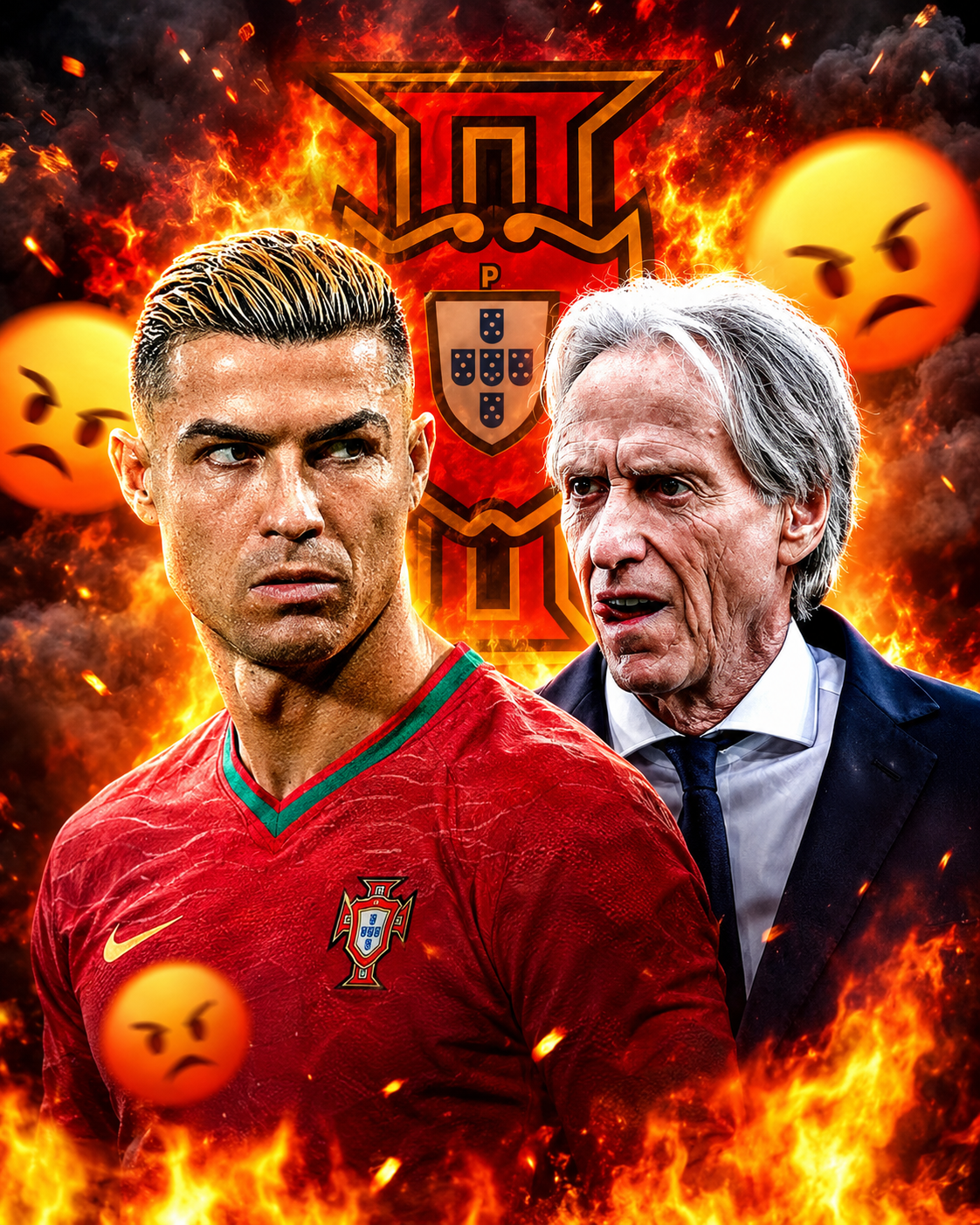
Ronaldo Leaves Portugal’s Camp, Boards a Private Jet and Promises to “Tell the Truth”: Is This the Messy End of His National Team Career?
A private jet, a captain who walked out of camp, and a promise to tell the truth someday.
All that was missing was a “To Be Continued” screen.
One week ago, Portugal had a simple story, a 2-1 win over Norway and a team cruising in the Nations League.
Now the scoreline has been completely swallowed by something much bigger.
Cristiano Ronaldo has not announced his retirement from international football, and that needs to be said first.
But when a 41-year-old with 234 caps and 146 international goals voluntarily leaves camp while his relationship with the head coach is strained, every question about a farewell becomes fair game.
A Record Holder Walks Out
Think about who we are talking about.
Ronaldo holds the records for both the most caps and the most goals in men’s international football.
Anything he does carries historical weight, even when it looks like a simple trip home.
This time, it is anything but simple.
It All Started in Oslo
The trouble began in Oslo, where Portugal beat Norway 2-1.
Ronaldo sat on the bench for all 90 minutes, even though he had warmed up.
According to Portuguese outlet A Bola, it was the first time since 2008 that he had been an unused substitute in an official match for the national team.
When the final whistle blew, he went straight down the tunnel.
He did not join his teammates to thank the 600 Portuguese fans in the stands.
That small moment said more than any statement could have at that point.
The Promise of 30 Minutes
After the match, head coach Jorge Jesus admitted he had planned to let Ronaldo play the final 30 minutes.
He even said he had discussed that possibility with the captain beforehand.
But Gonçalo Ramos played well, scored the decisive goal and had another one ruled out, so Jesus changed his plans.
On pure authority, the coach did nothing wrong.
A pre-match plan cannot tie a manager’s hands when the game shifts minute by minute.
If he had put Ronaldo on just to keep his word, he would have turned his selection power into a personal favor.
Ronaldo Is Not a Normal Player
Here is the difficulty.
Ronaldo is not a regular player wondering whether he will get 30 minutes this weekend.
He has 979 official career goals, 21 shy of the 1,000 mark.
He is the captain and all-time top scorer of Portugal, and he has worn the national shirt since 2003.
When a coach talks about minutes in advance with a figure like that, it instantly becomes an expectation.
And when expectations are not met, disappointment follows almost on schedule.
The Training Ground Puzzle
Things only got more tangled after the match.
Ronaldo appeared with the squad in Malmö but did not train.
The next day he arrived at the stadium about half an hour before the session, then went back to the hotel for a private gym workout.
The Portuguese Football Federation explained that he needed specific equipment for his routine, which the stadium gym could not provide.
Jesus confirmed that Ronaldo was not injured, and he denied reports that his player had refused to train.
The Federation Steps In
The situation became serious enough that FPF president Pedro Proença changed his schedule.
He had planned to watch the Portugal Under-21 team face Gibraltar in Estoril.
Instead, he diverted to Copenhagen to be closer to the situation.
Portuguese media reported that he arrived in Denmark overnight, hoping to mediate directly between the captain and the coach, after the two had already spoken at the hotel.
It is rare to see a federation president rearrange his week for a training session.
It tells you exactly how heavy the moment felt.
Jesus Tries to Calm the Storm
Jorge Jesus faced the press and tried to put out the fire.
He said there was no “Ronaldo incident” and insisted that CR7 had not refused to train.
He added that the captain had spoken to him in a professional spirit.
If the coach wants him to play, he plays, and if the coach wants him in the stands, he accepts that too.
Jesus also said Gonçalo Ramos would continue to be prioritized, and that Ronaldo would only enter the pitch if the team needed him.
It was a message of control.
It did not stay calm for long.
The Statement
A few hours later, Ronaldo left the training camp.
He issued a statement saying the decision came after the coach’s press conference and after talks with the FPF president.
He promised that at the right time, he would tell all Portuguese people the truth about the reasons that led him to leave the national team.
He then wished Portugal and his teammates the best of luck.
The two most important words are “the truth.”
The moment a player uses that phrase, the public naturally concludes that the version heard so far is not the full story.
Ronaldo left camp, but he left behind an unopened envelope, and now an entire country is waiting for the day it is opened.
The Jet That Became a Character
Then came the plane.
A Bombardier Global Express XRS, believed to have gone to Copenhagen to pick up Ronaldo, became a key character in the story.
It reportedly left Madrid after 7:30 p.m. Spanish time, was scheduled to land in Copenhagen around 10:20 p.m., and then flew back to Madrid around 11:15 p.m.
A disagreement inside a national team now had its own flight map.
Football fans around the world were tracking dots on a screen.
The Family Joins the Fight
The story took another turn when Ronaldo’s sister, Elma Aveiro, took to social media to defend her brother.
She argued that CR7 deserves more respect and that the national team’s setup needs to improve.
She said the Portuguese press should speculate less.
The harshest part of her message criticized the Portuguese people themselves, calling them envious, contemptuous and ignorant, and saying the country deserves to return to the mediocrity it knew before the CR7 era.
That is the family’s view, and it is not a statement from Ronaldo.
But it shows the atmosphere around this story has moved far beyond who starts against Denmark.
Criticism From Inside Portuguese Football
Ronaldo has also faced plenty of criticism.
Former player Maniche believes he needs to handle situations more carefully, talk to the coach clearly, and stop letting frustration feed more rumors.
Journalist Sofia Oliveira was even harsher, stressing that the collective interest must stand above the captain’s ego.
Those two views may be hard for his fans to hear.
But they touch on a real part of the problem.
A player has every right to be angry, but a captain has to weigh the consequences of how he shows it.
What Was Actually Promised?
Portuguese media figure Pedro Sousa added another layer.
He said Ronaldo had once helped Jesus become head coach, and that the two had talked about how to use CR7 before the training camp.
Sousa also confirmed the possibility that Jesus had told Ronaldo he would play 30 minutes against Norway.
That private understanding has not been publicly confirmed by Ronaldo, Jesus or the FPF, so it cannot be treated as a settled fact.
But the coach himself admitted that his plan to give Ronaldo about 30 minutes was where he made his own job harder.
The Problem With Promising Minutes
A coach has every right to say you are on the bench.
He can say he needs to rotate, or he can say flat out that he is not sure he will use you.
But promising specific minutes to Ronaldo is like writing a promissory note in a sport full of variables.
The match state can change, other players can excel, and plans can be torn up.
At that point, either the coach keeps his word and ties his own hands, or he breaks it and faces a storm.
Jesus chose the second option.
On in-game management, he has a point.
On managing expectations before the game, he left the door open for trouble to walk in.
The Reality Ronaldo Hates Most
Ronaldo is also facing the thing he has resisted most throughout his career.
He is no longer an automatic starter.
Only a few days earlier, he had started against Wales in a 1-0 Nations League opening win under Jesus.
Against Norway, he did not play at all.
Jesus has publicly prioritized Gonçalo Ramos.
At 41, that is the new reality.
The 1,000-Goal Dream
Ronaldo is chasing his 1,000th career goal, and he currently sits at 979, including 146 for Portugal.
Before this Nations League window, he said he was not obsessed with the number.
But he admitted that if the 1,000th came in the colors of the Portuguese national team, it would be the perfect finishing touch to his career.
After this past summer’s World Cup, he considered retiring from international football.
He chose to continue because he still felt he could contribute.
That is why a possible departure right now feels sad in a different way.
The Ending Nobody Wants
Imagine if Ronaldo retired after a major tournament, after a final match everyone knew was the last, with applause from teammates and fans.
We would retell his 23 years with the national team through Euro 2016, the Nations League, the goals, the times he pulled Portugal out of tight spots, the captain’s armband, the tears, the shouting and the records.
But if it all ends after this incident, the final image risks being a car leaving Parken, a private jet flying to Madrid and a promise to tell the truth.
That would be the worst-case scenario.
And the reason would not be that he was a substitute, because at 41 that is entirely normal.
It would not be because Jorge Jesus dared to pick Gonçalo Ramos, since coaches are paid to make exactly those calls.
And it would not be because Ronaldo is angry, because anyone who has competed for over two decades would hardly be happy to warm up for 20 or 30 minutes and never be called on.
The real shame is that a relationship that could have been managed with clear boundaries has been pushed into a crisis of trust.
Two Men Who Know Each Other Well
Ronaldo worked with Jesus before, at Al-Nassr.
Jesus took over Portugal after the World Cup and was given a contract through 2030.
They did not walk into the dressing room as strangers.
That is exactly why, if there is a real misunderstanding about CR7’s role, it needed to be addressed directly from the start.
Ronaldo remains important, but he is not guaranteed a starting spot.
The coach still respects the captain, but he makes no promises about minutes.
The 1,000-goal target is a worthy personal story, but the team has no obligation to rearrange its plans to serve that milestone.
It is that simple.
But in football, the more power, fame and history involved, the harder it is to say simple things.
Portugal Must Carry On
Whatever happens next, Portugal have matches to play.
They have six points from two Nations League games and are the defending champions after beating Spain in the 2025 final on penalties.
After the away trip to Denmark, they host Norway on October 4.
The other 24 players are still training.
Gonçalo Ramos still has to play, and Jorge Jesus still has to do his job.
The national team cannot hit pause because Ronaldo boarded a plane.
The Line Ronaldo Needs to See
That is the boundary the captain has to recognize.
He is the greatest player in Portuguese history, by goals and by caps.
But the team must always be bigger than any single individual.
His legacy will not shrink because of one match on the bench.
How he handles his final chapter, however, could shape the impression he leaves behind.
The Truth Is Still Waiting
Nobody yet knows what the truth is that Ronaldo has promised to share.
It could involve promises, roles, communication, or something the public has not seen.
Until he speaks for himself, any conclusion that he was betrayed or deliberately pushed out remains speculation.
And there has been no retirement announcement.
So it is not yet time to write the final chapter of Cristiano Ronaldo’s international career.
But perhaps that clock has started ticking faster.
One thing is certain, a 23-year career deserves to end with applause on the pitch, not with thousands of tiny dots on Flightradar24.









