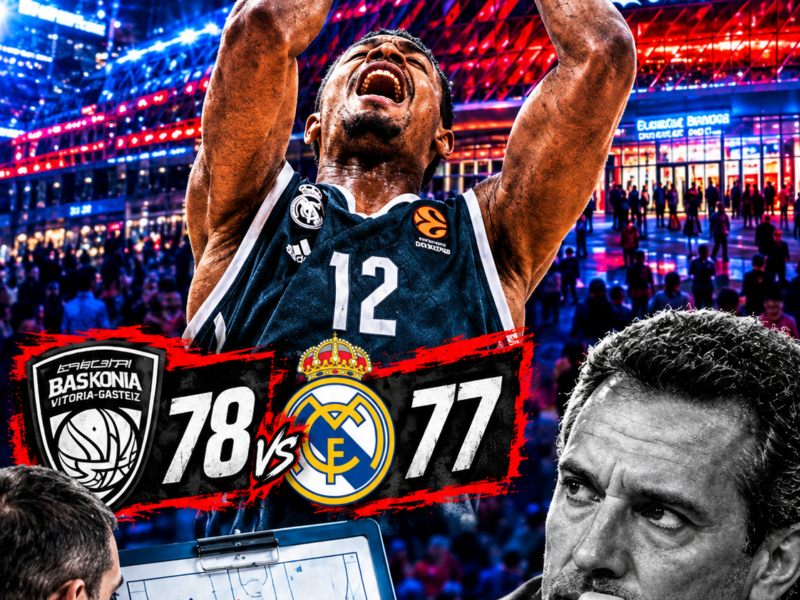
Real Madrid’s Unbeaten Run Finally Snapped As Dubai’s Petrodollar-Fueled Roster Exposes Cracks In Pedro Martínez’s Rotations, Costly Final-Minute Meltdown, And A Wake-Up Call Before Facing Unicaja
There is always one night, no matter how good a team looks in the early weeks of a season, when the illusion of invincibility finally cracks.
For Real Madrid’s basketball team, that night arrived far sooner than anyone inside the locker room wanted to admit.
The unbeaten start to the EuroLeague campaign is over, and the manner of the defeat is what stings the most.
This was not a game Madrid got outclassed in.
This was a game Madrid arguably could have won, and in some ways probably should have won, before it all unraveled in the final two minutes.
Let’s break down exactly how one of Europe’s most dangerous rosters managed to hand away a winnable basketball game, and why the warning signs from this loss matter far more heading into the next stretch of the schedule.
The final buzzer confirmed Real Madrid’s first EuroLeague defeat of the season, and the fingerprints of that collapse were all over the closing possessions.
In the final two minutes, the offense completely lost its shape.
There was hesitation everywhere, a visible fear of attacking the basket against a Dubai defense that had spent the entire fourth quarter growing more and more confident.
That hesitation turned into empty possessions, and empty possessions turned into a loss that will require some serious film study before the next matchup.
It is the kind of defeat that is easy enough to rationalize on paper, given the financial firepower Dubai Basket has assembled with its now well-documented spending power.
But rationalizing a result and feeling good about it are two very different things.
This one hurts precisely because it did not have to end this way.
There were specific possessions, specific decisions, that could have gone differently, and in a league this competitive, those small margins are what separate signature road wins from frustrating collapses.
Real Madrid had been closing out tight games all preseason, dating back through the EuroLeague’s own Super Cup tournament, and this time, for the first time, that clutch gene simply did not show up.
Before diving into the individual breakdowns, it is worth understanding the bigger structural problem that defined this entire performance.
This was never a smooth, rhythmic basketball game for Real Madrid.
It played out in runs and spurts, with neither team ever fully seizing control of the tempo, and in that kind of chaotic environment, Dubai simply handled the final possessions with more composure.
Two major issues stood out above everything else, and the first one is rebounding.
When a game refuses to settle into any kind of rhythm, defensive rebounding becomes the single most important lever available to seize control of the pace.
Dubai out-rebounded Madrid by a staggering margin, and that gap alone tells most of the story of why the game felt so unmanageable throughout.
Pedro Martínez wants his team built around two specific pillars, transition basketball and a heavy diet of three-point attempts, and both of those pillars require possessions to actually come easily.
Instead, Madrid settled for far too many contested, low-quality three-point looks, while simultaneously bleeding long offensive rebounds back to Dubai on the other end.
Those long rebounds in particular were a killer, arriving at exactly the moments when Madrid looked poised to finally seize control of the scoreboard.
Now for the encouraging part of an otherwise frustrating night, because it would be inaccurate to say Madrid simply got beaten everywhere on the floor.
Inside the paint, this Real Madrid roster genuinely impressed.
Walter Tavares, even without a monster stat line, contributed winning minutes in the post.
Damian Jones quietly had one of his best outings in a Madrid uniform, and in several stretches actually outproduced Tavares in terms of raw impact.
Jaime Pradilla chipped in solid minutes as well, and Mikael Jantunen turned in a genuinely excellent two-way performance that deserves real recognition.
Together, that frontcourt group did an outstanding job neutralizing two of Dubai’s most important interior weapons, containing both Nate Petrusev and Khalifa Cabengele for most of the evening, no small task considering how central Cabengele is to Xavi Pascual’s offensive system.

Toko Shengelia, another key Dubai frontcourt piece, never really found his footing either.
So defensively, in the trenches, Madrid actually won that specific battle.
The problem was everywhere else, and it had a name, or rather, two names.
Dwayne Bacon was an absolute problem all night long, continuing a trend from the previous meeting between these two clubs where he had already torched Madrid’s perimeter defense.
He finished with twenty-four points and an overall efficiency rating of thirty-one, numbers that reflect a guard who was simply unguardable from start to finish.
Nobody on the Madrid roster found an answer for him, not Chus Mateo’s usual defensive matchups, not Gabi Deck’s length, nothing.
And then there was Okobo, who quietly built toward an explosion of his own.
He finished with only eight points across thirty minutes on the stat sheet, but the way those minutes unfolded tells a very different story than the box score suggests.
He grew more dangerous as the game progressed, and by the second half, after a quiet opening stretch, he was fully locked in, hitting shots at exactly the moments Madrid could least afford them.
There was a specific sequence that changed the entire complexion of the fourth quarter, when Madrid was up by roughly six points and appeared to be pulling away.
Okobo answered with one of those improbable, borderline impossible shot-clock-beating baskets that completely shifted momentum right back toward Dubai, almost identical to a similar dagger he had delivered against Madrid in their previous meeting.
That one shot did not just erase points off the lead.
It seemed to erase Madrid’s entire sense of control over the game’s rhythm.
Cabengele also deserves real credit here, finishing with nine points and seven rebounds in a winning effort.
There is a layer of irony to his performance too, because reports had circulated for years that Real Madrid was close to signing him back when he was playing in Italy, before Dubai Basket ultimately outbid everyone with the kind of financial package few European clubs can realistically match.
Watching him operate against Madrid now, in a Dubai uniform, only reinforces how much talent slipped through the cracks in that pursuit.
Now let’s get into the numbers that actually explain how this game got away from Madrid, because the box score tells a much clearer story than the flow of the game itself ever did in real time.
Start with the most damning statistic of the entire night, the rebounding differential.
Dubai finished with forty-five total rebounds compared to Madrid’s thirty.
A fifteen-rebound gap in a game this tight is enormous, because extra rebounds simply mean extra scoring opportunities, and in a contest defined by runs and momentum swings, every additional possession matters enormously.
Rebounding is control, plain and simple, and on this particular night, that control belonged entirely to Dubai.
The assist numbers paint an equally concerning picture.
Madrid had been building real offensive fluidity across the preseason and the early EuroLeague Super Cup stretch, and that fluidity showed up clearly in the ball movement, reflected directly in a healthy assist total game after game.
Tonight, Madrid finished with only thirteen assists.
That number alone signals a team that reverted to individual, hero-ball possessions rather than trusting the system that had been working so effectively up to this point.
Turnovers, interestingly, were not actually the problem, with only eight giveaways on the night, a perfectly respectable number.
The issue was not sloppiness. The issue was selfishness, whether intentional or not, baked into shot selection.
Too many possessions turned into isolated, talent-reliant attempts rather than genuine team offense, and the one exception standing above that pattern was Sergio Rodríguez’s protégé in the backcourt, Theo Maledon.
Maledon was the one true compass for Madrid’s offense across the entire night, finishing with an overall efficiency rating of sixteen, earning game MVP honors, and contributing eleven points, four rebounds, and six assists in what amounted to the most complete two-way performance from any Madrid guard on the floor.
Compare that against the rest of Madrid’s guard rotation, and the gap becomes impossible to ignore.
Facundo Campazzo, normally the emotional and tactical engine of this roster, simply never got going.
He did find one basket late in the fourth quarter, but the trademark aggression that usually defines his game was completely absent for most of the night, and his shooting looked tentative rather than assertive from start to finish.
That timidity from beyond the arc was not limited to Campazzo either.
It infected the entire roster, and it is exactly the kind of approach that frustrates Pedro Martínez the most, because his offensive system is built entirely around a high, confident shot volume designed to generate rhythm and easy scoring chances.
Part of the issue traces back to personnel limitations that have quietly existed all season.
Certain rotation pieces simply struggle to knock down open shots consistently, and both Gabriel Deck and Alberto Abalde fall squarely into that category on nights like this one.
Deck missed two enormous three-point attempts at critical junctures, finishing the night with zero points overall, an almost unthinkable number for a player of his caliber.
Abalde, meanwhile, continues to present a real tactical puzzle, because once he puts the ball on the floor off the dribble, his offensive game essentially disappears.
There is a defensive argument to be made for keeping him on the floor specifically to guard Okobo, and that argument has some merit.
But modern basketball increasingly demands that every starter represent a legitimate offensive threat, and right now, in terms of scoring confidence, Abalde simply is not delivering that at the level this roster needs from a starting wing.
There is also a rotation decision from this game that deserves direct scrutiny, and it involves the usage of Gabriele Procida.
He logged only three minutes of total playing time, an allocation that is genuinely difficult to make sense of given the matchup in front of Madrid tonight.
There was a clear opportunity for Procida to soak up eight to ten minutes in the second unit, providing fresh legs defensively, and specifically helping share the defensive burden against Bacon rather than leaving Deck and Luwawu-Cabarrot to absorb all of that punishment themselves.
Speaking of Luwawu-Cabarrot, he finished with eleven points, including a couple of genuinely excellent makes, but his overall game looked disorganized for long stretches, shooting a modest three-for-six on twos, a rhythm that likely cost him the chance to be a more decisive factor late in the contest.
Jaime Pradilla added five points and showed flashes of quality, even in a game that was far from his best overall showing.
Jantunen, as already mentioned, was genuinely one of Madrid’s better performers on the night, finishing with ten points while creating real problems for Toko Shengelia defensively at the power forward spot, an underrated storyline buried inside an otherwise disappointing team result.
Andrés Feliz delivered one of those classic split personalities that define his game, part electric difference-maker, part liability.
At one stretch, with the score sitting around seventy-five to seventy, he drilled a hugely important three-pointer that injected real life back into Madrid’s offense.
There is no denying the pure competitive fire and personality he plays with on a nightly basis.
But his decision-making continues to lag behind his talent level, and in moments of high intensity, that competitive fire sometimes tips over into recklessness.
The final offensive possession of the game, designed specifically to go through him, ended in a heavily contested, deeply rushed attempt that never had a realistic chance of falling.
It is the kind of shot he is fully capable of making on a different night, but tonight, it was simply too forced, too hurried, and ultimately symbolic of the entire fourth-quarter unraveling.
Damian Jones deserves one more mention here, because his overall impact tonight rivaled, and in certain sequences even surpassed, that of Tavares himself.
He finished with ten points and five rebounds, and his plus-minus impact on the floor was genuinely excellent throughout the evening.
Tavares, for context, closed with eight points and four rebounds, solid but clearly a notch below Jones’s overall efficiency tonight.
That is a meaningful development for a Madrid frontcourt that suddenly looks deeper than many expected heading into the year.
Now for one of the more curious storylines buried inside this loss, the continued mystery surrounding Usman Garuba’s complete absence from the rotation.
For the second straight matchup against this exact opponent, his lack of involvement was genuinely difficult to understand.
There were viable alternatives sitting on the bench that could have offered something different, whether that meant giving Max Heidegger a shot to provide perimeter scoring punch, or even turning to the experience of a veteran presence in exactly this kind of high-stakes environment.
Inside the paint, Madrid already had enough coverage, even with names like Chima Moneke unused, which only deepens the confusion, because at a certain point, roster construction and eligibility logistics start to feel like they are working against the coaching staff’s own preferred rotations.
Ultimately, of course, those decisions rest entirely with Pedro Martínez, and any head coach is going to get calls right and get calls wrong across the course of a long season.
The important context here is that his track record so far has clearly leaned toward more good decisions than bad ones, and tonight’s misfires should be viewed inside that broader pattern rather than as some sudden alarm bell.
This was not a game where the team’s mentality or focus was ever really in question.
The competitive spirit and attentiveness were both clearly present throughout the night, especially on the defensive end against an opponent that is genuinely difficult to slow down.
What was missing tonight was simply brilliance in the biggest moments, the kind of individual shot-making or split-second execution that turns tight games into wins rather than agonizing losses.
Credit where it is due, Xavi Pascual once again proved exactly why he carries the reputation he does as one of the sharpest tactical defensive minds in European basketball.
Whether at Barcelona, at Zenit Saint Petersburg, or now leading this ambitious Dubai project, he has repeatedly shown an ability to grind opponents down into ugly, low-scoring environments, and tonight’s game, which never cracked the eighty-five-point threshold for either side, fit that exact pattern perfectly.
His team simply moved better in the second and third quarters, particularly during a brutal fourteen-point stretch spanning the end of the second quarter into the start of the third, when Madrid looked completely unsettled defensively, allowing quick, precise ball movement that Bacon in particular exploited relentlessly.
That specific run is really where this game was lost, even if the final agonizing minutes are what everyone will remember first.
So where does that leave Real Madrid heading into the next stretch of games.
This was not a defeat that should trigger panic or a wave of harsh criticism directed at Pedro Martínez.
It is simply a result to acknowledge, analyze honestly, and then move past, because the margin for a different outcome was razor thin, decided by a handful of specific possessions rather than any fundamental breakdown in quality or preparation.
Madrid genuinely could have closed this game out with a comfortable cushion in the final minute, even if that cushion had only been four, five, or six points, simply by making slightly sharper decisions in crunch time.
Campazzo’s overall usage tonight deserves one final look, because his seventeen total minutes stand out as an unusually light workload for a player of his stature and importance to this roster.
Compare that against Abalde’s fourteen minutes, an allocation that is honestly difficult to fully justify given how the matchup actually played out.
Procida’s three minutes have already been discussed, and frankly deserved to be higher.
Maledon, given his MVP-caliber performance tonight, likely could have handled twenty-five or twenty-six total minutes rather than the allocation he actually received, especially considering how clearly he was operating above everyone else on the floor.
There is also a broader roster question worth raising about Sarr’s inclusion in tonight’s squad.
He looked unprepared for this specific matchup in the previous meeting against this same opponent, and unfortunately, he again looked unprepared tonight.
These are the kinds of granular, day-to-day decisions that either quietly help a team or quietly hurt it, and tonight, several of those choices leaned toward the latter, even while acknowledging that on other nights, those same instincts from the coaching staff have paid off handsomely.
Looking ahead, the schedule does not slow down, and neither does the pressure to respond correctly.
Madrid’s next assignment shifts away from EuroLeague play entirely, moving into Spain’s domestic ACB league for a matchup against Unicaja Málaga, and there is real urgency attached to opening that stretch with a confident, bounce-back victory.
There is a specific cautionary history worth remembering here too, tied directly back to last season’s underwhelming road form under previous head coach Sergio Scariolo, when a stretch of away losses in EuroLeague play ultimately prevented Madrid from finishing higher than third in the overall standings, despite going unbeaten at home for the entire campaign.
Avoiding a repeat of that exact pattern has to become a genuine organizational priority this season.
The margin between finishing third and finishing first in a competition this brutally competitive often comes down to exactly these kinds of road performances, the ones where composure, shot selection, and rebounding discipline determine outcomes far more than raw individual talent ever could.
There is also a broader lesson buried inside tonight’s rotation questions, one that speaks directly to team psychology moving forward.
If Maledon needs to be the primary ball handler in certain matchups instead of Campazzo, that has to be an adjustment this roster embraces without any wounded pride attached to it.
The goal is simply better decision-making in these specific high-leverage moments, regardless of which name ends up controlling the ball when the game is on the line.
There is a proven, winning starting lineup already established here, built around Campazzo, Andrés Feliz, Luwawu-Cabarrot, Pradilla, and Tavares, a group that performed excellently throughout the earlier Super Cup tournament.
But tonight exposed real cracks in that formula, specifically Campazzo’s uncharacteristically quiet shooting performance and Abalde’s struggles defending the two-guard position against a genuinely dangerous scoring threat in Okobo.
One final storyline worth monitoring closely as the season progresses involves Nick Smith Jr., who remains unregistered for EuroLeague competition at this point in the year.
The expectation is that he still needs a proper preseason buildup before he can be added to the active roster for European play, and exactly how much time that buildup requires remains an open question.
Given how long he has already gone without genuine competitive game action, it seems reasonable to expect his best form will not really surface until sometime around late November, December, or possibly even January, once he has had a genuine chance to rebuild real basketball rhythm.
So that is the full breakdown of Real Madrid’s first EuroLeague loss of the season, an eminently winnable game against a heavily bankrolled Dubai Basket roster that ultimately handled the final possessions with far more poise than Madrid managed to muster.
The warning signs are clear enough, a rebounding disadvantage that needs urgent correcting, an assist number that needs to climb back toward the fluid ball movement Madrid showed earlier in the preseason, and a series of rotation decisions that deserve closer scrutiny heading into the next matchup.
None of that erases the genuinely excellent frontcourt performance turned in tonight, or Theo Maledon’s star turn as the lone offensive engine keeping Madrid competitive deep into the fourth quarter.
It simply means there is real, actionable work to do before the trip to face Unicaja Málaga, and how this team responds to that challenge will say far more about the health of this season than any single result against a big-spending Dubai roster ever could on its own.









