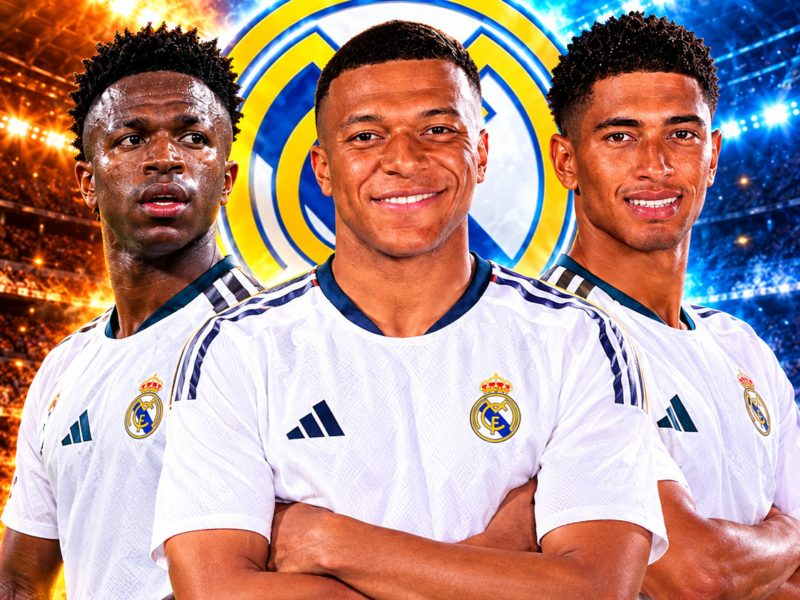
Real Madrid’s Secret Pay Ladder Exposed: Why Vinicius Doesn’t Earn What Mbappe Does, How Guler Is About to Leapfrog Camavinga, and the Ballon d’Or Chess Game Nobody Saw Coming
Somewhere inside Valdebebas, a number is being written down that could change the entire hierarchy of Real Madrid’s locker room.
It isn’t a transfer fee. It isn’t a scoreline. It’s a salary figure, and it belongs to a 20-year-old Turkish playmaker who, until recently, was earning less than half of what a struggling teammate takes home every single month.
That gap is about to close, and the way it closes says more about where this Real Madrid squad is heading than almost anything happening on the pitch right now.
Over the last few days, whispers from inside the club have started to firm up into something close to a blueprint. A picture is forming of exactly how Florentino Perez’s Real Madrid pays its players, who sits where on that ladder, and why one player in particular is about to jump two rungs at once.
Buckle in, because untangling this salary structure means wading through transfer clauses, signing bonuses, contract renegotiations, and a Ballon d’Or subplot that is somehow just as dramatic as anything happening in the dressing room.
The Gap Nobody Talks About: Vinicius Doesn’t Earn What Mbappe Earns
Let’s start with the biggest myth going around Madrid right now.
Plenty of fans assume that when Kylian Mbappe arrived on a free transfer and signed his blockbuster contract, the club effectively lined him up alongside Vinicius Junior on identical terms. That assumption is wrong.
According to people close to the club’s finance department, there is a real and deliberate gap separating the two. Mbappe sits above everyone else in the squad, full stop, and no other player is being paid on his level.
Part of that gap may come down to how his signing bonus was structured rather than his base wage. Real Madrid effectively paid Mbappe a fee for arriving as a free agent, and some of that money appears to be folded into what looks, on paper, like salary.
Even accounting for that, sources insist the base salary itself is higher for the Frenchman. This was one of Florentino Perez’s explicit goals during Mbappe’s arrival negotiations, a point the club was never going to concede, even as Vinicius pushed hard during his own renewal talks.
Real Madrid was never going to put Vinicius on Mbappe’s exact pay grade. That was the line fed to reporters throughout the process, and while nobody can rule out a secret handshake agreement made purely between the two players and hidden from outside eyes, the working assumption inside Spanish football is that Mbappe remains the highest earner in the building, full stop.
Pinning down the exact number is genuinely difficult. Nobody at the club will confirm gross figures, and untangling how much of Mbappe’s unpaid transfer value got folded into salary versus bonuses versus performance-based clauses is close to impossible from the outside.
The rough estimate floating around is that Mbappe is being paid somewhere in the neighborhood of thirty million euros net per year, which works out to roughly sixty million gross once Spanish tax rates are applied. Even by superstar standards, that is a genuinely rarified number.
Vinicius: The Second Tier, All By Himself
Just below Mbappe sits Vinicius Junior, occupying a tier that nobody else in the current squad is sharing.
Estimates on his net salary bounce around depending on who you ask. Some reports put him at twenty-three million euros net annually, which comes out to roughly forty-six million gross. Other sources land closer to twenty-four million net, translating to somewhere around forty-eight million gross.
The wobble in those numbers likely comes down to performance clauses baked into his deal. If Vinicius mounts another serious Ballon d’Or campaign, wins more silverware, or hits certain individual milestones, additional money kicks in that outside observers simply can’t track from a distance.
Whatever the precise figure, the picture is consistent: Vinicius sits in his own bracket, comfortably above the rest of the squad, but still a clear step below Mbappe.
Enter Jude Bellingham: The Club Wants Him in That Same Bracket
Here’s where things get genuinely interesting, because Real Madrid appears ready to promote a third player into that elite bracket alongside Vinicius and Mbappe.
Jude Bellingham currently earns somewhere around 20.8 million euros a year on his existing terms, a healthy salary by almost any measure but still a clear step below Vinicius. Conversations have reportedly begun to change that.
The framing being used inside the club isn’t just about money, it’s about status. Real Madrid wants to formally recognize Bellingham as one of the three untouchables in this squad, alongside Vinicius and Mbappe, rather than treating him as merely an excellent squad member sitting a notch below them.

Whether the final number lands exactly at parity with Vinicius or just short of it remains to be seen, but the direction of travel is clear. The plan is to close the distance significantly, creating what insiders are already nicknaming the “three magnificent ones,” a trio separated from the rest of the roster by a genuinely enormous salary chasm.
The renewal talks themselves are reportedly expected to be straightforward. Bellingham is described as extremely content at the club, and the belief is that both sides want the same outcome: a longer contract that reflects the leadership role he has already claimed on the pitch, with or without an armband to make it official.
Watch him during matches right now and the framing makes sense. He operates like a connective hub between attack and midfield, constantly organizing teammates around him. He has been called, only half-jokingly, a captain without the armband, and Real Madrid apparently wants to make that status financial as well as symbolic.
The Next Rung Down: Where Life Gets Complicated
Below the top trio, the numbers drop off a cliff, and this is where the real drama of Real Madrid’s pay structure lives.
The next visible bracket sits around sixteen million euros a year, and it’s populated by a genuinely fascinating mix of players. On one side are the free transfers, guys who arrived without a transfer fee attached and therefore had more room in their contracts to negotiate higher base salaries plus signing bonuses.
Ibrahima Konate fits that mold. So does Bernardo Silva-style free-agent logic, and so does Trent Alexander-Arnold, who joined on a free transfer from Liverpool and reportedly landed in this same bracket almost immediately.
On the other side of that sixteen-million tier sit players who earned their way there through performance rather than negotiating leverage at signing. Federico Valverde and Rodrygo Goes both belong here, having started on considerably lower salaries when they first broke into the first team and climbed steadily as trophies piled up.
The logic behind that combination makes sense once you see it laid out. A free transfer arriving with no signing fee owed to a selling club can be offered, say, a twelve-million-euro base salary plus a six-million-euro signing bonus paid annually, landing them at eighteen million total. Meanwhile a homegrown or long-tenured player who proved himself over multiple title runs earns a similar overall number purely through salary growth tied to performance.
It’s worth noting Thibaut Courtois may belong somewhere in this conversation too, with some reports placing him around fifteen million net, translating to roughly thirty million gross, putting him in similar territory to Alexander-Arnold once you adjust for net versus gross figures.
The Bracket Just Below: Camavinga, Cucurella, Mendy, and the New Arrival
One tier down from that sits a group hovering somewhere between roughly ten and twelve and a half million euros a year, gross. This is currently home to Eduardo Camavinga, Dean Huijsen, and Ferland Mendy, with Alvaro Carreras also believed to be in this range.
Dani Ceballos-style depth pieces and other recent squad members without marquee individual leverage tend to land here as well, though the exact placement of every single name is genuinely difficult to pin down from outside the club’s finance office.
This is the bracket that matters most right now, because it’s the one a certain 20-year-old Turkish international is about to blow straight through.
Arda Guler’s Contract Jump: A Double Promotion
Here is the headline that’s been circulating inside Real Madrid circles, and it’s a genuinely striking one.
Arda Guler currently earns somewhere between six and seven million euros gross per year, a modest figure that reflects the deal he signed as a promising young talent arriving from Fenerbahce roughly three years ago. Back then, he was still an unproven teenager with obvious potential but no track record at the highest level.
That status has changed dramatically, and the club appears ready to acknowledge it with an extraordinary jump in salary. Rather than moving him up one tier, as would be typical for a standard renewal, Real Madrid is reportedly planning to skip him past the entire Camavinga-Cucurella-Mendy-Huijsen bracket entirely.
Instead, Guler would land directly in the sixteen-million tier, putting him alongside Tchouameni, Valverde, Rodrygo, Konate, and potentially Alexander-Arnold and Courtois depending on how those figures shake out. That’s not a modest bump. That’s a double promotion in one move.
The negotiation angle behind this jump is straightforward once you think about it from the club’s perspective. Guler’s current contract runs until 2029, so Real Madrid isn’t under pressure from an expiring deal. This is proactive, not reactive.
The motivation appears to be almost entirely about protecting against outside interest. If Guler has a strong Turkish national team campaign or continues his current trajectory at club level, the fear inside Madrid is obvious: a Premier League club could show up offering to quadruple his current wage, framing the conversation as “you’re being criminally underpaid at Real Madrid, come here instead.”
By moving proactively now, before any transfer speculation gains real momentum, the club locks in a longer-term commitment while the leverage still favors them rather than waiting until Guler’s value has appreciated even further and negotiating from a weaker position.
Why Guler Deserves This, According to People Inside the Club
The case for elevating Guler goes beyond simple asset protection, though. There’s a genuine argument being made that his on-field importance has already outpaced his salary bracket by a wide margin.
Right now, Guler is being described by people close to the squad as close to an untouchable, a player whose absence from the lineup is immediately and painfully felt. That’s a remarkable status shift for someone still just 20 years old.
Compare that trajectory to Camavinga’s. The Frenchman arrived with enormous hype and instantly earned a lucrative contract befitting a future superstar. Several seasons later, by several accounts, his level on the pitch has actually regressed rather than progressed, even as his salary has continued climbing.
The comparison being drawn inside football circles right now is genuinely stark: Camavinga reportedly earns more than double what Guler currently makes, despite Guler’s clear ascension and Camavinga’s apparent stagnation, or even decline, in form. It’s being described as one of the more jarring disconnects between pay and performance on the current roster.
There’s also a simple availability argument. When Mourinho or whoever is coaching needs a reliable body in midfield right now, Guler is increasingly the name getting called first, while Camavinga’s playing time has become considerably less certain, valued more by the fanbase’s emotional attachment than by the coaching staff’s tactical trust.
The Ceiling Question: How High Can Guler’s New Deal Actually Go?
There’s genuine debate inside football media circles about exactly where Guler should land, and it’s not a unanimous opinion that the sixteen-million bracket is even the correct ceiling.
The argument for capping him at that tier, alongside Tchouameni, Valverde, and the rest, is that it represents a level occupied by proven, title-winning midfielders and squad regulars who have already delivered multiple trophies. Guler, while clearly talented, hasn’t accumulated that trophy resume yet in a Real Madrid shirt specifically.
But there’s a counter-argument gaining traction too. Some observers believe Guler’s ceiling and current importance to the team actually exceeds several names already sitting in that sixteen-million bracket. Camavinga is the most frequently cited example, a player who has technically been a Champions League winner and plays in a similarly demanding position, but whose importance to the current squad’s day-to-day functioning has clearly diminished.
The honest answer is probably somewhere in between. Guler has the talent level to eventually justify a spot even higher than the sixteen-million tier, potentially approaching the Vinicius-Bellingham bracket in future years if his trajectory continues. But he hasn’t yet delivered the trophy-laden resume that typically justifies that kind of positioning, at least not by this club’s usual criteria.
There’s also a slower alternative path being discussed: rather than the aggressive double jump, the club could take an age-based, incremental approach, bumping him to the roughly twelve-and-a-half-million bracket currently occupied by Camavinga and Cucurella, with the expectation of further renewals down the line as Guler continues to develop and accumulate silverware.
Whichever route the club chooses will say a great deal about how seriously they view his long-term ceiling. A double jump signals genuine belief that he belongs among the club’s most important players right now. An incremental step signals a more conservative, wait-and-see approach that still protects against outside offers without fully committing to elite status just yet.
Courtois: Not a Pay Raise, More of a Loyalty Reward
While the younger core of the squad is seeing salaries climb, one veteran’s situation reportedly works in the opposite direction.
Thibaut Courtois, currently under contract through 2027, is believed to be negotiating an extension that won’t actually increase his salary. Instead, at 34 years old, the framing is about security and longevity rather than a pay bump.
This mirrors how the club historically handled Luka Modric’s later-career renewals, which typically saw the Croatian’s salary decrease incrementally year over year as his deal was extended, reflecting his advancing age rather than any decline in his contribution to the dressing room or on-field leadership.
There’s an emotional subplot here too. Courtois reportedly demonstrated his commitment to the club recently by withdrawing from Belgium’s Nations League squad, a gesture that has been read by people close to the situation as a clear signal of where his priorities lie heading into the later stages of his career.
Because he plays a position where career longevity tends to differ from outfield players, there’s also speculation that his renewal structure might break from the standard year-by-year pattern typically applied to players once they cross 30. Sources close to the club have reportedly floated the idea that goalkeepers might be treated as something of an exception to that rule, potentially locking in multi-year security rather than the annual reassessments applied to aging outfield veterans.
Rudiger’s Uncertain Future: Is This His Last Season?
Not every renewal conversation happening around the club has a clean or optimistic outlook, and Antonio Rudiger’s situation is a genuinely murky one.
Despite appearing in some reports as part of the club’s broader renewal package this year, there’s real skepticism from people close to the situation about whether Rudiger actually has a long-term future at the club at all. The belief circulating is that this might realistically be his final season in Madrid colors.
That skepticism comes with an important caveat, though. Rudiger would need an excellent season to change that outlook, and right now he isn’t getting the playing time necessary to build that kind of case, largely because Real Madrid’s current center-back rotation has left him on the outside looking in more often than not.
Here’s where the analysis gets genuinely counterintuitive, though. Despite the uncertainty hanging over his future, there’s a strong argument that Rudiger, once he shakes off typical preseason rust, is currently performing at a higher level than Ibrahima Konate, the player who has largely taken priority in the center-back pairing.
The reasoning centers on ball-playing comfort and composure. Konate, while an obviously gifted athlete, is still viewed by some close observers as a work in progress when it comes to possession under pressure, sometimes coughing up the ball in dangerous areas more frequently than a teammate might. His defensive reading is also seen as still developing in certain phases of play.
Rudiger, by contrast, offers a more finished, physically dominant profile even at this stage of his career, one that some believe should currently be preferred in the biggest matches, even against difficult opposition. The suggestion floated was even a hypothetical pairing of Rudiger and Huijsen in a genuinely hostile away environment like the Metropolitano, a pairing acknowledged as unlikely to actually happen given the coaching staff’s current preferences, but one considered defensively sound on paper regardless.
The Mourinho Press Conference Mood: A Coach Running on Empty
Away from the contract talk, there’s been a noticeably different energy from the touchline lately, and it’s worth understanding the broader context.
During a recent press conference, the mood from the head coach was described as unusually flat, almost detached from his typically combative public persona. Reports suggest he’d been up since early morning at the training complex, only to head into a mid-morning media session already running on limited enthusiasm.
He reportedly voiced open frustration about the sheer volume of media obligations piling up in a single week, noting that in the past there was occasionally room to skip one press conference here or there, flexibility that appears to have disappeared under current league media requirements.
There’s some sympathy for that frustration, even from critics. Requiring a head coach to front six separate media appearances within a single week is a genuinely heavy workload, particularly when it falls disproportionately on the manager rather than being shared among players, who currently have more flexibility about whether they engage with reporters in mixed zones after matches.
That imbalance draws an interesting contrast to how things used to work. In an earlier era, it was reportedly common for reporters covering the club to simply request which specific player they wanted to hear from that day, whether it was a veteran captain or a rising star, and the club would typically accommodate those requests directly through the press office.
There’s a suggestion that some of the current pressure being placed on Mourinho specifically could be redistributed if the league found ways to compel more player-facing media availability rather than funneling almost every obligation through the head coach.
The Penalty Comment That Raised Eyebrows
One particular line from that same press conference generated plenty of speculation about what exactly Mourinho was referring to.
He reportedly asked reporters directly not to bring up penalty decisions, a comment widely interpreted as a veiled reference to a controversial call involving Barcelona rather than his own team’s most recent match. The read among observers close to the situation is that he was building toward a specific comparison.
The theory going around is that Mourinho intended to draw a contrast between a penalty appeal denied to his own team, reportedly involving Guler, against a penalty that was awarded in Barcelona’s favor under circumstances some believe didn’t warrant one. There’s also acknowledgment from within that same circle that there may be a separate incident where Barcelona should have received a penalty and didn’t.
In other words, the situation isn’t being framed as one-sided outrage, but rather a broader complaint about inconsistency in officiating that happened to touch both sides of the same weekend’s fixtures.
The Ballon d’Or Subplot: A Wide-Open Race and a Calculated Campaign
Stepping away from Real Madrid’s internal pay structure for a moment, there’s a genuinely fascinating parallel storyline developing around this year’s Ballon d’Or race, one that’s dominating football conversation regardless of which club you support.
The framing making the rounds is that this is the most wide-open Ballon d’Or race in recent memory, without an obvious frontrunner locked in months ahead of the ceremony. That openness has created space for players to actively campaign for themselves in a way that feels more overt than usual.
To understand how that campaigning works, it helps to break down the actual judging criteria, which reportedly rest on three central pillars. The first is form and statistical output across the entire season, including goals, matches played, and overall influence on games. The second is collective trophies won during the calendar year in question. The third involves broader factors including sportsmanship and career context.
Pillar One: Individual Form Favors Mbappe and Kane
Looking purely at the first criterion, individual output and consistency across the season, the case being made favors players like Kylian Mbappe and Harry Kane over Lamine Yamal.
Comparing Mbappe directly against Yamal in this category, Mbappe’s case looks stronger by raw output. Despite dealing with injuries during the season and a stretch where his focus reportedly drifted toward the upcoming World Cup rather than club form, his overall goal tally still gives him the edge in this specific category.
Yamal’s case for individual brilliance rests more on assists and overall creative influence rather than pure output. What’s argued to be missing from his resume in this specific category is a signature standout tournament performance or a truly commanding individual campaign with Barcelona specifically, something that would have pushed his case over the top in raw individual terms. He came close domestically but fell just short in the Champions League specifically.
Pillar Two: Collective Trophies Is Where Yamal’s Case Explodes
The second criterion is where the entire calculus flips, and it’s the pillar that’s reportedly doing the heaviest lifting for Yamal’s candidacy.
Winning a World Cup with the senior national team sits above every other trophy in this specific conversation, even above continental league titles. Domestic league titles matter, but they’re generally viewed as a tier below the World Cup when this particular criterion gets weighed.
This is where Yamal’s case becomes genuinely formidable, and it’s reportedly no accident that his own public comments have leaned so heavily into this exact framing. He’s been quoted publicly suggesting that the race essentially comes down to two names, himself and Mbappe, deliberately sidestepping teammates and international teammates who could otherwise split the vote pool in his favor.
The Political Chess Game: Why Yamal Is Avoiding Rodri and His Own Teammates
Here’s where the story becomes less about football and more about vote-splitting strategy, and it’s a genuinely sharp piece of political maneuvering if it was deliberate.
By explicitly framing the race as a two-horse contest between himself and Mbappe, Yamal effectively removes Rodri, the reigning champion and a World Cup-winning teammate on the Spanish national team, from consideration in the public conversation. He’s also implicitly sidelined Fabian Ruiz and other Spanish teammates who share in the same collective trophies.
The strategic logic here is straightforward once you see it laid out. If multiple Spanish players with legitimate championship-caliber seasons are all in the conversation simultaneously, voters sympathetic to Spain’s success end up splitting their support across several names rather than consolidating behind one. That fragmentation could easily hand the trophy to someone outside the Spanish contingent entirely.
By essentially saying, “don’t vote for Rodri, don’t vote for Fabian, it’s between me and Mbappe,” Yamal is consolidating the entire Spanish and World Cup-winning vote share behind a single name: his own. Whether this messaging came from Yamal himself or from advisors managing his public image, it’s being read as a genuinely shrewd piece of positioning.
There’s a historical parallel being drawn here too, reaching back to Spain’s 2010 World Cup victory. That tournament produced multiple legitimate Ballon d’Or-caliber Spanish candidates, including Xavi, Andres Iniesta, and Iker Casillas, and the vote ultimately splintered across all three names. The trophy went instead to Lionel Messi, in a year when Argentina hadn’t even won the tournament.
That historical lesson appears to be exactly what Yamal’s camp is trying to avoid repeating in real time.
Rodri’s Impossible Choice
All of this sets up a genuinely fascinating dilemma for Rodri himself, who reportedly has a significant media appearance lined up where the Ballon d’Or question is almost certain to come up directly.
The framing is that Rodri effectively faces two distinct paths when asked about it publicly. He could make the case for himself, arguing that having already won it once doesn’t disqualify him from a second, and that his own season merits serious consideration on its own terms.
Alternatively, he could take the more magnanimous public route, effectively deferring to his younger national teammate by suggesting that Yamal represents the start of a new era and deserves to claim his first Ballon d’Or now, positioning it as a changing of the guard moment rather than a personal pursuit of a second trophy.
Whichever path Rodri chooses publicly will itself become a storyline, because it either reinforces Yamal’s consolidation strategy or potentially undercuts it by reopening the exact vote-splitting risk his camp has apparently been trying to avoid.
Six Weeks of Noise Before the Actual Gala
With the ceremony reportedly scheduled for late October, there’s a widespread expectation that the surrounding media conversation is only going to intensify from here, especially with an international break creating extra space for storylines to dominate the news cycle without actual club matches competing for attention.
There’s a hope that Spain’s upcoming fixture against England specifically will draw enough neutral interest to slightly dilute some of the nonstop Ballon d’Or chatter, at least temporarily, simply because it’s a genuinely compelling matchup in its own right rather than a routine international friendly that nobody outside the participating countries actually cares about.
What This All Means Heading Into the Rest of the Season
Step back from the individual storylines for a moment and a broader picture starts to emerge about where Real Madrid is heading, both financially and competitively.
The club appears to be in the process of formally codifying a hierarchy that’s already visible on the pitch, elevating Bellingham into the same financial bracket as Vinicius and Mbappe while simultaneously fast-tracking Guler past players whose form has plateaued or regressed.
That’s a notable philosophical shift for a club that has historically been somewhat conservative about jumping young players up multiple salary tiers at once, generally preferring the slower, performance-tied incremental raises that shaped contracts for players like Valverde and Rodrygo earlier in their careers.
The Guler situation specifically will be worth monitoring closely over the coming weeks, both in terms of where his final number actually lands and in terms of what it signals about how the club is now willing to move proactively to protect its most promising young assets before external suitors even get the chance to make an offer.
Meanwhile, the aging core of the squad, players like Courtois and Rudiger, face a very different calculus entirely, one weighted more toward loyalty, legacy, and managing the natural decline that comes with advancing years in elite competition, rather than continued financial growth.
And hovering over all of it is a Ballon d’Or race that has become a genuinely fascinating study in public positioning, vote-splitting strategy, and the delicate art of campaigning for individual glory without appearing to undercut the collective success that made the case possible in the first place.
Whatever happens on the pitch between now and the ceremony in late October, one thing already seems certain: this is shaping up to be one of the more genuinely unpredictable Ballon d’Or races in recent memory, and Real Madrid’s internal salary reshuffle is quietly rewriting the power structure of one of the most successful clubs in football history at the exact same time.
Stay tuned, because both stories are only just getting started.









