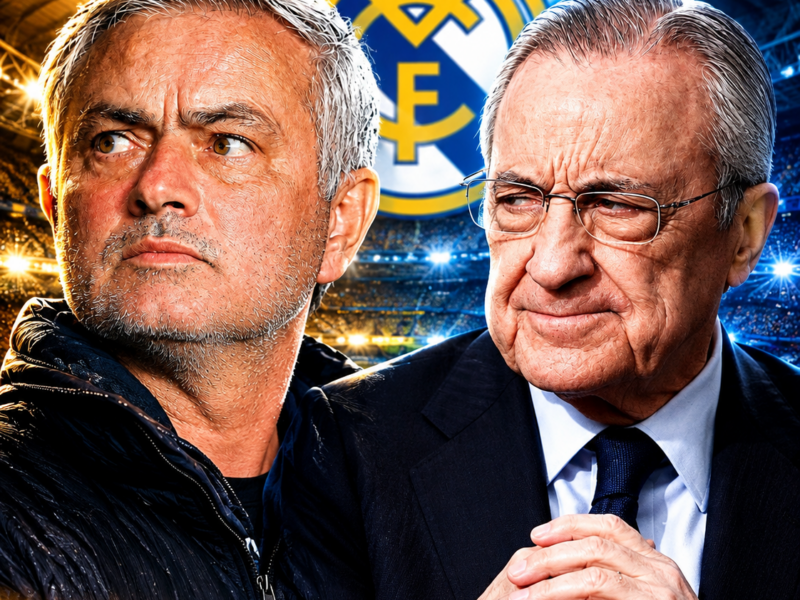
Real Madrid’s Secret Panic Attack: Inside Florentino Pérez’s Growing “Run Run” Over José Mourinho’s Second-Half Collapses Just Days Before the Madrid Derby
It starts with a whisper in Valdebebas, the kind that never quite makes it into an official press conference but somehow finds its way onto every sports radio show in Spain by the following morning.
A word that has no real English equivalent, but every Real Madrid fan understands instantly the moment they hear it.
Run run.
It is the sound of smoke before anyone has confirmed there is a fire, the low hum of concern that ripples through a club as powerful and as paranoid as Real Madrid whenever something, anything, starts to feel slightly off.
And this week, that whisper has a name attached to it.
José Mourinho.
Just three months into his sensational second spell as Real Madrid manager, the same man who was carried back into the Santiago Bernabéu on a wave of nostalgia and 65 percent of the club membership vote for Florentino Pérez, is suddenly facing his first real test of confidence from inside the marble corridors of the club he once ruled with an iron fist.
Not a crisis. Not yet.
But something Spanish football insiders are already calling exactly what it is.
A run run.
Here is what nobody at the club will say on the record, but what several well-connected voices inside Spanish sports media, including veteran broadcaster Rubén Cañizares and his long-running radio tertulia, are now reporting with increasing confidence.
Real Madrid’s hierarchy, the people who orbit closest to club president Florentino Pérez, are growing uneasy about a pattern that has quietly repeated itself across six league matches and one Champions League fixture since the start of the season.
Real Madrid keep losing their grip on games in the second half.
And they want Mourinho to fix it, fast, and they want him to fix it before the fixture that matters more to Florentino Pérez than almost any other on the calendar.
This Sunday’s Madrid derby against Atlético at the Metropolitano.
Let’s back up and explain exactly what has happened, why it has happened, and why a club that just spent 15 million euros luring Mourinho out of Benfica is already nervous enough to be talking, quietly, about substitution timing.
A Coach Wanted Back, A Fanbase Split In Twelve Months
To understand the tension bubbling under the surface at Real Madrid right now, you have to appreciate just how fast the club’s managerial direction has whipsawed over the last calendar year.
In the summer of 2025, Real Madrid handed the reins to Xabi Alonso, a young, tactically progressive coach who represented everything modern about the European game.
He lasted barely six months.
By January 2026, Alonso was gone, undone by results and, according to persistent reporting out of Spain at the time, a dressing room atmosphere that had begun drifting toward something toxic.
Álvaro Arbeloa, promoted from within the club’s structure, took over as an emergency measure and steadied the ship well enough to reach the Champions League quarterfinals, but Real Madrid still finished the 2025-26 campaign without a single trophy, watching Barcelona lift the La Liga title after a Clásico win, and suffering a brutal 6-4 aggregate exit to Bayern Munich in Europe.
For a club of Real Madrid’s self-image, two consecutive trophyless seasons is not a rough patch. It is an emergency.
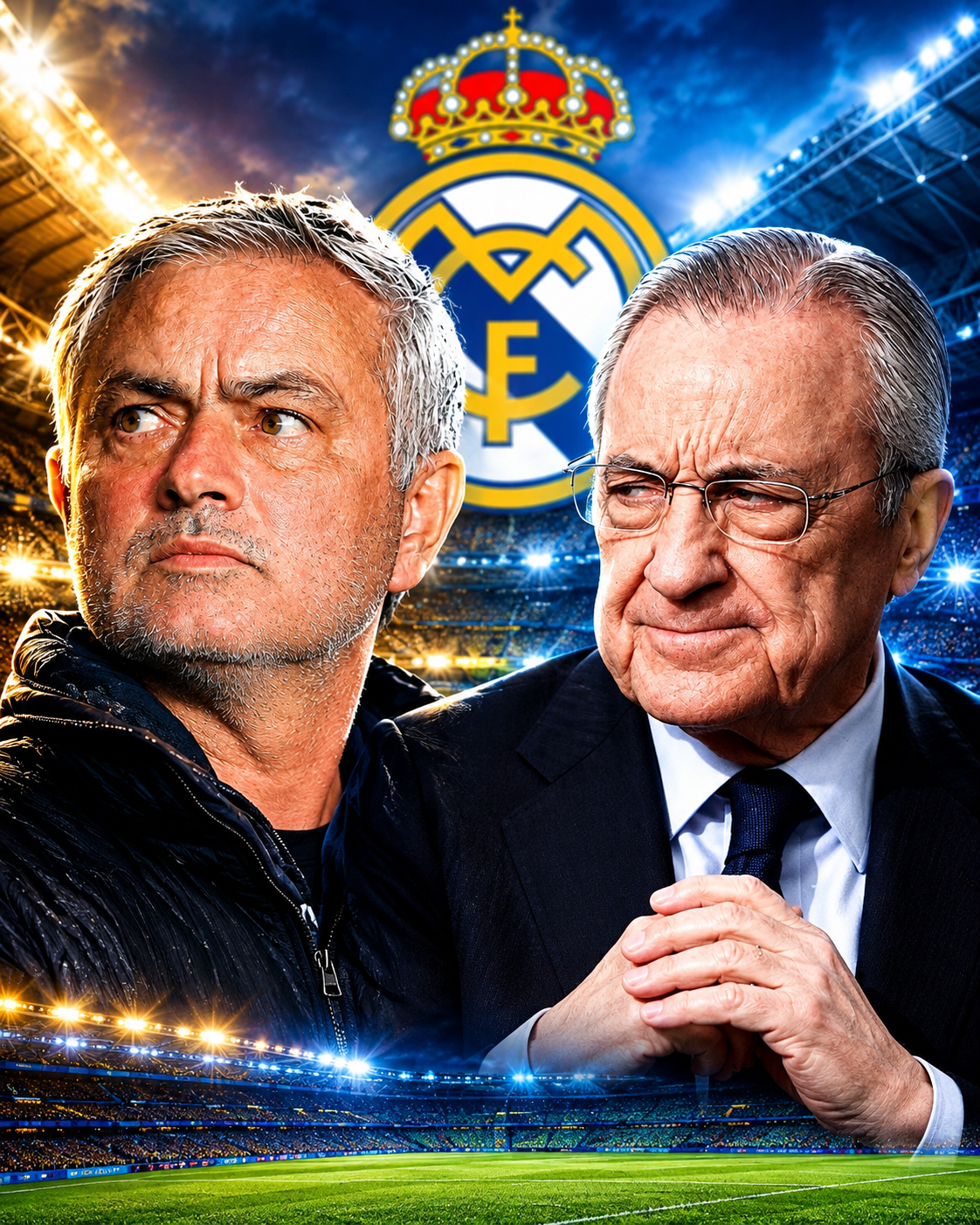
So when Florentino Pérez stood for re-election as club president in the spring of 2026, he did something he rarely does. He told members exactly what card he intended to play if given another mandate.
Mourinho.
Pérez won that election in a landslide, taking roughly 65 percent of the vote against challenger Enrique Riquelme, and within days the deal was done. Real Madrid activated a 15 million euro release clause to prise Mourinho away from Benfica, where he had just guided the Lisbon giants to an unbeaten league campaign, and brought him back to the Bernabéu on a three-year contract running through the summer of 2029.
It marked an extraordinary full-circle moment. Thirteen years after leaving Madrid amid dressing room fallout and a bitter split from several senior players, the 63-year-old Portuguese was back in the building, tasked with restoring the discipline, authority, and old-school leadership that Pérez and his inner circle apparently felt the club had been missing.
In other words, Mourinho was not brought back to play beautiful football. He was brought back to win, and to be the adult in the room.
Which is exactly why the current murmurs matter so much.
Six Games In, A Worrying Pattern Has Emerged
Mourinho’s return started reasonably well on paper. Real Madrid arrived at this international break sitting level at the top of La Liga with Barcelona on 15 points, buoyed by a run that included four wins in five matches across all competitions heading into mid-September.
But scratch beneath the league table and a far less comfortable story begins to surface, one that has become the central talking point of Spanish sports radio this week.
According to the numbers being cited on air by Cañizares and his fellow pundits, Real Madrid have effectively been playing something closer to 45-minute matches for most of this season, dominant and controlled in the first half, then fragile, tired, or simply careless once the second half begins.
Espanyol gave Madrid problems after the break. So did Rayo Vallecano. Málaga, in preseason, created chances Madrid had no business conceding. Inter Milan overwhelmed them for large stretches, not only after halftime but well before it too.
And then came Elche.
On September 15, at the Estadio Manuel Martínez Valero, Real Madrid raced into what should have been a comfortable evening. An early own goal off an Arda Güler free kick and a clinical finish from Kylian Mbappé had Mourinho’s side 2-0 up inside 33 minutes against a team sitting rock bottom of the table with barely a point to their name after four rounds.
Then the collapse arrived, right on schedule.
Elche pulled one back through Abiel Osorio in the 71st minute. Eleven minutes later, after a loose ball from Marc Cucurella handed the hosts an opening, Fer Niño leveled it at 2-2, sending a stadium that had been silent for an hour into a frenzy.
Real Madrid eventually escaped with all three points, but only because substitute Carlos Espi produced a stoppage-time winner in the 91st minute off another Mbappé assist, sealing a dramatic 3-2 victory that flattered a performance defined by a second-half implosion against a team fighting for its Liga survival.
It was the club’s fifth game in a row, roughly, where the second 45 minutes told a completely different story than the first.
And for an organization as sensitive to optics and narrative as Real Madrid, that kind of repetition does not go unnoticed in the president’s box.
“Inquietan Al Club”: The Headline That Started It All
The spark for this week’s discussion came from an unlikely source. Not a tabloid rumor mill, but a respected reporter working out of a serious, mainstream Spanish outlet.
Rubén Cañizares, publishing under his own byline, ran a headline that translates roughly to “Mourinho’s Real Madrid Blackouts Are Unsettling The Club.”
On its face, that is an explosive claim about one of the most powerful institutions in world football. Cañizares himself, appearing on his own radio program the following morning, seemed almost surprised by how much attention the phrase generated, and spent a significant chunk of his broadcast trying to calibrate exactly what he meant, and did not mean, by it.
His clarification is worth dwelling on, because it captures precisely how these things work inside Spanish football media, where information rarely arrives as a formal statement and almost always arrives as atmosphere, inference, and secondhand color from people close to the corridors of power.
According to Cañizares, there is no active discussion inside Real Madrid about removing Mourinho. Nobody at boardroom level is questioning whether he is the right man for the job. The trust in him, he insisted, remains completely intact after just six league matches and one Champions League fixture into a three-year project.
What does exist, he explained, is something closer to healthy, constructive frustration. A feeling among people close to Pérez that Mourinho, with his three decades of coaching experience and his famously stubborn tactical convictions, is waiting too long to react when a match starts slipping away.
The specific grievance being relayed through Madrid’s football press this week is remarkably concrete. People inside the club, according to this reporting, believe Mourinho has strong depth options on his bench, players like the returning Brahim Díaz when fit, or Espi, who match the level of certain starters, and that Mourinho should be using them earlier and more decisively rather than waiting until the 85th or 87th minute to intervene.
The specific example being passed around Madrid’s inner circle, per this radio discussion, involves the timing of a Vinícius Júnior substitution that came in the 87th minute of a recent match, a change so late in the game it barely qualified as tactical and instead read as symbolic, arriving too close to the final whistle to actually influence anything.
The phrase reportedly circulating among people close to the president is blunt and simple.
Make the changes earlier.
Not Every Run Run Is Created Equal
If you have followed Real Madrid closely over the past year, alarm bells might already be ringing, because “internal club unease” was also the exact phrase used to describe the atmosphere in the final weeks of the Xabi Alonso era, shortly before his dismissal.
Cañizares was careful, almost insistent, on drawing a hard line between that situation and this one, and it is worth taking his distinction seriously rather than assuming every rumbling out of Valdebebas points toward the same outcome.
The unease around Xabi Alonso, as it was reported at the time, stemmed from suspicion of a genuinely toxic atmosphere developing inside the dressing room itself, friction between the coaching staff and senior players, a sense that the group was fracturing from within.
What is being described this week about Mourinho is something entirely different in both nature and intensity. This is being framed, repeatedly and deliberately by those doing the framing, as pure footballing critique. A performance-based note, not a relationship-based crisis. Nobody around Pérez, according to this account, is worried about Mourinho losing the dressing room. They are worried about him being too slow to press the eject button on a game that is starting to unravel.
It is the difference between a marriage counselor being called in and a friend telling you your car needs an oil change.
Both are forms of concern. Only one of them threatens the relationship itself.
There is also the matter of timing and patience, something Cañizares was keen to stress on air. Six league matches into a three-year contract is an almost comically small sample size by any rational standard, and even the internal critics inside Madrid’s boardroom apparently understand that. Nobody is panicking in September. But Real Madrid’s ownership has never operated purely on rational patience, and Florentino Pérez in particular has a well-documented history of moving fast the moment his gut tells him something is wrong.
Understanding Florentino Pérez, The Man Behind The Whisper
To understand why a five-game pattern of second-half slippage has generated this much noise, you need to understand the man sitting atop Real Madrid’s hierarchy, and what actually keeps him up at night.
Florentino Pérez, at 79 years old, has now spent 23 years across two separate spells running Real Madrid, making him one of the most powerful and enduring figures in the history of European football administration. He does not experience football the way a modern analytics department does. He experiences it the way a lifelong Madridista does, shaped by a childhood spent going to matches with his father decades before he ever sat in a boardroom.
And that upbringing, according to those who have covered him for years, wired something very specific and very particular into him. His deepest, most primal footballing rivalry was never really Barcelona.
It was Atlético Madrid.
That may sound strange to outside observers accustomed to thinking of the Clásico as the defining fixture in Spanish football, and financially, competitively, and globally, it absolutely is. But emotionally, for a man of Pérez’s generation who grew up watching the crosstown rivalry define the capital long before Barcelona’s modern ascension turned El Clásico into the sport’s biggest global spectacle, the derby against Atlético hits a different, older nerve.
This dynamic became public knowledge in a memorable moment a few years back, when Pérez, addressing criticism of his club at a press conference, responded not by pointing at Barcelona, the club most commonly cast as Real Madrid’s fiercest institutional rival, but by turning the question back with a pointed reference to Atlético Madrid, essentially asking critics why they never leveled the same scrutiny at the rojiblancos.
It was a small moment, but a revealing one, and it is exactly why this Sunday’s fixture at the Metropolitano carries a different emotional charge for the club’s president than almost anything else on the September calendar.
Real Madrid have not forgotten what happened the last time they walked into that stadium for a derby. A 5-2 humiliation, one of the most lopsided results in the fixture’s modern history, a result so painful that those close to the club have described Pérez’s reaction to it as something approaching genuine, personal anger, distinct from his usual complaints about refereeing or media coverage.
According to secondhand accounts relayed on Spanish radio at the time, the president’s fury after that particular derby loss was not the routine grumbling Madridistas have grown used to over decades of Pérez press conferences. It was described as something quieter and colder, a kind of anger that took people close to him weeks to fully register, in the same way it later became clear that dressing room discontent under Xabi Alonso had been simmering long before it became public knowledge.
That is the emotional backdrop against which this week’s murmurs about Mourinho’s substitution patterns are landing. Not just any match is coming up. The derby is coming up. And in Florentino Pérez’s personal hierarchy of games that matter, this one sits in rarefied territory.
The Mourinho Paradox: Old-School Discipline, New-School Staff
Here is where the story gets genuinely interesting from a tactical and philosophical standpoint, because the criticism being leveled at Mourinho right now carries an ironic twist that even his sharpest defenders inside Spanish football media have been quick to point out.
When Carlo Ancelotti returned for his second spell in charge of Real Madrid several years ago, he was widely praised for surrounding himself with a young, forward-thinking staff, including his own son, filled with coaches in their early thirties who brought fresh tactical ideas and a more contemporary reading of the modern game into an experienced manager’s setup.
Mourinho, according to those inside Valdebebas, has done something remarkably similar during this second Madrid tenure. His technical staff is stocked with specialized, relatively young analysts working across highly specific departments, and by most accounts this has genuinely opened Mourinho up to ideas and approaches that might not have penetrated his thinking during his dominant, trophy-laden peak fifteen or twenty years ago, when few dared challenge his tactical instincts.
And yet, in one specific and very old-school way, Mourinho is reportedly still Mourinho. He remains cautious, even conservative, about breaking up his front line and his established hierarchy of starters, preferring to make defensive or midfield changes before touching his most senior attacking players, and generally waiting until a match is deep into its final stretch before intervening decisively.
That, ironically, is almost identical to the exact complaint Real Madrid fans and pundits leveled at Ancelotti during parts of his second spell. Too passive with substitutions. Too reluctant to disrupt the front three. Too willing to trust that senior players would solve problems the bench had already signaled solutions for twenty minutes earlier.
The parallel has not gone unnoticed inside Spanish football media this week, with some pundits pointedly noting the awkward irony that Real Madrid effectively swapped one coach criticized for exactly this pattern of late, reactive substitutions for another coach who, despite his completely different reputation and completely different managerial persona, appears to be repeating precisely the same habit.
There are, however, some early signs of adjustment. Mourinho reportedly substituted Jude Bellingham relatively early during matchday six, a departure from his usual hierarchy-first approach, and in the win over Elche, his decision to remove Vinícius Júnior in the 65th minute, rather than the symbolic, ovation-driven substitutions he made in earlier matches, suggested a coach beginning to read the physical state of his players in real time rather than simply rewarding reputation and status.
Whether that represents the start of a genuine tactical evolution, or simply one data point in a small sample, is exactly the question Real Madrid’s hierarchy will be watching closely over the coming weeks.
Why This Particular Sunday Matters More Than The League Table Suggests
On paper, this Sunday’s derby against Atlético Madrid is simply matchday seven of a thirty-eight game league season, an early fixture that, in a rational, dispassionate footballing sense, will not decide anything by itself.
But Real Madrid does not operate on a purely rational, dispassionate footballing sense, and neither does its president.
The context stacking up around this specific match makes it feel considerably heavier than a typical September derby. Real Madrid arrive off the back of that nervy, second-half-collapse win over bottom-of-the-table Elche, a result that papered over serious defensive and game-management cracks rather than resolving them. The broader murmur campaign about Mourinho’s substitution timing has now spilled into mainstream Spanish sports journalism just days before kickoff. And Atlético Madrid, under Diego Simeone, will be desperate to build on the psychological dominance they established with that infamous 5-2 demolition the last time these two sides met at the Metropolitano.
For Florentino Pérez personally, a repeat of that kind of result, or even a narrower defeat delivered via the same pattern of a promising first half followed by a defensive unraveling, would not simply register as three lost league points in September. It would register as confirmation of exactly the concern his inner circle has spent the past week voicing through intermediaries and sympathetic media contacts.
That does not mean Mourinho’s job would be in any kind of genuine danger over a single derby result, six matches into a three-year contract signed with presidential fanfare barely three months ago. Nobody credible inside Spanish football is suggesting that, and even the reporting fueling this entire narrative has been careful, almost defensively so, to stress that trust in Mourinho remains completely intact at every level of the club.
But a poor derby performance, particularly one that follows the now-familiar script of Real Madrid controlling the first half before fading in the second, would almost certainly turn this week’s quiet radio-show run run into a considerably louder, more public conversation. And in a results business like elite football, momentum in the media cycle has a way of becoming self-fulfilling.
What Real Madrid’s Front Office Actually Wants From Their Manager
Strip away all the noise, the radio chatter, the secondhand quotes relayed through intermediaries, and the anonymous sourcing that defines so much of Spanish football journalism, and the actual substance of this week’s story is fairly narrow and specific.
Real Madrid’s hierarchy is not questioning Mourinho’s suitability for the job. They are not debating his philosophy, his personality, or his fit for the club’s identity, three months after specifically choosing him, by presidential mandate, over every other available alternative on the market.
What they appear to want, based on everything being relayed through Spanish media this week, is simpler and more tactical than any of that. They want their 63-year-old, three-time Champions League-winning manager to trust his bench earlier. They want him to stop waiting for a match to visibly slip away before reaching for his substitute options. And they want the current five-game pattern of promising first halves undone by shaky second halves to stop being a pattern at all.
It is, in the words used repeatedly on Spanish radio this week, a case of sana crítica deportiva. Healthy, sporting criticism, offered without malice, without disloyalty, and crucially, without any appetite whatsoever for repeating the kind of managerial upheaval that has defined Real Madrid’s bench for the past calendar year.
Whether Mourinho hears that message and adjusts, the way Ancelotti eventually did during parts of his second Madrid tenure, or whether he continues trusting his senior hierarchy the way he generally has for three decades as one of the most successful managers in the sport’s history, may end up being one of the defining subplots of Real Madrid’s entire season.
Sunday at the Metropolitano will be the first real test of which version of Mourinho shows up when his team starts to wobble.
And Florentino Pérez, watching from the stands with thirteen years of history and one particularly painful 5-2 scoreline still fresh in his memory, will be watching every single substitution.









