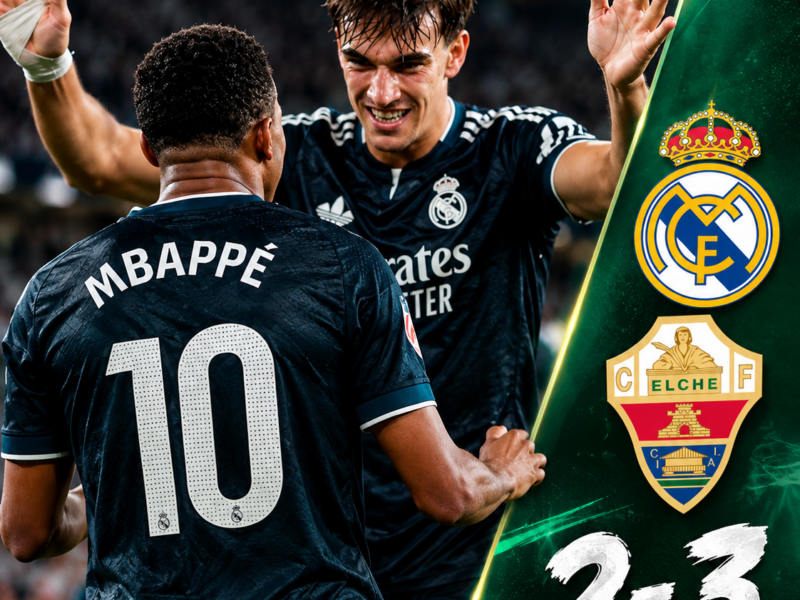
Real Madrid Survive Elche Horror Show: How a 92nd-Minute Miracle Saved Mourinho From Total Collapse
For eleven minutes, Real Madrid stopped being a football team and turned into a countdown clock nobody wanted to watch.
Two goals up. Cruising. Comfortable enough that half the stadium had already mentally checked out and started thinking about the derby four days away.
Then Elche, a side many inside the Bernabéu dressing room privately considered one of the weakest in the league, did what wounded underdogs do best. They bit back, twice, and for one horrifying stretch, it looked like Real Madrid was about to hand La Liga its second gut-punch collapse in less than a week.
What happened next is the kind of ninety-second sequence that either saves a season or exposes exactly how fragile it already is. A substitute nobody outside Madrid could have named in August ghosted into the box, met a cross with the calm of a man who had been doing this his whole life, and turned a potential humiliation into a 3-2 escape act that will be remembered less for the three points and far more for the warning label attached to them.
The Scoreline That Lied
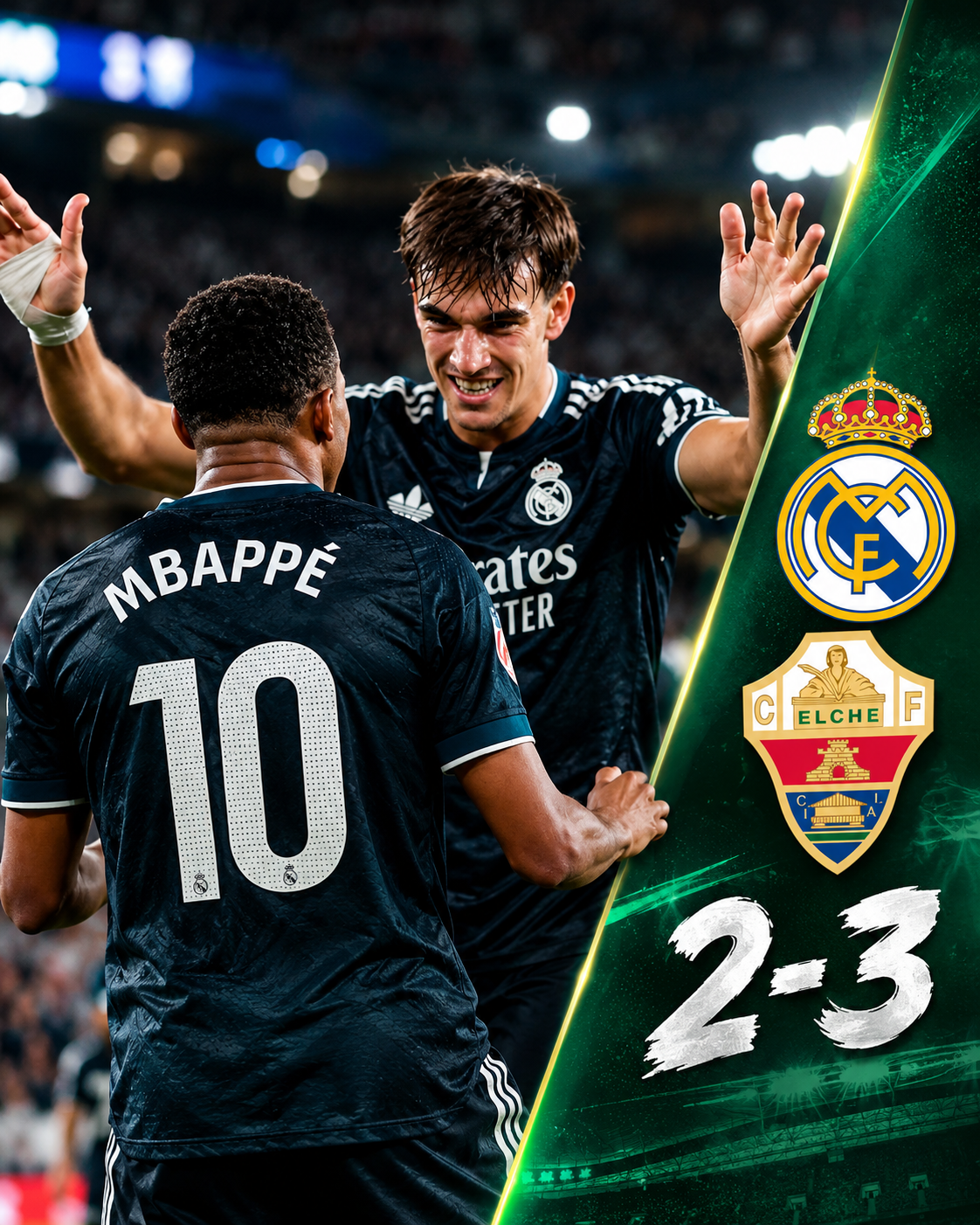
Final score: Real Madrid 3, Elche 2. On paper, that reads like a routine away win against a newly promoted side scrapping for survival.
On the pitch, it read like a horror script with a last-second rewrite.
Real Madrid opened the game the way a title contender is supposed to open a game like this. Controlled possession. Sharp combinations through midfield. A goal inside the first half that should have set the tone for a comfortable evening in the southeast of Spain.
Instead, something happened in the dressing room at halftime, or maybe nothing happened at all, and that absence of urgency is precisely the problem. Real Madrid came out for the second half and, according to two of the sharpest football voices covering the club this week, simply stopped playing with any tension.
Elche equalized. Then Elche went ahead. Then, with the away end at Estadio Martínez Valero beginning to smell blood, a substitute striker who had entered the pitch with almost nothing to lose delivered the goal that changed the entire complexion of the week.
Three points. A near-disaster. And a growing sense that this Real Madrid squad has a second-half problem that isn’t going away on its own.
A Coach Who Said the Quiet Part Out Loud
Jose Mourinho was asked before kickoff what he expected from the trip to Elche. His answer was almost aggressively simple: he didn’t care how it looked, he only cared about winning.
He got the win. Whether he should actually be happy about it is a different question entirely, and it’s one that pundits who cover the club closely spent the better part of an hour picking apart after the final whistle.
The logic here matters. When a manager is trying to instill what football people like to call a winning mentality, a performance like this one is supposed to subtract from that project rather than add to it. A team that wins ugly and ignores why it won ugly rarely fixes the underlying issue before the underlying issue costs it something bigger.
And the uncomfortable part, the part that stings more than the final scoreline suggests, is that this wasn’t an isolated incident. Real Madrid had shown almost the exact same pattern days earlier in a different match, collapsing from a position of control into a stretch of nervous, sloppy football that let an inferior opponent back into the game.
Two matches. The same mistake. That’s not bad luck. That’s a pattern, and patterns are what separate a rough week from a real structural problem.
The Second Half That Should Never Have Happened
Here’s what makes the collapse against Elche so difficult to explain away as a one-off.
The first half was, by most accounts inside the press box, genuinely good. Real Madrid moved the ball with purpose. Midfielders found pockets of space. The front line looked connected in a way that had been missing in patches through the opening weeks of the season.
Then the second half arrived, and it was, in the blunt words of one radio analyst who covers the club religiously, better left unwatched.
The gap between those two halves is the real story of the night, more than the final scoreline, more than any single individual performance. A team doesn’t accidentally forget how to defend, how to press, how to compete for fifty-plus minutes. Something shifts mentally, and for a squad that has gone roughly two years without a major trophy, that mental shift at the exact moment a game is there to be closed out is the single most alarming thing a fan base can watch.
There’s a phrase that came up repeatedly in the postgame breakdown: soberbia. Arrogance. Not the loud, chest-thumping kind, but the quiet, dangerous kind where a team with a two-goal cushion starts assuming the opponent in front of them simply isn’t capable of doing anything about it.
Elche made them pay for that assumption. Twice.
Bellingham’s Night Off, and the Double Pivot Nobody Fully Trusted
Mourinho made a decision before kickoff that raised eyebrows across the football world watching from home. Jude Bellingham, arguably the most talismanic figure in this current Real Madrid side, was given a rest.
In his place, Arda Guler slid into the number ten role, and behind him, Mourinho paired Aurelien Tchouameni with Federico Valverde in a double pivot that many assumed would be a one-off experiment rather than a long-term blueprint.
It wasn’t a disaster. In fact, for large stretches of the first half, it worked. Tchouameni has a way of freeing up whoever plays alongside him, letting a partner push forward and take risks that a more rigid double-pivot setup wouldn’t allow. Valverde looked comfortable in that framework, and the pass he threaded to set up one of the night’s goals was, by any measure, an excellent piece of vision and execution.
But comfort in the first half is not the same as a long-term solution, and that’s where things get complicated for Mourinho going forward.
The Guler Problem Nobody Wants to Call a Problem
Arda Guler was, without much argument from anyone watching, the single best Real Madrid player on the pitch through the first forty-five minutes. A different level entirely compared to the twenty other players sharing the grass with him.
He created chances early. He was directly involved in the buildup for the opening goal. He looked, for one half at least, like a player who deserves to never leave the starting eleven again.
Then his body seemed to betray him. A drastic physical drop-off in the second half worried more than one analyst watching closely, the kind of fade that raises questions about fitness management as much as tactics.
But here’s the tension at the heart of this Real Madrid squad right now, the one Mourinho has to solve without an obvious clean answer. Guler and Bellingham are both, in their best form, players who belong in the same central attacking role. They are both operating near their ceiling right now. And there is currently no tactical arrangement on the table that lets both of them play their best position at the same time without someone else being squeezed out.
One suggestion floated by football analysts covering the club: stop thinking of Guler purely as an attacking number ten. Mourinho himself hinted at this back at the start of the season, describing Guler as a potential long-term option even deeper in midfield, closer to a true six. If that experiment ever gets a real run, it could be the single cleanest way to fit both of his most gifted attacking midfielders onto the same pitch without compromise.
Whether Mourinho actually pulls that trigger, or keeps leaning on Guler purely as an attacking spark off the bench and in rotation, remains one of the more fascinating subplots of this entire season.
Diomandé, Playing Angry and Playing Brilliant
If there was one player who walked off that pitch with his reputation enhanced rather than damaged, it was Soumaila Diomandé.
He picked up a yellow card in the fourth minute, an early booking that a lot of analysts considered borderline harsh from the referee. From that point forward, he had to manage an entire ninety minutes knowing one more reckless challenge could get him sent off.
He didn’t let it change how he played. If anything, it seemed to sharpen him. He was directly involved in the buildup for Mbappe’s goal with a pass that multiple pundits singled out as one of the best individual moments of service all night. He nearly set up a second that was eventually ruled out for offside, another pass that drew praise for its timing and precision.
And this wasn’t just about what he did with the ball. Analysts who watch this squad every week made a point of highlighting his defensive work rate, the running he put in without possession, the kind of unglamorous graft that doesn’t show up on a highlight reel but absolutely shows up in how a team holds shape.
There’s a subplot here worth sitting with. Diomandé had been quietly criticized by parts of the Madrid fanbase earlier in the season simply because he wasn’t getting minutes. It’s an old, familiar trap in football commentary: it’s nearly impossible to fairly judge a player you never actually get to watch. Tonight, he got the chance, played through a card that limited his margin for error, and delivered anyway.
If he keeps performing at this level, Mourinho is going to run out of good reasons to keep him out of the strongest available eleven, even with Vinicius Junior’s reputation and history still carrying enormous weight inside that dressing room.
The Vinicius Question That Won’t Go Away
And that brings the conversation to the player everyone keeps circling back to, the one whose name comes up in nearly every single postgame breakdown this season for reasons that have nothing to do with good news.
Vinicius Junior was, by the honest assessment of multiple pundits who otherwise clearly respect and admire him, well below the level expected of him again on this particular night. The chances he did get in front of the goalkeeper were finished poorly. The explosiveness that used to define him, the ability to simply run past defenders at will, wasn’t consistently there.
One analyst offered a theory worth taking seriously: Vinicius arrived to this season out of match sharpness, and that alone explains a meaningful chunk of the dip. But there’s a deeper layer to the theory as well, one that’s harder to fix with a preseason training block.
At his absolute peak, the peak that made him a legitimate Ballon d’Or contender, Vinicius operated on two pillars. The first was an internal fire, a hunger to keep proving himself. The second was pure physical devastation, a level of speed and explosiveness that made defenders afraid before he even touched the ball.
The theory goes that the internal fire has dimmed somewhat, not extinguished necessarily, but diluted in a way that’s notoriously difficult to fully recover once a player has already reached the summit of the sport. And the physical explosiveness, the second pillar, simply isn’t operating at the same register it once did.
The contrast with Diomandé on this particular night made the gap impossible to ignore. A winger at full pace needs that extra gear, not just to physically get past a defender, but to have the confidence walking into the duel that he’s going to win it. Diomandé has that right now. So does Mbappe, arguably even more so, to the point where he can stop and restart at will because he knows he’s simply faster than whoever is marking him.
Vinicius, at least on this evidence, doesn’t currently have that same conviction. There were moments in the first half where he rushed a pass or gave the ball away faster than the situation actually called for, almost as if some part of him already knew his first touch or his next stride wasn’t going to be quick enough to justify holding onto it. That’s not just a physical problem. That’s the kind of thing that starts eating at a player mentally too.
Mourinho pulled him off early again, a decision that multiple analysts flagged as notable given how visibly his performance had struggled. But nobody covering this club expects a dramatic benching anytime soon. The relationship between Mourinho and Vinicius has been described, fairly or not, as one built on genuine affection and a mutual investment neither man seems willing to abandon just yet.
There’s a line that’s been floating around Madrid football media that captures the situation better than almost anything else: this isn’t really Mourinho’s project. It’s Mbappe’s, Bellingham’s, and Vinicius’s. And that framing helps explain why a coach known throughout his career for ruthless tactical pragmatism keeps building lineups around a player currently delivering well below his historic standard.
The honest, uncomfortable read from people who watch this team every single week is simple. Everybody can see what they’re seeing when Vinicius plays right now. Whether they say it out loud or soften it out of lingering affection for what he’s already given this club doesn’t change what’s actually happening on the pitch.
If this continues past the international break, when the calendar tightens and the games start stacking up with real weight attached to them, patience is going to run out fast, no matter how much residual goodwill Vinicius has stored up over the years.
Mbappe: Physically His Best, Emotionally Still a Question Mark
Kylian Mbappe scored again. That’s becoming close to the least interesting thing to say about his season, which is itself a remarkable sentence to be able to write about any footballer on the planet.
Physically, multiple analysts agreed, he looks better than at any point since arriving at the club. There’s an added layer to his game now too, a willingness to take on more of a leadership responsibility than he showed in his first year in Spain, even if nobody watching closely believes he has the natural temperament to ever become the kind of vocal, unquestioned leader a player like Cristiano Ronaldo once was in that same shirt.
The comparison to Ronaldo isn’t accidental. Both players occupy a similar tier of importance to the club’s identity and status, even if their on-field personalities sit at opposite ends of the spectrum.
The first half against Elche showed Mbappe at his most complete. More involved in combination play. More willing to drop deep and help Diomandé and Vinicius connect. Generous, even, in setting up teammates rather than hunting solely for his own goal.
Then the second half arrived, and the same worrying pattern that infected the entire team seemed to infect him individually too. There’s a specific frustration that comes with watching a player of his caliber start mentally shifting toward the next fixture before the current one is actually finished, calculating effort in a way that doesn’t match the moment.
To be fair to Mbappe, the goal itself, Real Madrid’s decisive third, deserves a more precise breakdown of credit than headlines will give it. One respected analyst argued the buildup deserves more praise directed toward Bellingham than toward Mbappe himself, even though it’s Mbappe’s touch that ultimately ends up in the back of the net.
That distinction matters less to a scoreboard than it does to an honest tactical review, but it’s worth making anyway, because it highlights something important. This Real Madrid attack still functions best as a genuine collective, not as a collection of individual moments stitched together by one superstar carrying the rest.
The Bench Hero Nobody Wants to Stop Talking About
If Diomandé earned his reputation boost through ninety minutes of committed, disciplined work, Carlos Spi earned his through roughly fifteen life-changing minutes off the bench.
He came on late, with the game hanging in an uncomfortable balance, and delivered exactly what a manager dreams a substitute striker will deliver. A goal. A direct hand in the sequence that mattered most. The composure of a player who looks like he’s been doing this at the highest level for years rather than months.
One analyst made a point that’s worth repeating because it captures something real about how difficult this specific role is to play well. There are very few substitutes on this Real Madrid roster who look genuinely comfortable coming off the bench rather than starting. Status plays a part in that. Ego plays a part in that. Carlos Spi, by contrast, has walked into an incredibly difficult situation, a club with sky-high expectations attached to every shirt, and approached it with what multiple analysts described as a grounded, clear-eyed appreciation for the opportunity that landed in his lap.
That mentality is already translating into results on the pitch, and the broader implication is hard to ignore. Several of Real Madrid’s shakier results this season, the ones defined by second-half collapses just like this one, might have looked completely different with an earlier introduction for a player capable of delivering exactly this kind of impact.
There’s chatter growing among the fanbase, echoed by pundits on this specific broadcast, that Carlos Spi might end up being remembered alongside Marc Cucurella as one of the club’s most quietly impactful signings of the entire summer window. That’s a significant claim for a player who arrived to relatively little fanfare and had to have his arrival explained and justified to a skeptical fanbase almost overnight.
What he’s proving, night after night, is that the explaining is no longer necessary.
Endrick: The Cruelest Kind of Bad Timing
There’s a sadder subplot buried inside the same substitute story, and it belongs to Endrick.
He made what was effectively his debut under Mourinho in this Real Madrid setup, but the sample size is far too small to draw any real conclusions about his performance level. What isn’t too small to evaluate is the broader shape of his situation, and the body language that keeps showing up whenever television cameras find him sitting on the bench.
His career at the club so far has been a brutal case study in bad timing. He first had to contend with a manager, Carlo Ancelotti, who leaned heavily on more experienced, trusted veterans rather than giving a young striker consistent minutes to develop through mistakes. Then came a chaotic season disrupted by the Club World Cup, followed by an injury last year under a different manager, Xabi Alonso, who was himself leaning toward a different striking profile entirely.
After that came a loan spell that, by most independent assessments, was genuinely productive for his development. He came back for preseason under Mourinho, who reportedly wanted him to stay and fight for a role in the squad, only for a fresh injury to rob him of the chance to start the new season with the rest of the group, right at the moment he might have finally carved out real playing time.
It’s the kind of accumulated bad luck that would test any young player’s patience, let alone one carrying the weight of expectation that comes with being a homegrown Brazilian striker at Real Madrid specifically.
And yet the pundits covering him closely haven’t given up on him, not even close. There’s genuine belief in his finishing instincts, in his raw qualities as a goal-scorer, with one analyst going as far as to suggest his long-term ceiling might actually be higher than Carlos Spi’s, even while acknowledging Spi is the one rightfully soaking up the spotlight right now given how well he’s converting his own limited chances.
The hope from people who watch this club closely is straightforward. They want Mourinho to eventually match the public confidence he’s expressed in press conferences, reportedly telling Endrick directly that he personally intervened to stop potential exits from happening over the summer, with real, sustained playing time. Nobody forces a manager to say something like that out loud in front of assembled media unless there’s a genuine plan behind it.
The competition for minutes up front is only going to intensify, too. Diomandé has arrived and impressed. Vinicius, whatever his current struggles, isn’t losing his spot through a lack of managerial faith anytime soon. Brahim Diaz stayed when he could easily have left for regular football elsewhere. And there’s growing chatter that Rodrygo, who has already been floated by Mourinho himself in various contexts, could re-enter the picture as a factor once the January transfer window opens.
Every single year, in other words, gets harder for Endrick to break through, not easier, even as the belief in his eventual ceiling stays remarkably intact among the people paying closest attention.
A Quiet Word for the Kid Who Stayed
One detail from the broadcast is easy to overlook amid all the drama surrounding the senior stars, but it’s worth pulling out on its own.
Just a few months ago, the assumption inside Madrid football circles was that Endrick would need to leave on loan again to get consistent minutes elsewhere, the same conversation that had surrounded him before. Instead, once Gonzalo Garcia’s move to Fulham became official, the club moved quickly and brought in Carlos Spi within roughly half an hour of that departure being confirmed.
That timeline says something honest about squad planning behind the scenes, and it also says something about how much convincing it apparently took from Mourinho to get Endrick to commit to staying and fighting for a role in a squad that just kept getting more crowded around him.
Whatever was said in that conversation, it worked. Endrick stayed. And based on how he’s carried himself, at least according to those inside and around the club, his hunger to succeed in this specific shirt hasn’t dimmed one bit despite every obstacle stacked in front of him.
That’s a harder thing to measure than goals or assists, but it matters just as much to how this story eventually plays out.
Cucurella’s One Bad Moment in an Otherwise Solid Defense
Defensively, the headline number, two goals conceded, isn’t going to look great on the stat sheet no matter how the performance is spun. But the more detailed breakdown from analysts watching closely was noticeably more forgiving toward the back line as a whole than the scoreline alone might suggest.
The center-back pairing drew consistent praise, described as one of the more reliable, cohesive partnerships this Real Madrid squad has fielded so far this season. The one genuine mark against the defense fell on Marc Cucurella, specifically tied to a moment during Elche’s second equalizer where he played a loose pass back toward midfield in a situation that multiple analysts described, somewhat bluntly, as a basic error more bef. of academy-level football than what’s expected at this level of the game.
But context matters here, and the pundits were careful to apply it. When an entire team stops running, stops competing with the intensity a match situation demands, it’s rarely the players who are already struggling who get dragged into the breakdown first. More often, it’s the reverse. A handful of players who are otherwise performing well get pulled down into the same lapse of concentration infecting everyone else around them.
That’s roughly what happened to Cucurella on this particular night, according to the analysts breaking down the tape. Not a player in crisis. A very good competitor who got caught inside a collective breakdown that had very little to do with his individual quality.
There’s also a broader adjustment period worth acknowledging. Cucurella arrived at a massive, historic club mid-project, joining a group of new teammates who are themselves still trying to figure out exactly how they fit together defensively and structurally as a unit. That kind of alignment doesn’t happen instantly no matter how talented or competitive any individual signing happens to be.
The expectation from people who watch this defense closely is that tonight was a blip rather than a trend, and that his overall body of work so far this season still points toward him being one of the club’s more successful new arrivals.
Ninety-Two Minutes: The Number That Says Everything
If there’s one single detail from this match that captures the entire story better than any tactical breakdown could, it’s this. Real Madrid needed a goal in the ninety-second minute, deep into stoppage time, to avoid dropping points against a team many inside the club privately consider one of the weaker sides in the entire division.
Ninety-two minutes. Against a promoted club fighting relegation. With two of the biggest attacking talents in world football, Mbappe and Bellingham, both on the pitch.
There’s a meaningful difference, one of the analysts pointed out with real emphasis, between winning a match 2-1 and winning it 3-2 after conceding twice from a position of total control. The first version is a professional job well done. The second version carries a psychological scar that lingers well past the final whistle, the uncomfortable sensation of watching a two-goal cushion evaporate against a side that, on paper, shouldn’t have had the quality to make it happen.
That discomfort doesn’t disappear just because the scoreboard eventually tilted back in Real Madrid’s favor. If anything, it lingers longer precisely because the win papers over a problem that desperately needs to be addressed before it happens again in a match where the opponent isn’t a struggling promoted side, but a genuine title rival.
Two Matches, One Identical Mistake
The comparison that keeps surfacing throughout every postgame conversation about this result isn’t really about Elche at all. It’s about the match immediately before it, a different fixture where Real Madrid showed almost the exact same symptoms, dropping points from a winning position after failing to maintain any competitive tension in the second half.
Two matches. The same collapse. That repetition is what elevates this from a forgivable one-off into something that genuinely worries the people who watch this club as closely as anyone in football media.
One pundit phrased the concern in especially stark terms. After roughly two years without a major trophy, and presumably two years of hard, honest lessons learned from that drought, a team in Real Madrid’s position should be arriving into September with those lessons already internalized, not still visibly working through them in real time on the pitch.
Instead, the same soft, complacent pattern that cost the club results last season under a previous manager appears to be resurfacing under a new one, which raises an uncomfortable question that has nothing to do with any individual coach’s tactical philosophy. Is this a systemic issue with how this specific group of players manages leads, something that survives coaching changes because it’s baked into the squad’s psychology rather than any one manager’s setup?
Nobody covering the club claimed to have a definitive answer to that question after just one match. But the fact that it’s even being asked out loud, twice in the space of a single week, tells its own story about where the mood currently sits around this Real Madrid squad heading into one of the biggest fixtures of the early season.
What the International Break Actually Means This Time
Real Madrid now heads into an international break carrying all of this uncertainty with it, and the timing couldn’t be more loaded with consequence.
One analyst offered what he openly admitted was a somewhat cheeky, conditional answer to how the break would land for this squad. If Real Madrid wins the upcoming derby against Atletico Madrid at the Metropolitano, the break arrives as a welcome opportunity to regroup, rebuild confidence, and let the current doubts quietly fade into the background. If Real Madrid drops points there, in either a draw or a loss, the break instead becomes a pressure cooker, an extended stretch of noise and second-guessing with absolutely no midweek fixture available to change the conversation.
That’s the real stakes attached to this coming derby, and it’s a heavier burden than a typical early-season Madrid derby usually carries. A poor result at the Metropolitano won’t just cost points on the table. It will retroactively reframe both of these recent collapses, against Elche and in the match before it, as the early warning signs of something much bigger rather than isolated bad weeks.
The flip side carries real weight too. A genuinely commanding, competitive performance at the Metropolitano, the kind built on ninety minutes of sustained intensity rather than a first-half spark followed by a second-half fade, would go a long way toward silencing exactly the kind of doubt currently swirling around this team.
Why the Atletico Game Changes Everything
There’s a specific reason analysts keep circling back to this derby as the true test, rather than treating this Elche result as some kind of standalone data point.
Atletico Madrid, under their current setup, has shown some real inconsistency of their own through the opening weeks of the season, enough that even pundits who watch them closely admit there’s genuine uncertainty about which version shows up on a given weekend.
But a derby played at home, in front of their own fans, tends to strip that inconsistency away almost entirely. Analysts were blunt about this specific expectation. In a home derby, Atletico Madrid is going to be at or extremely close to its absolute best version, regardless of how shaky recent form has looked in less charged fixtures. Anything short of that would qualify as a genuine surprise.
Real Madrid, in other words, doesn’t get to show up assuming its opponent is vulnerable simply because recent form suggests some fragility. That exact assumption, applied specifically to Elche, is a meaningful part of what nearly cost Real Madrid the match being discussed here in the first place.
There’s a deeper psychological layer to this too, one tied directly back to painful recent history. Real Madrid arrived at the Metropolitano last season riding a strong run of results, only to watch a talented squad get physically and emotionally overwhelmed once Atletico Madrid imposed its intensity from kickoff. Several individually gifted Real Madrid players reportedly shrank under that pressure, and the coaching decisions made that day, under a previous manager, were later widely criticized as contributing directly to the collapse rather than managing it.
Nobody covering the club this week is predicting an identical outcome. The circumstances, the manager, the specific players involved, plenty has changed since then. But the psychological shadow of that previous visit hangs over this fixture regardless, and pundits were explicit that Real Madrid cannot afford to walk into the Metropolitano again carrying any hint of the same assumption of superiority that just got badly punished against Elche.
The Headline Everyone Wants to Write
One pundit offered what he framed as the single cleanest takeaway from the entire ninety minutes against Elche, the sentence he wanted to leave hanging in the air heading into the international break.
Real Madrid needs to fully internalize a simple, non-negotiable truth. Either this team plays at one hundred percent effort and intensity for the full ninety minutes, or it isn’t actually superior to anyone it’s facing, no matter what the roster sheet or transfer fees might suggest on paper.
That’s not a small philosophical point buried in postgame analysis. It’s arguably the central storyline of Real Madrid’s entire season so far, more important in the long run than any single individual performance or tactical tweak.
A club that escaped a near-disaster tonight against a team many privately consider among the weakest in the entire competition cannot afford to walk into a hostile away derby carrying even a fraction of that same complacency. The margin for error against Atletico Madrid, at their own stadium, with their season already carrying its own pressure and expectations, is going to be dramatically smaller than it was against a struggling, newly promoted Elche side fighting to survive relegation.
The Warning Real Madrid Can’t Afford to Ignore
The second pundit’s closing message carried a similarly blunt edge, framed around a direct comparison to a different recent match against Rayo Vallecano, where a nearly identical pattern of complacency had already surfaced once before this month.
If Real Madrid shows up at the Metropolitano playing anything resembling the version that appeared against Rayo, or the version that appeared in the second half tonight against Elche, the honest assessment is that this specific group simply doesn’t have much realistic chance of winning that derby.
The only path forward, in his view, runs directly through a full mentality shift, something closer to what he described as competing like animals from the opening whistle straight through the final one, with zero mental drop-off in between regardless of the scoreline at any given moment.
There’s an added layer of urgency buried in that phrase too. Every single member of this squad, from Mourinho down to the newest arrivals still settling in, needs to have genuinely absorbed the lesson from these two recent near-collapses, because Atletico Madrid, playing at home in a fixture this heated, is going to be desperate to erase every ounce of doubt currently surrounding its own inconsistent form this season.
That desperation, combined with home advantage and derby stakes, is going to produce an incredibly demanding test. And based on the evidence from the last two matches, Real Madrid has not yet proven it’s currently built to consistently pass that kind of test for the full ninety minutes.
A Result Worth Everything and Almost Nothing at the Same Time
There’s a particular kind of football result that leaves everyone involved feeling two contradictory things simultaneously, and this one against Elche fits that description almost perfectly.
On one hand, three points is three points, and in a league table that will eventually come down to fine margins, tonight’s win matters just as much on paper as a comfortable, drama-free 3-0 victory would have. Real Madrid heads into the derby with the win column intact and the pressure of a potential loss avoided entirely.
On the other hand, the manner of the victory revealed exactly the kind of structural, mental fragility that title-winning teams simply cannot afford to carry into the toughest stretches of a season. A club with genuine ambitions of ending a two-year trophy drought doesn’t get to keep surviving on late heroics from a bench player, no matter how brilliant that specific player looked in his limited minutes tonight.
The two truths sit side by side without canceling each other out. This was, in the most literal sense, both a valuable result and a deeply alarming performance, and reducing it to just one or the other would misrepresent exactly what happened across those ninety-plus dramatic minutes in southeastern Spain.
What to Actually Watch For This Sunday
Kickoff for the derby is set for 4:15 in the afternoon, and based on everything that unfolded against Elche, there are a handful of specific things worth tracking closely once the whistle blows.
Watch the double pivot decision first. Does Mourinho stick with Tchouameni and Valverde as his preferred central midfield pairing, or does he find a way to work Guler into that deeper role given how well he demonstrated his creative range in the first half against Elche.
Watch the fifty-fifth to seventieth minute window specifically. That’s roughly where the collapse against Elche began to take shape, and it’s the exact stretch where Real Madrid needs to prove, definitively, that last week’s pattern was an aberration rather than a genuine tactical or psychological blind spot.
Watch how Mourinho handles Vinicius if the early minutes don’t go his way. Does the manager show the same patience he’s shown throughout September, or does the derby stakes finally force a harder decision that fans have been quietly expecting for weeks now.
And watch the substitutes’ bench closely too. If this match tightens up in the final twenty minutes the way so many Madrid derbies historically do, the manager now has options in Carlos Spi and potentially Endrick that simply didn’t exist in previous seasons, options that could end up deciding the outcome the same way they nearly rescued a much less consequential match against Elche.
The Bottom Line Heading Into the Storm
Real Madrid survived. That’s the honest, unglamorous truth buried underneath every tactical detail and individual performance breakdown from this match.
They survived a two-goal collapse against a side they should have handled comfortably. They survived thanks to a bench player who has quickly become one of the most reliable pieces of this entire squad. And they survived carrying forward almost exactly the same warning signs that nearly cost them results twice within the span of a single week.
Whether that survival becomes the foundation for a real course correction, or simply a temporary reprieve before a much harsher lesson arrives at the Metropolitano, is going to be answered in full within the next several days.
For now, Real Madrid gets to enjoy three points, a dramatic highlight reel moment courtesy of Carlos Spi, and a short, uneasy pause before the biggest test of its young season arrives at full speed.
The clock that nearly ran out on them against Elche is about to start ticking again, and this time, there won’t be a ninety-second-minute miracle waiting to bail them out if the same mistake repeats itself.









