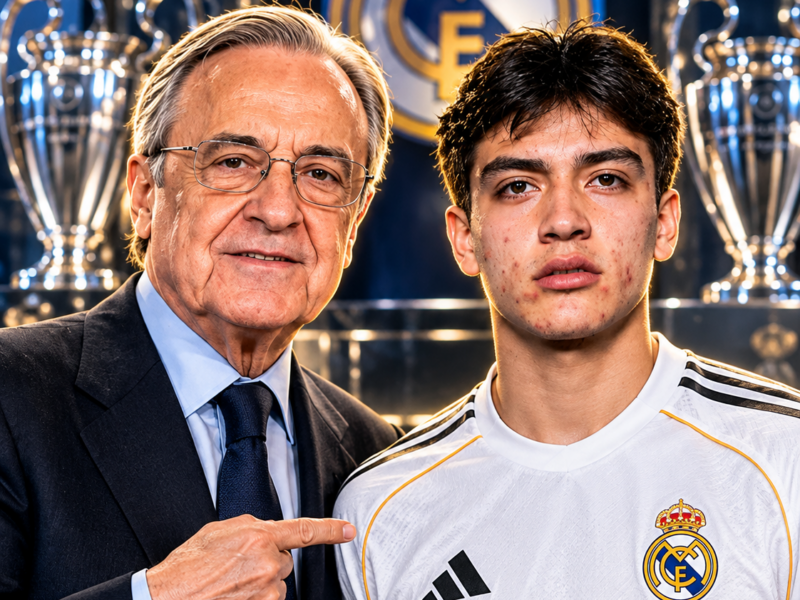
Real Madrid Locker Room Split Wide Open Over Gilberto Mora: Jude Bellingham’s Secret Push, Camavinga’s Parents Cry Foul, and Why Vinicius Junior Is Begging For The Mexican Wonderkid To Save His Career
There is a specific kind of silence that takes over football administrative offices when a true generational talent surfaces. It isn’t the loud, agent-driven noise of deadline day, nor is it the calculated leak of a contract extension dispute. It is a quiet, deliberate scrambling behind closed doors—a flurry of encrypted messages, sudden transatlantic flight bookings, and deep tactical audits.
Right now, that silence surrounds a 17-year-old midfielder from Xolos de Tijuana named Gilberto Mora.
If you spend any time on social media or sports forums, you have likely encountered the sensationalized rumors: tales of fractured locker rooms, senior players panicking over their starting spots, and backroom political warfare at the highest levels of European football. But when you strip away the tabloid melodrama and the fabricated drama of the internet rumor mill, the reality underneath is far more fascinating.
What is actually happening with Gilberto Mora is a classic, high-stakes chess match between Europe’s absolute elite. Real Madrid and Barcelona—two titans whose rivalry dictates the rhythm of global football—are actively monitoring, assessing, and positioning themselves for a player who represents the next great evolution of North American talent.
This is not a story about dressing room mutinies or fabricated scandals. It is a story about modern scouting, international transfer regulations, tactical compatibility, and the enormous weight placed on the shoulders of a teenager who hasn’t even reached his full physical ceiling.
Part I: The Anatomy of a Prodigy—Who Is Gilberto Mora?
To understand why multi-billion-dollar clubs are spending top-tier scouting resources on a teenager in Liga MX, you have to look beyond the highlight reels and examine how the modern game is played at the elite level.
Modern football has become increasingly systematic, athletic, and press-heavy. The days of the romantic, slow-paced classic “Number 10” who sits behind a striker without defensive responsibilities are long gone. Today’s elite playmakers must possess a rare combination of physical resilience, tactical intelligence, spatial awareness, and technical execution under high-velocity pressure.
Gilberto Mora, despite his youth, checks almost every single box on a modern scout’s dream checklist.
+———————————————————————–+
| GILBERTO MORA: PLAYER PROFILE |
+———————————————————————–+
| Current Club: Club Tijuana (Liga MX) |
| Position: Central Midfield / Attacking Midfield |
| Key Traits: Press-Resistance, Spatial Intelligence, Line-Breaking |
| Scouting Priority: High (Elite European Clubs) |
+———————————————————————–+
1. Elite Press Resistance
The single most valuable commodity in top-tier European football today is the ability to receive the ball under pressure, turn, and break the opponent’s first line of defense. Mora possesses an extraordinary first touch—a micro-adjustment of his body angle before the ball even arrives—that consistently leaves chasing defenders out of position. He doesn’t panic when closed down; he uses the defender’s momentum against them.
2. Spatial Intelligence and Scanning
Watch Mora during a match when he doesn’t have the ball. His head is on a constant swivel. This habit of continuous scanning allows him to map out the pitch in real time. By the time the ball hits his feet, he has already made three calculations: where the space is, where his winger is moving, and which passing lane is opening up.
3. Line-Breaking Verticality
Many young midfielders are comfortable circulating the ball side-to-side to keep possession statistics high. Mora is different. His instinct is fundamentally vertical. When he acquires possession in the central third, his eyes immediately look for line-breaking passes that eliminate two or three opposition players in a single sequence.
4. Tactical Adaptability
Whether deployed as a roaming central midfielder in a 4-3-3, an advanced playmaker in a 4-2-3-1, or a dynamic box-to-box engine, Mora demonstrates a sophisticated understanding of positional responsibility that typically takes players years to develop at the senior level.
Part II: The European Recruitment Engine—How Scouting Actually Works
The idea that a major club simply “sees a good player and buys him” is a myth from a bygone era. Today, the acquisition of a young international talent like Gilberto Mora involves an intricate, multi-layered scouting and analytics pipeline.
+—————————————————————–+
| THE SCOUTING & ACQUISITION PIPELINE |
+—————————————————————–+
| 1. Data Screening (Identifying statistical anomalies) |
| 2. Video Scouting (Detailed structural analysis) |
| 3. Live In-Person Audits (Psychological & off-ball evaluation) |
| 4. Background Checks (Family, character, work ethic) |
| 5. Legal & Regulatory Mapping (FIFA Regulations / Visas) |
+—————————————————————–+
When Real Madrid or Barcelona targets a player of Mora’s profile, the process breaks down into distinct, rigorous stages:
Step 1: Algorithmic & Statistical Screening
Before a human scout even sets foot on a plane to Mexico, data analytics departments run advanced metrics on player performance. They evaluate Mora’s stats not just against Liga MX benchmarks, but projected against European leagues using predictive modeling:
Progressive passes per 90 minutes
Successful dribbles in high-density central zones
Turnovers forced through counter-pressing
Expected Threat (xT) generation from open play
Step 2: Live Live-Match Audits
Video clips show what a player does on the ball; live scouting reveals what he does off it. Scouts sent to monitor Mora are paying close attention to details that television cameras miss:
How does he communicate with veteran teammates when things go wrong?
Does he track back transitionally when his team loses possession?
How does his body language adapt when subjected to physical fouls or aggressive opposition tactics?
Step 3: Background & Character Vetting
At the elite level, physical talent is only half the equation. Clubs invest millions into understanding a prospect’s personal ecosystem: his family structure, his discipline in training, his adaptability to new cultures, and his mental resilience.
Part III: Real Madrid vs. Barcelona—Two Contrasting Philosophies
The battle for Gilberto Mora highlights the fundamental divergence in how football’s two greatest clubs build their rosters for the future.
+———————————————————————–+
| REAL MADRID vs. BARCELONA |
+———————————————————————–+
| REAL MADRID |
| * Strategy: Global Talent Capture (The “Young Galácticos” Era) |
| * Profile: Athleticism, Power, Dynamic Transitions |
| * Pathway: High-Competition Midfield Engine |
| |
| BARCELONA |
| * Strategy: Positional Play & Technical Integration |
| * Profile: Spatial Mastery, Positional Discipline, Short-Passing |
| * Pathway: Direct Alignment with La Masia Principles |
+———————————————————————–+
The Real Madrid Blueprint: The “Young Galácticos” Strategy
Under the guidance of President Florentino Pérez and Chief Scout Juni Calafat, Real Madrid executed a brilliant pivot over the past decade. Instead of buying established superstars at the absolute peak of their valuation, Madrid shifted toward securing generational talent before their market price hit nine figures.
This model brought Vinícius Júnior, Rodrygo, Federico Valverde, and Eduardo Camavinga to the Santiago Bernabéu.
In Real Madrid’s high-octane, transition-heavy tactical setup:
Midfielders are required to cover vast amounts of ground.
Players must excel in physical duels while maintaining technical quality.
Versatility is paramount—midfielders often rotate positions dynamically depending on game state.
For Gilberto Mora, the appeal of Real Madrid lies in joining a winning culture built around elite young athletes who are set to dominate European football for the next decade. However, the path to starting minutes in Madrid’s midfield—currently populated by world-class talents like Jude Bellingham, Eduardo Camavinga, Federico Valverde, and Aurélien Tchouaméni—is arguably the most difficult hurdle in all of sports.
The Barcelona Philosophy: The Positional Play Ideal
Barcelona’s recruitment philosophy remains deeply rooted in the principles of Juego de Posición (Positional Play). For Barca, midfield profile isn’t just about athletic coverage; it is about rhythm, geometry, and spatial control.
In Barcelona’s system:
Midfielders must act as the team’s heartbeat, controlling tempos through short, rapid passes.
Positional discipline is strict; players occupy specific pockets of space to overload opposition defensive structures.
The connection between midfield and attack relies heavily on subtle timing rather than raw athletic power.
Mora’s natural game—characterized by quick combination play, tight-space navigation, and exquisite vision—fits the traditional Barcelona profile like a glove. Joining Barcelona could offer a more seamless tactical integration, but it also carries the pressure of competing alongside homegrown academy prodigies who have practiced this exact style of play since early childhood.
Part IV: The Regulatory Reality—FIFA Article 19 and the Wait Until 18
While the media loves to speculate about immediate transfer moves, the reality of international football governance imposes strict boundaries on transfers involving minors.
FIFA Article 19 (Protection of Minors): International transfers of players are only permitted if the player is over the age of 18, subject to specific, highly restricted exceptions (such as parents moving to the country for non-footballing reasons, or transfers within the EU/EEA under strict educational conditions).
Because Mora is a Mexican national playing in Liga MX, he cannot legally complete an international transfer to a European club until his 18th birthday.
This regulatory framework completely alters how European clubs approach the negotiation process:
+—————————————————————–+
| THE PRE-18 TRANSFER TIMELINE |
+—————————————————————–+
| 17th Year: Scouting, Data Audits, & Relationship Building |
| 17.5 Year: Pre-Agreement Negotiations (Non-Binding/Pre-Contract) |
| 18th Birthday: Official FIFA Registration & Medical Exam |
| Post-18: Physical Integration into European Squad Structure |
+—————————————————————–+
Strategic Patience: Clubs cannot simply sign Mora and put him in their squad tomorrow. They must play a long-term game of relationship building with his family, his representatives, and his current club, Club Tijuana.
Pre-Agreements: European clubs frequently negotiate pre-agreements or “first-option” clauses that secure a player’s rights the moment he turns 18, similar to how Real Madrid secured Endrick long before he arrived in Spain.
Development Monitoring: During the waiting period, buying clubs often provide detailed physical and tactical development plans to the player’s current club, ensuring his training aligns with European standards.
Part V: Tactical Deep Dive—Where Does Mora Fit Best?
To truly evaluate Mora’s potential destination, we must analyze his tactical fit within the potential lineups of Real Madrid and Barcelona.
========================================================================
SCENARIO A: REAL MADRID (4-3-3 / 4-4-2 Diamond)
========================================================================
[ Forward / Wingers ]
Vinícius Jr. Mbappé
[ Advanced Creator ]
Jude Bellingham
[ Dynamic Central Midfielders ]
Federico Valverde GILBERTO MORA / Camavinga
[ Defensive Anchor ]
Aurélien Tchouaméni
========================================================================
SCENARIO B: BARCELONA (4-3-3 Traditional)
========================================================================
[ Front Three ]
Winger Striker Winger
[ Free-Eight Playmakers ]
Pedri / Gavi GILBERTO MORA / Fermín López
[ Holding Pivot ]
Single Pivot
========================================================================
Analysis of Scenario A (Real Madrid)
In Real Madrid’s system, Mora would likely operate as an interior midfielder or an advanced central playmaker.
The Benefit: Playing alongside elite physical athletes like Valverde and Tchouaméni would shield Mora defensively, allowing him to focus on creative execution in the final third.
The Challenge: Real Madrid’s squad depth is staggering. Minute allocation is ruthlessly competitive, and young players must produce instant results to keep their places.
Analysis of Scenario B (Barcelona)
In Barcelona’s classic setup, Mora would slot directly into one of the “free-eight” interior roles.
The Benefit: His natural instincts for short-passing combinations and spatial awareness match the team’s core identity. He would be given structural freedom to create.
The Challenge: Barcelona’s midfield depth is heavily weighted toward high-potential young players. Every mistake is dissected under the intense spotlight of the Catalan media.
Part VI: The Human Element—Navigating the Pressure of Expectation
It is easy to analyze a football player as a collection of stats, tactical maps, and transfer valuations. But at the center of this narrative is a 17-year-old kid experiencing an extraordinary life transition.
The jump from domestic football in Mexico to the pressure cooker of elite European sport is one of the most demanding transitions in modern athletic culture:
1. The Cultural Shift
Moving from Latin America to Western Europe involves massive lifestyle changes—adapting to new tactical demands, intense media scrutiny, different climate conditions, and the reality of being far away from family support systems.
2. Media Oversaturation
In the era of 24-hour sports coverage and algorithmic social media, every play a young prospect makes is magnified. A single bad performance can lead to unfair criticism, while a single great match leads to ridiculous comparisons with legendary players. Maintaining psychological balance is essential.
3. Physical Adaptation
The physical intensity and speed of European football are significantly higher than in most domestic leagues across the globe. Transitioning to European play requires dedicated strength and conditioning programming, tactical conditioning, and injury prevention protocols.
Part VII: Alternative Paths—The “Stepping-Stone” European Route
While headlines focus exclusively on Real Madrid and Barcelona, smart recruitment strategists often advocate for an intermediate step. History shows that jumping directly from North or South America to an elite mega-club can sometimes stall a young player’s development due to a lack of consistent playing time.
Consider the alternative model: The Development Hub Path.
+———————————————————————–+
| DEVELOPMENT HUB ALTERNATIVES |
+———————————————————————–+
| BENFICA / SPORTING CP (Portugal) |
| * World-class history of developing Latin American talent |
| * High-volume starter minutes in competitive domestic league |
| * Direct exposure to UEFA Champions League football |
| |
| BORUSSIA DORTMUND / BAYER LEVERKUSEN (Germany) |
| * Bundesliga environments renowned for tactical transition speed |
| * Track record of trusting teenagers in crucial match situations |
| |
| AJAX / PSV EINDHOVEN (Netherlands) |
| * Tactical schools focused heavily on technical masterclasses |
| * Lower physical demands allows gradual body adaptation |
+———————————————————————–+
Clubs like Benfica, Sporting CP, Borussia Dortmund, or Ajax offer a compelling environment for a 17-year-old prodigy:
Guaranteed, high-volume starting minutes in top-flight European competitions.
Environments built specifically to absorb developmental mistakes without career-ending media backlash.
A clear, structured pathway toward a future mega-transfer once the player reaches full tactical and physical maturity (around age 21 or 22).
For Gilberto Mora and his advisory team, evaluating whether to take the immediate giant leap to Madrid/Barcelona or to take a calculated intermediate step through a club like Benfica could be the defining decision of his career.
Part VIII: What Lies Ahead—The Timeline to Watch
As we look toward the upcoming transfer windows, the situation surrounding Gilberto Mora will unfold in clear, predictable phases:
+—————————————————————–+
| KEY MILESTONES TO WATCH |
+—————————————————————–+
| PHASE 1: Domestic Consolidation (Liga MX starter consistency) |
| PHASE 2: National Team Integration (International exposure) |
| PHASE 3: European Pre-Contract Negotiations (Behind the scenes)|
| PHASE 4: Official European Transfer (Upon reaching age 18) |
+—————————————————————–+
Phase 1: Domestic Consolidation
Mora’s primary objective over the coming months must remain consistent performance at Club Tijuana. Proving that he can dominate games week in and week out in Liga MX builds the athletic and mental baseline necessary for Europe.
Phase 2: International Exposure
Continued selection and strong performances for Mexico’s national team squads will serve as the ultimate proving ground. Performing against top international opposition provides European scouts with high-fidelity proof of his ceiling.
Phase 3: Behind-the-Scenes Negotiations
As Mora approaches his 18th birthday, expect his representatives to engage in formal discussions with interested European suitors. While nothing can be officially registered until he turns 18, the foundation for his European career will be laid long before the contract signing photo appears on social media.
Conclusion: Separation of Fact from Fiction
The transfer saga of Gilberto Mora is a perfect snapshot of modern football culture. On one side, you have the noisy world of internet rumors, sensationalized headlines, and fabricated locker room drama designed to drive clicks. On the other side, you have the real world of professional football: meticulous scouting, tactical audits, legal regulations, and strategic long-term planning.
Gilberto Mora is not a wrecking ball coming to disrupt a European dressing room. He is a extraordinarily gifted 17-year-old footballer who represents the bright future of Mexican football.
Whether he ultimately steps onto the pitch at the Santiago Bernabéu, commands the midfield at the Spotify Camp Nou, or refines his craft at a European development hub first, one thing is certain: Gilberto Mora is a name that will define football conversations for the next decade.
What Do You Think?
If you were advising Gilberto Mora and his family, which path would you recommend? Should he aim directly for a giant like Real Madrid or Barcelona, or would an intermediate step in Portugal or Germany be the smarter move for his career development?
Leave your thoughts, tactical breakdowns, and predictions in the comments section below!









