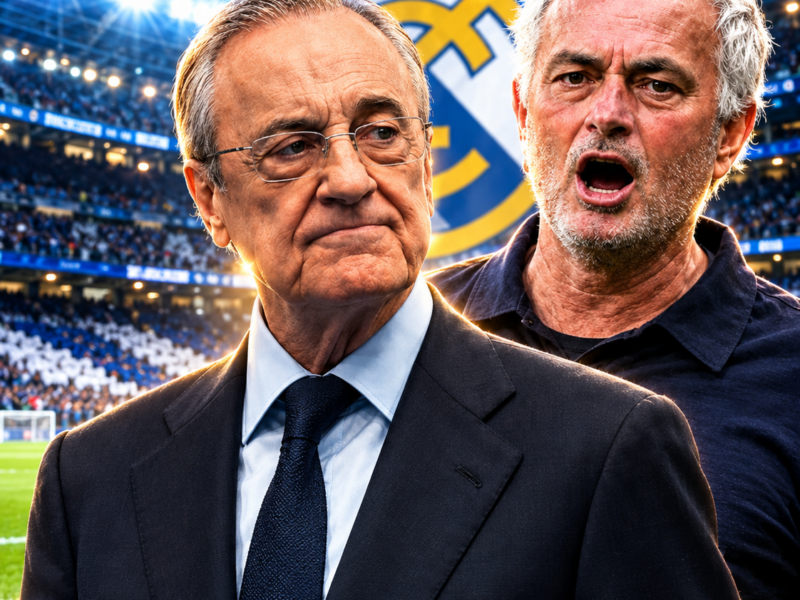
Real Madrid Is Thinking About a January Rescue Mission: Why Mourinho May Get the Midfielder the Club Refused to Buy
Real Madrid does not believe in the January transfer window.
So why is the club now quietly thinking about using it?
One Spanish journalist put the question in the simplest terms possible. If Madrid was interested in Rodri, why not sign another midfielder?
It is the one thing about this Madrid that keeps catching his attention.
A colleague had read something the week before, and he believed it came from Ángel Rubiano. The report said Madrid is considering a change of course this year.
Translated, that means the club has begun to wonder whether January action will be necessary.
He was careful about how much he knew.
He did not have the information himself, he said, but under these circumstances he would not be surprised.
The context matters here. Madrid sits six points behind Barcelona, and the international break has stretched the wait for the next game.
The hosts could not hide their frustration with the calendar. Players travel less, they said, and then fly to Australia and India to play, which makes the whole schedule hard to understand.
Inside the club, the mood after the derby is calmer than outsiders might expect.
Madrid still insists it did not compete on equal terms against Atlético. The plan Mourinho drew up fell apart, they argue, because of the red card shown to Dean Huijsen, and from that moment the team did not know how to react.
There is even a positive spin at the club.
In the closing minutes, without doing much, Madrid managed to put some fear into the Atlético players. That is the version Madrid believes, one host explained, even if Atlético sees it differently.
He admitted that nobody can say whose plan really worked.
Everything was affected by the naive sending-off, but Atlético did win and did create more danger. Madrid, meanwhile, holds to the idea that it was a one-sided game.
That belief has a practical consequence.
It let Mourinho leave the derby without looking weak, and it means the manager still carries the club’s trust. In the host’s view, that is exactly why Mourinho could arrive in January and say what he needs.
But the same host warned that history is not on his side.
Real Madrid has traditionally treated January signings as a sign of weakness. The thinking is that whatever is available in the winter, leftovers or players out of favor, will not improve the squad, and a big club rarely sells an important player midseason.
The most recent serious attempt, he recalled, was the effort to sign Trent Alexander-Arnold from Liverpool in the winter of 2025. Madrid failed to reach a deal then and eventually signed him for the Club World Cup.
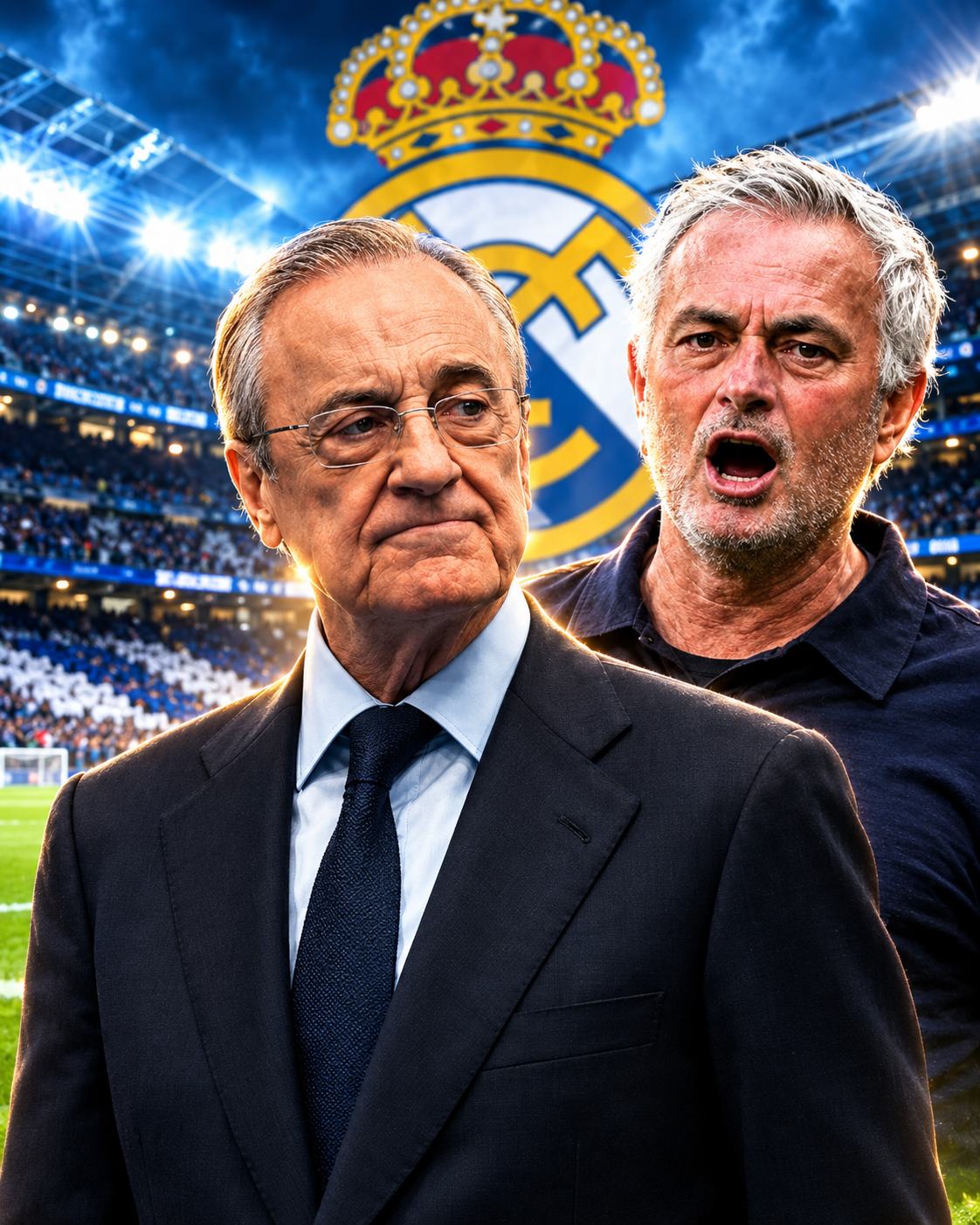
He also mentioned Brahim Díaz as possibly the last January arrival of the decade, though he said he was still trying to remember.
So the obstacle is not only the market. It is the person who has to approve the move.
The hosts agreed that Florentino Pérez decides who presses the button and who signs. José Ángel Sánchez carries real weight, and the club listens to Mourinho, but Florentino is not a fan of January deals.
Then again, one host said, he may not have been a fan of what he did this summer either, and he did it anyway.
That leads to a theory: the summer overhaul was only a beginning. Florentino, in this reading, wanted to do more than he managed.
The reason is not a lack of ambition, the hosts said, but a lack of exits.
Look at who actually left Real Madrid this summer. Dani Carvajal departed only because his contract expired. Madrid wanted Asencio gone and could not make it happen. Alaba’s deal ran out, and Gonzalo García would have been easy to move but would not have changed the shape of the team.
In other words, the revolution stalled halfway.
The plan was bigger than what the market allowed, and the squad that resulted is the one now struggling.
The hosts then turned to what a January signing could actually be.
Their answer was almost unanimous: a midfielder. The entire defense that Madrid uses today is new, and in attack there is no room for anyone. With Diomande, Vinícius, Bellingham and Mbappé, who would you sign up front?
Only a midfielder makes sense, they said, and only a midfielder would change the shape of the team.
Bernardo Silva has not done that yet. Perhaps he will, but so far he has not.
That brought them back to Rodri and the summer’s confusing chase.
One host said that if Madrid truly wanted a player like Rodri, it could have gone for someone else, such as Zubimendi. He suspects the club was not chasing Rodri as a type of player at all. It was chasing the star of the moment.
His colleague agreed and added a detail.
Madrid seemed to be after whoever shone at the World Cup, either Rodri or Diomande. Though on Diomande, he had now been told that talks started well before the tournament, so the timing was older than it looked.
The Rodri idea, in the end, should be generalized, one of them said.
Even if the club looked for players who could do that job, it did not follow through. And convincing the people who need to be convinced to sign in January, he added, will be very hard.
Meanwhile, the hosts noted, Madrid keeps doing something that surprises them.
For the third season in a row, the club starts with a midfield of Aurélien Tchouaméni and Federico Valverde. It did not work in the past years. This year the idea was that Bernardo Silva would take over the playmaking role, perhaps once he reaches full fitness.
They hope the break changes that.
If Bernardo gets a bigger role after the pause, the team could gain the clarity it has lacked.
The conversation moved to Vinícius Júnior, and here the tone changed.
One host said he spoke with two players directly, including Kylian Mbappé, at a sponsor event on Monday. Both told him the same thing: the plan against Atlético was to survive the first half, because the opponent would start at high intensity, and then push harder after the break.
Everything, he said, was clearly damaged by the Huijsen red card.
There was one detail he wanted to share, and it concerned Vinícius. He was told the winger was deeply affected by the night.
He knows he is not at his level, they said. He knows he is far from where he should be, and he is frustrated that his performances are not improving and he is not appearing on the pitch.
Being substituted well before the end of the second half hurt even more. Vinícius left the stadium and did not approach the fans when his teammates went to greet them.
The host saw a contradiction in what comes next.
Vinícius now has two weeks, but he will fly to Australia and then to India, so it is not clear how he can work on his game. Still, the host said, he knows he must do more and that things cannot go on like this.
Another host tied the problem to the renewal.
Now that Vinícius is in poor form, the extension looks bad, he said, and it is obviously because of the extension that people are asking questions. If he had started the season the way he finished the World Cup, everyone would say the club was right to renew him.
So the club will give him a little time.
The host noted that in the last game there was a ball Vinícius cut out that in other years he would have carried toward goal with no one catching him. This time the speed and directness were missing, and he knows it.
A theory circulating among journalists came up next.
Some ask whether Vinícius’s renewal and the signing of Diomande were connected, since both players share the same agency. One host doubted it. Madrid, he said, always wanted to renew Vinícius, and he does not believe the agency would turn its back on a possible 125 or 140 million euros because the winger did not sign.
An agency is a business, he said, and the story does not make sense to him.
What might have been affected, he added, is other potential operations the agency had in mind.
The last thread of the conversation was about Mourinho himself.
The ball is in his court now, one host argued. The club was convinced Mourinho came to bring fairness, and now it is time for him to judge what every player does in every training session and every match.
He sees the substitution of Vinícius around the 52nd or 53rd minute as a first step.
Taking off one of your pillars, the man who just renewed, is not simple. It also shows that ideas are forming in Mourinho’s head, and that he may have said to himself: I do not get an answer from Vinícius, so I will look for it in Diomande.
A colleague suggested it was a coaching matter more than anything else.
The host agreed, noting that the change came when Madrid was trailing 2-0, a scoreline both men recalled.
The final warning was almost a prediction.
Madrid, one host said, will not reach its required level until late October, and that is a shame, because there will be a lot of noise in the meantime. There will be plenty of rumors and plenty of outside factors, depending on how you look at things.
For now, the question sits with Mourinho.
Will he get the January tools he needs, or will the club stay loyal to a philosophy that has served it for decades and may be failing it now?
A note for readers: everything above reflects opinions, rumors and predictions shared in a casual conversation between commentators. None of it is confirmed, and reports about transfers, contracts and club policy remain subject to official announcements.









