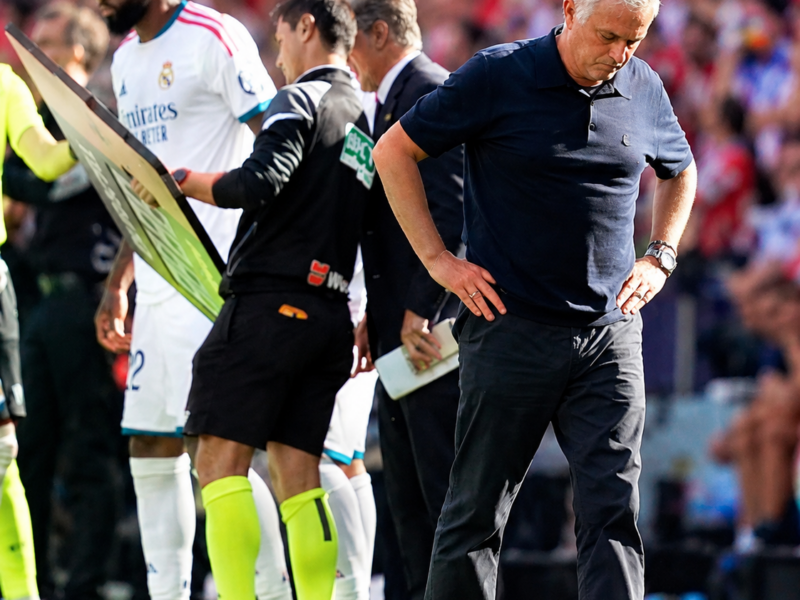
Real Madrid Have A Bigger Problem Than The Referee And This Panel Just Exposed It
Every football fan loves a good villain, and after this particular derby, most of Spain decided the villain wore a whistle.
But strip away the outrage over the officiating for just a moment, and a much more uncomfortable story starts to surface, one about a team that keeps running into the exact same wall no matter who is standing on the touchline.
That is the conversation two sharp-eyed analysts had in the hours after Atletico Madrid’s 2-1 win over Real Madrid at the Metropolitano, and it is far more damning than any referee rant could ever be.
Here is the full breakdown of what actually went wrong for Real Madrid, why the officiating controversy might be masking a deeper identity crisis, and why one number from exactly one year ago should be terrifying every Real Madrid fan right now.
Three Incidents, One Half, And A Referee Under Fire
Let’s start with the obvious flashpoint, because it genuinely shaped everything that followed.
Dean Huijsen was sent off in the second half for bringing down Giuliano Simeone inside the box, and depending on which analyst you ask, that decision sits anywhere between debatable and unquestionably correct.
The panel’s assessment was that Huijsen had been beaten so badly for pace and positioning on that play that a red card was essentially unavoidable regardless of the specific manner of the challenge, since he had no realistic path to the ball no matter how the contact happened.
That single moment turned an even contest into an uphill battle, and no team, especially not one already short on confidence, finds it easy to claw back from a numerical disadvantage against a talented opponent playing at home.
But the two incidents from the first half generated far more heated debate, and for good reason.
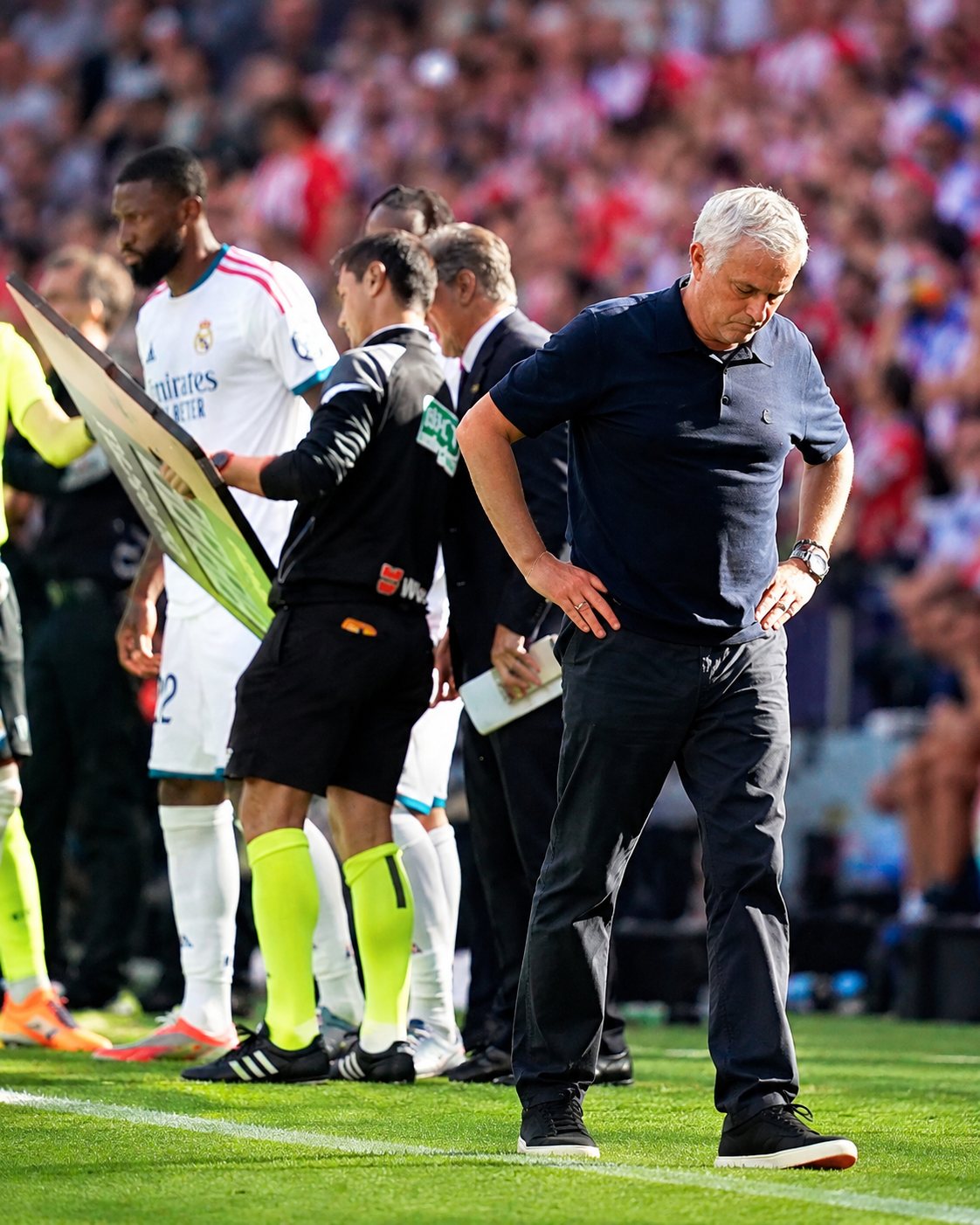
One panelist argued that the challenge from Cristian Romero on Jude Bellingham left no room for interpretation as a red card offense, while the tackle from Lee Kang-in on Federico Valverde was, in his words, even more clear-cut and completely indefensible for going unreviewed.
The frustration wasn’t really about one questionable call, it was about the pattern of three separate incidents inside a single high-stakes derby, two of which never even reached a video review despite the technology existing specifically to catch exactly this kind of oversight.
A Small Detail That Made The Whole Thing Feel Worse
Sometimes it’s not the big decision that stings the most, it’s the little one that nobody talks about.
Before any of the major flashpoints, there was a first-half moment involving Atletico’s Alex Baena, who reportedly caught Mourinho’s attention by going in with a rough challenge, then following it up moments later with what one panelist described as a nasty knee into an opponent.
The complaint here wasn’t really about the severity of either individual moment, it was that letting the second incident go unpunished sent a signal, whether intended or not, about where the tolerance line for that referee was going to sit for the rest of the afternoon.
Add in the fact that this same referee had, according to the panel, been the subject of an unrelated but eyebrow-raising anecdote from earlier in the season involving a coin toss and an oddly personal remark to a Barcelona player about matching mustaches, and you start to understand why so much of Spanish football media piled onto this specific official rather than treating the derby result as a simple case of one team outplaying the other.
The panel’s closing verdict on the officiating was blunt.
One analyst said flatly that if this same referee gets assigned to another major fixture in Spanish football again this season, something has clearly gone wrong with how appointments are being made, calling the entire performance surreal from start to finish.
Real Madrid’s Actual Football Problem, Explained
Here is where the conversation shifted from officiating to something far more uncomfortable for anyone who supports this club.
Before the red card ever happened, in a first half played eleven versus eleven, the panel agreed that Real Madrid simply did not look like a team playing in one of the most intense fixtures on the calendar.
One analyst pointed directly at the double pivot pairing in central midfield, arguing that this specific partnership continues to struggle building attacks from deep positions, a problem that has followed the team for what feels like an eternity at this point.
Layer on top of that a back line that struggled with distribution, wide attacking options that offered little in the way of movement or solutions, and a key playmaker who spent long stretches of the first half stuck out on the right flank rather than operating centrally where his influence is greatest, and the resulting picture is a team with very little actual football being played, regardless of what the referee did or didn’t do.
That is a genuinely damning assessment, because it means the officiating controversy, however legitimate parts of it may be, conveniently distracted from a performance that was underwhelming even before the numbers went uneven.
The Vinicius Question Nobody Wants To Ask Out Loud
If there was one storyline inside this match that generated the sharpest disagreement between the two panelists, it was about a decision made weeks and even months before this specific derby ever kicked off.
One analyst pointed out that across eight matches to open the season, counting both league and Champions League fixtures, the manager had invested an enormous amount of patience and playing time trying to get one particular attacker, Vinicius Junior, back to his best form, all while giving comparatively little opportunity to a marquee summer signing in Bernardo Silva.
That patience reached its limit inside this specific derby, with Vinicius pulled off the pitch by the fiftieth minute, immediately after the red card forced the manager’s hand.
Where the panel diverged was on how to interpret that substitution.
One analyst called it a brave decision, a sign that bigger changes might finally be coming.
The other pushed back hard on that framing, arguing it wasn’t bravery at all, simply the only sensible move available given how poorly the player had performed, and that true boldness would have meant making that change at halftime rather than waiting for an external event to force the issue.
Both analysts landed on a shared and much sharper point buried underneath that disagreement, using a single statistic to make it.
Yan Diomande, the 19-year-old winger, played only 36 minutes off the bench yet still finished as the most productive dribbler on the entire pitch that afternoon, repeatedly attacking his marker and forcing the foul that eventually led to Real Madrid’s consolation goal.
Compare that to Vinicius, who according to the panel barely attempted a single meaningful dribble or one-on-one situation across his entire time on the field, and the contrast becomes almost impossible to defend.
The argument wasn’t that Vinicius should be written off entirely.
It was that after eight matches of unresolved struggle, and with a teenager delivering more end product in half an hour than an established star managed in fifty minutes, sticking rigidly to the same lineup and rotation pattern stops looking loyal and starts looking stubborn.
Bernardo Silva And The Substitution That Made No Sense
If the Vinicius situation frustrated the panel, the handling of Bernardo Silva outright baffled them.
Despite Real Madrid visibly struggling to build attacks and control possession for large portions of the match, one of the club’s headline summer signings didn’t enter the game until the eighty-second minute, essentially too late to have any meaningful influence on the outcome.
One analyst called this decision impossible to justify given the circumstances, arguing that if a team is having as much trouble progressing the ball as Real Madrid clearly was, a player specifically brought in for his passing and creative qualities should have been introduced far earlier to try to change that dynamic.
There was a similar frustration raised about a completely different player never getting off the bench at all.
Carlos Espi, a forward signed this past summer, had already scored a dramatic late winner away at Espanyol and followed it up with another crucial goal in a comeback win at Elche, without starting either match.
Given his knack for making an instant impact and his usefulness in aerial and hold-up situations exactly when a team is stuck for ideas, the panel felt his complete absence from this particular derby, a match where Real Madrid desperately needed a spark, was another missed opportunity in a night full of them.
The broader conclusion both analysts reached was that the bench held real answers to the problems unfolding on the pitch, and those answers arrived too late, or in Espi’s case, never arrived at all.
A Diomande Masterclass In Just Half An Hour
Amid all the frustration, there was at least one genuinely bright spot the panel couldn’t stop praising.
Yan Diomande, thrown into the fire after Huijsen’s red card forced a reshuffle, immediately looked like a player unwilling to be intimidated by the occasion.
One analyst pointed out that even when shifted to the opposite flank from his usual side, the teenager’s explosiveness in one-on-one situations remained just as dangerous, repeatedly getting past opponents who were far from slow themselves.
He nearly had a moment to remember entirely on his own, breaking clean through on goal in a one-on-one situation before his teammates failed to support the play by not making the necessary runs into the box to capitalize on the space he had created.
The panel’s takeaway was less about the individual performance itself and more about what it represents going forward.
A young, in-form player is delivering end product with a fraction of the playing time given to an established star who has yet to rediscover his rhythm this season, and continuing to overlook that reality, according to both analysts, is no longer a defensible coaching choice.
Deja Vu At The Worst Possible Time
Perhaps the most cutting observation of the entire conversation had nothing to do with a single match at all.
One analyst pointed out that Real Madrid’s attacking core from midfield forward is essentially unchanged from the version of the team that suffered a lopsided 5-2 defeat roughly a year earlier, despite an entire offseason, a managerial change, and significant financial investment in new signings.
That kind of continuity might sound like stability on paper, but the panel framed it instead as a warning sign, arguing that repeating the same personnel decisions while hoping for a different outcome is precisely the kind of pattern that keeps a club stuck in place rather than moving forward.
They went even further, referencing a controversy from earlier in the year when a key holding midfielder was reportedly involved in a locker room altercation serious enough that a portion of the fanbase openly questioned whether either player involved deserved to keep wearing the club’s badge.
Just months later, both players remain central figures in the squad, one of them even wearing the captain’s armband, illustrating just how quickly difficult conversations get buried the moment results and optimism return, only to resurface again the next time things go wrong.
A Dangerous Parallel To Last Season
The panel closed their discussion by drawing a direct line to almost exactly one year earlier, when a previous Real Madrid manager took his team into this same stadium and suffered a defeat that later became widely viewed as the turning point of an entire disappointing campaign.
One analyst raised the uncomfortable coincidence that the club now finds itself in a remarkably similar position on a remarkably similar date, trailing a red-hot Barcelona side by a significant margin just seven matches into the new season.
The counterpoint offered was that context matters just as much as the calendar, and that the version of Barcelona currently steamrolling the rest of the league is playing at a level that has genuinely surprised most observers, which complicates any tidy season-over-season comparison.
Still, the fundamental worry expressed by both analysts wasn’t really about the table position itself.
It was about mentality, specifically the sense that key players inside Real Madrid’s dressing room seem to carry the same body language, the same lack of urgency, and the same underlying complacency regardless of who is coaching them or what has happened in matches before, as though wearing the club’s crest alone is expected to eventually fix everything without anyone having to change their habits.
The Final Verdict
When asked to grade the overall performance, the reaction from the panel was about as blunt as football analysis gets.
One analyst gave the team a failing mark, saying he felt genuinely disconnected from this current squad on an emotional level, adding that even something as fundamental as a sense of belonging and identity is difficult to locate within this current group of players.
The other was slightly less severe numerically but no less critical in tone, framing the club’s ongoing struggles as now stretching across three consecutive seasons rather than a single rough patch.
Their shared closing message was simple.
Real Madrid have a three week international break to figure out whether this is finally the moment real, uncomfortable decisions get made about personnel and tactics, or whether the club continues drifting through the same cycle that has defined the last two campaigns, hoping talent alone eventually papers over everything else.
Given how loudly this same warning has been repeated after nearly every difficult result over the past two years, the real question isn’t whether the diagnosis is accurate.
It’s whether anyone inside the club is actually prepared to act on it before the gap at the top of the table becomes impossible to close.









