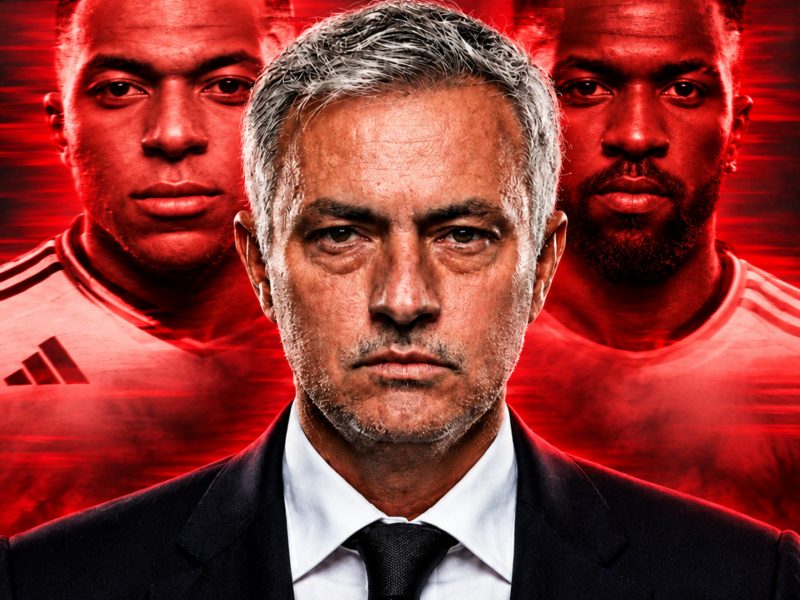
Real Madrid Has A Mbappe And Vinicius Problem Nobody Wants To Admit: Inside The Space Crisis Breaking Mourinho’s Attack And Why 2010 Jose Is The Only Answer
There is a problem sitting right in the middle of Real Madrid’s attack, and it has nothing to do with referees, transfers, or bad luck.
It shows up every single time this team faces a genuinely tough opponent, and it keeps happening no matter who sits on the bench.
It has two names.
And if you think that sounds exaggerated, all you had to do was watch Sunday’s derby.
Before the red card, before the penalty, back when it was still eleven against eleven, Real Madrid spent the entire first half producing almost nothing dangerous whatsoever.
One single detail summed up the whole problem perfectly.
Mbappe and Vinicius spent those first forty five minutes occupying the exact same area of the pitch, so overlapping that their positioning became almost comedic to watch from above.
And this was not an isolated case either.
Against Real Betis, Real Madrid lost, and Mbappe missed a penalty in the process.
Against Elche, a comfortable two goal lead somehow turned into a two two draw within minutes, only rescued by a stoppage time goal from a young substitute making an instant impact.
Against Inter Milan, a Champions League win arrived largely thanks to two gifted mistakes from the opponent.
Against genuine top tier competition, the record currently sits at one win and two losses.
This piece is going to break down exactly what that underlying problem actually is, why it did not begin with the current coaching staff, and what Real Madrid could realistically do to fix it.
And at the end, there is one question that matters more than any of it.
Is the current head coach actually capable of solving this, or is this ultimately a personal decision he has been avoiding.
To understand why Madrid supporters are this worried, it helps to remember exactly how this current chapter began.
Back in June of 2026, club president Florentino Perez ran for reelection on essentially one promise, bringing Jose Mourinho back to the Real Madrid bench.
He won, and the move became official through a contract running through 2029.
Thirteen years after his initial departure, Mourinho returned as head coach, and reinforcements arrived alongside him.
On defense, the club added Kounde and Dumfries.
In midfield, Bernardo Silva joined on a free transfer from Manchester City, reportedly at Mourinho’s own direct request.
On paper, the message could not have been clearer.
A solid, competitive team built in the coach’s own image.
And for the opening weeks, it genuinely looked like this approach might work beautifully.
A four nil win over Malaga.
A four one win over Rayo Vallecano.
A Champions League victory over Inter Milan, even if that result raised eyebrows and drew whistles from the home crowd by the final whistle.
Mbappe has scored seven league goals already this season.
Through six matchdays, Real Madrid sits on fifteen points, five wins and only one loss.
This is one of the best starts in recent memory.
But there is a detail the raw numbers alone will never reveal, and it matters enormously.
The real question is not simply how many matches Real Madrid has won, but who they beat and how they beat them.
Think about it honestly.
Malaga, Rayo, and Elche, with all due respect, are matches Real Madrid should win purely on individual talent, almost without needing any coherent tactical plan at all.
Even so, the Elche match specifically turned unnecessarily complicated.
The middle tier of the league, particularly toward the lower half of the table, has become remarkably competitive, which allows teams like Real Madrid, and occasionally even Atletico Madrid, to win these matches purely through attacking firepower rather than genuine tactical structure.
But here is what actually happened against the three legitimate top tier opponents faced so far, Inter, Betis, and Atletico.
One win, accompanied by criticism and whistles from the home crowd at full time.
Two losses.
That raises an uncomfortable question worth asking directly.
Is the head coach doing his job well, and are these simply early stumbles in a new project, or is there something fundamentally broken inside that locker room that no coach can realistically fix.
Remember, last season alone burned through three different coaches across one full season and part of another.
Let’s start with what everyone is currently talking about, the derby itself.
Watching the replays, the frustration Madrid fans felt toward the officiating is completely understandable, though a few important clarifications deserve mentioning.
One challenge on Valverde, looking at the still image, appears to be a genuinely clear red card.
Another challenge on Bellingham, regardless of how it was later presented in a press conference alongside the other incident, does not look like a clear red card at all.
Mourinho stated flatly that the press conference could essentially be summarized in one sentence, that both incidents were obvious red cards, and that the officiating overall lacked the experience and stature required for a derby of that magnitude.
He reportedly spent roughly four consecutive minutes discussing the officiating during that press conference.
The opposing manager responded afterward, noting that not everything is fair game in these situations, that this was not the first time such complaints had surfaced, and that after a previous loss to Betis, similar complaints about cards had also been raised.
Regardless of where anyone lands on that debate, let’s agree on the obvious part.
The officiating included real mistakes, and everything that unfolded afterward genuinely happened.
But that raises the question so many Madrid fans have been quietly asking themselves.
What exactly did Real Madrid actually produce during the first forty five minutes, back when it was still an even eleven against eleven, before any of the controversial moments had even occurred.
The answer is nothing.
Absolutely nothing.
And this is not simply a feeling or an impression, it is measurable reality.
During that first half, Mbappe touched the ball twenty three times, lost possession eight times, and did not register a single shot on target.
Real Madrid’s only genuine chance in those first forty five minutes came from Arda Guler.
In that same press conference, the head coach stated he felt satisfied because he had nothing to criticize his players for.
Nothing worth blaming at all.
Watching from the outside, it is fair to ask honestly whether any coach should genuinely feel satisfied with a first half performance that produced one shot on target and showed no real intention or coherent idea in the final third, especially considering the starting lineup included Mbappe, Vinicius, Bellingham, and Arda Guler simultaneously.
Frankly, there had been plenty of doubt throughout that entire week regarding whether these attackers could actually function together on the same pitch.
The head coach apparently had no interest in resolving that doubt before kickoff, and that first half arguably provided the exact answer many people had already suspected.
This question, more than anything else, is the single most important thread running through this entire situation.
Fine, give the officiating argument its due, Real Madrid arguably lost the derby partly because of refereeing decisions.
But that explanation does nothing to address why Real Madrid created literally nothing while playing under completely even conditions.
If you settle for blaming the referee alone, you are missing the actual structural problem plaguing this team.
That problem did not appear on derby Sunday because of an injustice.
It has existed for weeks, arguably months, and it remains completely unresolved regardless of which coach happens to be in charge.
The real problem, as mentioned, has two names, Vinicius and Mbappe.
Before anyone rushes to the comments section in frustration, this is not an argument that either player lacks quality.
Both rank among the best attacking players anywhere in the world right now.
Mbappe already has seven league goals this season.
In a recent match, Vinicius drew the penalty and also set up Mbappe for a golden opportunity with the goalkeeper caught out of position.
When these two connect on a specific individual play, they can absolutely be devastating together.
The issue is not talent, it is spacing.
Think carefully about what each player actually does best.
Vinicius is a left winger who thrives receiving the ball wide before cutting inward toward goal.
Mbappe, even when nominally playing as a center forward, has spent his entire career gravitating toward that exact same area of the pitch.
Both players want the ball in the same zone, and both require open space in front of them to be truly dangerous.
This is not a brand new phenomenon either.
It dates back to 2024 under the previous head coach, when reports already suggested Vinicius and Mbappe struggled to find their footing together, constantly overlapping positions and getting in each other’s way.
It happened under that regime, it happened under the coaching staff that followed, and most recently, Sunday’s positional heat map illustrated the exact same overlapping pattern in almost comical detail.
It is genuinely one of the strangest visual patterns anyone following football closely has seen in a long time.
On top of everything else, Vinicius was substituted during the derby, visibly frustrated and walking off with his head down somewhere around the fifty minute mark.
For a player who recently signed a massive contract extension running through 2032, that kind of moment carries real symbolic weight.
Of course, against teams that leave open space behind their defense, none of this positional overlap matters nearly as much.
Win the ball high, break quickly, bring your strike partner along, and given the sheer speed both players possess, they can dismantle almost any opponent in transition.
With all due respect, that is exactly how matches against teams like Malaga, Rayo, and Elche get won.
But against a well organized Atletico Madrid side, or a disciplined Betis team that sits deep and refuses to concede running space, or any opponent that controls possession while denying pressing opportunities, the wheels come off entirely.
Real Madrid simply runs out of ideas.
On paper, Vinicius and Mbappe are obviously different players.
But in practice, against a well organized defense playing above the league’s average level, they essentially become the same player, functionally speaking.
They need the exact same resource, in the exact same location, at the exact same moment.
So if this problem is this visible, why hasn’t the coaching staff addressed it.
Why hasn’t anything changed.
The uncomfortable answer likely relates to something Real Madrid currently does not have, arguably the single biggest gap on the entire roster.
Nobody talks enough about the midfield, about that controlling presence the club possessed for the better part of a decade.
Real Madrid had, without exaggeration, the best midfield anywhere in world football for years.
One player dictated tempo effortlessly.
Another consistently found the pass nobody else could see, and still contributed goals of his own.
Attackers simply had to run into space and finish.
One of those midfield greats retired in 2024.
The other departed in 2025 at forty years old.
Since then, Real Madrid has not possessed anyone who comes remotely close to that level or that specific type of quality.
Look at the current midfield options available right now.
Tchouameni, Valverde, Camavinga, Bellingham, Arda Guler, Bernardo Silva.
All excellent players individually, but not one of them is a true, pure playmaker, a genuine conductor of the game.
Tchouameni destroys everything that comes near him defensively.
Valverde runs relentlessly and strikes the ball powerfully, but that is a different skill entirely.
Camavinga, even now, leaves plenty of people wondering exactly what makes him a professional footballer at this level, with all due respect.
Bellingham, arriving into the penalty area, ranks among the best in the world at that specific skill and finishing ability.
Guler has genuine talent for the final incisive pass.
Bernardo Silva, arguably the closest fit to what this team actually needs, is a creative midfielder who moves intelligently across the pitch, but he is not the type who anchors in front of his own defense to dictate tempo and build attacks from deep.
And despite being the closest fit available, he was left on the bench again for the derby.
Beyond that, Bernardo Silva has played significantly fewer minutes than many expected when he first arrived at the club.
That needs to be said plainly.
So what happens when your midfield lacks that specific type of player.
The ball reaches the attack without any real advantage attached to it, landing at the feet of Vinicius or Mbappe, who occupy the same flank and get in each other’s way while defenders converge on both.
At that point, everything depends purely on individual dribbling success, something neither player has consistently produced recently.
Plenty of people point to the Inter Milan match as a counterexample.
Fair enough, beating a Champions League caliber opponent matters, and a two one win at the Bernabeu genuinely looks solid on paper.
But look closely at how those goals actually happened.
In the fourteenth minute, Inter’s goalkeeper made a mistake distributing the ball, Real Madrid stole possession, and Mbappe scored.
That specific sequence, high pressing leading directly to a turnover near the opponent’s goal, is honestly something this current roster should be doing far more consistently.
Without elite midfield creativity, pressing high at least shortens the distance attackers need to cover, turning a sixty meter defensive recovery run into something closer to twenty five or thirty meters.
That is exactly where players like Vinicius and Mbappe become lethal.
But that alone clearly is not enough for this team right now.
In the twenty third minute of that same match, Inter’s goalkeeper made another costly error, attempting to dribble around Valverde instead of simply clearing the danger, gifting Valverde an open net.
International media outlets broadly agreed those mistakes were essentially unforgivable defensive errors.
Watching it honestly, that sequence did not look like a deliberate Real Madrid game plan succeeding, it looked like a gift falling directly from the sky.
Both goals stemmed from opponent mistakes, and beyond the initial pressing sequence that forced the first turnover, neither goal came from a sustained Real Madrid attacking plan.
From that moment forward, Inter controlled possession and created chances consistently, forcing Courtois into several important saves just to preserve the lead.
Spanish media outlets reported afterward that Real Madrid won without producing much actual football, eventually resorting to simply running down the clock, and were audibly whistled by their own supporters after securing that Champions League victory.
Here is what genuinely puzzles many observers.
That opening goal came directly from intense pressing forcing a turnover.
Why doesn’t that approach happen consistently.
In simple terms, the head coach has not managed to convince his players to commit fully to that specific approach, telling them essentially, we lack a true creative midfielder, so let’s press aggressively higher up the pitch and win the ball closer to goal, allowing Bellingham, Vinicius, and Mbappe to convert chances while Guler supplies the final pass.
That level of buy in simply has not materialized consistently yet.
One respected commentator summarized it well, calling this a team that does not produce coherent football but still generates plenty of attacking output through individual quality.
That statement holds true, but the moment that individual magic disappears, there is genuinely nothing else backing it up right now.
So here are the two puzzle pieces laid out clearly.
Two elite attacking stars occupying the exact same space, with nobody in midfield connecting or separating them effectively.
There is arguably a third missing piece too, one that depends entirely on coaching decisions.
If the primary plan fails and there is no backup plan ready, Real Madrid currently has no alternative solution, and no individual brilliance saves them because these attackers simply are not connecting with each other productively.
Let’s revisit that Betis match briefly.
In the eighty first minute, Courtois saved a header, only for a recently introduced substitute to convert the rebound, putting Betis ahead one nil.
From that moment forward, Real Madrid pushed forward relentlessly.
Mbappe struck the crossbar.
A young attacker attempted an audacious bicycle kick that was ultimately ruled offside.
In stoppage time, Vinicius drew a penalty, Mbappe stepped up, and missed it entirely.
That became the club’s first official league loss of the season.
One journalist’s observation about the head coach stuck with many observers afterward, suggesting that if too many players are treated as untouchable during substitutions, balancing the squad eventually becomes genuinely problematic.
The head coach defended himself after that match, insisting nobody on his roster was truly untouchable.
Just days later against Elche, the exact same scenario played out, but in reverse fashion.
Real Madrid entered halftime leading two nil.
In the second half, the entire team seemed to relax noticeably.
Elche scored twice to level the match, and the head coach introduced two substitutes in the ninety first minute.
Bellingham started the ensuing attack, and one of those substitutes finished it, making the score three to two.
The exact same substitute pattern repeated itself.
There is something worth noting there too.
It is genuinely encouraging when a player in his early twenties makes the most of limited minutes, and this particular young attacker now boasts a remarkable goals per minute ratio across two of this season’s most complicated matches.
But ultimately, the solution did not come from any coherent tactical plan, it came from simply throwing on a proven finisher from the bench to escape trouble.
The reality remains that the starting lineup stays essentially unchanged match after match, the exact same starting lineup that has genuinely struggled in bigger matches.
Vinicius, Mbappe, Bellingham, and Guler.
And whenever all four start together, the head coach eventually ends up substituting Vinicius out, though that specific derby substitution came only after Real Madrid had already taken the lead and was playing with an extra man advantage following the red card.
The underlying truth remains that Real Madrid genuinely could not produce anything meaningful during that first half under even conditions.
This conversation ultimately moves beyond simply diagnosing this current roster’s issues.
Was the current head coach genuinely the right hire to manage these enormous egos, someone capable of benching stars when necessary, exactly as he has famously done before.
This is not fundamentally a transfer problem, it is a decision making problem.
Let’s go back to 2010 with this exact same coach, because the parallels today feel remarkably similar.
This is essentially the same coach from that era.
When you think about that version of the coach, and what he represented tactically and what that Real Madrid team looked like, you picture a team built entirely around counter attacking football, intercepting possession, three quick passes, and finishing.
That specific version of Real Madrid was a machine when it came to executing transitions, winning the league during the 2011-2012 season with an incredible one hundred points and one hundred twenty one goals scored, numbers that remain genuinely staggering to revisit even now.
But why exactly did that team function so effectively.
Obviously it was not simply because of Cristiano Ronaldo alone, though having a player of that caliber matters enormously.
Look closely at how that entire roster was actually constructed.
Ronaldo attacked primarily from the left, that was his designated territory.
Di Maria ran the right flank tirelessly.
Ozil operated centrally, connecting gaps between the lines.
And the central striker, whoever occupied that role, consistently occupied central defenders, allowing the wide players room to operate even though they could also drift centrally when needed.
Behind all of them sat one specific player who made that entire system function seamlessly, someone whose signature long diagonal pass from deep created instant opportunities the moment possession was won.
That player essentially served as the engineer who made counter attacking football and defensive solidity coexist beautifully within one system.
Ironically, that exact same player sat on the bench last season and things simply did not work out during that stint.
So yes, in certain respects, this remains the exact same coach.
The defensive pressure created by conceding two early goals against Inter, that response was pure, unmistakable vintage coaching instinct from this manager.
The press conference theatrics, the printed photographs, the complaints, none of that has changed either.
But the roster currently available bears almost no resemblance to that 2010 squad whatsoever.
That earlier team possessed attackers with clearly defined, distinct roles along the front line, and crucially, it possessed a genuine tactical mind orchestrating everything from midfield who understood the value of possession.
The fundamental problem is that this is not 2010 anymore.
Starting 2026 with a midfield pairing that has repeatedly proven incapable of generating coherent, possession based football reflects just how dramatically the sport itself has evolved.
There is one more parallel worth remembering from that earlier era too.
That version of the coach was never afraid to challenge supposedly untouchable players.
The club captain at the time, a beloved goalkeeper and one of the most cherished figures among supporters for years, was benched entirely, losing his starting role for the first time in a decade in favor of a younger option.
That same team actually lost three to two against Malaga during that specific stretch with the captain watching from the bench.
All eyes naturally focused on that benching decision, and afterward the coach explained in his press conference that it was purely a tactical decision, explaining that in that moment, for him and his staff, the other option simply suited his preferred style of play better.
That decision, of course, ultimately backfired badly for him personally.
Even Cristiano Ronaldo experienced benchings under that same coach during that era.
Search online and you will find footage of Ronaldo visibly furious on the bench over various disciplinary or tactical decisions that did not sit well with him.
That coach never feared benching supposedly untouchable stars.
Eventually, that locker room fractured entirely, and by season’s end, the coach was forced to leave the club.
But it proved something undeniable about him, when he genuinely believes in something, he acts on it, regardless of how significant the name attached to that decision happens to be, even benching Cristiano Ronaldo himself when necessary.
Right now, it appears this same coach faces an eerily similar decision once again, and how he chooses to handle it will likely define this entire second chapter at the club.
So what can actually be done to fix this current version of Real Madrid.
What genuinely needs to change to address this underlying issue, particularly regarding overall attacking performance, which remains the single most important factor here.
Real Madrid cannot continue traveling the world producing nothing meaningful tactically while simply waiting for isolated moments of individual brilliance to bail them out.
Here is one honest perspective, and plenty of respected journalists will likely agree while others will strongly disagree.
The first genuine option involves directly addressing the Mbappe and Vinicius situation head on.
This is something club management arguably should have addressed already over the summer.
Whether the solution involves separating them positionally or benching one of them entirely remains debatable.
Vinicius would likely be the one more negatively affected by such a decision, given how consistently effective he remains in one on one dribbling situations and decisive moments.
Perhaps shifting him to the right flank, even if not his natural position, while allowing Mbappe to operate centrally as a true number nine while occasionally drifting left, could be worth exploring.
Neither player would welcome that adjustment, certainly, but right now they are actively competing for the exact same space on the pitch, and that situation is simply unsustainable long term.
A second option involves sacrificing one of the four primary attackers entirely, ensuring Vinicius, Mbappe, Guler, and Bellingham do not always start together simultaneously.
Introducing an additional genuine midfield presence would help the team retain possession more effectively, allowing the ball to reach Guler for that final decisive pass toward the attackers.
Honestly, this solution likely already exists somewhere within the current roster.
So why exactly was Bernardo Silva signed this past summer in the first place.
He was reportedly the exact player specifically requested by the head coach himself.
Perhaps he is not physically at his absolute peak given his age, that possibility cannot be dismissed outright, and that may explain the apparent hesitancy to fully trust him.
But even a player in his early thirties who has lost some flash can still offer far greater control over the actual flow of a match.
Perhaps sixty five minutes of Bernardo Silva controlling tempo is genuinely enough to win eighty five percent of matches, especially against opponents determined to make things difficult.
Even without peak physical condition, relying on his experience during those crucial minutes could finally give attackers the structural support they desperately need.
And if that approach still does not work sufficiently, a third option involves waiting until the January transfer window to pursue a genuine deep lying playmaker, though nobody knows exactly who that target might be, transfer fees will almost certainly be substantial, and that process realistically takes months to complete.
Meanwhile, the matches that matter most are happening right now.
In under a month, the Clasico against Barcelona arrives.
So, back to that central question, is the current coach genuinely doing his job effectively, or is this simply the wrong fit for this particular Real Madrid roster.
Honestly, the numbers speak for themselves, this represents one of his best starts to a season in his career by pure results alone.
But there remains a real, fundamental problem within this Real Madrid squad that cannot reasonably be denied, and it has nothing to do with transfers, bad luck, referees, or conspiracy theories.
It is fundamentally a decision making problem that ultimately rests with the head coach himself, which is precisely why he was hired in the first place, and precisely why players like Bernardo Silva were specifically brought in at his request to stabilize a midfield that clearly is not functioning properly right now.
The left wing situation looks genuinely concerning as well, though establishing genuine control in midfield could realistically resolve much of that uncertainty by extension.
Fundamentally, that missing piece could supply Mbappe, Vinicius, and the rest of the attack with far better service, helping generate more goals while masking that persistent positional overlap that keeps repeating itself match after match.
One final significant issue worth addressing involves scheduling itself.
During this current international break, sixteen Real Madrid players departed to represent their respective national teams.
That left the coaching staff working with only seven first team players remaining at the training facility.
Clearly, meaningful tactical work involving Vinicius, Mbappe, or Bernardo Silva together becomes essentially impossible under those circumstances, and once everyone returns, there will be almost no time remaining to properly address these issues before matches resume.
On October tenth, Villarreal arrives at the Bernabeu, and while they are not currently playing their best football, they remain a legitimately dangerous opponent theoretically capable of stealing a draw, or even a win, if Real Madrid is not fully prepared.
Just days later, the team must travel to Rome to face Roma on the road.
Ultimately, against genuinely elite level competition, the current record stands at one somewhat fortunate win and two losses.
Time will reveal whether that troubling pattern continues against Villarreal and Roma, or whether it can finally be reversed.
Whether the head coach makes meaningful adjustments during this break to genuinely rethink the team’s structure, or whether everything simply continues exactly as it has been, remains to be seen heading into one of the most consequential stretches of the entire season.









