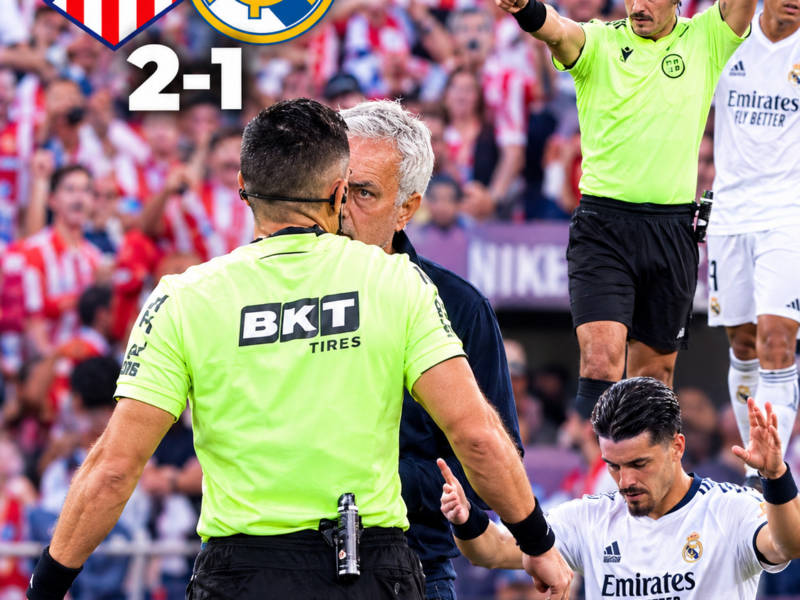
Real Madrid Derby Chaos Explodes At The Metropolitano: The Shocking Red Card That Became Yellow, Simeone’s Fury And The VAR Storm Nobody Can Stop Talking About
Some football matches get remembered for a moment.
A goal, a save, a single flash of brilliance that ends up on every highlight reel for years afterward.
And then there are matches that get remembered for something else entirely, a decision so contested, so wrapped in confusion and outrage from literally everyone watching, that the actual football almost becomes an afterthought.
This was one of those nights.
Real Madrid and Atlético Madrid delivered a Madrid derby that had barely reached halftime before it had already produced enough refereeing controversy to fuel Spanish sports radio for a full week, a match defined less by what happened on the scoreboard and more by four brutal minutes of officiating chaos that left players, coaches, commentators, and an entire viewing public screaming the exact same word at their television screens.
Roja.
Red card.
And somehow, incredibly, the man with the whistle disagreed.
A Derby That Turned Violent Before It Turned Tactical
From almost the opening whistle, this was never going to be a night for the purists.
The fouls started early and kept coming, the kind of relentless, niggling, physical intensity that has defined this fixture for decades, and by the fourth minute the referee, identified throughout the broadcast as Ortiz Arias, was already reaching for his pocket.
Nahuel Baena went into Arda Güler hard, a challenge that split opinion instantly among the commentary team calling the match, with some insisting it was a clear yellow and others questioning whether it even merited that much. Ortiz Arias sided with caution and showed the card.
Whatever goodwill that decision bought him evaporated almost immediately, because Güler’s reaction to it became its own small controversy. Rather than simply accepting the decision, the young Turkish playmaker sprinted toward the fourth official to continue arguing his case, prompting an immediate and pointed observation from the broadcast team.
Güler may well have had a legitimate grievance about the physicality he was facing. But storming toward an official the way he did was its own bookable offense in the eyes of most watching, a classic case of a player being right about the foul and wrong about his own conduct in response to it.
The chaos, though, was only getting started.
Simeone Storms The Pitch, And The Bench Empties
Diego Simeone has built an entire managerial identity around touchline intensity, and on this night, in just the sixth minute of the match, he gave the world a reminder of exactly why officials, opposing fans, and sometimes even his own club’s supporters have learned to brace themselves whenever he gets animated.
According to those watching closely, Simeone came several meters onto the actual playing surface to protest a decision, an action commentators immediately and unanimously agreed warranted a caution of his own.
What followed compounded the moment into a genuinely bizarre passage of officiating. As Simeone argued his case, members of the Atlético bench reportedly rose to their feet in support, more than the single substitute technically permitted to stand under the laws of the game, creating a small standoff over exactly how many yellow cards this one moment should actually generate.
The suggestion floated by commentators in real time was almost comically specific. If the fourth official was going to book Simeone for encroaching onto the field, consistency demanded a caution for someone on Real Madrid’s bench too, given how the touchline tensions had been building on both sides throughout the opening exchanges.
It was, in other words, six minutes into a Madrid derby, and the match had already generated enough refereeing subplots to fill an entire post-match highlight package.
The Moment That Changed Everything
Then came minute thirty-five, and the passage of play that would define not just this match, but potentially an entire week of Spanish football conversation.
Jude Bellingham surged into a tackle near the Atlético box, engaging with defender Cristian “Cuti” Romero in a physical, low-to-the-ground challenge. Both players ended up on the turf, visibly in pain, and for a moment the officials allowed play to continue under advantage.
Bellingham was shown yellow for the initial challenge. But it was what happened in the aftermath that turned this into a full-blown controversy.
According to the broadcast commentary, as both players lay on the ground, Bellingham appeared to be gesturing toward a mark left on his body, insisting that after his own challenge had been completed, Romero had planted his studs into him separately, an action entirely distinct from the original 50-50 collision moments earlier.
The distinction matters enormously in the laws of football. A player going for the ball and accidentally catching an opponent is one category of offense. A player deliberately leaving his foot down, with studs exposed, on a grounded opponent after the ball has already gone is an entirely different and far more serious act, one that referees are specifically instructed to treat as excessive force regardless of intent.
VAR intervened. Referee Ortiz Arias was called to the pitchside monitor to review the exact moment of contact for himself.
And in that review window, something remarkable happened that the broadcast team picked up on almost immediately.
Fellow official Trujillo, reportedly reviewing the same footage independently, apparently believed the incident merited a straight red card, a conclusion the commentary team suggested was obvious to essentially everyone watching, players from both teams included. Ortiz Arias, standing at the monitor with the same footage in front of him, ultimately reached the opposite conclusion.
Yellow card, for Romero. Not red.
“This Referee Should Never Officiate Again”
The reaction from the broadcast booth, when the decision was confirmed, was about as pointed as sports commentary gets without crossing into outright accusation.
One commentator, describing the review process, insisted that everyone in the stadium, every player from Atlético Madrid and every player from Real Madrid alike, understood in that moment that the correct decision was a red card, and that what followed instead was, in his words, an embarrassing outcome for a fixture of this magnitude.
The frustration wasn’t really about the existence of a gray area. Experienced observers acknowledged the underlying challenge itself was genuinely a fifty-fifty footballing collision, the kind of coming-together that happens dozens of times in every match without controversy.
The outrage was specifically about what happened afterward, the moment where Romero’s leg reportedly stayed extended and in contact with Bellingham’s body well after the ball had gone, an action that, once isolated and reviewed frame by frame on the broadcast monitor, appeared to leave little room for ambiguity in the eyes of almost everyone watching.
There was also a secondary layer of controversy brewing in real time about how that VAR conversation had actually unfolded behind the scenes. Word reportedly began circulating from broadcast sources connected to the refereeing body itself suggesting the review call to the pitchside monitor had actually been triggered by a case of mistaken identity, rather than a genuine, deliberate red-card review of the challenge itself.
That explanation landed with commentators about as well as you would expect. The pushback was immediate and pointed. Whatever the reason a referee is initially summoned to the monitor, the responsibility once he arrives there is to rule on what he actually sees unfolding on the screen in front of him, independent of why the review was triggered in the first place. If the review shows a stamp worthy of a red card, then a red card is what the review is supposed to produce, regardless of the original prompt.
Framing it any other way, several voices on the broadcast argued, treated the viewing public as unable to understand a fairly straightforward officiating principle, and only deepened suspicion about how the decision had actually been reached.
A Pattern, Not An Isolated Incident
If the Bellingham and Romero moment had been the only contentious call of the half, this would already have been a memorable, talkable derby.
It wasn’t close to the only one.
Minutes earlier, Atlético’s Marc Pubill had been shown yellow for a foul on Kylian Mbappé that broke up a promising Real Madrid counterattack. Around the same passage of play, Atlético players were reportedly protesting a separate incident, an open-handed contact from Mbappé that appeared to catch an opponent around the face, with Atlético’s bench, including assistant coach Coke, vocally appealing to the fourth official for a card of their own.
Then, deep into first-half stoppage time, arguably the second most serious officiating moment of the night unfolded, and it received almost as much airtime in the immediate aftermath as the Bellingham incident itself.
Atlético defender Kangin, a name broadcasters kept circling back to with visible alarm, went into a challenge on Fede Valverde from behind, a tackle described in real time as coming in with raised studs, well above the ankle, in the specific area around the Achilles tendon that coaches and medical staff consider among the most dangerous zones for serious long-term injury.
Commentators were unambiguous about how they viewed it. A trailing challenge, executed with excessive force, in one of the most injury-prone areas of the lower leg, delivered by a player charging in from behind where the recipient has no ability to protect himself, checks essentially every box the laws of the game use to define serious foul play. By that standard, several voices argued, the case for a straight red card was, if anything, even cleaner than the Bellingham incident minutes earlier.
That challenge, notably, went completely unpunished with so much as a caution, adding yet another layer to the growing sense among commentators that this fixture’s officiating had lost the thread entirely.
The Numbers Behind The Noise
Strip away the emotion and outrage for a moment, and the raw tally from this derby’s opening 45 minutes tells its own story.
By the interval, cards had been shown, threatened, or seriously debated for Baena, Güler, Simeone personally, members of both benches, Pubill, Bellingham, and Romero, alongside two separate incidents, the Bellingham-Romero collision and the Kangin challenge on Valverde, that multiple experienced observers believed warranted a sending-off and received nothing more than a yellow card, or in Kangin’s case, nothing at all.
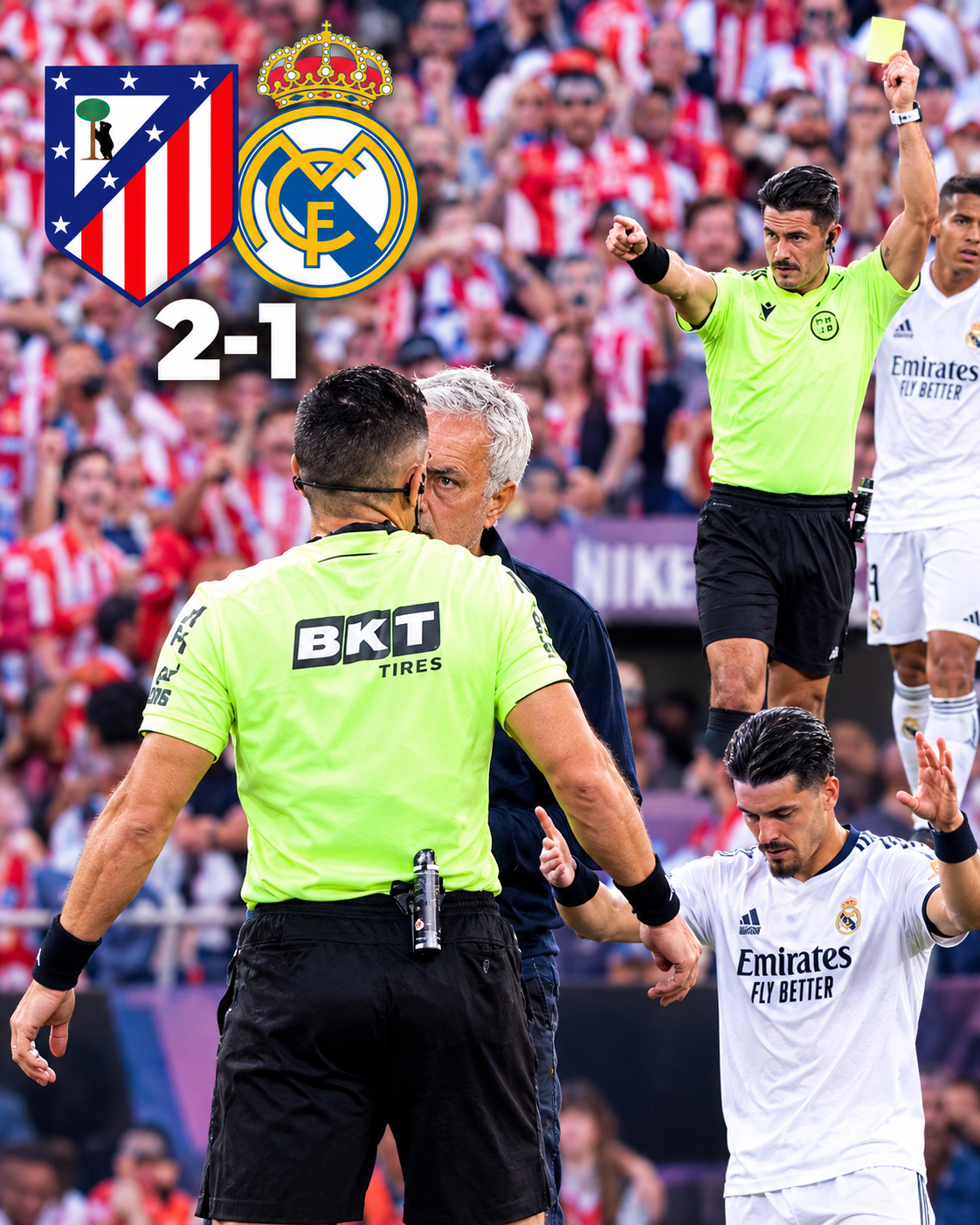
For context, one of the broadcast’s most experienced analysts, drawing on his own background as a former professional referee, offered a blunt statistical framing of just how far this had strayed from a normal derby. Based purely on the technical merits of the challenges committed, he suggested, Atlético Madrid should realistically have been playing with nine men well before the first half had even finished, a number that, whether or not you agree with every individual call, underlines just how much contentious material this single half of football had generated.
Social media reaction, according to the broadcast team monitoring their own audience in real time, mirrored the split inside the stadium itself, with the clear majority leaning toward the view that Bellingham’s challenge from Romero deserved red, alongside a smaller but vocal contingent defending the yellow card as the technically correct call under a stricter reading of the laws.
A Scoreless, Chaotic Opening 45
For all the officiating drama, the actual football produced a goalless first half, a 0-0 scoreline that, given everything that had unfolded around it, felt almost like a footnote by the time the referee finally blew for the interval.
Real Madrid had their moments, including a promising Bellingham run into the box that was snuffed out by good defending from Romero, and a dangerous Arda Güler pass that nearly released Bellingham through on goal before officials adjudged the buildup offside.
Atlético, for their part, threatened on the counter, with Pablo Barrios and company looking to exploit the space Real Madrid occasionally left in transition, though clear-cut chances at either end remained relatively rare amid the constant stoppages for fouls, cards, and video reviews.
According to the broadcast, Atlético emerged from the tunnel for the second half with intent, taking an early lead within the opening ten minutes to move 1-0 in front, a result that, given the chaos of the preceding 45 minutes, only intensified the sense inside the stadium that this was a night destined to be remembered for its officiating storyline as much as its football.
Why This Particular Derby Controversy Will Not Fade Quickly
Spanish football has no shortage of history when it comes to contested Madrid derby officiating, a rivalry where accusations of preferential treatment have flowed in both directions for decades, loudly and often, regardless of which side actually benefits on any given weekend.
What made this specific incident different, according to the reaction it generated in real time, was the unusual clarity of the underlying disagreement. This wasn’t a marginal handball call or a debatable offside line decided by inches. It was, in the eyes of a striking number of neutral, experienced observers, including a voice with direct professional refereeing experience, as close to a clear-cut sending-off as the sport produces, reviewed on video, at the pitchside monitor, by the one official specifically empowered to get it right.
And the outcome still landed on the wrong side of that consensus, at least according to the broadcast covering it.
Add in the reported behind-the-scenes explanation involving a mistaken identity trigger for the review, an explanation that commentators treated with open skepticism rather than acceptance, and you have all the ingredients for a controversy that outlasts the final whistle by days, if not longer.
Both benches, by full-time, will likely feel they have a legitimate grievance to voice publicly, Atlético over the sheer volume of first-half cautions shown against their players, and Real Madrid privately wondering how a stamp on their most expensive young midfielder failed to produce the outcome nearly everyone watching believed it deserved.
In a rivalry already carrying this much emotional weight, that combination rarely stays contained to a single news cycle.









