
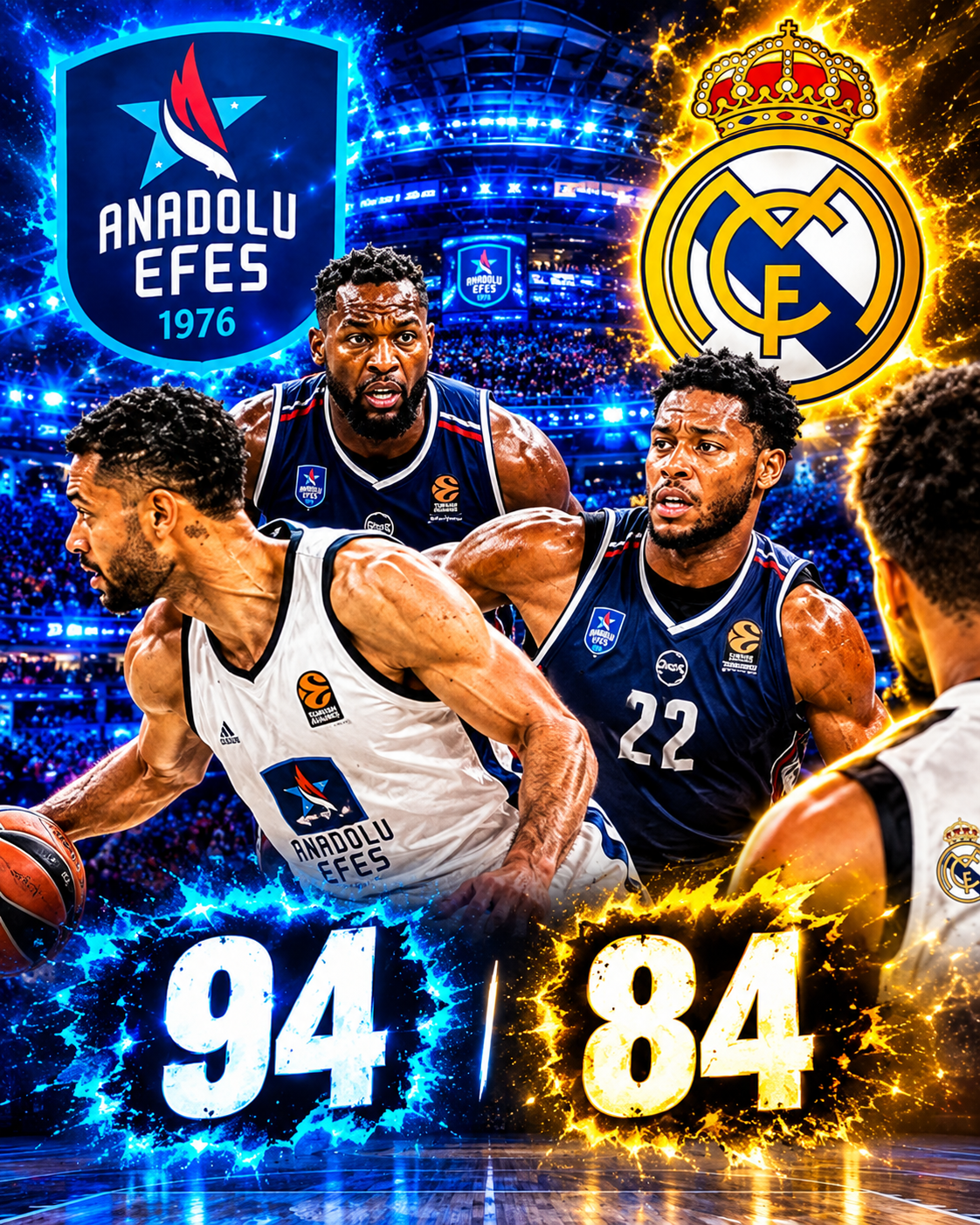
Real Madrid Crushed in Istanbul: The Second-Quarter Collapse, Nick Smith Jr.’s Bright Debut, and the Warning Signs Nobody Wants to Admit
La Liga’s Refereeing Chaos Explained: The Bleeding Player Rule, VAR’s Retreat, and the New Rulebook Fans Never Knew Existed
A player is bleeding from the face, and he is the one who has to leave the pitch.
That sounds like a bad joke, but it is exactly what Spanish football is dealing with this season.
It is one of several controversies shaking La Liga’s refereeing landscape, from VAR’s shrinking role to a rulebook that sometimes seems to say different things depending on who is reading it.
So what is really going on with the referees this year?
Two commentators, one of them speaking from the perspective of a referee analysis project, walked through the biggest talking points.
What follows is their analysis and opinion, and it is worth remembering that many of these calls are matters of interpretation.
Let’s start with the big question.
Has Madrid been helped, harmed, or simply left where it should be in the standings?
According to the analysts, the honest answer is that things look pretty even.
The top of the table is tight, and they note there are a couple of specific cases, but so far not much that has changed the picture.
And they offer a reason.
VAR is intervening less this season, and based on the data they have collected, there are fewer errors.
They are careful to say the word interpretation is a wildcard.
But they do see a clear trend.
Once a decision is accepted as valid, it stays.
And stepping in over trivial contact in the box is not happening the way it used to.
Now, in their view, referees are erring more on the side of letting a borderline penalty go than calling one.
They cite the penalty in the Levante and Barcelona match on Lamine Yamal.
The contact, they say, was really a brush with the studs, hardly a hit at all.
There was also an earlier handball penalty in that game.
What VAR accepted as valid was the second call, the brush, which the analysts say VAR should not even have considered.
But because it had already been called on the pitch, the thinking seems to have been that it stood.
So the direction of travel in Spain seems clear.
VAR intervenes less, and validates the referee’s decision more.
That is the old promise of keeping the referee at the center of the game.
Now to the rule that has caused the most eye-rolling.
If a player is fouled and the referee does not show the offender a yellow card, the injured player has to leave the field for a minute.
The analysts point to a photo that captures the absurdity.
Gerard Martin took an arm to the face and was bleeding, and because no yellow card was shown, he had to step off the field as if he were wasting time.
They call it ridiculous, and they are not shy about it.
They do not object to the goal behind the rule.
A goalkeeper who goes down in the 85th minute claiming his calf hurts, then keeps playing, deserves to be sanctioned.
That part, they say, is great.
But a player dripping blood from his nose or a gash above his eye cannot be punished for a referee’s mistake.
The logic, as they put it, is simple.
When the player has to leave, it is usually because the referee failed to show a card for an action that clearly deserved one.
So the team that suffered the foul loses a player because of the official’s error.
They expect the rule to change quickly.
They recall an earlier directive about the Achilles tendon, a rule that was dropped by matchday five.
This one, they think, will follow the same path.
That raises a technical question.
Can Spain change something that belongs to IFAB, the body that writes the laws of the game?
One analyst says a source once told him the referees’ committee cannot change that, because it is an IFAB matter.
His answer was that the Achilles tendon rule was also an IFAB matter, and it was changed through a committee circular in the end.
They point to another example.
The Prestianni rule, which involves sending off a player who covers his mouth while speaking, is not being applied in Spain.
It has been applied in some places, including in South American leagues, and there have been unfortunate mistakes.
The idea behind it was good, since it aims to stop racist insults made behind a covered mouth.
But if a rule is being misapplied, they say, it should be changed.
Circulars, they explain, are exactly the tool for that.
They are guidelines the committee gives to officials so that fans can also be informed.
The analysts also flag something fans might not expect.
Rules can differ between competitions.
They say a certain handball is a penalty in the Spanish card manual but is not one in what UEFA shows its referees.
The same handball, the same law, a different outcome.
So expect moments in the Champions League where a call seems inconsistent with what you saw in Spain.
Each league has its own guidelines, they remind us.
Next, a rule change that confused a lot of fans.
After the Julian Alvarez incident, the double touch on a penalty is treated differently.
Now, a penalty is retaken only if the double touch results in a goal.
So when Harry Kane’s penalty hit the post after a double touch, it did not need to be retaken.
The analysts believe VAR intervened almost out of excess.
They could have played advantage, and it would have changed nothing.
It looked more like a way to show the public how the new rule works.
To be clear, they say, a double touch is not always retaken.
If it is missed, play resumes with an indirect free kick, or the referee can play advantage so the defending team can counter.
The one thing that cannot happen is to disadvantage the defender.
Now to one of this season’s most useful novelties.
The Spanish federation has published a card manual.
It is essentially a rulebook with examples, heavily summarized.
The analysts see it as a positive, although they note that many examples are missing, and it seems little effort went into searching for plays.
They also point out that it is aimed at fans, even though the people who should be distinguishing between similar actions are the committee itself.
Still, having the committee’s written interpretations organized on its website is a plus.
They compare the full IFAB rulebook to an encyclopedia that used to fill three bookshelves at home.
Everything is in there, but it takes a very long time to read.
The manual is the short version, meant to help tell apart plays that look alike but carry different nuances.
One section stands out.
On handball, the manual describes deliberate handball, handball in an unnatural position, handball under the post, and handball on a shot.
It also includes a passage on what it calls interpretive complexity.
The gist is that handball actions require a contextual analysis in which multiple factors must be weighed.
In other words, simple contact between hand and ball does not automatically mean a foul.
The analysts have a wry take.
Interpretive complexity, they suggest, is a convenient cushion if a different decision is made later.
The manual also covers encroachment during a penalty kick.
Many people, they say, only discovered it after the Betis and Real Madrid match, when Bartra entered the box and everyone asked what had happened.
There, the answer was in the manual.
But they return to a familiar problem.
The trouble is less the rules than the interpretation.
In two or three weeks, a similar action can be judged differently, and the whole debate starts again.
Then came a question about a recent play.
Was Bellingham’s fall against Rodri a penalty?
The analyst says no, under any circumstances.
He understands the comments about there being no contact, but he sees a player who was going down before any contact and trying to be clever.
He goes further.
There are referees, he says, who do not understand football, and in that match, he believes two of them, one on the pitch and one in the VAR room, understood very little.
When a player drags both legs, he says, you already know the intention.
If it is called on the pitch, you accept it.
But for VAR to step in just because there was contact, he says, is unnecessary.
The analysts also tackle a term that confuses many fans.
The DOGSO zone, short for denying an obvious goal-scoring opportunity.
It is an English acronym, and, they joke, in Spain nobody invents a new word for anything.
The zone, they explain, roughly extends the lines of the penalty area toward the center of the field, and includes the small area.
If a player is heading toward goal with no defenders around and is fouled by the last man inside that zone, the expected sanction is a straight red card.
But in practice, they say, it varies.
Half a meter can make the difference.
They have seen red cards outside the zone and no red cards inside it.
Every referee, they say, is their own world.
That leads to a bigger topic.
The level of officiating this season.
Under the committee’s new leadership, the analysts say, certain guidelines have changed.
They do not say it is getting worse, because changes take time to settle.
But there is a clear shift.
Under the previous committee, they say, a non-international referee almost never got a big match unless the outcome no longer mattered.
Now, rising referees with projection are being handed major games.
They name García Verdura, Sesma Espinosa, and Busquets Ferrer, who have taken on derbies and other big matches.
They also note Ortiz Arias took the Madrid derby, though they say he has less projection because of his age.
These referees are being tested in important matches, and they may lack the experience the veterans had.
But the veterans, they add, have themselves delivered a somewhat lamentable level in recent seasons.
So this is a transition, and mistakes should be expected.
They also address another change, the regionality rule.
Ortiz Arias, from the Madrid referees’ association, took a Madrid derby, and an Andalusian referee took an Andalusian derby.
As a novelty, they say, it is fine.
But they are not sure it brings more to gain than to lose.
If it goes well, no problem.
If it goes badly, the downside is bigger.
So they call it a change that adds little to the refereeing atmosphere, and they wonder whether it will stick or be rolled back.
Finally, the toughest question.
What has been the most serious VAR error so far?
The first thing that comes to mind, one analyst says, is the non-intervention on Kang-in Lee’s tackle.
He adds that inside the committee, the explanation being given is that there was no time to review.
The suggestion, he says, is that Real Madrid took the kick quickly, though they agree that should not be an excuse.
He says the committee did acknowledge an error during the review time, and that an intervention should have happened.
But by then, play had restarted, and going back could have meant a protocol error.
To call it a truly major error, he says, the player would have had to be down while play continued.
And what about the standings without the errors?
The analysts say the table would look pretty even at this point, with only a couple of one and two point changes, because so few matches have been played.
So the story of this season is not one of a broken system.
It is one of a system in flux.
Fewer VAR interventions, new rules that may not survive, referees coming up from below, and a rulebook that leaves plenty of room for interpretation.
Whether that is progress or just a new set of problems is the question.
What do you think?
Is VAR getting better, or has the confusion just moved somewhere else?
Share your thoughts in the comments below.









