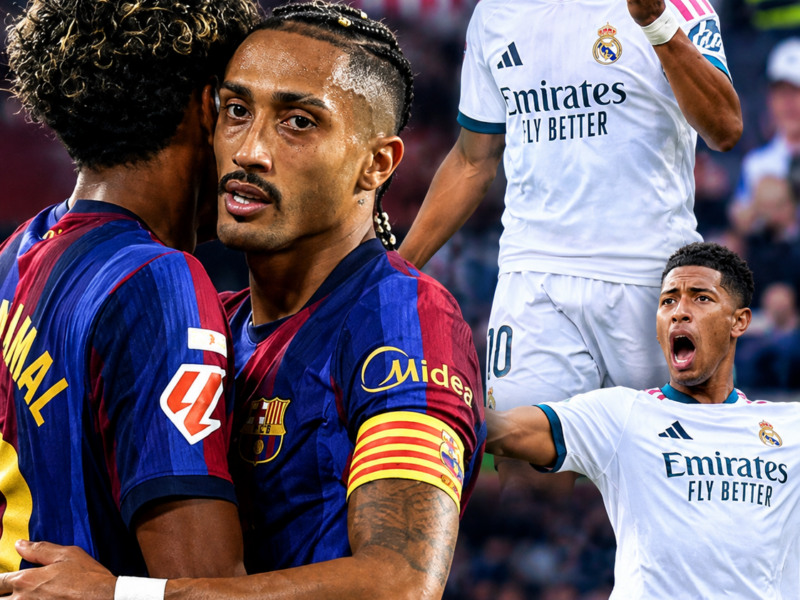
Real Madrid Crisis 2026: Why Mourinho’s Struggling Squad Looks Even Worse Than Last Season While Barcelona Flies Toward the Next Clasico
Two football clubs share a city, a country, and a century of rivalry, yet right now they appear to be living on entirely different planets.
One is gliding through the season with the kind of swagger that makes every substitute look like a starter and every starter look like a superstar.
The other just walked out of a derby defeat with its captain screaming at the referee, its brand-new manager fuming in a press conference, and its fans wondering if anything has actually changed at all.
That is the split-screen reality of Spanish football heading into this international break, and it is impossible to ignore.
Barcelona are floating. Real Madrid are drowning in the same water they were drowning in last May, just with a different lifeguard on duty.
And somewhere out there, circled in red on every calendar in Catalonia and Madrid alike, sits the next Clasico, a fixture that suddenly feels less like a rivalry and more like an ambush waiting to happen.
A Weekend That Confirmed Every Fear
The Madrid derby at the Riyadh Air Metropolitano was supposed to be the moment Jose Mourinho stamped his authority on his second spell in charge of Real Madrid.
Instead, it turned into a case study in everything currently wrong with the club, wrapped up in ninety chaotic minutes against Diego Simeone’s Atletico.
It was Mourinho’s first derby back in charge of Real Madrid, and it ended in defeat, a heated occasion with repeated confrontations, a card reversal for Jude Bellingham after a VAR review, and both an Atletico goalkeeper coach and a Real Madrid assistant sent off at halftime.
Football España
Real Madrid suffered a bruising defeat as defensive lapses and a costly red card derailed Mourinho’s tactical plan, with a penalty from Alex Grimaldo and a clinical finish from Jonathan David sealing the points for the home side.
Yahoo Sports
The turning point had a name and a number attached to it. Dean Huijsen’s dismissal in the 52nd minute was the game’s decisive moment, leaving Real Madrid a man down and gifting Atletico the penalty that opened the scoring.
Goal.com
For a club that spent heavily to fix its backline over the summer, watching one of the marquee new arrivals get sent off in a derby, at the exact moment the game hinged on discipline, is the kind of detail that turns muttered frustration into open panic.
But the red card was only half the controversy. The other half belonged to the officials, and it is the part that has genuinely enraged the Madrid dressing room.
Referee Ortiz Arias failed to send off Cuti Romero in the first half for stepping on Bellingham’s knee, even after reviewing the play on the monitor, and also let Kang-in Lee stay on the pitch after a challenge that left his studs on Fede Valverde’s ankle.
Real Madrid CF
In the 35th minute, during a contested ball, Bellingham reached it first and the Atletico defender planted his studs into the Real Madrid midfielder’s knee; the referee initially carded Romero, was called to the monitor, and then downgraded the punishment to a yellow instead of the red card the review seemed to invite.
Real Madrid CF
By full time, the frustration had boiled over completely. Bellingham was filmed in a furious confrontation with the match officials, walking away from the pitch repeatedly shouting that there should have been two red cards against Atletico that night.
Goal.com US
It is easy, and honestly tempting, to hide behind the officiating as the sole explanation for the defeat. Bad calls happened, and they mattered.
But that framing lets Real Madrid off the hook far too easily, because the uncomfortable truth is that this version of the club was already struggling before a single controversial decision was made.
The Uncomfortable Truth Nobody at the Bernabeu Wants to Hear
Here is the question that should be keeping Real Madrid executives up at night. In what specific way is this squad actually better than the one that finished last season empty-handed against Barcelona in every meaningful category?
Is it more entertaining to watch. Is it scoring more freely. Is it defending with more composure. Is it winning the moments that decide knockout football and title races.
If the honest answer to all four is no, then spending money over the summer did not solve a problem. It just moved the furniture around the same broken room.
That is the version of events playing out in Madrid right now, and it explains why so much of the frustration is being aimed not at any single player, but at the entire project.
A new head coach was brought in. New full backs arrived. A new center back was signed to add steel to the back line. On paper, it should have represented a fresh start.
In practice, the same collection of attacking players who dominated the ball and possession stats last season while somehow finishing behind Barcelona are still the ones dominating the ball and possession stats this season, with largely the same results to show for it.
Swapping out the back three or four while leaving the front six almost entirely untouched is a bit like taking a car in for a flat tire and having the mechanic replace the battery, flush the oil, and clean every filter in the engine bay instead.
The car might sound healthier idling in the garage. It is not going anywhere on that flat tire.
That is effectively what happened at the Santiago Bernabeu this summer. The structural issues that cost Real Madrid the title race were never really addressed at their root, because addressing them would have meant making difficult decisions about entrenched, senior, extremely well-paid attacking players.
Instead, the club patched the edges. New arrivals were expected to elevate the level of the group around them. So far, the opposite has happened, and several of the new faces have looked overwhelmed rather than transformative.
Huijsen’s derby performance was described as an absolute horror show for the young defender, tactically naive and physically overwhelmed in the high-stakes environment of a Madrid derby.
Goal.com
In a hybrid role, Cucurella found himself pinned back by the marauding runs of Marcos Llorente, offering very little going forward and completing zero successful crosses, while Dumfries was largely anonymous before picking up a booking for a cynical foul.
Yahoo Sports
Individually, none of that is a death sentence. New signings need time, especially in a fixture as combustible as a Madrid derby. But collectively, it paints a picture of a defensive rebuild that has not yet rebuilt anything.
Mourinho’s Return Was Supposed to Be the Fix
There is a particular kind of storyline that Spanish football adores, and it is this one. The prodigal manager returns, older, wiser, allegedly more tactically flexible than the version everyone remembers from a decade earlier.
Jose Mourinho arriving back at Real Madrid carried exactly that promise. A manager who has won league titles across four different countries, who understands the pressure of the Bernabeu better than almost anyone alive, stepping back into a dugout he once dominated.
Except a manager, no matter how decorated, cannot conjure a different team out of the same group of players in a matter of weeks. And that is precisely the trap Mourinho has walked into.
His tactical setup was criticized as far too passive for a derby, ceding the majority of possession and inviting pressure that his young defenders could not handle, with substitutions described as reactive rather than proactive once his side fell to ten men.
Yahoo Sports
By ceding around two thirds of possession, Mourinho invited pressure his back line could not cope with, and his side looked devoid of a plan once they went a man down.
LiveScore
That is a damning assessment for a coach whose entire reputation was built on suffocating bigger, more talented opponents through discipline and control. In this derby, Real Madrid did not control anything.
While Bellingham took his complaints out onto the pitch, Mourinho was equally scathing in his post-match assessment, questioning the experience level of the officials in charge of the fixture.
Goal.com US
That reaction says a great deal about where the club’s head is right now. The instinct after a chaotic, undisciplined derby defeat was to point outward at the referee rather than inward at a performance that had already been laboring before the red card changed the complexion of the match.
There will be time for deeper tactical inquests once the international break ends. But the early verdict from people who watched that game closely is unambiguous. This was not simply a night stolen by bad officiating. It was a genuinely underwhelming collective performance that bad officiating then made unforgettable for all the wrong reasons.
Kylian Mbappe and the Ballon d’Or Problem Nobody Wants to Say Out Loud
There is a subplot running through Real Madrid’s season that rarely gets discussed directly, mostly because it involves criticizing one of the best forwards on the planet during a stretch when he is technically still scoring goals.
Kylian Mbappe remains the club’s most dangerous individual weapon. Nobody disputes that. But there is a growing sense among frustrated supporters that his game right now is being shaped by something other than pure team success.
The timing lines up too neatly to ignore. This is the exact window in the calendar when Ballon d’Or voters are quietly forming their opinions, weighing recent form as heavily as full-season numbers, and Mbappe knows it as well as anyone in the sport.
The result is a forward who seems locked into chasing personal moments rather than facilitating the team’s rhythm, taking on shots from positions where a simple pass would keep possession moving and pressure building elsewhere.
It is a subtle distinction, and reasonable observers can disagree about how much it actually costs the team on a given afternoon. But zoom out over a full season and a pattern starts to form, one where individual pursuit occasionally comes at the expense of collective cohesion.
None of this makes Mbappe uniquely responsible for a squad-wide slump. Plenty of other issues, from defensive fragility to squad balance, matter just as much or more. But it is one more layer in a season that increasingly feels like eleven talented individuals occasionally remembering they are supposed to be a team.
Vinicius Junior’s Strange, Quiet Decline
If Mbappe’s issue is one of selective focus, Vinicius Junior’s issue looks entirely different, and in some ways more concerning.
The explosive, joyful, unpredictable winger who terrorized defenses across Europe for several consecutive seasons has looked like a shadow of himself for stretches of this campaign, subdued in games where he once would have been the decisive difference maker.
He was substituted during the derby, not as a tactical flourish but because the performance simply was not working, a decision that would have been unthinkable for this version of Vinicius eighteen months ago.
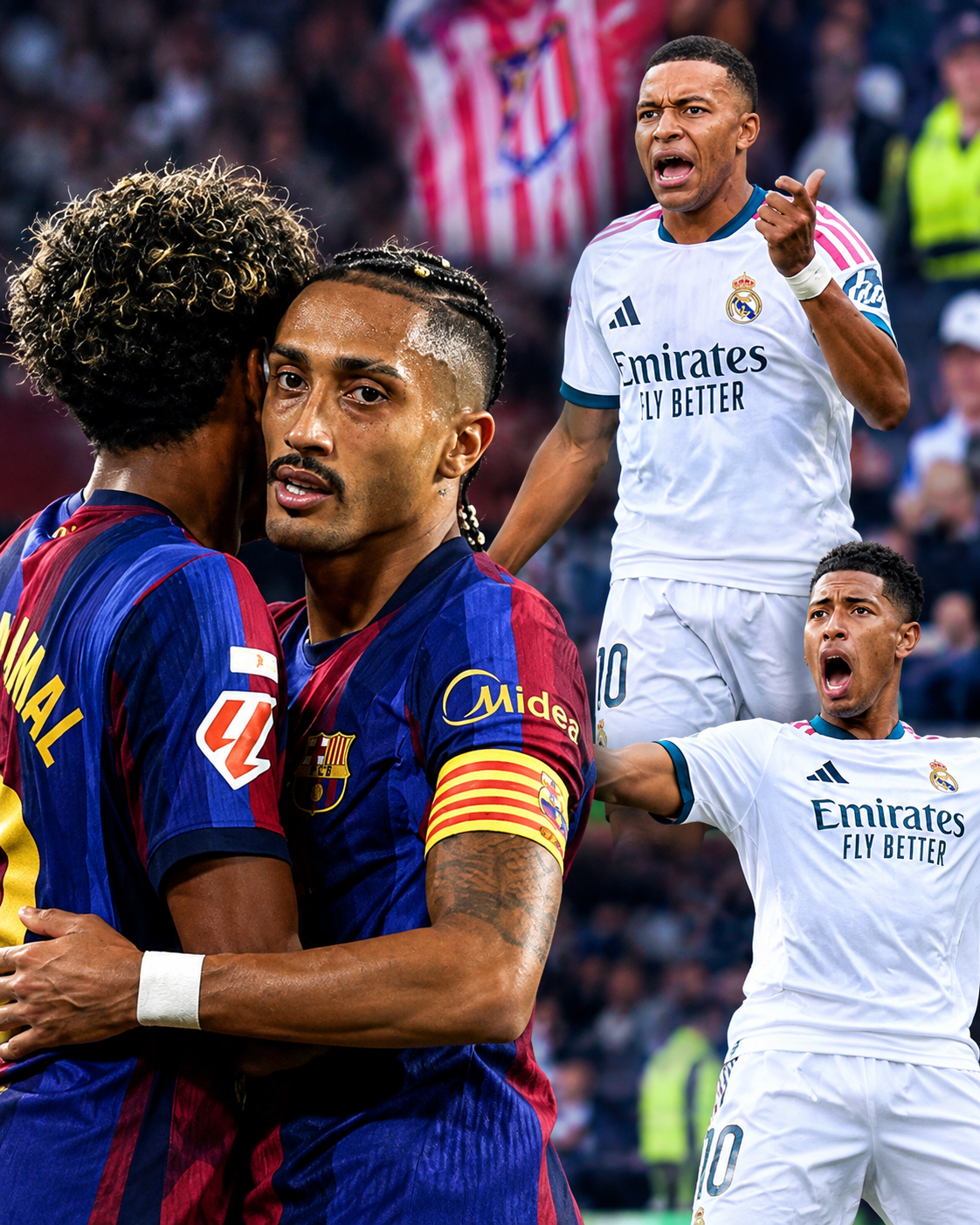
Contract situations, private frustrations, tactical instructions, physical form, there are a dozen possible explanations floating around, and none of them can be confirmed from the outside with any real certainty.
What can be confirmed is the eye test, and the eye test says something has shifted. The player who used to turn matches on a single dribble now looks hesitant, occasionally sulky, and strangely peripheral in games that badly need his old spark.
That is a problem no amount of squad depth can paper over, because Real Madrid built an entire attacking identity around Vinicius’s ability to create something from nothing. When that well runs dry, even briefly, the whole system feels lopsided.
Meanwhile, In Barcelona, Everything Is Going Right
Now pivot the camera roughly three hundred fifty miles northeast, and the contrast becomes almost comical.
Under Hansi Flick, Barcelona have built something that looks less like a squad and more like a genuine team, the kind where a substitute entering in the eightieth minute plays with the same intensity as a starter in the first.
That cultural difference shows up in the smallest moments. Players sprinting back to defend after losing possession. Bench players celebrating goals as hard as the scorers. A group that visibly buys into a collective plan rather than eleven separate individual campaigns running in parallel.
The attacking talent obviously helps. A front line stacked with generational young talent alongside proven senior firepower would make almost any manager’s job easier. But talent alone rarely explains a gap this consistent across an entire season.
What Flick appears to have built is structural clarity, a team that knows its patterns in and out of possession so thoroughly that it can absorb absences, injuries, and rotation without the identity collapsing. Real Madrid, right now, cannot say the same thing about itself.
That gap is precisely what makes the upcoming Clasico feel so daunting from a Madrid perspective, and precisely what makes it feel so tantalizing from a Barcelona one.
Why the Clasico Suddenly Feels Terrifying
Rivalries are supposed to produce nerves regardless of form, history, or league position. There is always the chance of an upset, always the unpredictability that makes this fixture the most watched club match on the planet.
But right now, honestly, few Real Madrid supporters are approaching the next Clasico with anything resembling confidence. The mood is closer to dread, the kind of quiet bracing you do before a storm you already know is coming.
Barcelona arrive with momentum, a settled system, and attacking talent peaking at exactly the right moment. Real Madrid arrive with a defense still finding its feet, a returning manager still searching for control, and two of the most important attacking players in the world dealing with very different but equally distracting issues.
Every recent version of this fixture that has gone lopsided has become historic in the wrong direction for whichever side was struggling. Nobody in Madrid wants a repeat of the kind of scoreline that gets replayed in highlight reels for a decade.
There is a very human, very understandable instinct among fans right now to almost wish the fixture away, to hope for a postponement, a scheduling quirk, anything that buys a few more weeks to fix what is clearly broken before facing the club’s fiercest rival in this state.
That is not cowardice. That is pattern recognition from supporters who have watched this exact story play out before and know how painful the ending can be.
What Actually Needs to Change
Strip away the emotion and the frustration, and the diagnosis for Real Madrid becomes fairly straightforward, even if the solution is anything but easy to execute midseason.
The squad needs its most senior, most entrenched attacking players held to the same accountability standards as every new arrival currently absorbing criticism. Reputation should not be a shield against tactical adjustment.
The new signings need time, patience, and a system built to protect their weaknesses rather than expose them in the most hostile fixtures on the calendar first.
The manager needs to find a version of control that does not depend entirely on structural changes he inherited but rather on adjustments he can actually implement with the players available to him right now.
And collectively, the club needs to have an honest conversation about whether talent alone, however abundant, can substitute for the kind of cohesive identity Barcelona has built under Flick.
None of that happens in the space of an international break. But the break at least offers something valuable, a pause before the next crisis headline, time to look at video, have hard conversations, and figure out whether this version of Real Madrid has any chance of closing a gap that currently looks uncomfortably wide.
The Bigger Picture
Football seasons are long, and reputations shift quickly in either direction. It is entirely possible that in two months this entire narrative reads differently, that Real Madrid regroups, the new signings settle, and the gap to Barcelona tightens back up.
It is also entirely possible that the trajectory holds, that this Clasico becomes another painful data point in a season that already has plenty of them, and that the conversation in Madrid shifts from tactical tweaks to something more fundamental about the direction of the entire project.
Right now, the evidence points toward concern rather than confidence. A derby defeat marked by a red card, a downgraded challenge that infuriated the away dressing room, a manager whose tactical setup got picked apart, and two attacking superstars each dealing with their own version of an off year.
Stack all of that against a Barcelona side that looks unified, hungry, and dangerous in every phase of play, and it becomes very hard to argue the two biggest clubs in Spanish football are currently operating anywhere near the same level.
The gap is real. The frustration in Madrid is real. And the countdown to a Clasico that could either expose that gap even further or offer the first real evidence that Real Madrid can fight back is officially underway.
For now, all anyone connected to the club can do is watch, wait, and hope the international break buys enough time to find some real answers before kickoff.









