Proof That Leonardo da Vinci Was a Genius
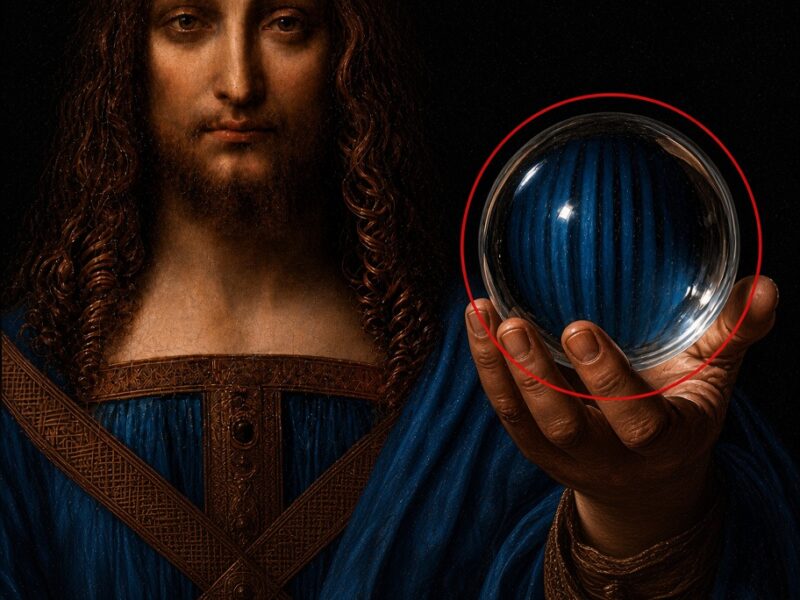
Look at this painting, Salvator Mundi, attributed to Leonardo and dated to around 1500. In 2017 it sold for $450 million, the most anyone has ever paid for a painting. It has been studied by experts, scanned by scientists and argued over for years.
And according to the account behind this story, every one of them missed something sitting in Christ’s left hand. Look at the orb. Now look at the robe behind it.
The folds seen through the sphere are nearly identical to the folds outside it. There is no dramatic bend and no stretch, just the faintest thickening near the center fold. It is so faint that most people never notice.
A transparent sphere that seems to break one of the most basic rules of physics has been sitting in plain sight for 500 years. That is not a small detail. It is a contradiction inside the most expensive painting in the world.
For a long time, art historians had a tidy answer. Leonardo made a mistake. He got caught up in symbolism and let the physics slide.
The explanation lasted because it is easy, and it asks nothing of anyone. But the account asks a more uncomfortable question. Was Leonardo da Vinci really the kind of painter who would get something this basic wrong?
This is a man who, by legend and by his own notes, dissected corpses at night to understand how a shoulder muscle moves beneath the skin. He watched birds for hours, tracking wing angles in an attempt to reverse-engineer flight. He was not content to paint what things look like. He needed to know what was happening underneath.
The same obsession runs through his notes on light, shadow and reflection, and on how a surface bends an image depending on its shape. In his notebooks, he sketched glass spheres bending beams of light. He traced how a ray bends once on entering a curved surface and again on leaving.
He drew crystal balls in direct sunlight, mapping where the brightest point would land on the wall behind them. He wrote about images flipping upside down when they passed through a small hole, the same principle behind the camera obscura. He was working through questions in optics that would not become established science for roughly another 100 years.
He was not guessing. He was testing. So look at the orb again.
Every visible detail of the painting shows a man watching closely. That makes the idea that he forgot how glass works awkward. It would mean he nailed a dozen tiny optical details and then missed the one obvious to a child holding a paperweight.
In 2019, according to the account, a group of researchers proposed something nobody had seriously tested. What if the orb is not solid? What if it is hollow? The story says nobody tested this earlier simply because nobody thought to.
The team reportedly ran high-resolution imaging across the orb’s surface, pulling the layers of paint apart pixel by pixel to see what Leonardo had recorded. Then they built a digital model. They rendered a solid glass sphere the same size as the orb and calculated how much a real crystal ball would bend the folds behind it.
Laid over Leonardo’s brushwork, the mismatch showed up at once. A solid sphere should have compressed and flipped sections of the robe by an amount you would catch without trying. Leonardo’s orb showed almost none of it.
They ran the test again, this time with a hollow shell, thin walls and empty space inside. The distortion in the model dropped to almost nothing. It came close to matching what Leonardo had painted, fold for fold.
A solid sphere would have bent the fabric, the account concludes, and a hollow one would not. Light bends hard in a solid sphere because it must travel through all that mass. In a thin shell, there is barely anything to bend it.
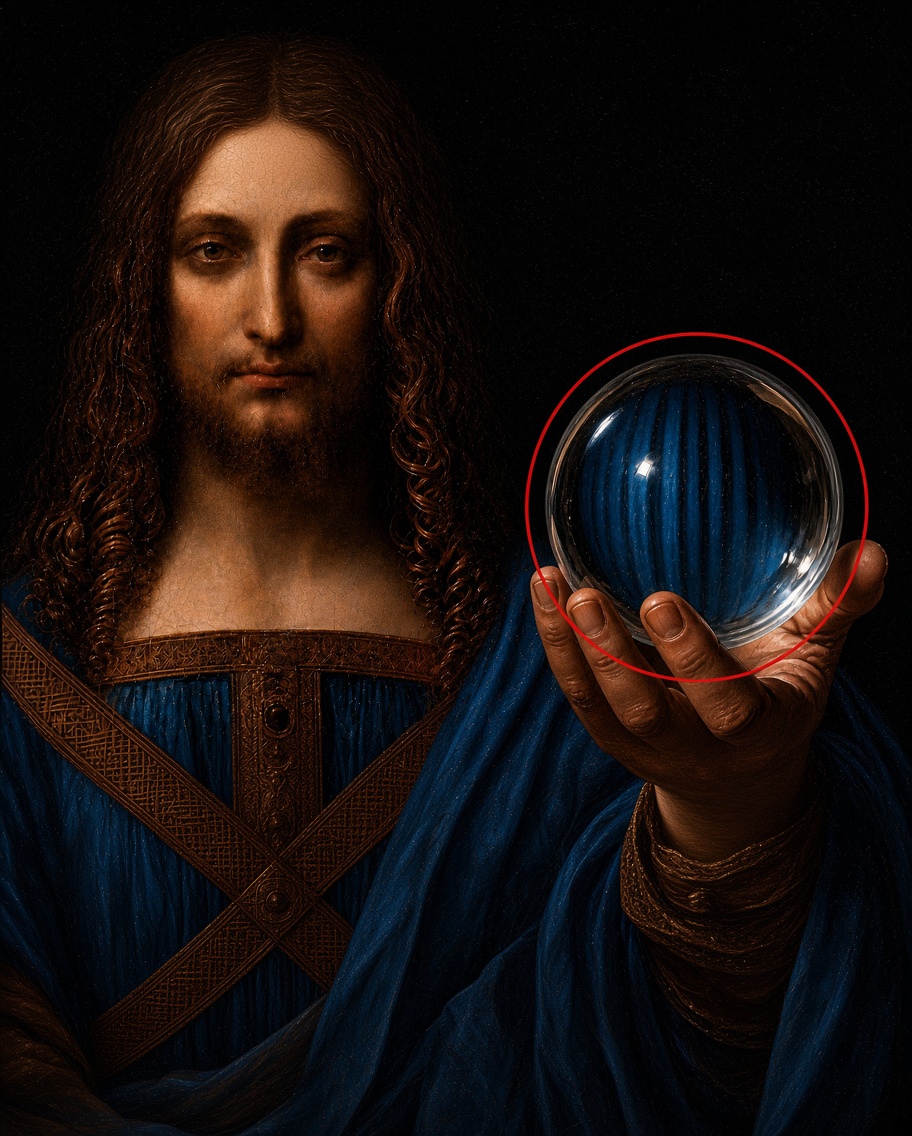
Then comes the bolder leap. The account argues that the orb has never been meant as a paperweight or a crystal ball. It is the celestial sphere, the heavens, with the entire cosmos resting on a palm as if it weighs nothing.
That would be a strange thing to paint as solid glass. So if the orb was never meant to be glass, the argument goes, we have been looking at the wrong material all along. This, it says, is space itself.
What does space do to light? The account points out that the cosmos does not refract light the way glass does. Push light through glass and it slows, drags against the atoms inside and bends toward a new angle, which is why a straw looks snapped in half in a glass of water.
Push light through empty space and none of that happens. There are no atoms to drag against and no molecules to shove the beam sideways. The light travels straight, uninterrupted, for millions of years if it has to.
A star sitting behind a wall of nothing looks the same as a star right in front of you. Physicists describe this through the large-scale structure of space-time, proved only through centuries of math, telescopes and instruments that did not exist in Leonardo’s lifetime. General relativity, satellite data and deep-field imaging came hundreds of years after his hands stopped moving.
Yet he painted this on a wooden panel, with a brush, around the year 1500. Go back to the little flecks inside the orb, the tiny points of light placed with a control that, the account says, rules out carelessness. Seen this way, they are not flaws in glass.
They are stars, points of light hanging inside a sphere that represents all of existence. The robe behind the orb does not bend because the universe does not bend what it holds. In this reading, Leonardo was not painting how a crystal ball looks. He was painting how the cosmos behaves.
And he placed it in the one pair of hands where that made sense. Christ’s hand belongs to the one figure in the painting not bound by the rules of everyone else in the frame. Every fold of the robe follows gravity, and the face follows anatomy, but the orb answers to something else.
To the account’s author, that is not a mistake in the middle of a masterpiece. It is the whole point of the painting.
Not everyone is persuaded. Skeptics note that Leonardo never wrote a word about the orb, so any reading of his intent is an inference. Many scholars also debate how much of the panel is his own hand, given its history of damage and restoration, and some argue that painting a sphere without distortion could be a simplification rather than a message.
The cosmic reading is the most daring part. It rests on interpretation, not on a document from the artist, and nothing in the surviving record says Leonardo was thinking of space-time. Supporters answer that the silence is exactly what you would expect from him.
Today the painting is believed to be in Saudi Arabia, in private hands and not on public display. The most studied, most expensive and most argued-about painting in the world is one most people alive will never stand in front of.
Leonardo, again, left no explanation. Not a note, and not a sketch with instructions. That fits what we know of him, the account says. He believed the work should speak for itself, and that pinning it down in words would only make it smaller.
This was a man who filled thousands of pages with notes. He wrote down the price of eggs and his laundry list. He wrote at length about the flight of birds, the flow of rivers and the shape of a fetus curled in a womb.
Yet on the one detail in his most expensive and most studied painting that appears to break physics, he wrote nothing. Perhaps that silence is not an absence. Perhaps it is the loudest clue in the painting. Some things, he seemed to believe, are not meant to be explained, only found.
So the question lands back with us. Did Leonardo work this out deliberately, or did his hand find something true without his ever fully knowing it? If it was deliberate, then a man with no telescope, no equations and no concept of space-time reasoned his way to a truth that took physicists centuries to prove.
That would not be a lucky brushstroke. It would mean it took 500 years, with telescopes built, Einstein’s equations written and satellites launched, for the world to catch up with what sits on that wooden panel. Just a man, a panel and a question he could not let go of.
The painting offers no clues. It never has. Go back and trace the robe as it passes behind the orb, and look for the exact point where the fold should snap, stretch or twist. It does not.
So what is your verdict? Was Leonardo’s orb a genius’s deliberate statement about the cosmos, or just a painter’s simplification that we have read too much into? Leave your thoughts in the comments.









