One Of The Most Detailed Paintings In History
You are looking at a painting that is almost 600 years old. Before you sits the Madonna and Child, with two saints standing at the sides and an elderly man kneeling before the Virgin Mary.
At first glance, it looks like an ordinary religious scene. But look closer, and something strange happens.
You begin to notice things you would never expect to find in a 15th-century painting. On the old man’s face, you can make out every vein and wrinkle. On the carpet, you can see the finest texture of the pile.
Reflections of the surrounding space glint on the metal parts of the armor, while precious stones catch the light each in its own way. Even the clothing seems not to have been painted with a brush, but almost photographed.
And here the question arises: how could an artist almost 600 years ago make paint look so real?
This is only the beginning. The painter hid in this work far more than impressive technical tricks. He turned practically every object into part of a huge visual puzzle.
What you are looking at is the Virgin and Child with Canon van der Paele, one of the most unusual works by Jan van Eyck, created in Bruges in the 1430s. So what exactly did the artist want to show?
Start with the composition. The Madonna sits in the center, the Christ child on her lap. On the right stands Saint George in shining armor. On the left is Saint Donatian, the patron saint of the church.
Between them, kneeling, is a man named Joris van der Paele. He was a canon, a member of the clergy at the church of Saint Donatian in Bruges. He was a real person, and he commissioned this painting for himself.
Van der Paele was already elderly and in poor health. The painting was meant to become part of his religious bequest and a lasting reminder of his prayers.
Now look at his face. Today it can seem almost uncomfortably realistic. Van Eyck made no attempt to make his patron look younger.
He rendered the man’s features with such precision that we seem to be looking at a photograph rather than a panel from the 1400s. Thanks to that precision, researchers centuries later were able to try to diagnose him.
Van Eyck captured worn and cracked skin, enlarged temporal arteries and swollen fingers. He even caught the odd awkwardness with which the canon holds his prayer book. Those details point to trouble with his left hand and to generally fragile health.
Some modern researchers believe the canon probably suffered from temporal arteritis, an inflammatory disease of the blood vessels. It is worth stressing that this is a retrospective reading of a painting, not a medical record, and not every specialist is convinced a diagnosis can be made from brushwork alone.
In his right hand, he holds a pair of glasses with a thick dark frame. In that era, they were far more than an everyday object. Glasses were expensive, and they signaled the wealth and education of their owner.
At the same time, they reminded viewers of how imperfect human vision, and human senses in general, can be.
What is especially interesting is that he is not wearing them. He has taken them off.
The gesture can be read as more than a casual detail. Before him lies no text that needs deciphering, but a sacred vision. The glasses that help him see the earthly world have become unnecessary.
The canon kneels and gazes not straight at the Virgin Mary, but somewhere into the space in front of him. That fits the social and spiritual etiquette of the time: he is close to the divine figures, yet keeps a respectful distance.
Above the canon stands his patron saint, Saint George. He is dressed in luxurious gleaming armor, with a white banner bearing a red cross and a sword at his side.
With his left hand, George gestures toward the canon, presenting him to the Virgin. With his right, he removes his helmet as a sign of respect.
And that helmet turns into a kind of mirror. Look closely at its surface and you can see reflections of the surrounding space. These are not abstract patches of light: in the polished metal, you can make out tiny images of the Madonna and Child.
Now look at the shield behind George. A tiny reflection of a man in a red turban is visible on it.
Many researchers believe this may be a portrait of Jan van Eyck himself. If so, the artist is using the same device we know from his famous Arnolfini portrait, where figures outside the main scene appear in a mirror on the wall.
Here, though, the self-portrait is so small that it is easily missed. And that is part of the debate: others point out that a reflection this tiny cannot be proven to be the painter, and the identification remains an interpretation rather than a fact.
On the opposite side stands Saint Donatian, one of the patron saints of Bruges. In his left hand, he holds a cross, and in his right, a wheel with five candles.
His clothing is especially striking. Van Eyck rendered the texture of the costly fabric with such care that it seems we are not looking at paint on a wooden panel, but at real, heavy church cloth.
Every fold, every pattern and every shimmer works to make the viewer believe in the physical presence of what is shown. On his blue and gold brocade are embroidered figures of Saints Peter and Paul, and you can actually pick them out.
The way Van Eyck handles light and shadow deserves special attention. The pearls look three-dimensional. The precious stones have different shades and different kinds of reflections. The surface seems to glow from within.
Medieval art was rarely a random collection of beautiful objects. A single object could carry several meanings at once, which is why some details of this painting can also be read symbolically.
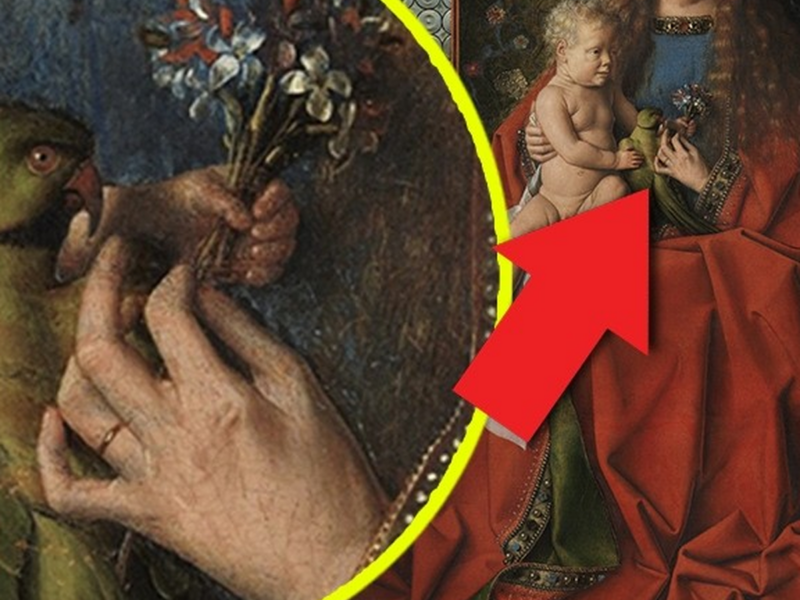
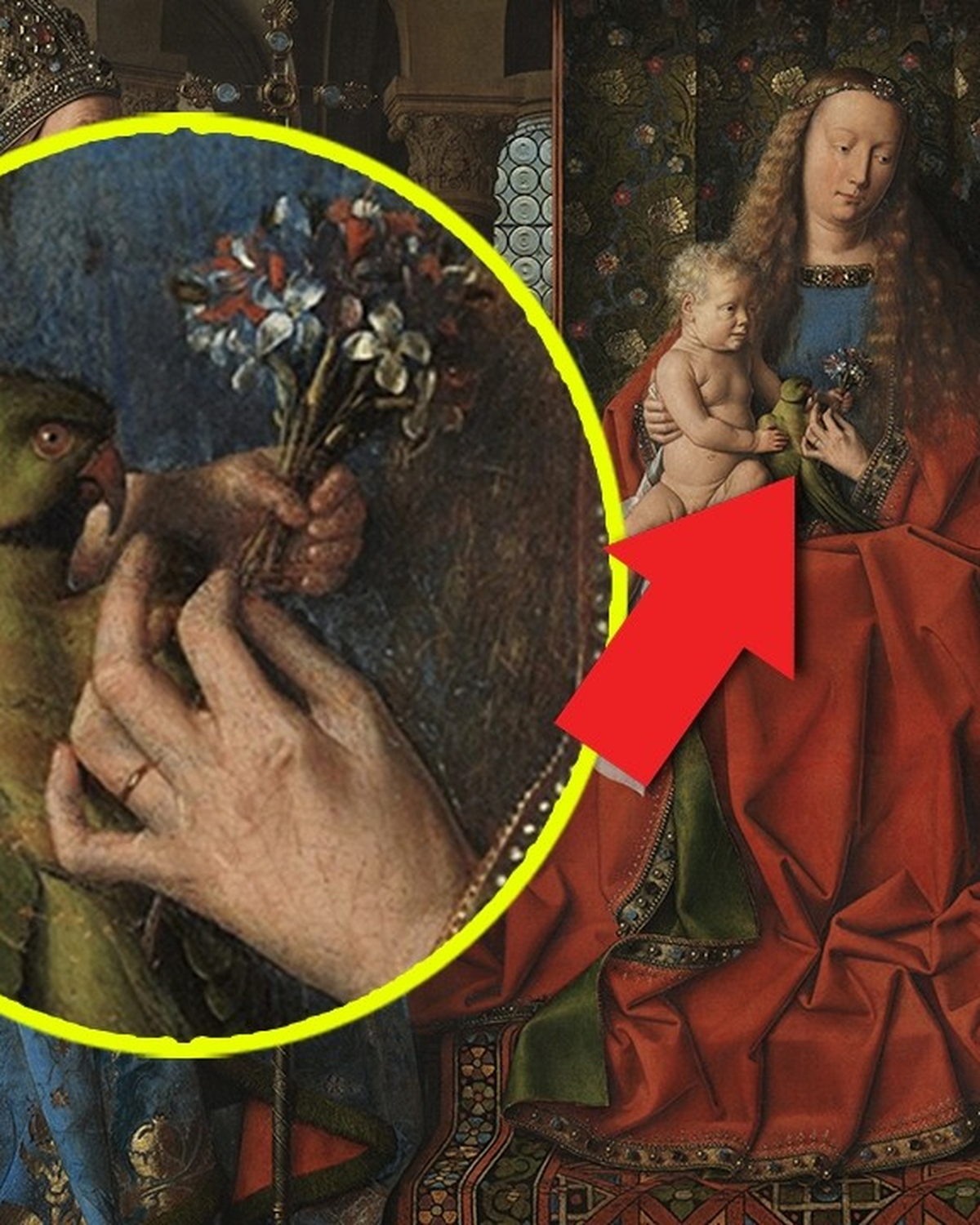
In the hand of the Christ child, we see a small bouquet of flowers. Its presence is no accident. Flowers were associated with the virtues of Mary: her purity, chastity and immaculate nature.
In his other hand is a detail that seems completely unexpected at first glance: a parrot. Its bright plumage and exotic look immediately draw the eye in a European painting of that period.
It did not arrive here simply for decoration. In Christian tradition, the parrot was linked to the Virgin Mary, and its ability to speak human words gave the image an added layer of meaning.
Scholars do not all read it the same way, and some see the bird as a mark of the exotic luxury of Bruges as much as a theological sign. The two readings are not mutually exclusive.
On the ends of the armrests, in Gothic niches, we see Adam and Eve, a reminder of the Fall that will be redeemed through the sacrifice of the Savior.
Above, to the right of the Virgin, Cain kills Abel, a foreshadowing of Christ’s sacrificial death. On the other side, Samson tears open the jaws of a lion, a prefiguration of Christ’s victory over death.
In the theology of the time, these two scenes could be read together as a statement that sin entered the world through an act of violence, and that only faith in God could overcome it.
But how was Van Eyck able to paint all of this 600 years ago? Studies of the painting show that his astonishing realism was not the product of a single secret technique.
Instead, the artist relied on a complex combination of methods, above all the careful layering of oil paint. The paint went on in thin, translucent layers, one over another.
One layer built the foundation of the form, the next altered its color and depth, and later layers gradually brought the surface to the desired state. The result is a surface that begins to resemble real material.
Today, we can examine the painting almost layer by layer, identify the composition of its pigments and trace the artist’s working process. Yet the result does not become any less mysterious.
We understand the principle, but we are still amazed at how masterfully Van Eyck controlled it. And perhaps this is where it becomes clearest why he is considered one of the great geniuses in the history of painting.
He did not merely master the technologies available to him. He pushed them to a level of perfection that continues to astonish viewers six centuries later.









