Once You See It, You’ll Never Unsee It!
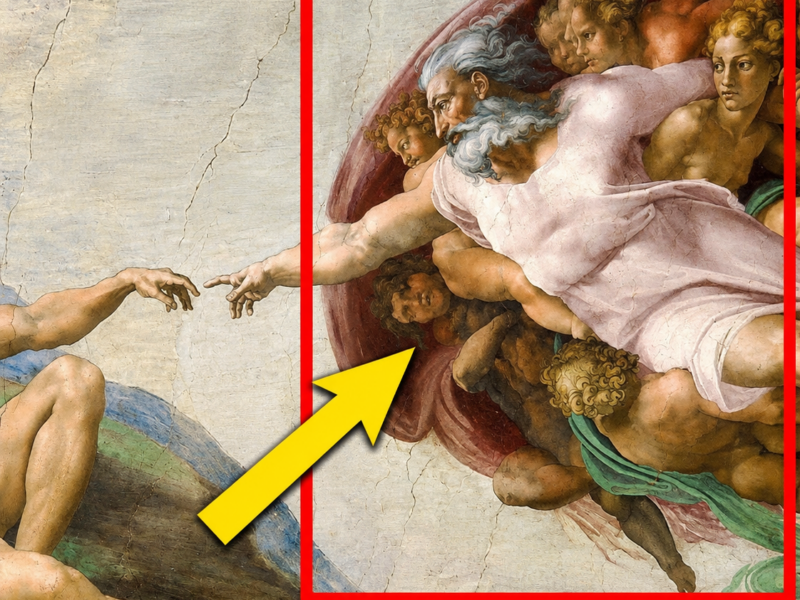
You already know the hands. God’s arm is out straight, his finger rigid with effort. Adam barely lifts a finger, his wrist gone completely floppy as if he can’t quite be bothered.
And then there’s that famous little gap in between, which measures just 1.9 centimeters, by the way. Your eyes go straight to those fingers. It makes sense. You’ve seen the image ripped off for the E.T. poster, it inspired Nokia’s classic “Connecting People” intro, and it has been parodied everywhere from The Simpsons to Bruce Almighty.
We are practically hardwired to focus on that spot, and that’s the problem. For five centuries, the whole world stared at those fingers while ignoring the massive, bizarre shape surrounding God. People studied this ceiling their entire lives and saw nothing.
It took until 1990 for an American doctor to look up at that shape and realize Michelangelo may have been hiding something huge in plain sight. But none of it makes sense unless we start in Florence in 1492, in a room full of dead bodies.
Behind the church of Santo Spirito stood a hospital, and attached to it was a mortuary where the bodies of the poor were kept until somebody got around to burying them. The prior, a monk named Niccolò Bichiellini, gave a seventeen-year-old Michelangelo a room, a supply of candles, and permission to cut those bodies open. That was very much not the done thing.
The Church tolerated dissection grudgingly, mostly on executed criminals, and ordinary people found it revolting. So it happened at night, and it went on for years. Vasari, who knew the artist, says he flayed a great many bodies in that room.
In other words, Michelangelo was teaching himself what a person is made of half a century before anyone printed a decent anatomy book. He repaid Bichiellini with a wooden crucifix that still hangs there today. And near the end of his life, he burned his drawings, piles of them, so nobody would ever see how much work it had cost him.
Whatever he worked out in that mortuary, he made sure it stayed inside one skull. Remember the mortuary.
Sixteen years later, in Rome, Pope Julius II told him to go paint a ceiling. Michelangelo didn’t want to. He was a sculptor, and he said so constantly, signing his letters “Michelangelo, sculptor” for four solid years.
Then he made it worse for himself by talking the pope into letting him paint the whole of Genesis. That meant three hundred figures across five hundred square meters, with one man on a scaffold, head cranked back, one arm above him, and paint running into his eyes. He never lay on his back, by the way. That part is a myth.
Around the autumn of 1511, he painted the panel you know. It measures three meters by six, and it hangs above the room where cardinals are still locked in to elect popes. Adam sits on the left, finished and flawless, draped over a green slope as if he pays rent on it.
Look at his eyes, because everything hangs on them. He is fully awake, propped on one elbow, looking straight back. He is alive in every way but one, and the whole painting is an argument about which one.
On the right is God, and nobody had painted God like this before. He is an old man in a thin shift, barefoot, packed in with a crowd of angels who don’t have any wings. And then comes the gap.
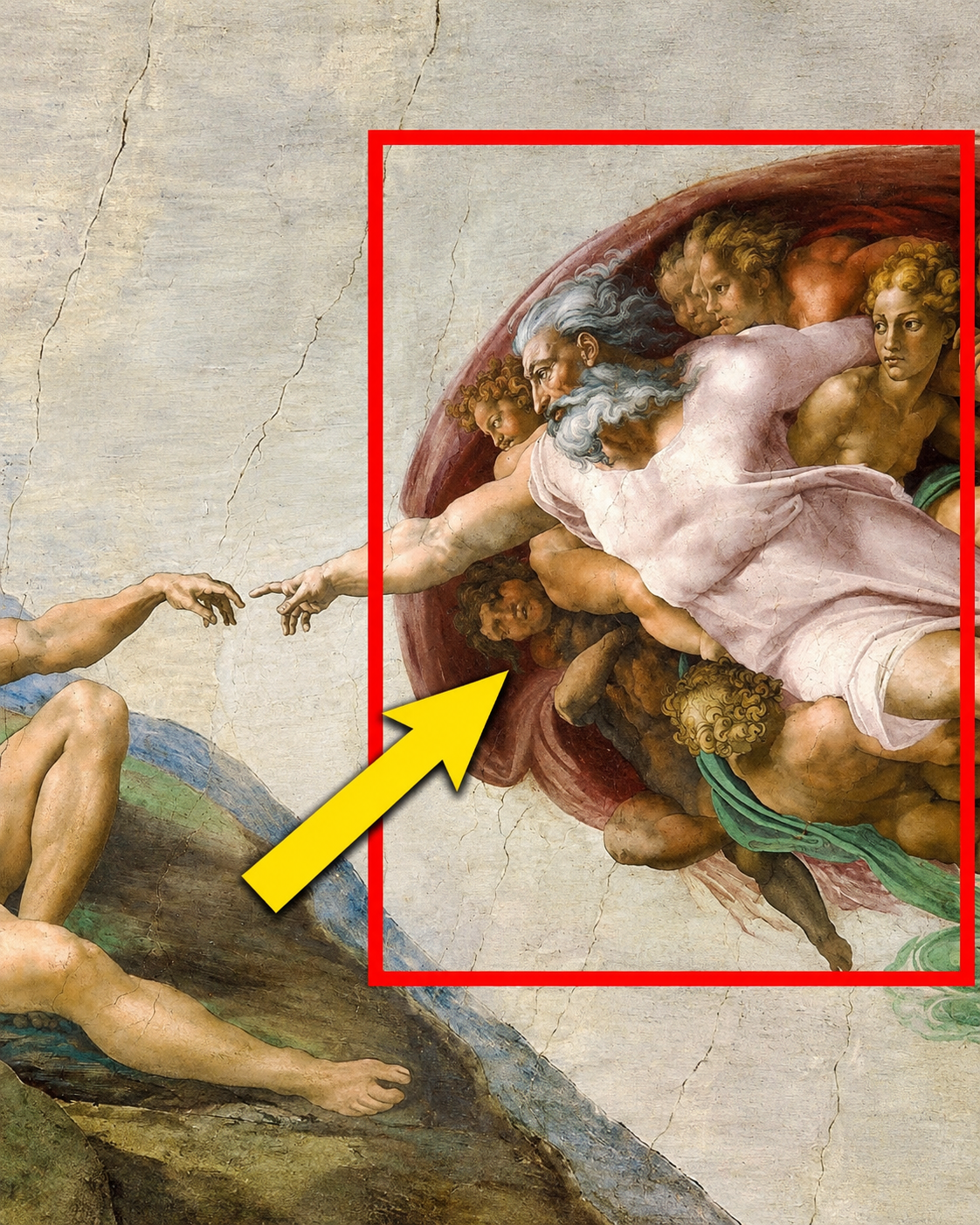
But the fingers were never the strange part. Everything on the right-hand side of the painting is traveling inside something, and that something is the oddest object on the entire ceiling.
The guidebooks call it a cloak. Try looking at it as a cloak and it falls apart in your hands. It doesn’t stream out behind him the way fabric does at speed. It seals the group into one closed shape, swollen, ridged along the top, and flat underneath, with a green sash spilling out the bottom and coiling back on itself.
It sits twenty meters up, and it spent four centuries under candle soot. The restoration that began in 1980 lifted the soot and brought the color back. Which is roughly when a man in Indiana went to check something he had been carrying around since medical school.
His name was Frank Lynn Meshberger. In the early 1970s, he was a medical student, and one evening after a full day in the neuroanatomy lab, he opened a book about Michelangelo to a foldout of the Creation of Adam. He recognized it instantly. It was the same thing he had been staring at all day.
Then he did what most of us would do and assumed it was old news. Surely somebody had noticed, perhaps someone in an art department years ago, in a footnote. So he shut the book, qualified as a doctor, and spent years delivering babies in Anderson, Indiana.
It was 1988 before it properly dawned on him that nobody had ever said it. So he checked. He laid a transparency of the fresco over a plate from a standard anatomy atlas and matched them up point by point.
On October 10, 1990, his findings ran in the Journal of the American Medical Association, with the fresco on the cover. His claim was that the shape carrying God across the sky is a brain. Not a vague resemblance, he argued, but a precise sagittal section of the skull and brain cut straight down the middle, the one image every first-year medical student has to have absolutely nailed.
Once you accept that, he said, the painting starts giving things up one at a time. According to Meshberger, a major brain fold called the sulcus cinguli extends exactly along the hip of the angel in front of God, across God’s shoulders, and right over Eve’s forehead. The back of the angel extending sideways below God is the pons, and the angel’s hip and leg represent the spinal cord.
The green sash spilling out the bottom, he argued, is the vertebral artery, which really does climb toward the brain in that same irregular coil. The dangling leg is the pituitary gland, hanging off its stalk. Even the human visual pathway, he said, is mapped out on another angel’s flexed leg.
So what is crossing the gap? Go back to Adam’s eyes. He is already alive. Genesis has God forming him from the dust and breathing into him before any of this happens.
Meshberger believed the painting had been given the wrong title all along, and that it should be called the Endowment of Adam. What crosses that gap, in his reading, isn’t life. Adam already has life. It’s the mind.
The art world didn’t take this lying down. One Renaissance specialist told The New York Times that God is a good deal more than a flying brain. An ophthalmologist pointed out that if you stare at anything long enough, you’ll find whatever you’re looking for.
Both objections are fair. A brain is exactly the sort of shape human beings hallucinate. We see faces in plug sockets and saints in burnt toast.
Except the idea didn’t go away. In 2010, a neurosurgeon and a medical illustrator at Johns Hopkins published findings on a different panel, the one directly above the altar. What had been nagging them was God’s throat.
It is lumpy and awkward, and the beard curls around the jaw in a way that doesn’t work, which is strange coming from a painter who plainly knew how to paint a neck. Trace those lumps, they said, and you get a precise view of the human brainstem seen from below.
They showed it to other neurosurgeons without saying what they were looking for. The neurosurgeons got there on their own.
If they’re right, it’s more than a depiction of the first breath of life. Michelangelo was capturing the moment God gave mankind its “intellect.”









