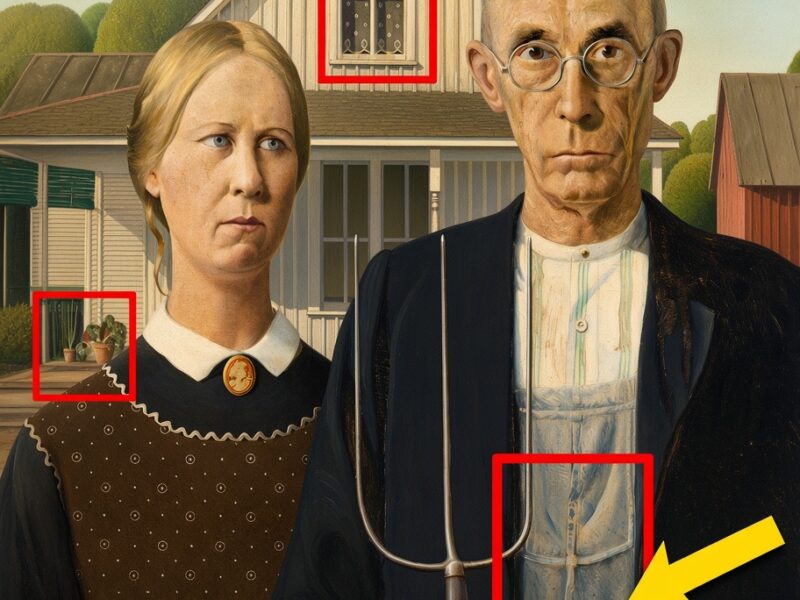
Not Husband and Wife: The Secret Hiding in American Gothic
It is arguably the most recognized, parodied and thoroughly misunderstood painting in American art history. You have seen these two figures countless times, standing rigid and grim beneath the sharp prongs of a pitchfork and a pointed, church-like window. They are etched into the culture as the ultimate symbol of rural, pioneering resilience.
Yet for nearly a century, most of the public has been looking at this canvas through a distorted lens, assuming something about its subjects that is simply false. There is an unsettling secret hidden in plain sight in Grant Wood’s 1930 painting. Once you notice it, the accepted story collapses and the relationship between the two figures changes completely.
To see it, look past the pitchfork, ignore the endless pop-culture parodies and strip away decades of collective misreading.
At first glance, the painting offers a stark, almost claustrophobic vision of rural life. The figures stand stiffly in modest, severely outdated clothing. Wood said he wanted to paint them as if they were tintypes from an old family album, capturing the awkward rigidity of early photography.
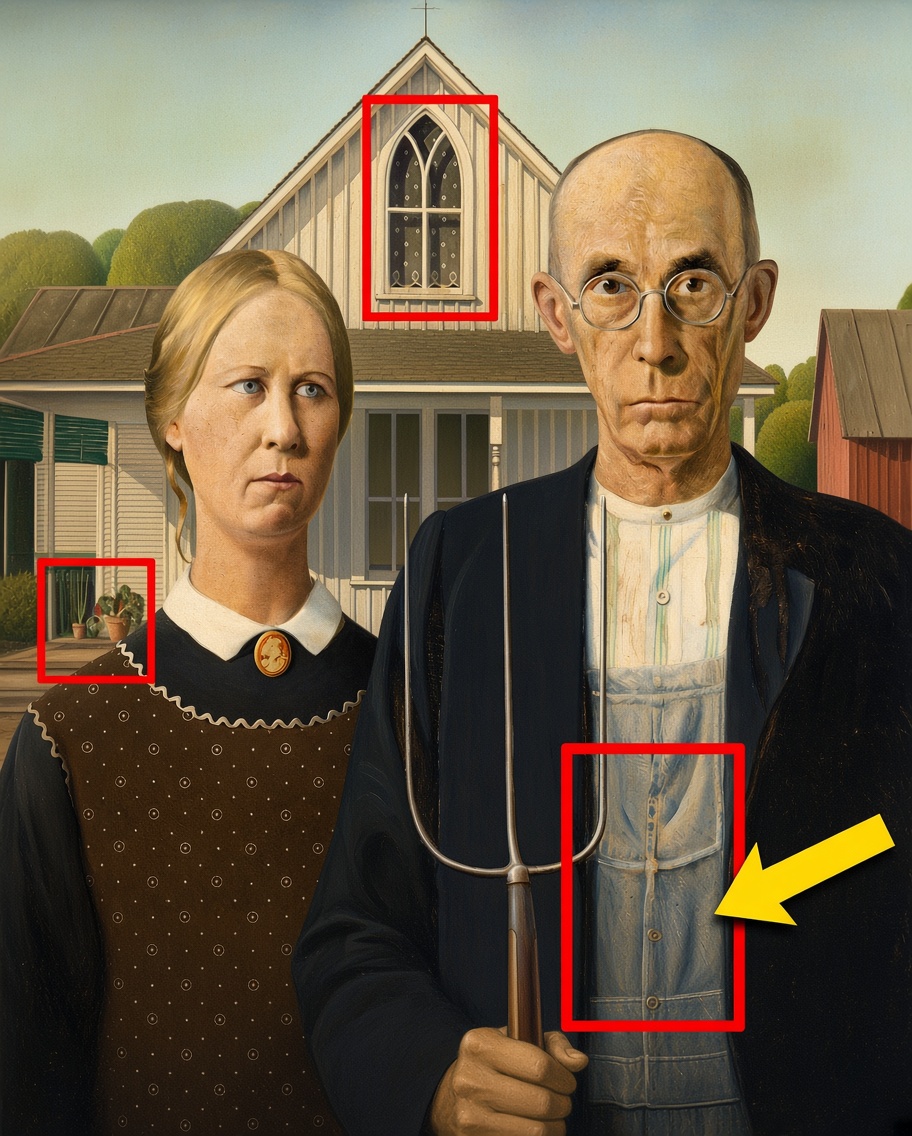
They stand defensively in front of a modest farmhouse in Eldon, Iowa, with one strikingly oversized feature. That style of 1880s domestic architecture is known as Carpenter Gothic, and it is this window, not the dour people in front of it, that gives the painting its famous title.
The window hints at a touch of vanity or aspiration. It is expensive craftsmanship, a sign that these are not entirely uncultured people and that they wanted to show good taste despite their weathered, agricultural look.
When the image first appeared in the Cedar Rapids Gazette, the local reaction was hostile. Iowans were furious. Many believed Wood was mounting a cruel, satirical attack on them, portraying Midwesterners as pinched, grim-faced, puritanical Bible-thumpers out of step with a modernizing world. To them, the painting was an ironic jab at the conformity of a cultural backwater.
Then the Great Depression tightened its grip, and the mood shifted. Hungry for symbols of stability and strength, audiences began reading the very same canvas as a sincere tribute to the tough, steadfast pioneer spirit. Critics of the first view still call it a fair reading of the era’s mockery. Defenders of the second say the nation simply saw what it needed to see.
Wood appears to have cultivated that ambiguity himself. He drew heavily on the visual language of the Northern Renaissance, borrowing the meticulous, slightly uncanny style of fifteenth-century Flemish artists such as Jan van Eyck. The extreme precision of the brushwork works like a mirror, forcing viewers to project their own prejudices onto the canvas.
The composition adds to the pressure. The two figures do not stand shoulder to shoulder on equal footing. The man is placed slightly forward, his bulk and elbow overlapping her space, which quietly reinforces a rigid hierarchy.
The light across their faces is harsh and direct, casting deep shadows with nowhere to hide. It mimics the unforgiving realities of the age.
The real people behind the characters add another layer of unease. The man with the hard stare and the pitchfork was not a hardened farmer at all. He was Wood’s own family dentist, Dr. Byron McKeeby. The woman beside him was the artist’s sister, Nan Wood Graham.
Wood asked Nan to trim her apron with rickrack, a zigzag braid long out of fashion. The shops no longer stocked it, so she unpicked some from a set of old dresses. At her collar she wore a cameo brooch, and on the porch behind her Wood placed two potted plants, a snake plant and a begonia.
Wood did not do small details by accident. In the early sketches, the pitchfork was a rake. In the finished picture, its three prongs echo in the stitching of the overalls and in the shape of the window. He had studied the fifteenth-century Flemish masters in Munich, which is where that eerie stillness comes from.
He also did not paint his sister as she really looked. He weakened her jawline, elongated her neck and altered her proportions, making her appear older, plainer and far more drab than she was. The severe, matronly result deeply upset her. She was fiercely embarrassed, and she spent years hurt by how the public saw her face.
The guilt reportedly haunted Wood. He later painted a more flattering, traditional portrait of his sister to make amends and present her with more dignity.
But why change her so drastically, and what is she actually thinking? Look closely at her face and posture. She does not look at the viewer. Her eyes slide sideways, with a complicated expression anchored by heavily furrowed brows. She seems neither happy nor serene.
In that era, farm life was punishing, with little upward mobility or freedom for women, who were often bound to relentless domestic labor from dawn to dusk as little more than family servants. Yet a small rebellion is painted into her otherwise pristine, rigid facade. A single loose lock of hair escapes from her tightly pulled bun.
That stray curl may stand for a quiet, suppressed wish to break free of the suffocating routine of farm life. Skeptics may see it as nothing more than a loose hair on a long working day.
The two figures were never posed side by side. Wood painted each separately, and they were not photographed together until after he had died.
Which brings us to the core misunderstanding that has defined the painting for generations. Almost from its debut, the public, the critics and later the endless parodies, from television sitcoms to Hollywood films, cemented the pair as husband and wife. The default assumption was a bizarrely mismatched marriage: an older, balding man and his far younger spouse.
Audiences accepted it readily because culture had long normalized the image of older men marrying women half their age. Nan hated that assumption so much that she began telling people the truth about Wood’s original vision. The artist himself often stayed playfully vague, keeping the mystery alive.
The truth of American Gothic, the detail that changes the whole psychological landscape, is that they are not a married couple at all. They are a father and his spinster daughter.
Once that single fact is corrected, the story shifts in an instant. The daughter may be a Dust Bowl widow, left behind because the young bachelors fled to the cities for industrial work. Or she may simply be the unmarried child, forced to sacrifice her independence to stay and care for an aging parent in his dotage.
The pitchfork gripped in the man’s fist is no longer just a tool of the harvest. It becomes a formidable psychological barrier. One reading sees a protective father’s stern warning to any suitor to keep away. The other sees oppressive, rigid control, keeping his daughter tethered to the homestead.
Either way, the grim tension on her face, the furrowed brows and that one desperate, escaping lock of hair suddenly make sense. It is not the portrait of a steadfast pioneer marriage. It is a quiet, chilling study of generational confinement.









