“No Insurance, No Door” — Until One Man’s Kidney Stone Forced a Hospital to Change Forever
**Part 1**
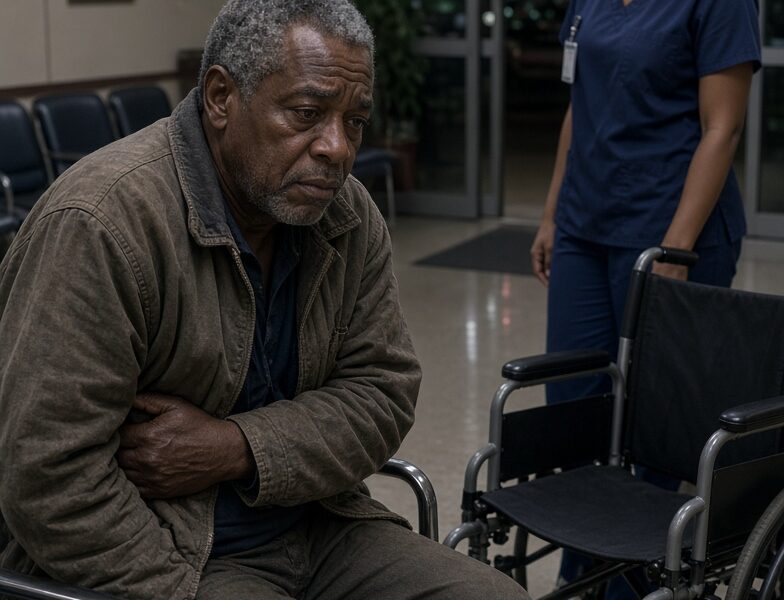
The automatic doors slid open at 11:47 p.m. and let in a man who looked like he’d been chewed up and spit out by the city bus system. Leon Pratt was sixty-one years old, his skin the color of strong coffee with too much cream, and he was holding his right side like it owed him money. The ER lobby of Detroit Avenue Medical Center smelled like antiseptic and broken promises.
He made it three steps past the threshold before the security guard, a mountain of a man named Kyle with a neck wider than most people’s thighs, stepped into his path. “Hold up, chief. You got insurance?”
Leon snorted, the sound wet and painful. “Insurance card. Don’t have it.” He cleared his throat, tasting copper. “Medicaid, Medicare.”
Kyle didn’t blink. “Not for two more years.”
“Then it’s 200 upfront.”
“I’ve got 40.” Leon’s voice cracked on the number, the way a man’s voice cracks when he’s trying to hold onto dignity that’s already slipped through his fingers.
“It’s 200, sir.”
“It’s my side.” Leon gestured vaguely at his torso, where a pain like a hot poker had taken up residence since last night. “Since last night, I threw up twice on the bus. Just have somebody look at it.”
Kyle shook his head, a practiced motion that probably came with the job description. “I can’t do that.”
A woman behind the reception desk, her name tag reading T. HOLLOWAY, didn’t look up from her computer screen. “Name?”
“Leon Pratt.”
“Date of birth?”
“March 4th, 63.”
“Phone number.”
“What for?”
“If nobody sees me—”
“For the call back list. Someone calls you back.”
Leon laughed, but there was no humor in it. “When?”
“Okay, sir. Let’s go.” Kyle reached for Leon’s elbow, his grip firm but not cruel. Just doing his job. Just following the rules.
“I’m not making trouble.”
“Didn’t say you were.”
“Son, I can barely stand.”
Kyle’s expression flickered, something human passing behind his eyes before the professionalism slammed back down. “Urgent care on Detroit Avenue opens at 8.”
“It’s midnight.”
“Not my rule. No insurance, no door.”
Leon looked at the automatic doors behind him, the ones that had welcomed him into a building designed to heal, and felt something inside him curdle. “Sir, look at me. Where’s the pain?”
“Right side, back, then front.”
“Did you hit your head?”
“Just my pride.”
A woman in scrubs appeared from the double doors leading to the treatment area. Dr. Imani Carter was thirty-four years old, her first night as charge nurse, and she had the kind of eyes that saw everything and forgot nothing. She took in the scene—the guard, the old man, the receptionist who wouldn’t make eye contact—and made a decision that would cost her everything and give her everything.
“Imana, he self-pay. No deposit. Get me a wheelchair.”
Kyle’s jaw tightened. “It’s Whitfield’s rule. I walk them out or I’m the one walking.”
“Kyle, a chair.”
“He’s going to ask me about this.”
“Tell them federal law says different.”
“Says what?”
Imani’s voice was steel wrapped in honey. “You walk into an ER, you get seen. The bill comes after.”
Kyle disappeared and returned with a wheelchair. Leon sank into it like a man who’d been standing on broken glass for years. “Pain 1 to 10.”
“Nine. 10 when I breathe.”
“Any blood when you pee?”
“Little pink this morning.”
“Ever had a kidney stone?”
“My brother did. Said it was worse than his hernia.”
Imani almost smiled. “Your brother’s right.”
The examination room was small and beige, the kind of space designed to be forgotten. Dr. Green, a thin man with tired eyes and steady hands, ran the ultrasound wand over Leon’s flank. “There. That bright spot, that’s your stone.”
“How big?”
“Hard to tell on this. Your kidneys backing up a little. I want a CT to measure it. Small, it passes. Big, you see urology.” He paused, making notes on a clipboard. “Tory back. Fluids. Something for the nausea. CT’s ordered.”
A technician appeared with a portable X-ray machine. “You’ll need that. I run hot. Hold still.”
Leon held still, staring at the ceiling tiles, counting the water stains. He’d been in this hospital before—September 19th, to be exact—but that visit had ended differently. That visit had ended with him standing on a sidewalk holding an envelope that said the charity fund had paid for his care. Care he never received.
“That sign out front,” Leon said, his voice rough.
Imani was checking his blood pressure. “$200.”
“Admin put it up in February.”
“And you walked me right past it.”
“I didn’t read the sign. I read your blood pressure. 160 over 95.”
“That bad? That’s the pain talking. It’ll come down.”
Imani handed him a plastic cup. “Every time you pee, you pee through this.”
“Through it?”
“Through it. I want to see that stone.”
Leon looked at the cup, then at her. “You want to see it?”
“If it’s big, the lab tells us what it’s made of. And I’m nosy.”
A nurse came in with a syringe. “Medicine’s going in. 10 minutes. You’ll like me better.”
“I like you fine now.”
Imani smiled, and for a moment, the exhaustion lifted from her face. “You’re fine. Tonight’s call backs—month end. Good.”
“Seven. Everyone with a date of birth.”
“Everyone.”
The nurse—her name tag said D. RODRIGUEZ—nodded. “The claim goes out at 6. I’m not retyping birthdays at 5:30.”
Leon watched the medicine flow into his IV, feeling the pain begin to recede like a tide going out. “Mr. Whitaker, does anybody actually call them back?”
“Someone will,” Imani said, but her voice was carefully neutral.
“Pratt, he’s in Bay 6.”
Kyle appeared in the doorway. “Kyle had him outside. Immani Carter went and got him.”
“Carter, her first night is charge.”
“Should I cross him off?”
A voice from the hallway—male, authoritative, the kind of voice that expected obedience—answered. “He got in, didn’t he? Then he’s on the list, too.”
The man who entered the room was tall, silver-haired, wearing a suit that cost more than Leon’s monthly Social Security check. Arthur Whitfield was the hospital administrator, and he looked at Leon the way a man looks at a line item on a spreadsheet. “Got this in the mail. Says the fund paid for me.”
Whitfield’s expression didn’t change. “Your charity care has been used for this year, Mr. Freeman.”
Leon blinked. “Used on what?”
“A visit on September 19th.”
“Ma’am, I never—”
“Without coverage. It’s the 200 deposit.” Whitfield turned to leave, then paused. “My foot’s been draining since Tuesday. I’m diabetic. Sir, I need you to step.”
Kyle appeared again, blocking the doorway. “Kyle, is that blood?”
“You self-pay?”
“That’s not what I asked.”
“Can you feel your toes?”
“Not since about 2019.”
“Then you don’t wait out here.”
Leon laughed, the sound hollow. “Funny thing, I came here last September with the same complaint. It was less serious then.”
“Who spoke with you?”
“No one. They stopped me at reception then.” He held up the envelope. “And what’s in the envelope?”
The fluorescent lights hummed. Somewhere down the hall, a monitor beeped in steady rhythm. “Three thousand dollars to stand on a sidewalk,” Leon said. “I’ve had worse deals.”
“Can I hold on to this?”
“Keep it. Only thing they ever gave me.”
Whitfield was already walking away, his shoes clicking against the linoleum like a metronome counting down to something. Imani caught up with him at the nurses’ station. “Self-pay. No deposit and a CT abdomen pending. He has a stone on ultrasound. I need the size.”
“Outpatient imaging can give him a size. Self-paced scans are on admin hold.”
“Since when?”
“Since the September budget. It was in the memo.” Whitfield didn’t look at her. “Mr. Pratt, you’ll be discharged at 7:00.”
Leon, who had been wheeled into the hallway, heard every word. “I haven’t passed it yet.”
“You can pass it at home. This is an emergency room, not a hotel.”
Imani’s hands were shaking. “Who canceled his CT?”
“It’s on hold.”
“His kidney’s backing up.”
“Then Dr. Green can put that in his note.” Whitfield finally turned to face her. “Who decides that?”
“I do.”
“Not the doctor.”
“The doctor decides medicine. I decide what this hospital can afford.”
“You the owner.”
“The owner’s a signature in Atlanta. He’s never once walked through that door. So, yes. Close enough.” Whitfield’s smile was thin and sharp. “Shame.”
“Not for me.”
“Mr. Whitfield, he’s at a 9. Is—”
“Miss Carter, see me at 3. Bring the night log.” He checked his watch. “3:00.”
“That bad?”
“It’s a meeting.”
“You didn’t answer me.”
“Drink your water. Pee in your cup.”
Leon snorted, the sound echoing in the empty hallway. A nurse appeared with a tray. “Antibiotics tonight. Wound clinic in the morning. You wait for the pharmacy. Opens at 8.”
“8.” Leon stared at the ceiling. “Mr. Freeman, September 19th. Who walked you out?”
“The big guard told me no insurance, no door, like it was printed on a shirt.”
“Did anybody write your name down first?”
“Lady at the desk. Name, birthday, phone said somebody had called.”
“Did they?”
“You’re the first one who asked me anything.” Leon’s voice was quiet. “They put you out on the sidewalk, then they build the fund for you.”
“Who’s they?”
“Get some rest, Mr. Freeman.”
But rest didn’t come. At 3:00 a.m., Imani Carter stood in Arthur Whitfield’s office, the night log in her hands like a shield. “Sit. Your predecessor signed these every night. The fund wants a clinical signature.”
“Why mine? You run the hospital.”
“You run the floor. If anyone ever has a question, they ask the person who was there. I don’t know these people.”
“You can’t see everyone.”
“I saw everyone who got past that desk tonight. Six of these didn’t.” She flipped open the log. “Leon Pratt. CT abdomen overnight observation. $5,600.”
“That’s correct.”
“You canceled that CT. I watched you.”
“We bill by the order, not the completion. The order exists.”
“The scan doesn’t.” Imani’s voice was rising. “Miss Carter, that fund keeps this ER open. Good numbers keep the lights on. Bad numbers, the board closes the department. Then nobody gets seen. You want that?”
“Otis Freeman, September 19th, $3,140. He never got past Kyle.” She slapped the log onto his desk. “Let’s talk about tonight instead. You brought a self-pay patient in against posted policy. Then another one—”
“Posted on a desk, not in federal law.”
“Sign the log and that’s a conversation. Don’t. And it’s a writeup.” Whitfield’s voice was ice. “I’m not signing for a scan that never happened.”
“Then you’re suspended. Effective now. Hand off your patients. HR opens at 8. Your badge is on my desk by then.”
“For not signing—”
“For insubordination, for admitting patients against policy. And the state board can decide what your license is worth after that. The fund will see these numbers.”
Imani stared at him. “That fund has never read past the totals.”
“8:00, Miss Carter.”
She turned and walked out, her footsteps steady, her heart pounding. In the lobby, she pulled out her phone and made a call. “Mr. Banks, it’s 3:30.”
A sleepy voice on the other end. “Freeze the charity care fund tonight. Not one claim gets paid.”
“What happened?”
“A man in a suit is billing the fund $5,600 for a scan I never got under the name on my hospital bracelet.” She paused. “I can lock payments within the hour. The board’s harder. Earliest I can put anyone in that building is 8.”
“8. Then the ER lobby.”
“Should I call their HR legal?”
“No. If he hears my name before 8, that paper goes in a shredder.” A pause. “Are you all right?”
“Still got the stone. A nurse just got suspended for not signing his paper.”
“Bring Harold. I need my sweater back.”
The line went dead. Imani looked at her phone, then at the automatic doors, then at the clock. Four hours until 8:00 a.m. Four hours until everything changed.
—
**Part 2**
Leon Pratt sat in the waiting area, his discharge papers crumpled in his fist, watching the clock crawl toward dawn. The pain was back, a dull throb that promised to become a scream. He’d passed the stone at 5:00 a.m., a tiny, jagged thing that looked like a piece of gravel from a driveway. He’d caught it in the plastic cup, stared at it, and felt nothing but exhaustion.
“Shift over,” a nurse said, walking past.
“Something like that.”
“Nothing yet.”
“Twice. Nothing.” The nurse—young, tired, her scrubs covered in cartoon cats—paused. “You’re not going home?”
“First bus is 5:30 and I have to be back here at 8.”
“What’s at 8?”
“Paperwork.”
“You always lie this bad?”
Leon almost smiled. “Only off the chair.”
“Why’d you come out and get me?”
“You were on the favorite.”
“A lot of people walked past.”
“A lot of people aren’t nurses. Drink.” She handed him a cup of water. “Nurse, visitor, whichever you are.”
“There it is. 4 mm maybe.”
“Felt like a brick.”
“They always do.”
“Thank you, Miss Carter.”
“I’m onie. I’m off the clock. University staff.”
“HR will call you.”
“They have my number.”
At 7:00 a.m., Kyle appeared. “Mr. Pratt, you were discharged at 7.”
“I’m waiting on a ride. Wait outside.”
“It’s 38°.”
“Kyle, walk him out.”
“You know the rule. Say it with me. No insurance, no door.”
“He’s discharged, sir. He’s just sitting.”
“Then he can sit on the curb.”
“Fine up.” Leon stood, his joints protesting. “I’ll go. One question first.”
“This is my hospital. I don’t take questions in the lobby.”
“Did Leon—did Leon Pratt get his CT?”
“I only ask because somebody billed for it.”
“Who are you?”
The voice came from behind them—female, sharp, carrying the weight of authority. “Dr. Sims. Nobody told me the board was coming in. If this is about the quarterly, uh, Leonard, you look terrible.”
Leon turned. The man standing there was in his seventies, wearing a sweater that had seen better decades, his eyes kind and tired. “Kidney stone. Passed it at 5 in that jacket. Long night.”
“Harold. You know this man?”
A woman in a tailored suit stepped forward. “Vanessa Cole, Mr. Banks’s attorney. Mr. Whitaker, this is Leonard Banks. He owns this hospital.”
“Mr. Banks lives in Atlanta.”
“I flew in Wednesday.” Leonard Banks looked around the lobby like a man seeing it for the first time. “Every year I put money in your charity fund. Your report says nobody got turned away this year. Not one person. I wanted to see that door for myself. I saw it from the sidewalk.”
Whitfield’s composure cracked, just for a moment. “Mr. Banks, I’m glad you’re here because your problem is standing right there. Miss Carter admitted uninsured patients against posted policy all night. I suspended her at 3.”
“That sign breaks federal law.” Imani’s voice was steady. “Anyone who walks into an ER gets screened. Insurance or not.”
“That’s a compliance question, not a crime.”
“Mr. Freeman, tell them where you were on September 19th.”
Otis Freeman, who had been sitting quietly in the corner, stood up. “Out there on that sidewalk. He walked me out.” He pointed at Kyle. “Then the mail says the fund paid $3,140 for my visit. What visit?”
“Did you walk him out?”
“Yes, ma’am.”
“Mr. Whitfield’s rule. He told us to say it just like that.”
“I write the names down. Name, birthday, phone. Every morning, the list goes up to his office.”
“For call backs.”
“That’s standard. Every claim carries a charge nurse’s signature.”
“Not mine. That’s clinical.”
“Not last night’s. I didn’t sign it.”
“Then who did?”
“It reached the fund at 6:02. Payment was already frozen.”
Vanessa Cole pulled a document from her briefcase. “Read the bottom line, Mr. Whitfield, out loud.”
Whitfield’s face was pale. “Acting for charge nurse B. Whitfield.”
“You can’t prove one of those people didn’t get care. Patients leave, charts go missing. It’s an ER at night.”
“I can prove one.” Imani stepped forward. “Line seven. Leon Pratt. My mother called me Leon. Pratt was her name before she married. I ordered that CT.”
“It never ran.”
“And you billed my own fund. $5,600 for it.”
“As of 3:30 this morning, the fund is frozen. Two years of claims go to an outside audit and to the county prosecutor.”
“This is a business. You think that fund keeps the lights on by itself? I kept this place open while you sat in Atlanta.”
“Your bonus is tied to margin, Mr. Whitfield. Two years of it came out of this fund.”
“Last night I asked you who decides. I do.”
“You’re finished here. Effective now.”
“The board agrees.”
“Kyle—”
“DON’T TOUCH ME.” Whitfield’s voice cracked. “Kyle, her badge.”
“You could hear—”
“Mr. Freeman. I remembered you last night. I remembered in September too. I walked you out anyway. I’m sorry.”
“You want my badge?”
“Not yet.”
“How many names on that call back list since February?”
“200 and some.”
“Kyle—you told every one of them no insurance, no door. Now you call them. Tell them to come back in.”
“I asked him once if anybody ever called them back. He said someone will.”
“Someone will.”
“Miss Holloway, you’re on leave until the audit is done.”
“I know.”
“Your suspension’s void. So’s the write up. Nothing goes to the state board.”
“Just like that. The man who wrote it is on the sidewalk.”
“Mr. Freeman, the September claim is canceled. The fund is paying for your foot. The real care this time. Wound clinic every visit.”
“And the insulin—that’s what eats me. And the insulin.”
“You could have told me you own the place. I’d ask for the good chair.”
“There’s a good chair.”
“Not out here. There isn’t.”
“This ER needs a director of nursing. I’d like it to be you.”
“Yes, right here.”
“Can I ask one thing first?”
“Ask.”
“This. It’s your desk now.”
“Yes. You said you wanted to see it.”
“I’ve seen it.”
“Then it’s yours.”
“First patient under the new rules.”
“Then the new rules say you still need that CT.”
“Do I need a deposit?”
“Not at this desk.”
The automatic doors slid open again, and a young woman walked in, her hand wrapped in a bloody towel, three children trailing behind her like ducklings. “I don’t have insurance.”
“Didn’t ask. Come on in. Nurse sees you first. Paperwork later.”
“Hi. Let me see that hand.”
The lobby of Detroit Avenue Medical Center smelled like antiseptic and something else now—something that might have been hope. Leon Pratt sat in the good chair, the one behind the desk that said DIRECTOR OF NURSING, and watched Imani Carter bandage the young mother’s hand while her children played with a stack of intake forms.
“You know,” Leon said, “I never did get that CT.”
Imani looked up. “You passed the stone.”
“That I did.” He pulled the plastic cup from his jacket pocket, the stone still inside. “4 mm of pure misery.”
“Keep it. Proof you survived.”
“Proof of what?”
“Proof that you walked into an ER and got seen. Bill comes after.”
Leon looked at the stone, then at the lobby, then at the sign that had been taken down from the front entrance and was now leaning against the wall, face-first. “$200 upfront,” he read. “I’ve got 40.”
Imani smiled. “We’ll take it.”
“Mr. Pratt,” a nurse called from the triage desk. “Your follow-up appointment is scheduled for next Tuesday. Wound clinic. No deposit.”
“No deposit?”
“New rules.”
Leon leaned back in the chair, the leather creaking beneath him, and closed his eyes. Somewhere in the building, Arthur Whitfield was packing his office, his bonus evaporating like morning fog. Somewhere in Atlanta, Leonard Banks was on a plane, his lawyer beside him, a list of 200 names in his briefcase. And somewhere in the ER, a young mother was getting her hand stitched up while her children colored on intake forms, their laughter echoing off the walls.
The sign said $200 upfront. The law said something different. And for one night, in one hospital, on one street in Detroit, the law won.
—
**Part 3**
Three weeks later, the audit was in full swing. Vanessa Cole had set up a command center in the hospital’s conference room, her team of accountants and lawyers working through two years of claims like archaeologists excavating a tomb. The numbers were staggering. $2.3 million in fraudulent billing, all funneled through the charity care fund, all signed by Arthur Whitfield’s careful hand.
“The board wants a full report by Friday,” Vanessa told Leonard Banks, who had taken up residence in a suite at the Marriott downtown. “They’re cooperating fully.”
“Cooperating because they’re terrified.” Leonard stirred his coffee. “What about the patients?”
“Kyle’s been calling them. All 213 names on the list. So far, 147 have come back in. Wound care, insulin, follow-ups. The rest are scheduled for next week.”
“And the ones who didn’t make it onto the list?”
Vanessa’s expression flickered. “We don’t know how many there were. Whitfield’s records are incomplete.”
“Find them.”
“We’re trying. But without documentation—”
“Then find the documentation.” Leonard’s voice was quiet but firm. “That’s what I’m paying you for.”
In the ER, Imani Carter was learning the difference between running a floor and running a department. The director of nursing position came with a corner office, a budget, and a never-ending stream of problems. The latest was the CT scanner, which had been on “admin hold” for so long that the technician had forgotten how to operate it.
“It’s a software issue,” the tech explained. “The license expired in August.”
“Then renew it.”
“That requires admin approval.”
“I’m admin now.”
The tech blinked. “Oh. Right.”
By noon, the CT scanner was operational. By 1:00, Leon Pratt was lying on the table, watching the machine spin around him, feeling the same mix of dread and relief he’d felt three weeks ago. The stone was gone, but the damage remained—a kidney that was still backing up, a urinary tract that was still inflamed. Dr. Green studied the images with a frown.
“There’s scarring,” he said. “From the stone, probably. And from the delay in treatment.”
“Will it heal?”
“With time and monitoring. We’ll need to do another CT in three months.”
“Another one?”
“To make sure the scarring isn’t getting worse.”
Leon nodded slowly. “And the bill?”
“Covered. The fund’s been restructured. Preventive care, follow-ups, chronic conditions—it’s all covered now.”
“Who decided that?”
“Mr. Banks. And the new director of nursing.”
Leon smiled. “Imani.”
“She’s something else.”
“She is.”
That evening, Imani found Leon sitting in the lobby, the same lobby where he’d been turned away three weeks ago, watching the automatic doors open and close. “You’re still here?”
“Waiting on my ride.”
“At 7:00 at night?”
“Bus runs every hour.” He paused. “I like watching people come in. Seeing who gets past the desk.”
“And?”
“Everyone gets past. No insurance, no door—that sign’s gone.”
“Whitfield took it with him. Said it was his personal property.”
“Good riddance.”
Imani sat down next to him. “I wanted to thank you.”
“For what?”
“For coming in that night. For not giving up.”
“I almost did.” Leon’s voice was quiet. “When Kyle walked me out, I thought—this is it. This is what it feels like to be invisible. To be nothing.”
“You’re not nothing.”
“I know that now.” He gestured at the lobby, at the nurses, at the patients. “But that night, I didn’t. I felt like a ghost.”
“You’re not a ghost.”
“I know.” He smiled. “I’ve got the stone to prove it.”
They sat in silence for a while, watching the doors. A young man came in with a broken arm, his girlfriend holding his good hand. A grandmother came in with chest pain, her grandson translating. A veteran came in with a wound that hadn’t healed, his service dog at his side. Each one walked past the desk, each one got seen.
“Otis Freeman came back yesterday,” Imani said. “His foot’s healing. He’s going to keep it.”
“Good.”
“He asked about you.”
“What’d you tell him?”
“That you’re a pain in the ass.”
Leon laughed. “Accurate.”
“He also said—” Imani hesitated. “He said you’re the reason he came back. That seeing you stand up to Whitfield made him think maybe he wasn’t invisible either.”
“I didn’t stand up to anyone. You did.”
“I couldn’t have done it without you. Without that stone. Without that cup.”
Leon pulled the cup from his jacket pocket, the stone still inside. “You know what’s funny? I’ve been carrying this around for three weeks, and I still don’t know what to do with it.”
“Keep it.”
“For what?”
“For the next person who walks through those doors. When they think they’re invisible, you show them the stone. You tell them your story. You tell them they’re not alone.”
Leon looked at the stone—tiny, jagged, insignificant—and felt something shift inside him. “I can do that.”
“I know you can.”
The automatic doors slid open, and a young woman walked in, her face bruised, her eyes downcast. She hesitated at the threshold, looking at the reception desk, at the nurses, at the lobby full of strangers. She looked like she was going to turn around and walk back out.
Leon stood up. “Hey.”
She looked at him, startled.
“You okay?”
“I—I don’t have insurance.”
“Didn’t ask.” He gestured at the chair beside him. “Come on in. Nurse sees you first. Paperwork later.”
She sat down, and Leon sat beside her, and for a moment, they were just two people in a lobby, waiting to be seen. “My name’s Leon,” he said. “What’s yours?”
“Maria.”
“Nice to meet you, Maria. You want to see something?”
He pulled out the cup, the stone inside catching the fluorescent light. “That’s a kidney stone. 4 mm. I passed it three weeks ago, right here in this ER. Hurt like hell.”
Maria stared at the stone. “Why are you showing me this?”
“Because I want you to know—whatever you’re going through, whatever brought you here tonight, you’re not alone. You’re not invisible. You walk through those doors, you get seen. That’s the rule now.”
She looked at him, and something in her eyes changed—a flicker of hope, a crack in the wall she’d built around herself. “Thank you.”
“You’re welcome.”
Imani watched from the nurses’ station as Leon walked Maria to the triage desk, as the nurse took her information, as the doors to the treatment area swung open and swallowed them both. The sign was gone. The rule was changed. And somewhere in the building, a man in a suit was packing up his office, his bonus gone, his reputation in tatters, his future uncertain.
Arthur Whitfield walked out of the hospital at 8:00 p.m., a cardboard box in his arms, his security badge in his pocket. He paused at the automatic doors, looking back at the lobby he’d ruled for five years. The nurses ignored him. The patients ignored him. The only person who looked at him was Leon Pratt, sitting in the good chair, the stone in his hand.
“Mr. Whitfield.”
Whitfield stopped. “What?”
“I want to thank you.”
Whitfield’s face twisted. “Thank me?”
“For walking me out. For telling me no insurance, no door. For showing me what this place had become.” Leon’s voice was calm. “Without you, I never would’ve known what needed fixing.”
Whitfield stared at him, then at the lobby, then at the doors. “You’re welcome,” he said, and the words sounded like they cost him something. “I hope you choke on that stone.”
“I’ll try.”
Whitfield walked out into the night, the automatic doors closing behind him. Leon watched him go, then looked at the stone, then at the lobby full of people waiting to be seen.
“Next,” he said, and the doors opened again.
—
**Part 4**
The audit results were published in the Detroit Free Press three weeks later. The headline read: “Detroit Hospital Billed $2.3 Million to Charity Fund for Care Never Given.” The article detailed Arthur Whitfield’s scheme—how he’d billed the fund for phantom treatments, how he’d kept the money for himself, how he’d turned away patients who couldn’t pay while padding his own bonus with their suffering.
The board of directors held a press conference. Leonard Banks stood at the podium, his lawyer beside him, a list of 213 names in his hand. “These are the people we failed,” he said. “These are the people we turned away. Today, we’re turning the page.”
The hospital announced a new policy: no patient would be turned away for inability to pay. The emergency room would be open to everyone, regardless of insurance status. The charity care fund would be restructured, with independent oversight and public reporting.
Imani Carter was named permanent director of nursing. Leon Pratt was hired as a patient advocate, his job to walk the ER lobby and make sure no one slipped through the cracks. Otis Freeman became a volunteer, his foot healed, his diabetes managed, his smile a permanent fixture at the front desk.
Kyle—the security guard who had walked so many people out—was retrained. His new job was to welcome people in. He stood at the automatic doors, his arms open, his voice warm. “No insurance, no problem. Come on in. Nurse sees you first. Paperwork later.”
The sign that had said “$200 upfront” was replaced with a new one: “Everyone Welcome. Everyone Seen.”
Leon kept the old sign in his office, leaning against the wall, a reminder of what had been. He kept the stone in his pocket, pulling it out when he needed to make a point. He kept the cup on his desk, a trophy of sorts, a symbol of survival.
One year later, on the anniversary of the night he walked into the ER and almost got walked out, Leon stood in the lobby and watched the doors. A young man came in, his arm hanging at a strange angle, his face pale with pain. “I don’t have insurance.”
“Didn’t ask,” Leon said. “Come on in.”
The young man hesitated. “I can’t pay.”
“You don’t have to.”
“But—”
“Listen.” Leon pulled out the stone. “You see this? This is a kidney stone. 4 mm. I passed it in this ER a year ago. Before that, I was turned away. Told no insurance, no door. Told I wasn’t worth seeing.”
The young man stared at the stone. “What happened?”
“A nurse named Imani Carter came out and got me. A lawyer named Vanessa Cole froze the charity fund. An owner named Leonard Banks flew in from Atlanta and fired the man who turned me away.” Leon smiled. “And now I’m here, telling you that you’re worth seeing. That you matter. That you’re not invisible.”
The young man’s eyes were wet. “Thank you.”
“You’re welcome. Now go get that arm looked at.”
The young man walked through the doors, and Leon watched him go, and the lobby was full of people—Black, white, brown, young, old, insured, uninsured—all of them waiting to be seen. The automatic doors opened and closed, opened and closed, a rhythm like a heartbeat.
Imani appeared beside him. “You’re still here?”
“Waiting on my ride.”
“At 10:00 at night?”
“Bus runs every hour.”
She laughed. “You know, you could just take an Uber.”
“And miss all this?”
They stood together, watching the doors, watching the people, watching the hospital that had almost broken them both and then, somehow, had put them back together.
“You know what I think about?” Imani said.
“What?”
“That night. When Whitfield suspended me, I thought my career was over. I thought I’d never work in healthcare again. I thought—”
“You thought you’d failed.”
“I thought I’d failed.”
“But you didn’t.”
“I know that now.” She looked at him. “You know what else I think about?”
“What?”
“The 213 names on that list. The people we turned away. The people who never came back because they thought they weren’t worth it.”
“We found most of them.”
“Most. Not all.”
“There’s always going to be more.”
“I know.” She sighed. “That’s what keeps me up at night.”
“Then we keep looking. We keep calling. We keep opening those doors.”
Imani nodded. “We keep opening those doors.”
The automatic doors slid open again, and a family walked in—a mother, a father, three children, all of them looking tired and scared. The mother was holding her stomach, her face contorted with pain. “I need a doctor.”
“Come on in,” Leon said. “Nurse sees you first. Paperwork later.”
The family walked through the doors, and Leon watched them go, and the lobby was full of people, and the night was full of hope, and the stone in his pocket was warm against his thigh.
“Mr. Pratt,” a nurse called. “Your ride’s here.”
Leon looked at the doors one more time—the doors that had once been closed to him, the doors that were now open to everyone—and smiled. “I’ll be back tomorrow.”
“We know,” Imani said. “You’re always here.”
“Someone has to be.”
He walked out into the night, the stone in his pocket, the cup on his desk, the sign in his office, the memory of that night forever etched in his mind. And behind him, the automatic doors opened and closed, opened and closed, a heartbeat, a promise, a new rule.
No insurance, no door.
No more.
—
**Part 5**
The one-year anniversary of the audit came and went. The hospital was thriving—patient satisfaction scores at an all-time high, staff morale improved, the charity care fund fully funded and independently audited. Leonard Banks flew in from Atlanta for the celebration, his sweater a little brighter, his smile a little wider.
“You did good,” he told Imani. “Both of you.”
“We had help,” she said.
“From who?”
“From a man who walked into an ER with a kidney stone and a lot of nerve.”
Leonard laughed. “Where is Leon?”
“In the lobby. Where else?”
Leon was in his usual spot, the good chair, the stone in his pocket, watching the doors. A young woman came in, her face streaked with tears, her arm in a makeshift sling. “I don’t have insurance.”
“Didn’t ask,” Leon said. “Come on in.”
She sat down beside him, and he pulled out the stone, and he told her the story—the night he was turned away, the nurse who came out and got him, the lawyer who froze the fund, the owner who flew in from Atlanta, the sign that said $200 upfront and the law that said something different.
“So you see,” he said, “you’re not alone. You’re not invisible. You walk through those doors, you get seen. That’s the rule now.”
The young woman looked at the stone, then at Leon, then at the doors. “Thank you.”
“You’re welcome. Now go get that arm looked at.”
She walked through the doors, and Leon watched her go, and the lobby was full of people, and the night was full of hope, and the stone in his pocket was warm against his thigh.
Imani appeared beside him. “You tell that story every time, don’t you?”
“Every time.”
“Doesn’t it get old?”
“Never.” He looked at her. “You know why?”
“Why?”
“Because every time I tell it, I remember that night. I remember what it felt like to be turned away. I remember what it felt like to be seen. And I remember that there are still people out there who think they’re invisible. Who think they’re not worth it. Who think no insurance means no door.”
“And you want to change that.”
“I want to change that.”
Imani sat down beside him. “You know, when I first met you, I thought you were just another patient. Just another guy with a kidney stone and no insurance.”
“And now?”
“Now I think you’re the reason this hospital is still open. The reason I still have a job. The reason 213 people got their care.”
“I didn’t do anything.”
“You did everything. You walked into that ER. You stood your ground. You refused to be invisible.”
Leon looked at the stone, then at the lobby, then at the doors. “I was just trying to get seen.”
“And you did. You got seen. And now everyone gets seen.”
The automatic doors slid open again, and a man walked in—middle-aged, well-dressed, his face pale with pain. “I need a doctor.”
“Come on in,” Leon said. “Nurse sees you first. Paperwork later.”
The man hesitated. “I have insurance.”
“Doesn’t matter. Everyone gets seen.”
The man walked through the doors, and Leon watched him go, and the lobby was full of people—insured, uninsured, documented, undocumented, rich, poor—all of them waiting to be seen. The sign on the wall said “Everyone Welcome. Everyone Seen.” And for the first time in a long time, it was true.
Imani stood up. “I have to go. Board meeting.”
“At 10:00 at night?”
“Emergency session. Budget stuff.”
“Everything okay?”
“Everything’s fine. Just—” She paused. “Just making sure the fund stays funded. Making sure the doors stay open.”
“You do that.”
“I will.” She looked at him. “You coming back tomorrow?”
“I’m always here.”
“I know.” She smiled. “That’s what I count on.”
She walked away, and Leon watched her go, and the lobby was full of people, and the night was full of hope, and the stone in his pocket was warm against his thigh. He pulled it out, held it in his palm, felt the jagged edges press against his skin.
“You know what?” he said to no one in particular. “This little rock saved my life.”
A nurse walking past glanced at him. “What?”
“This rock. This kidney stone. It saved my life.”
“How?”
“Because it got me in the door. Because it made me stand up. Because it made me fight.”
The nurse smiled. “You’re weird, Mr. Pratt.”
“I know.” He put the stone back in his pocket. “But I’m here. And that’s what matters.”
The automatic doors slid open again, and a family walked in—a mother, a father, a child in a wheelchair. The child was pale, her eyes closed, her breathing shallow. The mother was crying. The father was holding her hand.
“Please,” the mother said. “Please help us.”
Leon stood up. “Come on in. Nurse sees you first. Paperwork later.”
The family walked through the doors, and Leon watched them go, and the lobby was full of people, and the night was full of hope, and the stone in his pocket was warm against his thigh.
“Next,” he said, and the doors opened again.
—
**Part 6**
Two years later, the hospital was unrecognizable. The ER had been expanded, the charity care fund had been doubled, and the sign that once said “$200 upfront” was now a museum piece in the lobby, a reminder of what had been and what would never be again. Leon Pratt was still there, still in the good chair, still telling his story, still pulling out the stone for anyone who needed to see it.
Imani Carter had been promoted to chief nursing officer. Vanessa Cole had been named to the hospital board. Otis Freeman had become a community health worker, his foot healed, his diabetes managed, his smile a permanent fixture at the front desk. Kyle had been retrained, his new job to welcome people in. And Arthur Whitfield—well, Arthur Whitfield was serving three years in federal prison for healthcare fraud.
“Mr. Pratt,” a young nurse said, approaching him. “There’s someone here to see you.”
Leon looked up. A young man stood in the lobby, his arm in a cast, his face familiar. “You’re the guy who came in with the broken arm.”
The young man smiled. “You’re the guy who told me I wasn’t invisible.”
“I remember.”
“I came back to thank you. I got my arm fixed, and then I got a job, and then I got insurance, and then I got my life back. And it’s all because of you.”
Leon shook his head. “It’s not because of me. It’s because of the nurse who came out and got me. The lawyer who froze the fund. The owner who flew in from Atlanta.”
“But you were the one who told me I mattered. You were the one who showed me the stone. You were the one who said, ‘You walk through those doors, you get seen.'”
Leon looked at the stone in his hand, then at the young man, then at the lobby. “I was just trying to get seen.”
“And you did. And now everyone gets seen.”
The young man walked away, and Leon watched him go, and the lobby was full of people, and the night was full of hope, and the stone in his pocket was warm against his thigh.
Imani appeared beside him. “You’re still here?”
“Waiting on my ride.”
“At 11:00 at night?”
“Bus runs every hour.”
She laughed. “You know, you could just retire.”
“And miss all this?”
They stood together, watching the doors, watching the people, watching the hospital that had almost broken them both and then, somehow, had put them back together.
“You know what I think about?” Imani said.
“What?”
“That night. When Whitfield suspended me, I thought my career was over. I thought I’d never work in healthcare again. I thought—”
“You thought you’d failed.”
“I thought I’d failed.”
“But you didn’t.”
“I know that now.” She looked at him. “You know what else I think about?”
“What?”
“The 213 names on that list. The people we turned away. The people who never came back because they thought they weren’t worth it.”
“We found most of them.”
“Most. Not all.”
“There’s always going to be more.”
“I know.” She sighed. “That’s what keeps me up at night.”
“Then we keep looking. We keep calling. We keep opening those doors.”
Imani nodded. “We keep opening those doors.”
The automatic doors slid open again, and a woman walked in—elderly, alone, her face pale with pain. “I don’t have insurance.”
“Didn’t ask,” Leon said. “Come on in. Nurse sees you first. Paperwork later.”
The woman walked through the doors, and Leon watched her go, and the lobby was full of people, and the night was full of hope, and the stone in his pocket was warm against his thigh.
“Mr. Pratt,” a nurse called. “Your ride’s here.”
Leon looked at the doors one more time—the doors that had once been closed to him, the doors that were now open to everyone—and smiled. “I’ll be back tomorrow.”
“We know,” Imani said. “You’re always here.”
“Someone has to be.”
He walked out into the night, the stone in his pocket, the cup on his desk, the sign in the lobby, the memory of that night forever etched in his mind. And behind him, the automatic doors opened and closed, opened and closed, a heartbeat, a promise, a new rule.
No insurance, no door.
No more.
The stone was small, jagged, insignificant—4 mm of calcium and misery. But it had saved a life. It had changed a hospital. It had rewritten a rule. And somewhere, in a lobby in Detroit, a man sat in a good chair and told a story to anyone who would listen.
“You walk through those doors, you get seen. Bill comes after. That’s the rule now.”
And the doors opened, and the people came in, and the night was full of hope.
—
**Part 7**
The third year brought changes. Leonard Banks sold the hospital to a nonprofit healthcare system, ensuring that the charity care fund would be protected in perpetuity. Imani Carter became the system’s regional director of nursing, overseeing five hospitals across Michigan. Leon Pratt was named to the hospital board, his patient advocate role expanded to include community outreach. And the stone—the 4 mm kidney stone that had started it all—was placed in a small glass case in the lobby, a plaque beneath it reading: “This stone changed everything.”
Leon still came to the lobby every day, even though he was technically retired. He sat in the good chair, watched the doors, and told his story to anyone who would listen. “You see that stone?” he’d say, pointing at the case. “That’s my stone. I passed it right here in this ER. Before that, I was turned away. Told no insurance, no door. Told I wasn’t worth seeing.”
“And now?” someone would ask.
“And now everyone gets seen.”
The hospital had become a model for the nation—a place where no one was turned away, where the charity care fund was fully funded, where the sign on the wall said “Everyone Welcome. Everyone Seen.” Politicians came to tour the facility. Journalists came to write about the transformation. And Leon Pratt, the old Black man who had once been walked out of the ER, became a minor celebrity.
“You’re famous,” Imani told him one day.
“I’m not famous. I’m just stubborn.”
“Same thing.”
They were sitting in the lobby, watching the doors, watching the people. A young mother came in with a sick child, her face drawn with worry. A veteran came in with a wound that hadn’t healed, his service dog at his side. A teenager came in with a broken wrist, his skateboard under his arm. Each one walked past the desk. Each one got seen.
“You know what I think about?” Leon said.
“What?”
“That night. When Kyle walked me out, I thought—this is it. This is what it feels like to be invisible. To be nothing.”
“You’re not nothing.”
“I know that now. But that night, I didn’t. I felt like a ghost.”
“You’re not a ghost.”
“I know.” He smiled. “I’ve got the stone to prove it.”
Imani looked at the glass case, at the stone inside. “You know, when I first met you, I thought you were just another patient. Just another guy with a kidney stone and no insurance.”
“And now?”
“Now I think you’re the reason this hospital is still open. The reason I still have a job. The reason 213 people got their care.”
“I didn’t do anything.”
“You did everything. You walked into that ER. You stood your ground. You refused to be invisible.”
Leon looked at the stone, then at the lobby, then at the doors. “I was just trying to get seen.”
“And you did. You got seen. And now everyone gets seen.”
The automatic doors slid open again, and a man walked in—middle-aged, well-dressed, his face pale with pain. “I need a doctor.”
“Come on in,” Leon said. “Nurse sees you first. Paperwork later.”
The man hesitated. “I have insurance.”
“Doesn’t matter. Everyone gets seen.”
The man walked through the doors, and Leon watched him go, and the lobby was full of people—insured, uninsured, documented, undocumented, rich, poor—all of them waiting to be seen. The sign on the wall said “Everyone Welcome. Everyone Seen.” And for the first time in a long time, it was true.
Imani stood up. “I have to go. Board meeting.”
“At 10:00 at night?”
“Emergency session. Budget stuff.”
“Everything okay?”
“Everything’s fine. Just—” She paused. “Just making sure the fund stays funded. Making sure the doors stay open.”
“You do that.”
“I will.” She looked at him. “You coming back tomorrow?”
“I’m always here.”
“I know.” She smiled. “That’s what I count on.”
She walked away, and Leon watched her go, and the lobby was full of people, and the night was full of hope, and the stone in the glass case was warm under the fluorescent lights. He pulled out his own stone—the one he kept in his pocket, the one he’d carried for three years—and held it in his palm.
“You know what?” he said to no one in particular. “This little rock saved my life.”
A nurse walking past glanced at him. “What?”
“This rock. This kidney stone. It saved my life.”
“How?”
“Because it got me in the door. Because it made me stand up. Because it made me fight.”
The nurse smiled. “You’re weird, Mr. Pratt.”
“I know.” He put the stone back in his pocket. “But I’m here. And that’s what matters.”
The automatic doors slid open again, and a family walked in—a mother, a father, a child in a wheelchair. The child was pale, her eyes closed, her breathing shallow. The mother was crying. The father was holding her hand.
“Please,” the mother said. “Please help us.”
Leon stood up. “Come on in. Nurse sees you first. Paperwork later.”
The family walked through the doors, and Leon watched them go, and the lobby was full of people, and the night was full of hope, and the stone in his pocket was warm against his thigh.
“Next,” he said, and the doors opened again.
And the story continued—not just Leon’s story, but the story of everyone who walked through those doors, everyone who was seen, everyone who was treated, everyone who was healed. The story of a hospital that had once turned people away and now welcomed them in. The story of a sign that had once said “$200 upfront” and now said “Everyone Welcome. Everyone Seen.” The story of a stone that had changed everything.
And somewhere, in a lobby in Detroit, an old Black man sat in a good chair and told that story to anyone who would listen. “You walk through those doors, you get seen. Bill comes after. That’s the rule now.”
And the doors opened, and the people came in, and the night was full of hope.
And the stone—the 4 mm kidney stone that had started it all—sat in its glass case, a monument to survival, a testament to the power of one person who refused to be invisible.
**THE END**









