
Nine Clubs in Six Years: What Really Went Wrong With James Rodríguez After the World Cup That Made Him the Most Wanted Player on Earth
At 22, he was the most desired footballer on the planet.
Every giant in Europe wanted him, and the world could not stop watching one volley.
Now, a little over a decade later, his career is summed up by a number that sounds like a punchline.
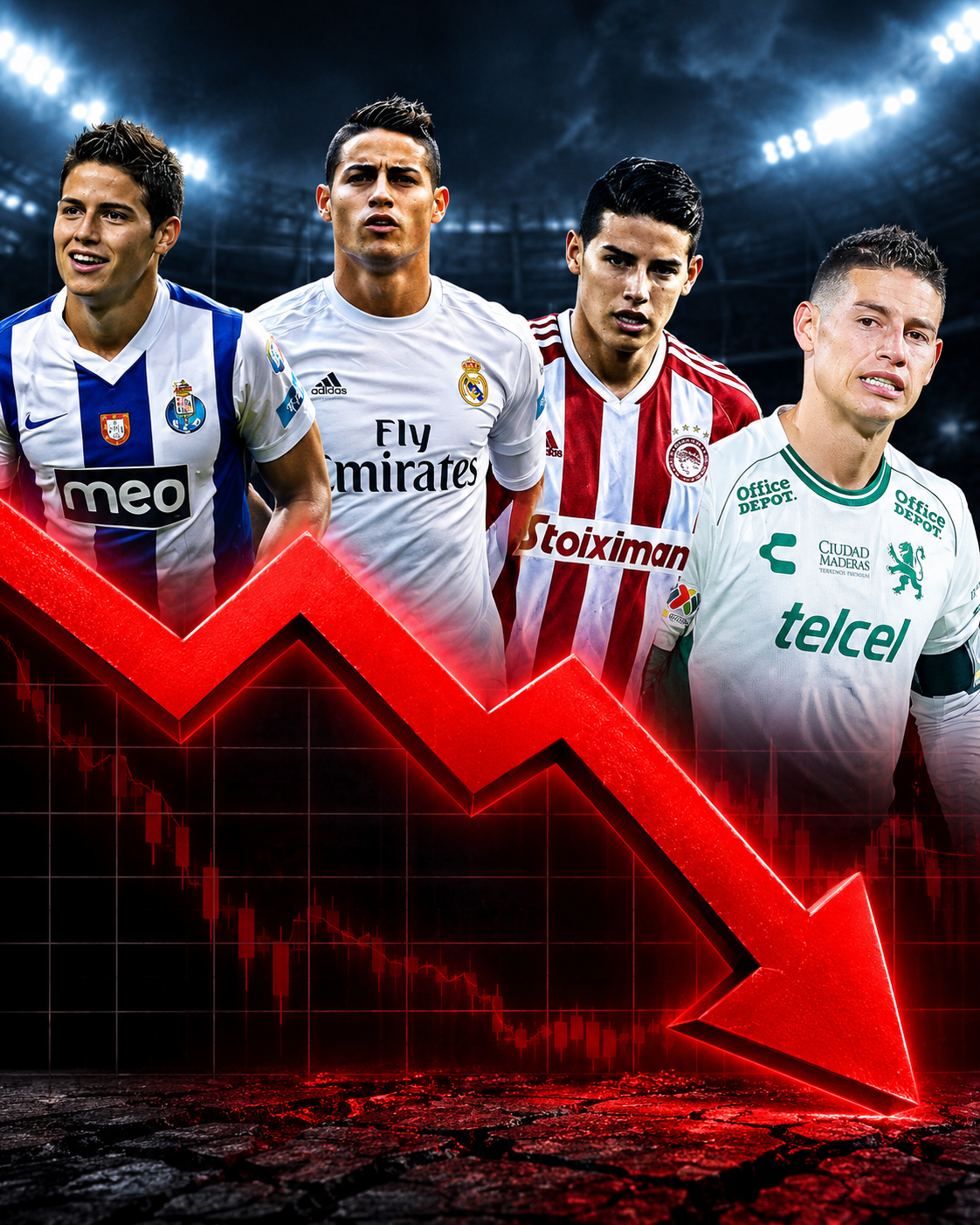
Nine clubs in six years.
How does a player go from the center of the football universe to a wandering name on contract termination lists?
The answer is more complicated than talent, and a lot more human.
A Farewell That Raises a Bigger Question
On September 15, James Rodríguez announced his retirement from the Colombian national team.
He leaves as the country’s second all-time leading scorer, with 31 goals in 131 matches.
That is a remarkable legacy by any standard.
But it also leaves a question hanging in the air.
What really happened with his club career?
To understand the fall, one analyst argued, you first have to understand the meteoric rise.
From Envigado to Banfield: A Prodigy Takes Shape
James started in the youth academy at Envigado.
It is the same club that produced players like Quintero, Giovanni Moreno and Freddy Guarín.
Even then, the profile of the player he would become was easy to see.
He had remarkable vision, polished technique, and a mid-range strike that would define his entire career.
At just 17, he moved to Banfield in the Argentine league.
There, he became the best foreign player in the league.
At 17.
That is something very difficult for any player to achieve, let alone a Colombian teenager.
He finished with 10 goals and seven assists.
And every major club in Europe began paying attention.
Porto: Where He Won Everything
The club that landed him was Porto, in 2010.
There he found fellow Colombians Radamel Falcao and Freddy Guarín.
Together, they won everything.
Leagues.
Cups.
Even an undefeated Europa League title.
Across three seasons, James collected 32 goals and 42 assists in more than 7,200 minutes.
Those numbers show a level of consistency that is hard to ignore, especially when you remember how young he was.
He was 19.
He played almost every game, he was rarely injured, and he scored and assisted constantly.
At the same time, he was already building his career with Colombia, first with the U-20 team.
His teammates there included Santiago Arias, Pedro Franco, Edwin Cardona and Luis Muriel.
Many of them would later share a locker room with him again in the senior squad.
At 19, he was already fundamental for Porto and for his country’s youth team.
Monaco and the First Warning Sign
In 2013, every club wanted him.
The one that won the race was Monaco, in what was then a record-breaking deal for a Colombian player.
The French club was trying to compete with Paris Saint-Germain.
But curiously, this is where the problems began.
The first was Claudio Ranieri.
The Italian coach had a very defensive idea of the game, and he did not give James much consistency.
Ranieri said publicly that James was a great player but had a mentality problem.
In his view, James thought only as an attacker, when he also needed to defend.
As a result, James was not a regular starter.
He often came on in the second half.
The analyst was candid about why.
James attacks beautifully when the ball is at his feet.
But when it comes to defending, he contributes very little.
And that, he said, was a story that would follow James for years.
Brazil 2014: The Tournament That Changed Everything
Then came the World Cup.
Colombia arrived in Brazil without its biggest star, Falcao, who had been injured.
Many people assumed the team would not match the level it had shown in qualifying.
Instead, Colombia had the best World Cup in its history.
And James became the face of the tournament.
He scored almost everything he touched and set up goals as well.
Six goals and two assists.
The Golden Boot.
And that volley against Uruguay, a goal that sits among the best in World Cup history.
Overnight, he went from being a substitute at Monaco to the most wanted player on the planet.
His next destination was Real Madrid.
Ancelotti: The Coach Who Unlocked Him
What followed at Madrid revealed a pattern that would repeat for years.
Under Carlo Ancelotti, James exploded.
The Italian gave him minutes, confidence and a leading role.
James responded by becoming a key piece of the team in his first season.
But Ancelotti left in 2015.
And James began to lose consistency, first under Rafa Benítez and then under Zinedine Zidane.
Zidane, the analyst noted, preferred a number five over a number 10.
He moved from wanting a playmaker like James to wanting a destroyer like Casemiro.
That change worked.
Madrid went on to win three Champions League titles.
But James ended up on the bench, with scattered minutes and a role as a substitute.
The First-Sub Complaint and an Internal War
Things got tense.
James once said publicly that he was always the first substitute.
The comment reportedly bothered Zidane a great deal.
An internal war began.
Reporters kept asking about James, and he preferred to ignore them or tell them to ask about other players.
It had become more than a sporting matter.
It had become personal.
Still, the numbers show he did not do badly.
Across his time at Madrid, he finished with 37 goals and 42 assists in around 8,000 minutes.
The problem was not the totals.
It was the trajectory.
He went from more to less.
Bayern Munich and the Stationary Bike Standoff
That is when he was loaned to Bayern Munich.
His first season was not bad.
He was reunited with Ancelotti, who spoke Spanish and guided him closely.
But then Niko Kovač arrived, and the relationship fell apart.
This is a key part of the story, because it comes from James himself in his Netflix documentary.
He said Kovač liked a training style he did not, which basically involved riding stationary bikes.
James told the coach he was not competing in the Tour de France.
He was a footballer.
The analyst’s reaction was simple.
At the end of the day, the coach is the one in charge.
James fought with him and began to lose the consistency he had shown early at Bayern.
The Pattern Behind the Fall
Look at the first half of his career, and a pattern emerges.
When a coach trusts James, he performs at the highest level.
When he disagrees with the coach, his minutes shrink.
His performances dip.
And he gets pulled into controversies.
The analyst said this is something we would see throughout the rest of his career.
Up to Bayern, he added, James was still doing reasonably well.
He was playing and producing decent numbers.
What came next is the part Colombian fans remember with frustration.
Everton: Ancelotti Again, Same Result
In 2020, James arrived at Everton, once again reunited with Ancelotti.
Once again, the formula worked.
He had a promising start in the Premier League.
But when Ancelotti left the following year, James was left adrift.
He finished that single season with six goals and eight assists.
He never reached that level in England again.
From there, his career turned into a series of stops in different countries.
It made him, in the analyst’s words, a globetrotter.
Qatar, Greece, Brazil and a Spanish Return That Went Nowhere
His next stop was Al-Rayyan in Qatar.
According to the analyst, some of his teammates there were not even professional footballers but police officers.
That season, James had physical problems and scored only five goals.
The club ended his contract by mutual agreement.
Then came Olympiacos in Greece, another incomplete season.
That one also ended with a contract termination, in April 2023.
After that, he went to Brazil.
There, he managed just two goals in almost 1,000 minutes, and according to the press he left through the back door.
Then he returned to Spain in 2024.
Many thought it would mark a comeback to a major league and the revival of a star.
It was far from that.
James did not score a single goal before his contract was terminated again.
Nine Clubs, One Repeating Script
The analyst described the script clearly.
He arrives with high expectations.
He might do something in his first few games.
Then he fades, struggles with physical problems, and runs into trouble with management.
Nine clubs in six years.
The analyst called it truly shameful.
He added that none of those clubs saw James leave as a star.
In his view, they paid more than they should have for a player who gave them practically nothing.
That is a harsh judgment, and it is his own.
But the statistics he cited at each stop give it some weight.
The Exception: Colombia
Here is the strangest part of the story.
While James bounced around the world, nothing changed for Colombia.
He remained the cornerstone of the national team.
The best proof came in the 2024 Copa América.
Colombia finished as runner-up, and James was named the best player of the tournament.
That put him ahead of figures like Lionel Messi.
For the national team, he finishes with 31 goals in 131 games.
He played in three World Cups, in 2014, 2018 and 2026.
And he was a key figure in the best result in the history of Colombian football.
Why It Worked for Country but Not for Clubs
So why the difference?
The analyst’s explanation is simple.
With Colombia, James was always the cornerstone.
Teams were built around him.
The whole squad played for James, and James made Colombia play better.
Clubs could not offer that.
They knew the national team would keep him in the spotlight for a long time, but a club could never be sure.
Especially for a player who had been at nine clubs in six years.
There is also the defensive question.
With Colombia, he said, James was specifically told not to defend.
Other clubs forced him to.
And that difference might explain a lot.
Talent Was Never the Problem
The conclusion the analyst reached is worth reading closely.
James never lacked talent.
What he lacked was consistency.
He had quite a few problems with coaches, and that cost him his rhythm.
It started with Ranieri at Monaco, who publicly questioned his defensive commitment.
Then at Madrid came Benítez and Zidane, who gave him far less prominence than Ancelotti had.
At Bayern, there was Kovač, with whom he even had a clash in the locker room.
James, the analyst noted, has acknowledged in his own documentary that he lacked a certain mentality to deal with adversity.
He never knew how to handle training sessions he did not like, or ideas a coach proposed that he did not agree with.
The idea might have been good or bad.
But the coach is the coach.
And in the analyst’s opinion, no player is bigger than the coach.
Or if there are any, there might be two in the world, and you probably know who they are.
James was not one of them.
The Question Fans Keep Asking
Is that the whole story?
The analyst himself was not sure.
He asked whether the coach clashes are the only reason James never worked out with clubs the way he did with Colombia.
There can be different points of view, he said, and this one is his.
Others will point to injuries.
Others will point to the pressure of becoming a global star at 22.
And some will simply say that football is a team game and James thrived best when the team was built for him.
What no one disputes is the contrast.
The same player who struggled to hold a place at club level was, for a decade and a half, the heart of his country.
A Career Measured in Two Different Languages
It may be that the answer is not one or the other.
Maybe James was both a gifted playmaker and a difficult fit for modern football.
A player who needed trust to shine, in an era when coaches demanded structure first.
Under Ancelotti, he flourished at Madrid, Bayern and Everton, at least at the start.
Under almost everyone else, he did not.
That pattern is hard to miss.
Even harder to miss is the volley against Uruguay.
Because when people look back at James Rodríguez, they will remember two things.
The summer of 2014, when the whole world fell in love with him.
And the question of what might have been if the world had kept loving him the same way.









