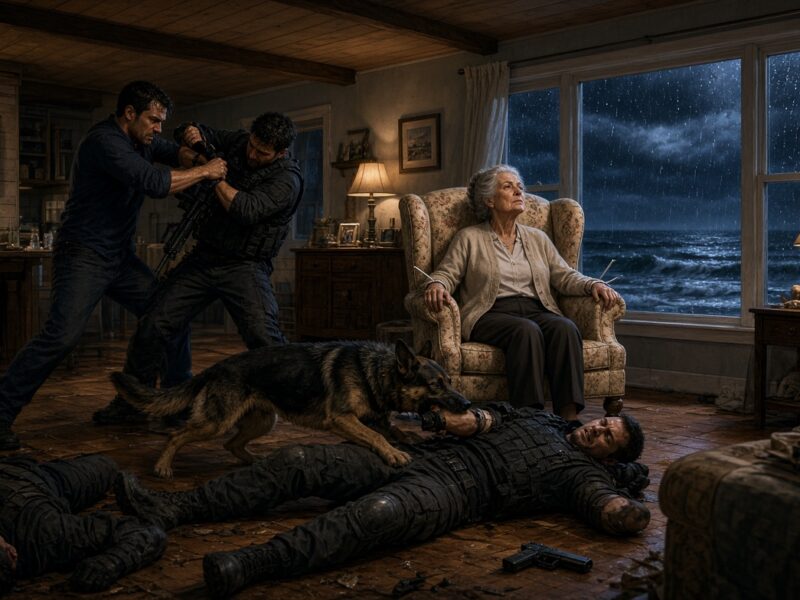
Navy SEAL and His Dog Rescue Bound Mother from Armed Intruders in Her Own Home
They Tied Up an Old Woman in Her Own Home… Until Her Navy SEAL Son and His Dog Walked In
They tied her to the chair in her own living room and they were laughing about it.
Four men in black balaclavas stood around Dolores—no, around Margaret—around a 71-year-old woman who still kept a vegetable garden and called her son every Sunday evening without fail.
They had zip-tied her wrists to the armrests of her floral wingback chair, the one she’d bought at an estate sale in Galveston 30 years ago.
The one she refused to re-upholster because the faded roses still reminded her of her late husband.
The largest of the four men pressed the barrel of a suppressed rifle against her collarbone like it was nothing, like she was nothing.
They thought she was alone.
They had no idea what was parked at the end of the long gravel road leading to her property, half hidden behind a stand of live oaks still dripping from the morning rain.
They had no idea who was watching.
The Gulf Coast of Texas in late November smells like salt and mud and something older than either.
The fog comes in off the water thick and low, swallowing the beach houses whole, erasing the horizon line until sky and sea become the same gray wall.
Cody had driven through that fog for six hours straight ever since he crossed back into the state from Naval Air Station Oceana in Virginia.
And he still wasn’t tired.
He didn’t get tired anymore, not the way regular people got tired.
Eight years of active duty service as a Navy SEAL had rewired something fundamental in him, replaced the part of his brain that recognized exhaustion with something quieter and colder and far more useful.
He was 34 years old, lean and wide-shouldered.
His jaw carried three days of dark stubble, and his green eyes had the particular stillness of a man who had spent long stretches of time being absolutely invisible in places that would kill most people in under an hour.
He was on leave—two weeks, the first real leave he’d taken in 11 months.
He was going home to surprise his mother.
In the passenger seat of his black pickup, a German Shepherd named Dagger sat with his snout pressed to the cracked window.
Dagger was four years old, 78 pounds of black-saddled muscle and engineered instinct.
He had been through six overseas deployments with Cody, had found IEDs buried in Afghan mountain passes, had tracked a kidnapped intelligence officer through three kilometers of Venezuelan jungle at midnight, and had once held a fleeing suspect pinned to the pavement for six full minutes without a single command renewal.
Dagger did not bark unnecessarily.
He did not fidget.
He watched the world the way Cody watched it, with a thoroughness that missed nothing.
The gravel road to Margaret’s property was a quarter mile off the main coastal highway, winding through a stand of wind-bent live oaks before opening into a flat lot with a white clapboard beach house at the center.
The house had a deep covered porch, pale blue shutters, and a weather vane shaped like a pelican that Margaret had bought on a trip to South Carolina years ago.
Cody pulled to a stop at the edge of the tree line.
He didn’t pull up to the house.
He never pulled straight up to anything.
Old habit, old survival.
He sat there for a moment with the engine idling.
Something was wrong.
He couldn’t have articulated it immediately.
The wrongness was ambient, the way a change in air pressure signals a storm hours before the clouds arrive.
His mother always left the porch light on if she was expecting him.
But the light was off.
Her old Buick sat in the side yard, which meant she was home.
The motion sensor light above the garage door, which activated if so much as a raccoon wandered into the driveway, was dark.
Someone had disconnected it.
Dagger made no sound, but the dog’s posture had changed.
The easy alertness of the drive was gone.
His body had gone dense and deliberate, ears swiveling, chin lowered.
Cody cut the engine.
He sat in the silence and listened to the fog.
There were vehicles he didn’t recognize parked in the scrub grass beside the road.
Two of them, dark-colored SUVs with no plates.
He’d missed them on the way in.
He hadn’t missed them now.
He reached under his seat and pulled out the .45 he kept in a magnetic holster clipped to the frame.
He checked the chamber.
He tucked the weapon into his waistband at the small of his back.
He had a folding blade on his belt.
He had Dagger.
He had 11 years of training that the United States government had spent an extraordinary amount of money building into his nervous system.
He stepped out of the truck without making a sound.
Dagger followed, touching down on the wet gravel as softly as a cat.
They moved through the live oaks parallel to the driveway, staying off the gravel, staying in the shadow of the tree line.
Cody scanned the exterior of the house in segments the way he’d been trained to scan a compound.
Porch, windows, roofline, side yard, back corner.
He spotted the first man at the rear corner of the house.
The man stood with his back against the clapboard siding, arms crossed, rifle hanging loose on a chest sling.
He was watching the scrub grass that led down to the beach.
He wasn’t watching the tree line.
Amateurs covered what they could see.
Professionals covered what they couldn’t.
Cody crouched and touched Dagger on the shoulder.
He held up two fingers, then made a slow downward gesture with his palm.
The dog melted flat into the wet grass, still as a stone.
Cody circled wide, keeping the corner of the house between himself and the standing guard.
He came at the man from his blind side, the angle of his approach precisely calculated to stay outside the man’s peripheral vision until the last three feet.
The man started to turn, some subconscious alarm finally firing.
But by then, Cody had one arm locked around his throat and his own body weight driving the man backward into the siding, muffled by the fog and the sound of the waves.
The man went down in 11 seconds.
Cody zip-tied him with the guard’s own restraints, one of the four that hung from the man’s utility vest, stripped the suppressed rifle from the chest sling, checked the magazine, and rose back into a crouch.
He signaled Dagger.
The dog came forward, pressed against his left leg.
They moved to the porch.
The side window of the living room was fogged with condensation, but the gap in the curtains was enough.
Cody pressed himself flat against the porch rail and looked.
He saw his mother immediately.
Margaret sat in the wingback chair with her spine rigidly straight, the way she always sat when she was frightened and trying not to show it.
Her wrists were bound.
Her silver hair was disheveled, a strand fallen across her cheek that she couldn’t brush away.
Her eyes were fixed on the middle distance, the practiced thousand-yard stare of a woman refusing to give her captors the satisfaction of watching her cry.
Cody counted.
Three men visible in the room.
One near the window he was looking through.
One standing directly behind the chair.
One pacing the far side of the room near the hallway entrance.
All three were armed.
Suppressed rifles, tactical vests.
This was not a robbery.
You didn’t kit up like that to rob a 71-year-old woman in a beach house on the Texas coast.
You kitted up like that when you were doing a job that needed to look like something else afterward.
A cold fury moved through Cody’s body like a current.
He contained it.
He had learned long ago that anger was a fuel source, not a steering mechanism.
You used it carefully or it steered you off a cliff.
Three inside, one down behind him.
He had not yet cleared the other SUV.
He pulled back from the window.
He signaled Dagger to stay at the porch corner and moved back through the yard to circle the second vehicle.
He found the fifth man crouched at the driver’s side door facing the beach road, monitor of some kind in his hand, a coordinator, earpiece, radio.
Five total, three inside with his mother.
Cody made his calculation in about two seconds.
He came at the coordinator from the rear of the vehicle, grabbed the man’s collar, drove his head into the door frame with controlled force, and eased him to the ground before he’d finished falling.
He stripped the radio and the earpiece.
He tucked the earpiece into his own ear.
Static, then a voice in patient Spanish.
“Gomes, give me a status check.”
Cody pressed the transmit button once and released it, the universal affirmative click, enough to satisfy for another few minutes.
He moved back to the house.
There is something that happens to a person who has done genuine violence in real conditions, the kind sanctioned by government and necessity and the weight of lives depending on correct decisions.
The body stops wasting resources on fear.
Fear becomes information instead of interference.
Cody felt the information clearly.
His mother was in that room.
She was alive.
The men holding her believed they had total control of their situation, and they were about to learn they had none.
He went through the side door of the kitchen.
The lock was a single deadbolt.
He defeated it in four seconds with the blade of his knife and a technique he’d learned in a SEAL course that he was technically not supposed to use on domestic doors.
The door swung inward without a sound.
The kitchen smelled like Margaret’s house always smelled—coffee and cedar and the faintest trace of whatever she’d cooked last.
In this case, cornbread, he thought.
The cast iron skillet was still sitting on the back burner.
He moved through the kitchen to the narrow pass-through that connected to the living room.
He pressed himself against the wall and did a slow lean to look around the edge.
The man near the window had drifted to the center of the room.
He was talking at Margaret, keeping his voice low and controlled, the patient intimidation of someone who has done this before.
The man behind the chair had one hand resting on Margaret’s shoulder, a casual and horrifying possession.
The third man was still near the hallway.
Cody needed the one behind the chair first.
If that man’s trigger finger twitched for any reason, the barrel of his rifle was less than two feet from his mother’s head.
He clicked his tongue once, the sound barely audible, the signal to Dagger, who had come in silently behind him through the kitchen door.
Then he pointed.
Dagger did not growl, did not bark.
The dog simply moved, a shadow detaching from the kitchen darkness and crossing the living room floor in absolute silence.
And by the time the man near the hallway registered peripheral movement, it was already too late.
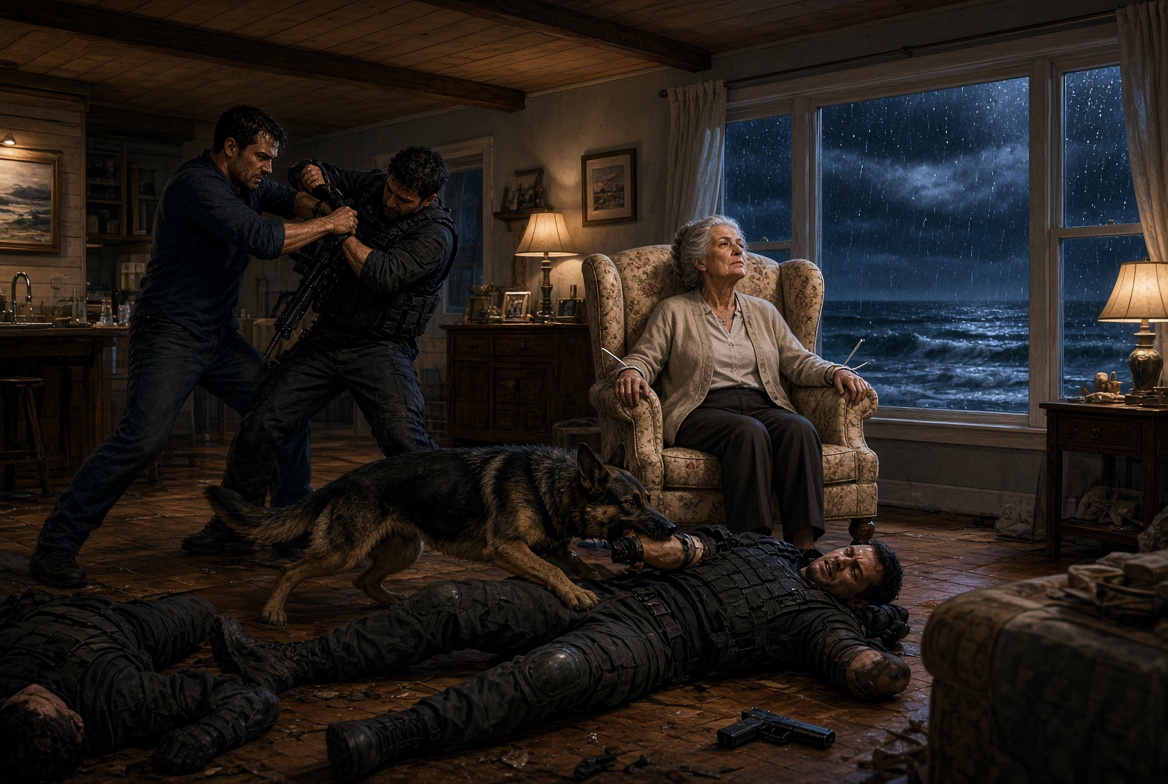
Dagger’s jaws had closed on his forearm, and the man was going down hard with the dog’s full weight driving him into the area rug.
In the same half second, Cody stepped into the room.
The man near the window spun toward the sound of the impact.
He brought his rifle up.
Cody closed the distance in three strides, grabbed the barrel of the weapon, twisted it away from his own body and toward the ceiling, and drove his elbow into the side of the man’s jaw.
The man dropped.
The third man, the one who had been standing behind the chair, was the problem.
He had stepped back from Margaret the instant the noise started, which put distance between him and her, which was good.
But he had his weapon raised and he had a clear line to Cody.
“Don’t,” the man said.
His voice was steady, professional.
Cody stopped.
The two of them were eight feet apart.
The man’s rifle was up.
Cody held the first man’s captured weapon down at his side.
No time to raise it to a useful angle.
Margaret sat in the chair between them, bound wrists, chin still up.
Nobody moved.
Then Margaret spoke.
“He doesn’t negotiate,” she said quietly.
“He never has. You should drop that gun before he takes it from you.”
It was the distraction Cody needed and also the most accurate thing anyone had ever said about him.
In the half second the man’s attention fractured toward Margaret’s voice, Cody moved.
He was inside the rifle’s effective range before the man could adjust.
He stripped the weapon at the grip, rotated the muzzle away from his body, and used the buttstock to deliver a controlled strike to the man’s temple.
The man sat down hard on the floor and did not get up.
Silence filled the beach house.
Dagger stood over the man near the hallway, his paws on the man’s chest, amber eyes glowing with cool attention.
The man was not moving.
Cody crossed the room to his mother.
He crouched in front of the chair.
He looked at her face, checking for injury methodically, the way he checked everything.
Forehead, eyes, jaw, neck.
His hands were already at the zip ties on her wrists, the blade of his knife working carefully, precisely, not wanting to nick her skin.
“Cody,” Margaret said.
Her voice was absolutely even, the voice of a woman who had decided several minutes ago that she was either going to survive this or she wasn’t, and either way, she was not going to let them see her fall apart.
“I’m here,” he said.
“Your leave started yesterday.”
“I drove straight through.”
The zip tie on her right wrist gave way, then the left.
She brought her arms forward slowly, rubbing the marks the plastic had left.
Her wrists were red and abraded, but not cut.
“Did you eat anything on the drive?” she asked.
“Mom.”
“You look thin.”
Something moved in Cody’s chest.
He pressed it flat.
Later.
“Can you stand?”
She stood on her own, declined his hand with a small wave, and took three steady steps away from the wingback chair, putting distance between herself and the thing it had just been for the last hour.
Then she turned and looked at the three men on the floor of her living room.
Then she looked at Dagger, who had not moved from his position over the man near the hallway.
“That’s a good dog,” she said.
Dagger’s tail made one slow wag and was still again.
Cody zip-tied all three men using the restraints from their own vests, wrists behind backs to the legs of the heavy oak dining table that had occupied the same corner of that living room for 40 years.
He did it quickly and without ceremony.
He checked outside through the window before moving to the next one.
Then he turned to his mother.
“Tell me who these men are.”
Margaret sat down at the kitchen table.
She folded her hands in front of her the way she did when she was about to say something she’d been holding for a while.
“You know about the development project,” she said.
Cody leaned against the counter.
“The resort development. You mentioned it last spring. The offer on the property.”
“Several offers. I declined them all.”
She paused.
“The man behind the offers is named Clifford Reigns.”
She caught herself.
“That name mean anything to you?”
It did.
Reigns was a name that showed up in the financial section of Texas news about twice a year, attached to resort acquisitions and coastal development projects and the kind of ribbon-cutting photographs where everyone’s teeth were very white.
He was not, as far as Cody knew, the kind of man who sent five armed men to a beach house.
But money had a way of making men into kinds they hadn’t been before.
“He bought up four lots on this stretch of coast,” Margaret continued.
“All four neighbors sold. I’m the last one. Without this lot, his resort project doesn’t connect to the beach access. He’s been very patient about it. He stopped being patient about three months ago.”
She looked at her hands.
“The calls started. Then there was an incident with my car. A tire cut through. Then someone left a dead bird on the porch.”
She met Cody’s eyes.
“I didn’t call you because you were in the middle of something I knew was more important.”
“Nothing is more important than this.”
“You were overseas.”
“Nothing,” he said again quietly.
She didn’t argue.
She knew him well enough not to.
“Two nights ago, a man knocked on the door and told me to think carefully about my attachments to material things.”
She said it with the flat affect of someone recounting something they’d processed into data.
“I called the county sheriff’s office. Deputy told me it didn’t rise to the level of a threat.”
She paused.
“The deputy’s name is Burl Tanner. He was in the photographs at Reigns’s last ribbon-cutting.”
There it was.
Cody absorbed the shape of it.
Reigns wanted the land.
He owned the local law enforcement response.
He’d sent five men tonight because he’d calculated that Margaret was alone, elderly, and without protection, and that a home invasion could be staged to look like any number of things.
A robbery, a random act of coastal violence, an old woman living alone at the end of a road that nobody much traveled.
They had miscalculated the road.
“I need to make a call,” Cody said.
He stepped onto the back porch.
He dialed a number from memory.
It rang twice.
“Tibo.”
The voice was deep and unhurried, the voice of a man accustomed to being called at inconvenient hours about inconvenient things.
“Commander, it’s Cody Vance.”
A brief pause.
“Vance, you’re on leave.”
“Yes, sir. I’m at my mother’s property in Galveston County. I’ve got a situation.”
He outlined it in clean, declarative sentences.
The five men, the weapons, the coordinated approach, the developer, the compromised sheriff’s deputy.
He gave names, vehicle descriptions, the radio frequency he’d stripped from the coordinator.
When he finished, Commander Tibido was quiet for four seconds.
“Are you and your mother unharmed?”
“Yes, sir.”
“The men are secured.”
“Yes, sir.”
Another pause.
“I’m going to make two calls. One to the FBI field office in Houston. One to the Texas Rangers. You sit tight, Vance. Do not leave that property. The men you’ve secured are about to become very valuable witnesses.”
“Understood.”
“And Vance—”
“Sir?”
“Happy Thanksgiving.”
Cody ended the call and stood for a moment on the back porch.
The fog had thinned slightly, and through the gap in the gray he could see the Gulf of Mexico, dark and flat and enormous, indifferent to all of it.
The waves came in and went back.
They had been doing that since before anyone had thought to build anything along this coastline, and they would be doing it long after.
Dagger pushed through the screen door and came to stand beside him.
The dog pressed his solid flank against Cody’s leg.
Cody put his hand on the dog’s head.
They stood there together in the dark and the salt air, listening to the water.
Inside the house, through the kitchen window, Cody could see Margaret moving.
She had put the kettle on.
She was pulling mugs down from the cabinet.
Her hands were steady.
Her movements were the unhurried movements of a woman in her own kitchen, on her own land, in her own life, which no one had managed to take from her.
The kettle began to whistle.
The first set of headlights appeared at the end of the gravel road 40 minutes later.
Not the familiar red and blue of county sheriff vehicles.
These were the white and blue of Texas state law enforcement, followed by two unmarked black SUVs that moved with the quiet authority of federal presence.
Cody stood on the porch and watched them come.
The man who stepped out of the lead vehicle was not wearing a uniform.
He wore a dark jacket and carried himself with a particular economy of motion that Cody recognized from years of working alongside federal agents in the field.
He walked directly to Cody.
“Vance?”
“That’s me.”
“Special Agent Warren, FBI Houston. Your commander speaks highly of you.”
He glanced at the house.
“We’re going to need you to walk us through what happened here tonight, and we’re going to need a statement from your mother. After that, you two can stand down.”
He paused.
“We picked up Deputy Burl Tanner on the road out here about 15 minutes ago. He was driving toward the property. He’s already talking.”
Another pause.
“Clifford Reigns is going to have a bad morning.”
Cody nodded once.
Warren looked at Dagger, who was watching the arriving agents with alert, amber eyes and absolute stillness.
“Military working dog?”
“My partner,” Cody said.
Warren almost smiled.
“Yeah, I can see that.”
The next two hours moved the way these things always moved—methodically, documented, procedural.
Agents photographed the living room.
The five men were transferred to custody one by one, still zip-tied, remarkably cooperative in the way that men become cooperative when they realize their employer’s network has already started to unravel.
One of the five, the coordinator, began talking before he even reached the vehicle.
He talked about Reigns.
He talked about Tanner.
He talked about two previous properties in two previous counties where he had performed similar work for similar money, neither of which had resulted in a survivor to make a statement.
Margaret gave her account at the kitchen table with a cup of tea in her hands and a Texas Ranger sitting across from her taking notes.
She was precise and thorough and did not editorialize.
When she finished, the ranger thanked her.
“That’s a very clear account, ma’am.”
“I taught third grade for 22 years,” she said.
“I know how to organize information.”
Around 2:00 in the morning, the last of the federal vehicles backed down the gravel road, and the property was quiet again.
The fog had thinned to a light mist.
The porch light was back on.
Someone had reconnected the sensor, and the pale yellow glow made the beach house look the way it always looked to Cody when he came home.
Like the one place on earth that was entirely, unconditionally his.
He found his mother in the living room.
She had dragged the wingback chair to its usual spot by the window and was sitting in it with a second cup of tea, looking out at the invisible gulf.
He sat on the arm of the couch across from her.
For a moment, neither of them spoke.
That was fine.
They had always been comfortable in silence.
It was something they shared, the ability to be in a room together without feeling it.
“You should sleep,” he said.
“I will.”
She looked at him.
“Are you all right?”
The question landed differently than it usually did.
He considered it honestly.
“Yeah,” he said.
“I’m all right.”
She nodded.
She looked back at the window.
“Your father built this porch,” she said.
“Did I ever tell you that? He built it the summer before you were born. He said he wanted a place to sit and watch the water in the evenings.”
She ran her thumb along the arm of the chair.
“I always thought this chair was where I was closest to him. That’s why I never reupholstered it.”
She was quiet for a moment.
“I wasn’t going to let them take that.”
“I know,” Cody said.
“I knew you’d come,” she added.
“I didn’t know when, but I knew you would.”
He didn’t answer that.
There was nothing to answer.
She was right, and she had always been right, and she had known him long enough to know that some things you simply do not calculate.
Some things you simply do.
Dagger had stretched himself out on the floor between them, his chin resting on his paws, his eyes half-closed in the particular drowsy peace of a dog who has completed his work for the day and found it sufficient.
His breathing was slow and even.
Cody watched his dog breathe.
Outside, the gulf kept coming in.
The waves hit the beach and pulled back and hit again.
Steady and indifferent and ancient.
The same rhythm they had kept through every storm and every season and every quiet night like this one, when the people in the little white house above the waterline were simply still and safe and home.
There are things that no developer can put a price on, no corrupt official can deed away, no amount of money can replicate.
The feeling of walking into a place that holds the shape of your whole life.
The smell of coffee and cedar.
The sound of water through old walls.
The weight of a dog sleeping at your feet.
The sight of someone who loves you sitting in her chair in her house on her land, alive.
These things were worth what they cost to defend.
They always are.
Cody leaned back against the couch cushion and let his eyes close.
Dagger made a small sound in his sleep, the quiet, contented noise of a dog dreaming about something good.
Margaret’s chair creaked softly as she shifted her weight.
The night had been in a lot of places, listened to a lot of stories that ended in the dark.
This one ends here, in the light of a porch lamp on the Texas Gulf Coast, with a soldier and his dog and the woman who raised him and a piece of land still exactly where it belongs.
Some things the fog does not get to swallow.
—
The morning came slow and gray, the way mornings always came on the Gulf Coast in late November.
Cody woke on the couch with a blanket over him that he did not remember pulling up, and Dagger’s head resting on his knee.
The house smelled like coffee and bacon.
His mother was in the kitchen, moving around like nothing had happened, like she hadn’t spent the previous night bound to a chair with a rifle at her throat.
He sat up and rubbed his face.
“You didn’t wake me,” he said.
“You needed the sleep.”
“I don’t need sleep.”
“Everyone needs sleep, Cody.”
She set a plate in front of him before he could argue.
Eggs, bacon, toast, black coffee.
The same breakfast she had made him before every deployment, every leave, every return.
He ate without being told.
Dagger got a bowl of scrambled eggs and a strip of bacon, which Margaret slipped to him with the practiced stealth of a woman who had been sneaking table scraps to dogs for decades.
“You spoil him,” Cody said.
“He earned it.”
The phone rang at 8:15.
Cody answered it.
It was Commander Tibido.
“Vance. How’s your mother?”
“Better than I am.”
A low laugh.
“The Bureau picked up Reigns about an hour ago at his office in Houston. White-collar guys, the whole show. They’re building a case that ties him to three separate intimidation campaigns, two of which ended in unsolved deaths. Your mother’s account is going to be the centerpiece.”
“What about Tanner?”
“Suspended without pay this morning. The county sheriff is cooperating. Turns out Tanner’s been on Reigns’s payroll for two years. They found 19,500 in cash in his desk drawer.”
Cody absorbed that number.
Nineteen thousand five hundred dollars.
That was what a man’s conscience cost these days.
“The U.S. Attorney is going to want a formal statement from you both. Probably tomorrow. I’ll send you the details.”
“Yes, sir.”
“And Vance—”
“Sir?”
“Good work.”
Cody ended the call and stood in the kitchen for a moment, looking out the window at the gulf.
The fog had lifted.
The water was blue-gray and calm, and the horizon line was sharp and clear, the way it only got after a storm.
Margaret came to stand beside him.
“Well?” she said.
“Reigns is in custody. Tanner is suspended. The FBI wants a statement tomorrow.”
She nodded slowly.
She looked out at the water.
“I’ve lived in this house for 40 years,” she said.
“I’ve watched every sunrise and every sunset. I’ve buried a husband and raised a son. I’ve planted tomatoes every spring and pulled them up every fall. I’ve never once wanted to live anywhere else.”
She turned to look at him.
“I’m not leaving now.”
“I know,” Cody said.
“You’re not going to ask me to come stay with you in Virginia?”
“I know better.”
She smiled, just a little.
“That’s why you’re my favorite.”
“You only have one son.”
“Still true.”
He laughed.
It was the first time he had laughed in a long time, and it felt strange in his chest, like a muscle he had forgotten he had.
Dagger, hearing the laugh, lifted his head and wagged his tail once, then let it drop back to the floor.
The day passed quietly.
Cody walked the property line, checking the fence, the gate, the motion sensor that had been disconnected.
He reconnected it, tested it, made sure it worked.
He walked down to the beach and stood at the water’s edge, watching the waves come in.
He thought about the men who had tied his mother to that chair.
He thought about what he had done to them.
He thought about the fact that he would do it again, without hesitation, without regret.
He was not a man who believed in violence as a solution.
But he was a man who believed in protecting what was his, and some things could not be protected with words.
He walked back up to the house.
Margaret was on the porch, sitting in the wingback chair, reading a book.
She looked up when he approached.
“Everything all right?”
“Everything’s fine.”
He sat down on the porch step, and Dagger lay down beside him, and the three of them stayed there as the afternoon faded into evening.
The sun set over the gulf in a wash of orange and pink and gold, and the water caught the light and held it for a moment before letting it go.
Margaret closed her book.
“It’s going to be cold tonight,” she said.
“I’ll build a fire.”
“There’s wood in the shed.”
He got up and went to the shed and brought in an armload of split oak and built a fire in the fireplace, the one his father had built, the one that had warmed this living room for four decades.
The flames caught and grew, and the light danced on the walls, and the room filled with the smell of wood smoke and cedar and home.
Margaret sat in her chair.
Cody sat on the couch.
Dagger lay between them, his eyes closed, his breathing slow.
Nobody spoke.
Nobody needed to.
The fire crackled and the waves came in and the night settled over the little white house on the Texas coast like a blanket.
And in the morning, when the sun came up, the house was still there.
The woman was still there.
The dog was still there.
The land was still there.
The fog had not swallowed any of it.
Some things the fog does not get to swallow.
Not ever.









