My Sister Told Me Why She Feared Her Marriage Bed, Father Was Standing Behind Us
The Morning Everything Changed
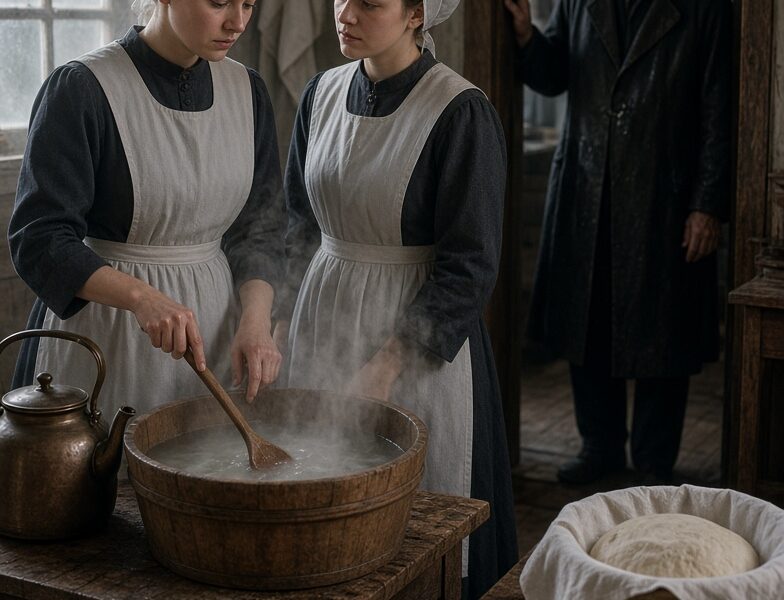
The wooden spoon struck the edge of the wash basin three times before my sister noticed her hand was shaking. We were standing in the back kitchen with the morning bread rising beneath a clean cloth and the windows clouded from boiling water. She had been married for eleven days. When she said she was afraid to go back to her marriage bed that night, I thought I had misunderstood her.
Then I heard a floorboard move behind us. Our father was standing in the doorway and he had heard every word.
My name is Katie. I am nineteen and I grew up in an Old Order Amish home where a great deal of life happens around a kitchen table. I tell these stories because what looks simple from the road can be complicated once you are living inside it. If you have ever heard somebody confess something difficult just as the wrong person walked into the room, you may understand why I still remember that morning so clearly.
My Sister Anna
My sister Anna was twenty-one when she married Daniel. I was old enough to help sew the hems on her wedding dresses and young enough to believe that knowing a person well meant knowing what marriage would feel like.
Anna had always been the calm one. When a horse broke a harness strap, she caught the loose rein. When our mother burned her fingers lifting a pan, Anna found cold water before the rest of us had thought to move. She did not raise her voice often. I can remember her crying only a few times in all the years we shared a room.
The week before her wedding, she folded her things into a wooden chest Father had made. She placed her plain dresses in neat stacks, then put a small book of hymns on top. She seemed cheerful when visitors were around. She laughed when our younger brother carried the chest from one side of the room to the other pretending it weighed as much as a wagon.
Yet after the house had gone quiet, I heard her getting out of bed and walking to the window. At the time, I thought she was thinking about leaving home. I did not ask.
The Wedding and the Days After
The wedding itself filled the house with footsteps and voices. Women moved from stove to table carrying dishes, and the men came in with the October cold on their coats. Anna looked tired, but pleased.
Daniel had always been polite when he came courting. He repaired a loose hinge on our gate once without being asked. He listened when Father spoke, which counted for a great deal in our house. I had no reason to imagine anything was wrong, although I had very little idea what happened when two people began sharing a home instead of visiting each other on Sunday evenings.
After the wedding, we saw her briefly at meeting. She stood beside Daniel and answered ordinary questions with ordinary words. Was the stove drawing properly? Yes. Had she learned where everything belonged? Almost. Was the road muddy on the way over? Terribly.
I noticed a little purple shadow beneath one eye. She said she had not slept well. I believed that moving into a new home would be enough to explain it.
Eleven Days Later
Eleven days after the wedding, Anna came to help Mother with laundry. Mother had gone to a neighbor whose baby was ill, leaving us with a steaming copper kettle, baskets of damp linen, and a whole morning of work. Outside, the yard was wet from a hard rain during the night. The geese had made tracks all the way from the fence to the pump.
Anna arrived wearing her dark bonnet pulled low, carrying a wrapped loaf because she said she had baked too much the day before. I was glad to see her alone. When you share a bedroom for years, you develop a way of talking while your hands are busy that feels different from talking across a table full of family.
We sorted towels, spread sheets over the lines, and scraped the blackened bottom of a pot. For a while, we spoke about the ordinary things we had always spoken about. A seam had come loose in my best dress. Our little brother had lost a boot in the mud. Daniel had planted some late greens and was worried the frost would take them.
Anna spoke normally enough that I almost missed how carefully she avoided looking at me.
The Question That Changed Everything
Then she asked whether I thought our mother had ever been frightened of Father. It seemed such a strange question that I laughed once before I saw her face. I said I did not know. They argued sometimes, usually about money or the weather, but I had never thought of Mother as afraid.
Anna kept rubbing one small stain on a towel that was already clean. The skin across her knuckles looked raw. She asked me whether a wife had the right to say she was not ready for something.
I asked what she meant.
She lowered her voice, although we were alone as far as I knew. She said Daniel was not a cruel man during the day. He thanked her for meals. He brought in firewood. He asked whether she was warm enough at night. But when evening came and the lamps were put out, she felt as though she became somebody whose wishes were no longer being heard.
I knew what she was speaking about then, at least in part. I did not know everything, and she did not tell me everything. What she told me was enough.
What Anna Told Me
The first nights had frightened her. She had asked him to be patient. He thought her uncertainty meant she needed to grow accustomed to married life. When she grew quiet, he took that for agreement. She was afraid of disappointing him. She was also afraid that if she spoke clearly, he would tell her she was failing at something she had promised to do.
I remember setting the towel down on the table. It was warm from the wash and my hands had gone cold. I said that marriage did not make her feelings disappear.
She stared at me as if I had said something in a language neither of us had been taught. She looked toward the doorway and spoke more quickly. She had tried to tell Daniel she needed time, she said. He had answered that every new wife must learn.
She did not say he had struck her, and I will not make her story into something she did not tell me. Her fear was real without my needing to add anything to it. What hurt her most, I think, was the thought that she had nowhere to take the question. She was newly married. People congratulated her whenever she appeared. Everyone wanted to hear that she was settling in beautifully.
Then Anna said the sentence I still hear when I think about that morning. She said she dreaded the sound of his boots being set beside their bed.
Father in the Doorway
I heard a faint creak from the passage. The back kitchen had an uneven board near the door. We had been warned a hundred times not to drag heavy pails over it because the edge lifted. I turned expecting our youngest brother and found Father standing with one hand against the door frame. His coat was damp at the shoulders. I had not heard his wagon come into the yard.
For several seconds, nobody moved. The kettle hissed behind us. Somewhere outside, a hen called sharply, then went quiet.
Anna’s face changed before Father spoke. She seemed to fold inward as if a question she had barely dared to ask had suddenly become an accusation.
Father asked how long she had been feeling this way. His voice was measured and that frightened me almost as much as if he had shouted. Father was a man who believed difficulties should be faced plainly. Yet he also believed families ought not put private matters into public view. Both ideas lived in him and I did not know which one would speak first.
Anna said it was nothing. She reached for the towel and began folding it into quarters. Father told her to stop working for a moment. She did not. I could see the corner of the cloth shaking in her hands.
Then he pulled out a chair from the table and sat down, but neither of us followed him. He asked whether Daniel knew she was afraid. She said she had tried to tell him.
Father looked toward the window instead of looking at either of us. That was how he looked when he needed to decide how much of his own opinion belonged in a conversation. He asked whether Daniel had threatened her. Anna shook her head. He asked whether she felt able to speak to him again. She gave the smallest shrug I have ever seen.
The Words I Never Expected
I wanted Father to tell her immediately that she could come home. I wanted him to say that no one should have to lie awake dreading nightfall, that a promise before church did not erase a person’s ability to speak.
Instead, he was silent so long that I began to fear he would say the opposite.
Father stood and walked to the stove. He moved the kettle away from the hottest part of the iron plate, though it did not need moving. Then he said, “You do not have to call fear obedience.”
Those were his exact words. I remember them because I had never heard him put those two things next to each other before.
Anna started crying then, not loudly. She made a little sound through her nose and pressed the towel against her face, embarrassed to be seen. Father did not embrace her. He was never a man who knew easily what to do with tears. He told her she could stay for dinner and that they would speak about what she wanted to do before she returned home. He did not say he would decide for her. That small difference mattered.
The Days That Followed
What happened after that was not as simple as I wished it would be. Father did not walk straight to Daniel’s farm and settle the matter in one stern conversation. Anna did not suddenly feel brave because someone had finally heard her.
We finished the washing. The lines were full when Mother returned and the weather had turned cold enough that our fingers stiffened as we gathered the pegs. Mother looked at Anna’s red eyes, then at Father, and she knew something serious had happened, though she waited until we were alone to ask.
That evening, Anna stayed with us. She slept in the bed she and I had shared before her wedding. Her side of the room looked unusually bare without her chest beside the wall. We placed an extra blanket across the foot because autumn nights were growing colder. There was no dramatic conversation once the candle went out. She lay still and I lay beside her listening to our brother cough in the next room.
After a long while, she said she was ashamed of being afraid. I told her I thought she had been brave to tell me. She did not answer. A little later, she asked if people would think she had made a poor choice of husband. I said I did not know what people would think and that was the truth.
We lived in a place where neighbors cared for each other, brought food when somebody was ill, and helped raise barns without asking who could repay them. We also lived in a place where private pain could stay hidden for too long because people did not want to disappoint anyone.
What We Teach Girls
I did not sleep very much that night. I kept thinking of the things we teach girls before they marry. We teach them to make bread without wasting flour, to tend a fire, to patch a shirt, to care for a child with a fever, to set a table for unexpected guests. We speak of patience, kindness, and service. Those can be good things.
But I could not remember anybody sitting Anna down and telling her that she was allowed to describe what frightened her without asking permission first.
The next morning, Mother and Anna talked while I carried water from the pump. I could see them through the window, two figures at the kitchen table. Mother held her hands together on the oilcloth. Anna looked up more often than she had the day before. I do not know everything they said. Some parts of her story belonged to her and even now, I try to remember that being her sister did not make me entitled to every detail.
Daniel Comes to the House
Daniel came by that afternoon after Father sent word that Anna would remain with us for a little while. I watched his buggy cross the yard and stop beside the shed. He looked puzzled when he stepped down and younger than I had ever thought him. I remember how the collar of his coat sat crooked because he had fastened it too quickly.
Father met him at the front door. They talked in the sitting room with Mother and Anna. I was not invited into that conversation, and I did not place my ear against the door, though I wanted to. I went outside and took the sheets down from the line. One had twisted around the rope, and it took me several minutes to loosen it without dropping the clean cloth into the mud.
When Daniel left, he walked toward his buggy slowly. Anna came outside a few moments later and stood on the steps. They said a few words to one another. He reached as though he might take her hand, then stopped and waited. She took a breath before stepping closer.
I cannot tell you from that moment alone whether he understood. I can only say that for the first time I saw him wait for her answer rather than assume it.
Anna Finds Her Voice
Anna remained at our house for several more nights. The first day, she helped Mother bake pies and kept checking the road. The second day, she sat on the porch in the cold with her mending. On the third, she asked me to walk with her to the lower field. The grass was wet, and we had to gather our skirts above our ankles where the path dipped.
We did not speak about her marriage at first. She asked whether the little apple tree we had planted in spring would survive winter. I said Father thought it would if the rabbits did not get at the bark.
Then she told me she wanted to speak to Daniel herself with no one answering for her. That was different from wanting me to argue with him or Father to issue an instruction. She had written down three things she needed him to understand. She did not show me the paper. I did not ask to read it. All I knew was that she had decided her words deserved room in the conversation.
The Conversation Between Anna and Daniel
There is something difficult about describing that week now because anyone listening might want the ending to be clear. They might want Daniel to become good or bad in one neat moment. Father to become wise beyond all doubt, and Anna to choose a road that settles every question. Real families are rarely so tidy.
A person can care for someone and still fail to listen. Another person can say the right thing once and need years to learn how to keep saying it through their actions. Fear does not leave just because everybody has agreed it should.
I can tell you that Anna did speak with Daniel and that he listened more carefully than he had before. He acknowledged that he had mistaken silence for comfort. It did not excuse the mistake. Anna told him she needed patience and the freedom to say no without facing an argument. They agreed that if she felt unsafe or unheard, she could return to our home. Mother and Father supported that decision.
What happened beyond those conversations remained between them, except for what Anna chose to share.
Going Back
She eventually went back to the farmhouse. Not the very next day, and not because Father ordered her to. Daniel came for her in the late afternoon when the sky was a pale gray and the fields were almost empty. She carried fewer things than she had taken on her wedding day. One small bag, her hymn book, and the folded piece of paper she had written for herself.
Before she climbed into the buggy, she turned toward the house. I lifted my hand, she lifted hers back.
For a while after that, I watched her closely whenever she visited. I looked for signs I thought I would recognize. Exhaustion, a hurried answer, that faraway look she had worn over the laundry basin. Sometimes she seemed at ease, sometimes she was quiet, the way she had always been when she was tired.
I learned that I could not measure another person’s whole marriage from a Sunday conversation beside the coat hooks. What I could do was ask real questions, make room for real answers, and believe her if she told me something was wrong.
A Month Later
A month later, she came over to help with preserving apples. The kitchen smelled of cinnamon and hot fruit, and the windows had misted over again. We worked side by side, filling jars, wiping the rims, and setting them in neat rows.
She told me she had been sleeping better. She did not say everything was perfect. I was grateful that she did not feel she had to.
We got talking about our childhood bedroom. She remembered how I used to talk in my sleep, especially when we were small. I remembered how she made me promise not to tell Mother when she broke a blue cup. For the first time since her wedding, she laughed without catching herself halfway through.
It was not a grand sign from heaven. It was just my sister laughing in a kitchen where she knew she was welcome.
The Floorboard
There was one more thing Father did that stayed with me. He repaired the uneven floorboard in the passage. I found him on his knees one Saturday, a hammer beside him, and two narrow pieces of wood laid across the floor. I asked why he had suddenly decided to fix it after all these years.
He said somebody was bound to trip.
I think he was right about that, though perhaps not in the way he meant.
I sometimes wonder what would have happened if he had come through the doorway one minute later. Anna might have finished speaking and gone home before dinner. I might have promised to keep a secret that was too heavy for either of us. Or perhaps she would have found her own way to ask for help. I cannot know.
I only know what happened when she finally said the words and somebody else heard them.
What Courage Really Looks Like
When I was younger, I thought courage would always look like a firm voice and a steady face. I thought a brave person would know what to do before taking the first step.
Anna taught me something different. Sometimes courage looks like a woman with trembling hands admitting that she is afraid. Sometimes it is the person listening who has the harder decision, because listening means refusing to make her fear small enough to ignore.
I want to be careful about something else. This is Anna’s experience, not a statement about every Amish marriage or every Amish father. I have known homes marked by gentleness and homes in which people struggled to speak honestly. I believe that is true far beyond our community. A plain dress and a horse-drawn buggy do not tell you everything about how two people treat each other in private. Neither does a wedding photograph, a church service, or a warm greeting at the door.
For Anyone Who Needs to Hear This
If you are listening and remembering a time when you were afraid someone close to you would not hear what you needed, I hope you had someone who made it safe to speak. If you did not, I hope you know that needing to be heard is not the same as being difficult.
I did not have those words ready when Anna stood beside the washbasin. I was nineteen and trying to understand a problem much larger than my experience, but I knew I wanted my sister to be able to come through our door without explaining why she needed it open.
I still think of that morning whenever I hear the back kitchen floor creak. The bread under its cloth, the wet towels on the table, the steam rising around us, and Father standing in the doorway with his coat damp from the rain. None of us had planned to speak honestly that day, yet once Anna had spoken, the room was not quite the same place, and neither were we.
A Final Thought
Before I go, I wanted to share that my new book, The Ninth Day, is out now. It is book one of The Katie Journals, and if you would like to spend more time with the stories I have been telling, you can find the link in the description.
If you would like to hear more from me about growing up Amish and the things families sometimes struggle to put into words, please subscribe.
And tell me in the comments: have you ever had someone truly listen just when you were most afraid to speak?









