My Sister Came Home After Midnight, Mother Hid Her Dress Before Father Woke
The Back Door Lifted
The kitchen clock had just struck twelve when I heard the back door lift against its latch. Not open—just lift, very carefully, as if someone on the other side was hoping the wood wouldn’t make a sound.
I was sitting on the bottom stair with my bare feet cold against the boards.
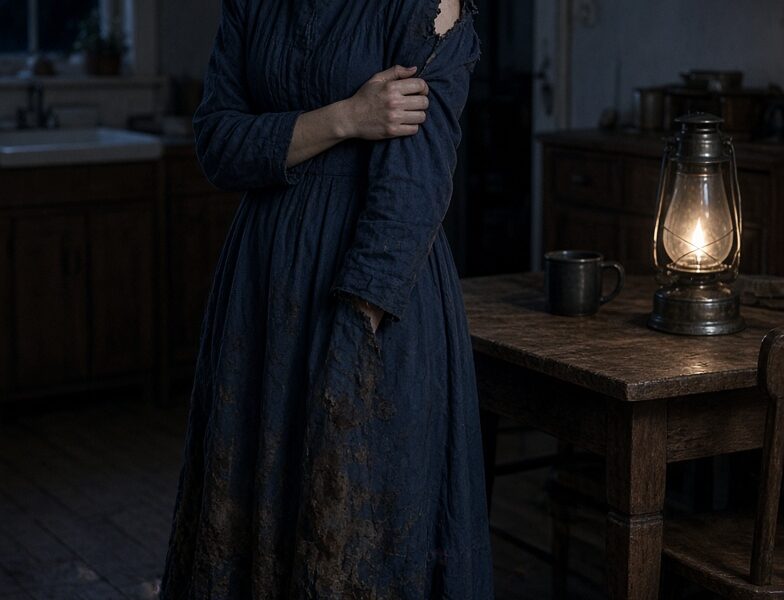
Then my sister came in. Her bonnet was missing. There was mud almost to the hem of her blue dress. And she was holding one sleeve closed with her other hand.
Mother took one look at her and said very quietly, “Give me the dress.”
By the time Father came downstairs in the morning, it was gone. And for a long while, I couldn’t understand why Mother was more afraid of him finding that dress than of learning where my sister had been.
My name is Katie. I grew up in an Amish home where you could tell the hour by the work being done outside, and where everybody knew if a chair had been moved from its usual place. I tell these stories because the little moments inside a family can stay with you longer than the large ones people talk about.
And if you’ve ever kept a secret to protect somebody you loved, I think you’ll understand why this particular night has never left me.
My Sister Miriam
I was eighteen that autumn. My sister, Miriam, was twenty, and she had always seemed older than the two years between us. She could milk a restless cow without raising her voice. She knew which of our mother’s jars held the good cinnamon and how to set a crooked seam straight without pulling out every stitch.
When I was a child and frightened of thunder, I would go to her bed because she never laughed at me for being afraid. She would simply move toward the wall and make room.
That week was cold enough for frost, though the trees had only begun to lose their leaves. We were bringing in apples from behind the shed, storing potatoes in the cellar, and checking each window for drafts before the real winter came. I remember the ordinary things clearly because it was one of those weeks when the ordinary things stopped feeling safe.
Father’s boots stood by the door. Nothing was out of place—until Miriam failed to come home.
The Saturday She Left
She had gone on Saturday afternoon to help with sewing at a neighboring house. That was what she’d told Mother, and I believe she had meant to go there. She took her work basket, a plain dark bonnet, and the little packet of needles we shared.
I watched her walk down the lane a little after three. She turned once—not to wave exactly, but to check whether anyone could see her. I thought she was making sure the gate was shut. Later, I wondered if she already knew she might need a reason for coming home late.
Our family had rules about evenings. Some came from faith, some from the practical danger of walking country roads in the dark, and some were simply Father’s ways of doing things. He wanted to know whose house we were visiting and when we would return. He wasn’t the loudest man in our district, but he could quiet a room just by stepping into it. When he asked a question, you were expected to have an answer ready.
Mother often answered first if one of us hesitated, and until that night, I had always assumed she did so because she knew the answer.
The Evening Stretched On
By supper, there was no sign of Miriam. Father cut his bread and asked whether the sewing had taken longer than expected. Mother said the work might have run late.
At half past seven, he pushed his chair back. At eight, he checked the lane. At nine, he told me to put away the leftover beans, then went upstairs. He said he’d speak with Miriam in the morning. His voice was level. That made it worse somehow. A raised voice tells you where the anger is. A quiet one leaves you listening for it.
Mother left the small lamp burning in the kitchen. She sat with her mending in her lap and did not put in a single stitch.
I was supposed to be in bed. I climbed the stairs, lay down fully dressed, and stared at the ceiling until I heard the clock strike eleven. Then I came back down, stopping on the last stair. Mother saw me but did not send me away.
Outside, the wind moved the bare branches against the washhouse roof. Every scrape made us both turn toward the door.
When She Came In
When Miriam finally came in, her face was pale, and her cheeks were marked by dried tears. A narrow tear ran through the fabric at her shoulder, and one cuff was dark with mud. I noticed the missing bonnet before I noticed that she was shivering.
Mother put a hand on her wrist and led her away from the door. She didn’t ask where she’d been. She asked if she was hurt.
Miriam shook her head once. Then she tried to say something and could not make any words come out.
Mother took the lamp and set it on the table so she could see the torn sleeve. Miriam pulled back as soon as the light fell on it. I thought Mother would insist on hearing everything right then, while we were all awake. Instead, she unfastened the pins at Miriam’s neck, brought her a clean nightdress, and held out both hands for the blue one.
Miriam was shaking so badly that she could hardly get her fingers to work. I stood there holding a towel I had fetched without being asked, feeling foolish and frightened at the same time.
I whispered that Father would ask why the dress wasn’t hanging in the room. Mother looked at me then. It wasn’t the look she used when I’d forgotten a chore. It was a look that asked me to become sensible immediately, without first understanding why.
“A girl deserves one night to tell her own story,” she said.
That was all.
Hidden in the Pantry
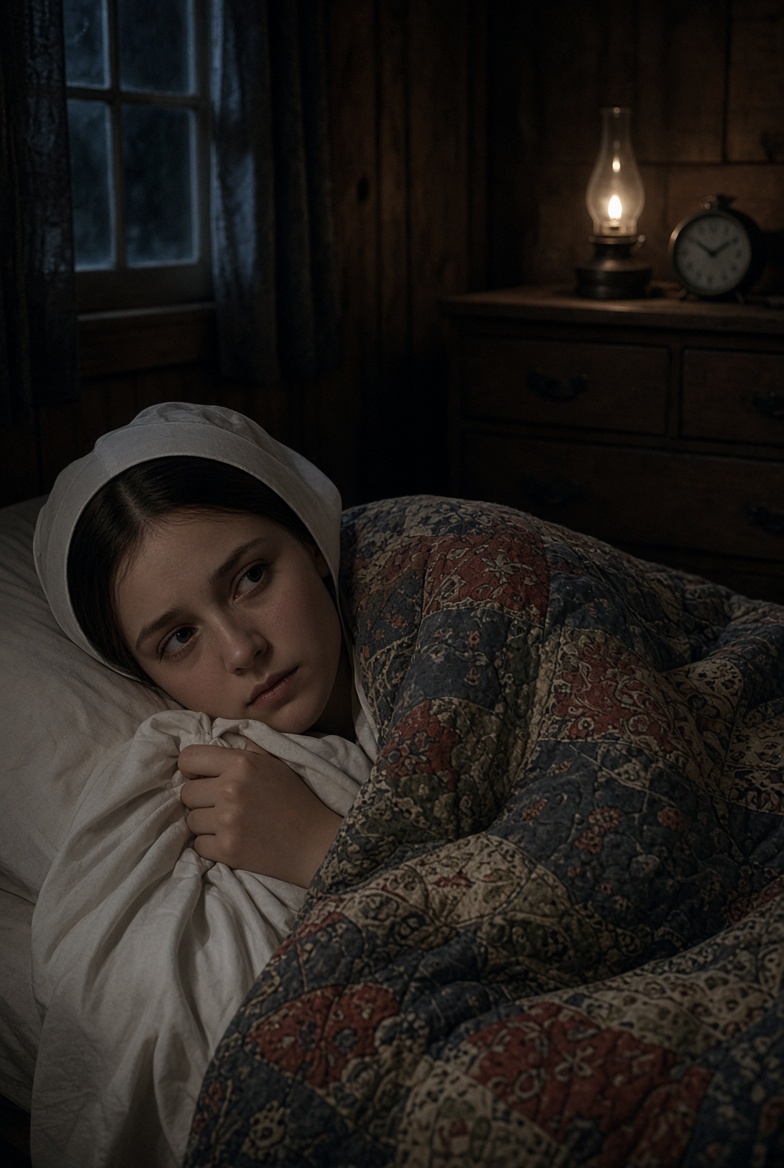
She carried the dress toward the pantry, where we kept the bags of flour and the cloth scraps. I heard the bottom drawer slide open, then close.
Miriam washed at the basin while I warmed water on the stove. Her hands had small scratches, the sort you might get from brambles along a fence. I wanted to ask a hundred things. Had someone followed her? Had she fallen? Was the dress torn while she tried to get away?
But she was looking down into the water as though she had traveled a great distance just to be able to stand in our kitchen again. I passed her the clean towel. She pressed it to her face for so long I wondered whether she was crying into it.
Mother made her drink half a mug of warm milk. Then she took Miriam upstairs and put her in bed. I heard the mattress creak and the faint sound of two women talking behind a closed door. I could not make out the words.
In our house, doors were usually left open unless someone was sick or changing clothes. That closed door seemed larger to me than the whole staircase. I sat by the stove until the fire fell into a low red glow, trying not to imagine what I might hear in the morning.
Before Dawn
Before dawn, Mother came back down. She had the blue dress folded under her arm, though I had watched her hide it hours before. In the daylight from the kitchen window, I saw something I had missed by lamplight.
The sleeve hadn’t torn at the seam. It had caught and pulled sideways, leaving a rough, uneven edge. Near the hem there were pale seeds from the weeds that grew beside the old creek path. We had walked that path dozens of times in summer but never after dark.
Mother put the dress in an empty flour sack and carried it to the narrow cupboard beneath the stairs. She did not burn it or wash it. She left it exactly as it was.
I remember that because at the time I thought cleaning it would have been the obvious thing. I was still thinking of the dress as evidence of disobedience. Mother seemed to be thinking of it as something Miriam might need to look at herself when she was ready.
Father Came Down
Father came down while I was kneading dough. He asked whether Miriam had returned. Mother said yes.
He asked what time. Mother said it had been very late.
He looked at the extra cup on the table, the damp towel near the stove, and the faint muddy mark we hadn’t managed to scrub from the threshold. Nothing escaped him when he was looking for it.
He asked where Miriam was. Mother said she needed sleep and that they would talk after breakfast.
He stood by the door for a moment, then went out to the barn. I let out the breath I’d been holding.
Breakfast
At breakfast, Miriam sat with us, her hands folded tightly in her lap. She wore a brown dress I knew she’d last worn to help gather pears.
Father asked why she had missed supper and why no message had come. She told him she had lost track of the time after visiting a friend. It was not the truth, but it was all she could say.
Father set his spoon down. He told her that making her mother worry was not a small matter, and that the family needed to be able to trust her word.
Miriam nodded. Her face did not change. I could see that each sentence was landing somewhere already sore.
After breakfast, Father went to help a neighbor mend a gate. He told Miriam that they would finish the conversation when he returned.
Mother Drew the Curtains
The moment his wagon had passed the end of the lane, Mother drew the curtains halfway and asked us both to sit.
She did not speak like someone preparing to punish a child. She spoke as though we had a difficult piece of work before us and needed to see it clearly.
Miriam sat across from me and finally told us where she had been.
Miriam’s Story
Several weeks earlier, she had received a note from a young man named Daniel, whom she knew through visiting families. They had spoken at church gatherings and at a singing. She liked him. That was the first thing she said, and it seemed important to her that we understand it. She wasn’t trying to describe him as a villain to make her own choices easier to explain.
She had agreed to meet him near the creek after helping with sewing because she wanted to speak without a crowd of relatives listening to every word. They had talked longer than she expected.
He told her he hoped they might begin a serious courtship. She told him she wasn’t ready to promise anything. She liked their walks, she said, and the way he asked about what she read, but she wanted time.
He thought she was refusing him outright.
Their conversation became sharp. Then a wagon sounded on the road above the creek, and Daniel moved toward the path to see who was coming. Miriam suddenly felt how late it had become and how far she was from home. She said she needed to leave. He asked her to stay so they could settle the disagreement. She told him no.
When she walked past him, he caught the loose cloth of her sleeve to stop her for another word. The fabric tore.
“He let go immediately,” she said, “and looked as frightened as I felt.”
I don’t know what was in his mind. I only know what she told us and how difficult it was for her to say it.
The Long Way Home
She ran toward the footbridge, slipped on wet earth, and lost her bonnet in the dark. When she reached the road, she couldn’t tell which way a light was moving, so she hid behind a hedge until the wagon had passed.
That was why she arrived after midnight. She had walked the long way around through two fields and the orchard road because she was frightened of meeting anyone who might ask questions before she could decide what to say.
She wasn’t only frightened of Daniel. She was frightened of becoming a story people would repeat at supper tables. A torn dress and a missing bonnet would be enough for some people to fill in the rest without ever asking her.
She knew Father’s first question might be why she had met a young man alone. She feared that answer would swallow everything else.
Why She Didn’t Come Straight Home
I asked why she hadn’t come straight home when she became afraid. She looked at me with the exhausted patience of someone trying to explain a choice that even she no longer understood.
She had believed at each turning in the road that she needed only another few minutes to gather herself. Then those few minutes became an hour. The longer she stayed away, the harder it seemed to face the doorstep.
I understood that part. Once, when I’d broken Mother’s favorite jar, I had hidden the pieces in a feed bucket and spent a whole afternoon wishing I’d told the truth the instant it happened.
Mother’s Questions
Mother listened without interrupting. She asked whether Daniel had hurt her anywhere else. Miriam said no. She asked whether he knew she’d come home safely. Miriam said she didn’t think so.
Then Mother asked what Miriam wanted to happen next.
That question startled me. I had expected her to decide for us all, the way she decided whether the bread needed another five minutes.
Miriam stared at the table for a long time. At last she said she wanted Father to know, but she needed him to hear that she’d said no before he asked why she’d gone.
It was not a simple request. Our father loved us, but he could be rigid about the order in which things should be spoken. To him, an explanation that began with breaking a rule often sounded like an excuse for breaking it.
And Miriam had broken one of his rules. She had gone somewhere different from where she’d said she’d be. She’d stayed out far too late. Those things were true. They were also not the whole truth.
Mother understood that if he saw the torn dress first, the conversation might begin with accusation instead of care.
The Dress in Daylight
I went with Mother to the cupboard. She drew out the flour sack and laid the dress across the table.
In daylight, it looked more ordinary than it had in the night. A dark blue bodice, a skirt with mud along one side, a sleeve torn near the upper arm. It was not some terrible object. It was cloth.
Yet I could see why Miriam had been unable to bear looking at it. There, caught in the threads, was the moment she told someone to let her pass and hadn’t been heard quickly enough.
Mother asked Miriam whether she wanted it mended. Miriam shook her head. Not yet.
Mother folded it again and laid it back in the sack.
Time Between the Event and the Telling
I began to see that hiding it overnight had not been the same as making it disappear. Mother had given Miriam a little time between the event and the telling. Time to sleep. Time to find words that belonged to her instead of having everybody else choose words for her.
As a younger sister, I had always thought bravery meant speaking immediately with a steady voice. That morning, bravery looked more like a woman holding a cup in both hands until she could speak at all.
Father Came Home
By the time Father came home, the afternoon had turned gray. His wagon wheels left damp marks along the lane. Mother met him at the kitchen door. She told him Miriam wanted to talk and asked him to listen before questioning her.
I could tell from his face that he did not like being given conditions in his own kitchen. He washed his hands at the basin, hung up his coat, and sat down.
I had been sent to peel carrots but was allowed to stay. Miriam wanted me there. That mattered more to me than she knew.
Miriam Spoke
She began badly. Her voice caught on the word “creek,” and Father frowned before she could explain why she’d been there. Mother placed the flour sack on the table but did not open it.
Miriam started again. She said she had wanted to speak privately with Daniel. That she had made a poor choice about the time and the place. And that she’d told him she wanted to leave.
She kept going even when Father’s jaw tightened. She told him about the sleeve, the footbridge, the lost bonnet, and the long walk home. She did not make her voice sound stronger than it was.
Father asked whether Daniel had followed her. She said she did not know. He asked whether anyone else had been there. She said she hadn’t seen anyone close enough to hear.
Then he became quiet.
Father Saw the Dress
I don’t know exactly what he felt. His face did not give much away. Eventually, he asked to see the dress. Mother looked at Miriam, and only when Miriam nodded did she open the sack.
Father lifted the torn sleeve with two fingers. He held it for a moment, then put it down. The clock ticked loudly beside the window.
He said he wished Miriam had trusted them enough to come directly home. She said she wished that, too.
He said he’d need to speak with Daniel’s family and learn what Daniel believed had happened. Miriam asked him not to turn it into a public spectacle.
Father did not promise that there would be no difficult conversations, but he did agree that she would not be made to stand before neighbors and explain herself to satisfy their curiosity.
It was a smaller promise than I wanted for her. It was also more than I’d feared he would give.
The Days After
In the days that followed, the story did not end with one conversation. Daniel sent word that he was sorry for grabbing the cloth and frightening Miriam. Father spoke privately with his father. There were questions about courtship and judgment, and Miriam had to sit through some of them.
She chose not to continue seeing Daniel.
I heard people say the two simply weren’t suited to one another. Perhaps that was easier for others to understand. I never corrected every person who said it. Some truths belong to the person who lived them, even when you are certain that telling more would make people see the matter more clearly.
The New Bonnet
Miriam got a new bonnet before the next church Sunday. The blue dress stayed in the cupboard for nearly a month.
Then one morning she brought it to the table and asked me for our needle tin. We sat together beside the window while she took out the torn stitches and cut away the frayed threads.
I offered to sew the sleeve for her, but she wanted to do it herself. Her hands were steady.
Outside, the branches had gone bare and the glass was fogged at the corners. We worked without much talking. She put in a narrow panel from a spare piece of matching fabric so the sleeve would lie flat again. When she finished, the repair showed if you knew where to look.
She held the dress up against herself, checked the seam, and folded it into the drawer with her other clothes. She didn’t say that everything was better. She didn’t need to.
An Ordinary Laugh
That evening she helped Mother make supper and laughed at something small I’d said about the carrots. I remember the sound because it was the first ordinary laugh I’d heard from her in weeks.
It did not erase what happened. It told me there would be ordinary days afterward.
Understanding My Mother
For a while I was angry at Mother for not telling Father everything the moment Miriam came through the door. I thought truth was something you owed immediately, especially inside a family that spoke so often about honesty.
Now, when I look back, I understand her choice differently. She didn’t teach us to lie and stay hidden. The next day she helped Miriam tell the truth.
What she protected was the order of things. Before an explanation, a warm room. Before questions, sleep. Before asking why a rule was broken, asking whether the person who broke it was safe.
I don’t mean that every family should handle trouble exactly as we did. I know there are situations where a person needs help straight away, and where waiting would only make harm worse. Miriam was home. She told Mother she was not physically hurt, and Mother stayed beside her. In those particular hours, the dress could remain in a cupboard. The important thing was that Miriam did not have to face the morning alone.
The Small Picture I Carry
I think of that when someone tells me a difficult story, and I feel the urge to jump immediately to what they should have done differently.
The thing I carry from that night is surprisingly small. It’s the picture of Mother’s hands not shaking, taking the blue fabric from Miriam’s hands.
Mother couldn’t undo the walk in the dark, or make Father a different man by morning. She could give her daughter a place to stand while she found her own voice.
Sometimes loving somebody means telling them the truth, and sometimes, just before that, it means making sure they can bear to hear it and speak it.
I didn’t know the difference at eighteen. I am still learning it now.
A Note Before You Go
Before I go, I also want to share that my new book, The Ninth Day, is out now. It’s book one of The Katie Journals, and if you’d like to spend more time with the stories I carry from growing up, you’ll find the link in the description.
Thank you for listening to this one. If you want to hear more stories about our home, our faith, and the choices that shaped us, I’d love for you to subscribe.
And tell me in the comments: have you ever had someone give you the time you needed before you could tell them something difficult?









