My Mother Warned Me About the Wedding Bed, But She Left Out the Worst Part
Six Hours Married: An Amish Bride’s Wedding Night and the Words Nobody Said
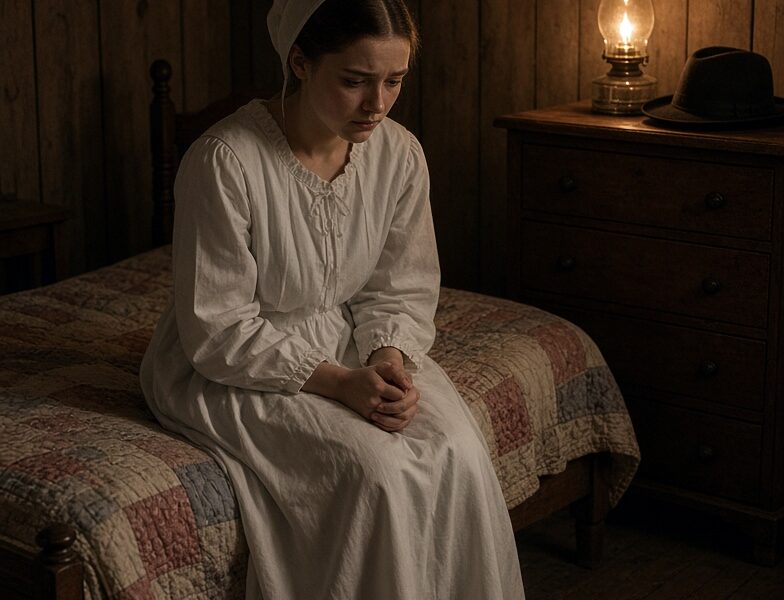
The room smelled like cedar shavings and lamp oil, and I remember hearing the floorboards creak downstairs long after everyone had gone quiet. I was sitting on the edge of a bed that did not feel like mine yet, with my hands folded so tightly in my lap that my knuckles hurt.
My mother had warned me about the wedding bed. She had told me I would be nervous. She had told me not to expect tenderness to look the way it did in the English novels I had once seen at a yard sale. She had even told me that marriage meant learning another person’s habits in ways nobody could prepare you for.
But the thing she left out was the part that frightened me most.
It was not what happened in that room. It was how completely alone I felt while waiting for it.
My name is Katie. I grew up Old Order Amish. And I share these stories because so much of our life is ordinary to us and mysterious to everyone looking in from the outside. If you were ever given advice before a big life moment and later realized the most important part had somehow been skipped, you will understand why this night has stayed with me.
Six Hours Earlier
I had been married for less than six hours. That is the part I keep coming back to when I think about that evening.
Six hours earlier, there had been benches full of people, the scrape of shoes on a wooden floor, steaming bowls of food, coffee poured over and over, and relatives appearing beside me every few minutes to squeeze my hand or whisper something meant to be comforting.
By nightfall, the noise was gone.
In our community, weddings were not private affairs. They belonged to families, neighbors, cousins, church members, children running between tables, women carrying platters, men moving benches, and older people quietly remembering their own wedding days. The whole day felt crowded with other people’s expectations.
Then suddenly, there were only two of us.
I was 18—old enough to marry, old enough to understand what marriage meant in the broad sense, and still young enough to discover how different knowing something can be from living it.
Three Nights Before
My mother had tried to prepare me. Three nights before the wedding, she came into the room I shared with my younger sister. My sister had already fallen asleep, or at least she was pretending to.
Mother sat on the edge of my bed and smoothed the quilt with both hands. She did not look at me at first. That was how I knew the conversation mattered. My mother was not a woman who became embarrassed easily. She could help deliver a calf in freezing weather, dress a chicken without flinching, and tell a grown man he had tracked mud across her kitchen floor. But that night, she studied the stitches in the quilt like they contained the exact words she needed.
She told me marriage was different from courtship. She told me a husband and wife would see one another tired, impatient, sick, worried, and afraid. She told me that sharing a bed could feel strange at first because I had spent my whole life sleeping beside a sister, not a husband.
Then she stopped. I waited.
Finally, she said, “Do not be ashamed of being nervous.”
That was the sentence I remembered most. I thought it meant nervousness was the hardest part. So I asked her the question I had been carrying for weeks.
“What if I do not know what to do?”
Mother looked at me then. She reached over and put her hand on mine.
“You will learn together.”
That was all. At the time it sounded gentle. Later I understood how much space there was inside those four words.
What Girls Like Me Were Not Told
You have to understand how little private information some girls in communities like mine can grow up with. I am not saying every Amish family handles these things the same way. They do not. Some mothers are direct. Some sisters talk openly. Some girls marry with far more practical understanding than I had.
My family was different. We were not completely silent, but we were careful. Certain subjects lived behind closed doors. Questions were answered with the smallest amount of information required to make the question disappear.
I knew how babies were born because farm life does not allow complete ignorance. I knew husbands and wives shared a closeness unmarried people did not. I knew enough to understand the mechanics of marriage in a vague way.
What I did not understand was the emotional part.
Nobody had told me what to do if I froze. Nobody had told me whether I was allowed to say, “I need a minute.” Nobody had told me that my husband might be just as frightened as I was. And nobody had explained what it feels like to walk from a house filled with fifty people into a room where every sound suddenly feels too loud.
That was the worst part. The silence—not the bed itself, not the expectations—the silence surrounding all of it.
The Door Closes
My husband, Daniel, closed the bedroom door behind us that night and stood there for a moment with one hand still resting on the latch. He was 19. He had spent the entire wedding day looking calm. At least I thought he had.
Now I could see his face clearly in the lamplight, and he looked almost pale. That surprised me.
He took off his hat and placed it carefully on the dresser. Then he moved it two inches to the left, as if the exact position suddenly mattered more than anything else in the world.
I almost laughed—not because anything was funny, but because nerves sometimes have nowhere else to go.
Daniel glanced at me. “You all right?”
I nodded immediately, too quickly. “Yes.”
He nodded too. Then neither of us said anything.
The clock downstairs struck 10. I could hear every click of the mechanism.
I remember thinking that married people were supposed to know how to behave in this moment. Surely every married couple before us had somehow known what came next. Our parents had. Our grandparents had. The older women at church had smiled at me all day with the strange knowing expression older women sometimes give a bride.
I felt like the only person in the world who had missed an important lesson.
An Invisible Examination
That feeling followed me into the room more strongly than fear did. I did not want to disappoint Daniel. I did not want to seem childish. I did not want him to think I had changed my mind about marrying him. Most of all, I did not want to admit that I was scared—because I thought being scared meant I was not ready, and I was already married.
Daniel sat down in the wooden chair near the window. Not on the bed. The chair.
That surprised me too. He rubbed his palms over his trousers and stared at the floor.
Finally, he said, “My brother told me something.”
I waited.
Daniel looked up. “The first night is mostly two people trying not to look foolish.”
That time, I did laugh. So did he.
The whole room changed—only a little, but enough. For the first time that evening, I could see the boy I had courted instead of the husband I had spent all day imagining I was supposed to understand.
The Conversation Nobody Expected
We talked. That was not what I had expected.
We talked for nearly an hour. We talked about the wedding meal. We talked about how Daniel’s cousin had dropped a spoon into the gravy. We talked about the horse that had tried to bite his sleeve that morning. We talked about how tired our feet were.
Then the conversation slowed. The nervousness came back. I could feel it gathering between us again.
Daniel moved from the chair to the edge of the bed, leaving a wide space between us. He asked, “Did your mother tell you much?”
I stared at my hands. “Some.”
He gave a small nod. “My father did not.”
I looked at him. “Nothing?”
“Not much.”
For some reason, that made me feel better. Not because I wanted him unprepared—because suddenly the mystery belonged to both of us.
That was the part my mother could have told me. She could have said, “Katie, you are not walking into an examination. There is no score. There is no audience. There is no single correct way to become comfortable with the person you married.”
Instead, I had imagined an invisible set of rules everyone else knew.
“That Is All Right”
Daniel reached for my hand. I pulled mine back without thinking. It happened so quickly that both of us froze.
I wanted to apologize immediately. The words were already in my mouth. But Daniel did something I will always remember.
He did not reach again. He just said, “That is all right.”
Four words, quietly spoken. No disappointment. No irritation. No question.
That was the moment the whole night changed for me. Not because the nervousness disappeared—it did not—but because I realized I could tell the truth.
“I am scared,” I said.
Daniel looked relieved. Actually relieved. “So am I.”
I had not expected that answer. I had imagined husbands entered marriage with certainty simply because they were men. That was another thing nobody had explained. He was not standing on the other side of some secret knowledge. He was beside me, just as new to marriage as I was.
We sat there holding hands after that.
The Ordinary Truth
Nothing dramatic happened. That is important to say because people sometimes expect stories like this to contain either a perfect romantic moment or something terrible. The truth was much more ordinary.
We were tired. We were embarrassed. We were trying to understand each other. We were also trying to separate what we actually wanted from what we believed newly married people were expected to do.
The pressure had not come directly from Daniel. It had come from everything around us. From jokes made by married cousins. From quiet looks exchanged by older women. From conversations that stopped when unmarried girls entered the room. From the way marriage was spoken about as a doorway you crossed all at once instead of a relationship you learned slowly.
I think silence creates its own stories. When people refuse to explain something, the mind fills in the empty places. And the mind is not always kind.
Mine had filled those empty places with rules that did not exist. I believed I was supposed to be calm. I believed Daniel was supposed to know exactly what to do. I believed hesitation would insult him. I believed asking for time would make me a bad wife before I had even finished my first day as one.
None of those things came from anything Daniel actually said. They came from silence.
The First Morning
The next morning, I woke before sunrise. For a few seconds, I did not know where I was. Then I heard Daniel breathing beside me. A pale strip of morning light had appeared under the curtain.
The room looked completely different—smaller, less frightening, just a bedroom. There were Daniel’s boots near the wall, my dress folded over the chair, two glasses on the washstand, and a hairpin I had dropped beside the bed.
I remember looking at that hairpin and thinking, This is what marriage looks like this morning. Not mystery. Not some enormous transformation. Just two people’s things in the same room.
Downstairs, my mother was already awake. Of course she was. Mothers always seemed to be awake after weddings.
She was helping prepare breakfast with two of my aunts. The kitchen smelled like coffee, fried potatoes, and bread warming near the stove. When she saw me, she studied my face for half a second. Then she looked away.
She did not ask anything. I was grateful for that. But I also felt something unexpected. I wanted her to ask. Not for details—I did not want details. I wanted her to ask if I was all right.
There is a difference.
“Because Nobody Told Me Either”
We worked side by side for several minutes. Finally, while one aunt carried a basket into the pantry and the other went outside, I said, “Mother.”
She looked at me.
“Why did you not tell me I could be frightened and still be ready?”
Her expression changed very slightly. She wiped her hands on her apron. Then she said something I have remembered ever since.
“Because nobody told me either.”
That was her one line. That was the whole inheritance—not cruelty, not indifference. Silence passed from one generation to another because each person assumed the silence itself was part of doing things properly.
I saw my mother differently after that. Before, I had believed adults made deliberate decisions about what to tell children and what to keep from them. That morning, I understood that sometimes adults simply repeat what was given to them.
My mother had prepared me as well as she knew how. She had told me not to be ashamed of nervousness. She had told me we would learn together. Those were good words, but she had not known how to say the sentence I needed most.
You are allowed to speak. You are allowed to say you are uncomfortable. You are allowed to ask a question even after the wedding. You are allowed to be uncertain without believing uncertainty is failure.
The First Months
I did not become suddenly bold after that morning. That would make a cleaner story, but it would not be true.
For the first months of marriage, I still struggled to say certain things directly. If I was upset, I sometimes became quiet instead of explaining why. If Daniel asked what was wrong, I would say nothing and then become frustrated when he believed me.
He had habits that bothered me. I had habits that bothered him.
He left his work shirt hanging over the same chair every evening. I stacked things on the table and insisted I knew where everything was. He liked the window cracked open at night, even when the air was cold enough to make me pull the quilt to my chin. I wanted it closed.
Marriage was full of tiny negotiations nobody had warned me about. The wedding bed was only the first.
Over time, Daniel and I became better at talking. Not perfect—better. There is an important difference.
We learned that discomfort spoken early usually became smaller. Discomfort hidden usually became larger. We learned that affection is not proven by pretending to be comfortable when you are not. We learned that kindness sometimes sounds like “not tonight.” Sometimes it sounds like “tell me what you mean.” Sometimes it sounds like “I was wrong.” And sometimes it sounds like nothing more complicated than “that is all right.”
Snapping Beans
Years later, I asked my mother more about her own wedding. We were snapping green beans at the kitchen table. There were two metal bowls between us, one full and one nearly empty.
I asked whether she had been afraid.
She kept snapping beans. “Yes.”
“Did Grandmother talk to you?”
“Enough.”
That word made me smile. Enough. I knew exactly what it meant.
I asked whether she wished Grandmother had said more.
Mother placed another bean in the bowl. Then she said, “I suppose every mother thinks she is protecting her daughter from embarrassment.”
That stayed with me—because embarrassment is temporary. Ignorance can shape years.
There are subjects we sometimes treat as dangerous simply because they are private. But privacy and silence are not the same thing. You can teach someone that marriage is personal without making them afraid to ask questions. You can protect modesty without making uncertainty feel shameful. You can tell a young woman that her voice still belongs to her after she marries.
That is what I wish I had known.
What I Remember Now
When I look back now, I do not remember my wedding night as something dark. I remember two very young people sitting on the edge of a bed, both pretending for a while that they were less nervous than they were.
I remember a lamp burning low. I remember the clock downstairs. I remember Daniel moving his hat two inches across the dresser because he did not know what else to do with his hands.
And I remember the enormous relief of hearing him say, “That is all right.”
The worst part was not the wedding bed. It was believing I had to enter that room without questions, without hesitation, and without a voice.
My mother had warned me about nerves. What she could not give me was language she had never been given herself. I understand that now.
And if there is one thing I would tell any young person standing at the edge of a life change—whether it is marriage or something completely different—it is this:
Being ready does not mean knowing everything. Sometimes being ready means being able to tell the truth when you do not know.
A Question for You
Before I go, I would love to know this.
What is one piece of advice someone gave you that turned out to leave out the most important part?
Maybe someone told you marriage takes work but never told you that work includes speaking up. Maybe someone told you to be patient but never told you that patience does not mean silence. Maybe someone told you to trust God but never told you that faith does not require you to ignore your own fear.
You can answer in the comments—in as much or as little detail as you want. You do not have to explain everything. Sometimes, just knowing somebody else understands is enough.
About This Story
This is one of the stories from The Katie Journals, exploring the quiet, complicated, beautiful, and sometimes difficult parts of Amish life that people rarely see from the road.
My new book, The Ninth Day, is out now. It is the first book in The Katie Journals, and if you would like to read it, you will find the link in the description.
If you like hearing these quieter stories about the parts of Amish life people do not usually talk about, you can subscribe and stay with me for the next one.









