My Mother Saw the Marks After My Wedding Night, Then Told Me to Cover Them
The Morning After
The first thing I remember is the cold edge of the wash basin pressing against my hip while I tried to pin my dress closed with one hand. It was not even six in the morning yet. The house was quiet except for the stove beginning to tick as it warmed, and I could hear my new husband moving in the bedroom behind me.
I had slept maybe an hour. My arms felt heavy, my neck was sore, and when I looked down, I saw the dark marks near my collarbone that had not been there the day before. I pulled the fabric higher and told myself no one would notice.
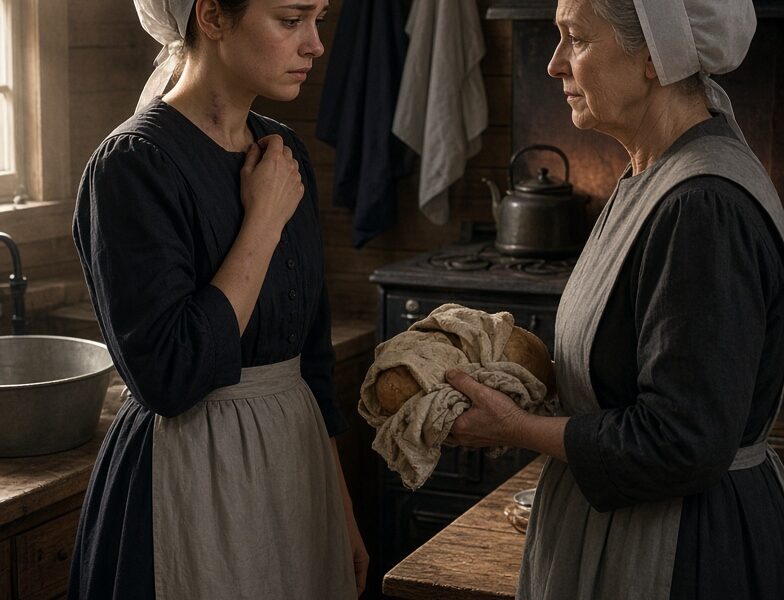
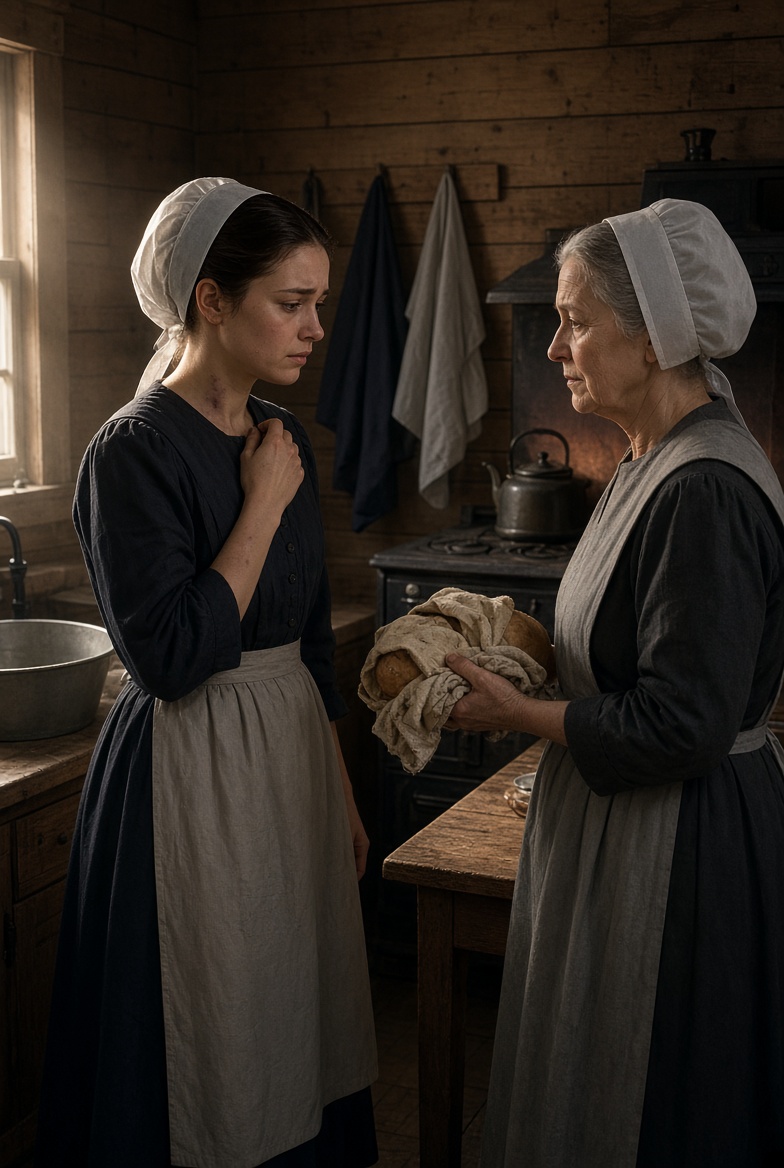
But Mother noticed. She came by before breakfast. She did not knock the way a neighbor would. She opened the door, called my name softly, and stepped inside, carrying a loaf of bread wrapped in a faded flower sack.
She had been smiling when she came in. Then I reached for a cup on the shelf. My sleeve slipped back and her face changed.
That was the moment I thought she would ask me if I was all right. Instead, she said very quietly, “Katie, cover those before someone sees.”
My name is Katie. I grew up in a plain Amish home where privacy was treated almost like a kind of discipline. You did not tell the whole world what happened under your roof, and you did not make a public spectacle out of a private hurt. I share these stories now because there are things I wish I had understood sooner, and because sometimes the smallest sentence can stay with you for years.
If you have ever had someone notice that something was wrong and still choose silence, tell me in the comments what you remember about that moment.
The Morning After the Wedding
I was eighteen when I married. The morning after the wedding, everything around me looked almost painfully ordinary. The kitchen table still had a damp ring where someone had left a jar the night before. There were two aprons hanging from wooden pegs near the pantry. A kettle sat crooked on the stove. Outside, a wagon rolled past on the road, and I could hear the wheels grinding over gravel.
Nothing in the room looked changed. I did.
My mother set the loaf on the table and kept her eyes on my sleeve. I pulled it down. She looked toward the doorway to the bedroom, then back at me.
“Did you fall?”
I knew she did not believe that.
“No.”
She waited. I had never been good at lying to her. As a child, I could hide a broken cup under the sink for half a day, but by supper, she would only have to look at me once before I confessed.
That morning, I wanted to tell her everything. I wanted to sit down at the table and put my head in her lap the way I had when I was ten years old and sick with fever. But I had been married less than twenty-four hours. Marriage was supposed to mean I had crossed into adulthood. I had been told for months that I was beginning a home of my own. People had shaken my husband’s hand after the service and told him to take good care of me. Women had hugged me and said I would learn as I went.
I thought admitting fear on the first morning would sound like admitting I had failed before I had even learned how to be a wife.
My mother pulled out a chair. “Sit.”
I sat. She reached for my wrist slowly, giving me time to pull away. When I did not, she pushed the sleeve up just enough to see the bruising on my upper arm. Her mouth tightened.
I expected anger. Instead, she closed her eyes for one second. Then she said the sentence I have carried longer than I wish I had.
“Cover them. People talk.”
The Weight of Those Words
I stared at her. That was all. Not “Did he hurt you?” Not “Are you safe?” Not “Come home with me.”
Just “People talk.”
At eighteen, I still believed grown women always knew what to do. So when my mother told me to cover the marks, I covered them. I buttoned my dress to the throat. I pulled my sleeves down. I put on my cape even though the kitchen was already warm enough that sweat gathered at the back of my neck.
Then I served breakfast.
My husband came into the room as if the night before had left no weight on him at all. He greeted my mother. He thanked her for the bread. He sat down and ate eggs while I poured coffee.
I kept looking at my mother. She did not look at me.
There are moments when silence is louder than shouting. That breakfast was one of them. A spoon scraped against a plate. The stove popped. Someone outside called to a horse. My husband asked my mother whether the garden at home had survived the dry week.
She answered him.
I remember thinking, “How can they talk about beans right now?”
It sounds almost foolish when I say it, but that question stayed in my head. How could the world keep discussing ordinary things when I felt as though I had been dropped into a life I did not understand?
When my mother left, she hugged me near the door. Her body was stiff. For half a second, I thought she might whisper something into my ear. Instead, she said, “I’ll see you Sunday.”
Then she walked down the lane. I stood there until she disappeared beyond the trees.
Learning to Hide
For the next several days, I became very good at arranging fabric. I learned which dress had the highest collar. I learned how to lift a basket without pulling my sleeve up. I learned to turn my body when another woman stood too close. I learned to keep my hair covering the side of my neck when I could.
That was the strangest part. I was not learning how to solve what had happened. I was learning how to hide the evidence that anything had happened at all.
And because no one said otherwise, I began to confuse silence with obedience.
My husband was not cruel every minute. I think that matters to say because when people imagine a harmful marriage, they sometimes imagine a person who is monstrous from sunrise to sunset. Life is rarely that simple.
He could be patient while repairing a broken cabinet hinge. He could laugh when flour covered my apron. He could bring in wood before I asked. He could sit beside me in church looking calm and familiar.
Then behind a closed door, something in him changed. Whenever he thought I was resisting him, at first I blamed myself for not knowing what marriage required. That is difficult for me to admit now. I wondered if I was childish. I wondered if I was too sensitive. I wondered if other wives woke up sore and simply did not speak about it.
No one had explained enough to me before I married. There had been hints, soft warnings, embarrassed phrases, but almost nothing direct. I entered marriage with more knowledge about preserving peaches than about what I was allowed to say when I was frightened.
So I did what young people often do when adults leave gaps. I filled the gaps with assumptions.
I assumed I was the problem.
The Conversation Behind the Laundry
About a week later, I was helping my mother hang laundry behind my parents’ house. The afternoon was warm and windy. White sheets kept snapping on the line so hard that we had to raise our voices to hear each other. My younger sisters were inside. My father was away helping a neighbor.
For the first time since the wedding, my mother and I were alone.
She handed me a wooden clothespin. I said, “Why didn’t you ask me?”
She stopped. She knew exactly what I meant. The sheet between us lifted in the wind like a wall and then dropped again. She looked older than she had a week earlier.
“I did ask if you fell.”
“No, you know what I mean.”
She kept holding the wet corner of the sheet. I said, “You saw.”
“Yes. And you told me to cover it.”
Her face folded in a way I had never seen before. Then she said, “That is what my mother told me.”
My Mother’s Secret
I did not understand at first. “What?”
She swallowed. “That is what my mother told me.”
The wind pulled the sheet sideways. We both grabbed it before it tore free from the line. For several seconds, neither of us spoke.
Then my mother rolled up the sleeve of her dress. There was nothing there now. No bruise, no scar, just the arm I had seen every day of my childhood. But she touched a place near her elbow.
“When I was nineteen,” she said, “I came home with marks here.”
I stared at her. I had never heard this story.
She told me her mother had taken one look and lowered her voice. Wear long sleeves. Do not embarrass your husband. Do not invite questions. Pray for patience.
My mother said she had obeyed. Then she had spent years teaching herself not to remember how afraid she had been.
I wanted to be angry with her. Part of me was. But another part of me suddenly saw that she was not standing there as a mother who had all the answers. She was standing there as a daughter who had once been given the same terrible instruction and had carried it forward without examining it.
That does not make what she said to me right. Understanding a wound does not make the wound disappear. But it changed what I heard beneath her words. She had not told me to cover the marks because she thought they did not matter. She had told me because hiding was the only response she had ever been taught.
My mother looked at the ground and said one sentence I still remember exactly.
“I mistook silence for peace.”
The Truth About Silence
That was the first time anyone gave me language for what was happening. Silence was not peace. A quiet kitchen was not peace. A clean dress was not peace. A family that looked respectable from the road was not necessarily at peace. Sometimes silence only meant everyone had agreed not to name the pain.
I asked her whether my father had heard her. She shook her head.
“No. This was before your father.”
That surprised me, too. There were whole parts of my mother’s life I had never known. She had been engaged once before him. The courtship ended before marriage, but not before she had learned what it felt like to have someone use fear to control her. She told me very little, and I did not press her.
What mattered was that she finally looked at me and asked the question she should have asked that first morning.
“Are you afraid of him?”
I started crying before I answered. Not dramatic crying, no sobbing. My face just gave way and tears began falling while I stood there holding a corner of a bed sheet.
“Yes,” I said.
My mother stepped around the laundry basket and held me. That was the first honest thing that happened after my wedding.
The Invitation Home
We stayed outside because there were fewer ears there. She asked me what had happened. I told her enough, not every detail. I did not need to.
When I finished, she said, “You are coming home tonight.”
I panicked. That is another thing people may not understand. You can desperately want help and still panic when help arrives. I thought about my clothes in the dresser. I thought about what people would say. I thought about his family. I thought about the wedding food people had prepared, the benches that had been moved, the gifts stacked in the house, the promises we had made. I thought about how foolish it would look to leave after one week.
“I can’t,” I said.
My mother answered, “You can.”
“Everyone will know.”
She looked directly at me. “Yes.”
That answer frightened me more than if she had promised secrecy. Everyone will know. For most of my life, those words had sounded like a threat. That afternoon, for the first time, they sounded almost like permission. People might know, and I might survive that.
The Night I Almost Stayed Silent
I did not go home with her that night. I wish I could tell you I was brave immediately, but I was not. I returned to my husband. I cooked supper. I washed dishes. I slept badly.
The next morning, I woke before dawn and sat at the kitchen table in the dark. I stayed there until a thin gray light appeared at the window.
My husband came in and asked why I was sitting there. I told him we needed to talk. My voice shook so badly I had to repeat myself.
I said what had happened could not happen again. He became defensive. He said I was making something private sound ugly. He said marriage required trust.
I said trust was exactly why I was afraid.
He told me I was overreacting. That word almost pulled me back into silence. Almost. Then I remembered my mother standing between two white sheets saying I mistook silence for peace.
I told him I was going to my parents’ home for a few days. He said I could not simply leave.
I said, “I am not asking.”
The Walk
I had never spoken to him that way. To be truthful, I had rarely spoken to anyone that way. My hands were shaking so hard I dropped the pin from my covering onto the table, but I still walked out.
The distance to my parents’ farm was a little more than two miles by road. I remember almost every part of that walk. The damp grass along the ditch. The smell of manure from a field that had been spread the day before. A red maple leaf stuck to the toe of my shoe. A wagon passed me and the driver lifted a hand in greeting. I lifted mine back and wondered whether he could tell I was leaving my husband.
Of course, he could not.
That is another thing I learned. When you are ashamed, you imagine everyone can see your whole story written across your face. Most people cannot.
My mother was on the porch when I came up the lane. She did not ask why I had changed my mind. She simply opened the door.
The Days That Followed
For three days, no decision was made that mattered. I had expected people to tell me exactly what to do because that was how I understood authority. Instead, my parents gave me time.
My father was quieter than my mother. When she told him why I had come home, his face went red, then pale. He wanted to confront my husband immediately. My mother stopped him.
“She needs to decide what happens next.”
She said that sentence may have been the most important gift they gave me. She needs to decide. Not the bishop, not my father, not my husband, not the women who would whisper.
Me.
There were conversations after that that I will not pretend were easy. Questions were asked. Tempers rose. My husband apologized, then qualified the apology, then apologized again. Some people focused too much on whether the situation could be kept quiet. Others surprised me by being far kinder than I expected.
One older woman sat beside me after church and said, “You do not owe anyone a performance of happiness.”
I never forgot that either.
What I Learned About Change
The marriage did not become healthy simply because I spoke once. Real change is not a sentence. It is a pattern. It takes accountability, boundaries, and time. And sometimes, even when someone promises to change, leaving is still the safest and wisest choice.
I am not going to tell you that every story like mine should end the same way. I would never presume to know the details of another person’s home.
What I can tell you is what changed in me.
I stopped measuring the seriousness of harm by how visible it was. I stopped believing that a mark had to remain on my skin for it to matter. I stopped assuming that keeping a family’s image intact was more important than telling the truth about what happened inside it.
My Mother’s Change
And my mother changed, too. Years later, she told me that the hardest part was realizing she had repeated a sentence she had once hated hearing herself.
Cover it.
Those two words had traveled from one generation to another, almost untouched, until one of us finally questioned them. That is how some family patterns survive. Not because every person agrees with them. Not because every person wants to hurt the next generation. Sometimes they survive because pain becomes familiar and familiar things can begin to feel normal.
My mother loved me. I believe that completely. She also failed me in that first moment. Both things can be true. It took me years to understand that love does not automatically give a person wisdom. Sometimes people love you with all they have and still hand you the wrong lesson because it is the only lesson they were given.
What matters is what happens when the truth becomes clear.
My mother could have defended herself. She could have said, “That is how I was raised.” She could have told me I misunderstood. She could have insisted she was only protecting me from gossip.
Instead, she apologized plainly. No excuses. She said, “I should have asked if you were safe.”
That apology did not erase the breakfast table. It did something else. It stopped the sentence from traveling one generation farther.
Looking Back
When I think back to that morning now, I do not remember the bruises as clearly as I remember the fabric of my dress pulled too high around my neck. I remember being hot. I remember my mother’s bread sitting untouched on the table. I remember my husband asking about the garden. I remember wanting someone to say that what I felt mattered.
And I remember how long it took me to learn that I did not need permission to say I was frightened.
If you are listening to this because some part of the story feels familiar, I want to be careful with my words. I cannot know your situation from here. But I do know that hiding pain does not make a home peaceful. Being frightened of someone who is supposed to care for you is not something you have to make look respectable for other people.
The clearest lesson I carry from that first week of marriage is not that my mother told me to cover the marks. It is that she eventually chose to break the silence she had inherited.
And once she did, I was able to begin breaking mine.
A Question for You
Before I go, I also wanted to tell you that my new book, The Ninth Day, is out now. It is the first book in The Katie Journals, and if you would like to read it, you will find the link in the description.
If you want to hear more of these stories about growing up, family, faith, and the things people do not always say out loud, you can subscribe and stay with me here.
And I would like to ask you one thing before you go: What is one sentence someone said to you that you carried longer than you should have? And what helped you finally set it down?









