My Amish Sister Begged Mother Not to Send Her Back, Then Her Husband Knocked
The Sound of Shoes on the Kitchen Floor
The first thing I remember is the sound of my sister’s shoes scraping against the kitchen floor. Not footsteps exactly—more like the soft drag of someone who had already decided she was not going anywhere, no matter who told her to stand up.
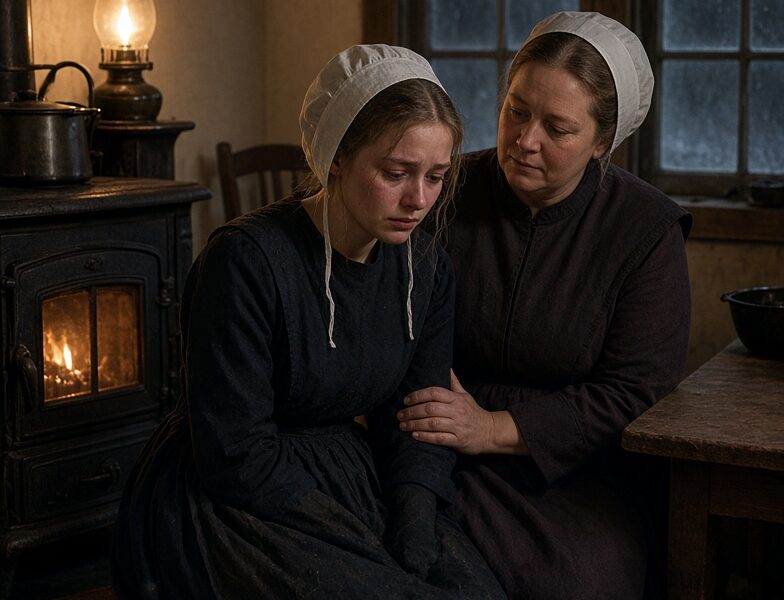
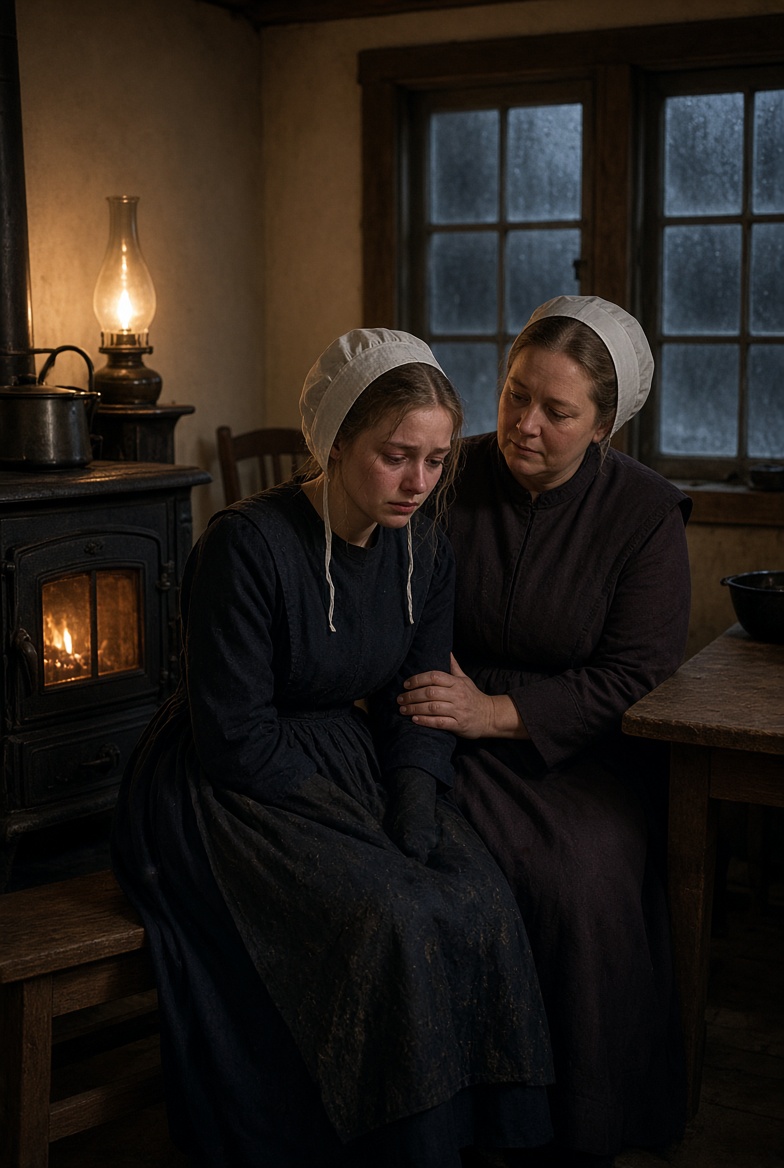
It was just after seven in the evening, cold enough that the windows had gone cloudy around the edges, and Mother was standing beside the table with both hands pressed flat against the wood. My sister Anna was sitting on the bench near the stove. Her bonnet was still on, but one tie had come loose and hung against her shoulder. She had been crying so long that her face looked almost blank.
Then she whispered, “Please don’t send me back.”
Mother did not answer her right away. None of us did.
And then, before anybody could say another word, there were three hard knocks on the front door.
My name is Katie, and I grew up in an Old Order Amish family, where marriage was treated as something serious, permanent, and larger than the two people inside it. I share these stories because there are things about our lives that are easy to misunderstand from the outside. And there are also things that can be hard to name when you are living inside them.
If you have ever watched someone you love ask for help while the whole room was trying to decide what was right, tell me in the comments what you think you would have done.
My Sister Anna
Anna was four years older than me. When she married Samuel, I was still young enough to think marriage mostly meant quilts, new dishes, a crowded wedding meal, and a house that suddenly belonged to two people instead of one.
Samuel had always seemed quiet to me—not shy, just careful with his words. He worked hard, kept his clothes neat, and never raised his voice around our family before the wedding. Father respected him because he did not waste money and because he could repair almost anything with an axle or a wooden wheel. Mother liked that he came from a family known for being dependable.
For the first months after Anna married him, she came home every few weeks. Sometimes she brought bread, sometimes eggs. Once she brought a little jar of apple butter because she said Samuel did not care for it and she knew I did.
She looked tired, but married women often looked tired to me then. There was always work—laundry by hand, meals, garden, cleaning, sewing, church visits, helping family. I did not know how to tell the difference between ordinary tiredness and the kind that changes a person.
The First Signs
The first thing I noticed was that Anna stopped laughing before she finished a laugh. She would start, then look toward the window or the door as if she had remembered something.
At first, I thought I was imagining it. Then I began seeing other little things. She asked Mother if it was wrong for a wife to want one afternoon at home instead of visiting her husband’s relatives. She asked whether a woman was supposed to tell her husband every time she spent even a small amount of household money. She asked whether a husband could decide who his wife was allowed to visit without him.
Mother answered carefully. She believed deeply in marriage, so did Father. Their own marriage was not perfect, but it was steady. They had arguments behind closed doors, and then the next morning Father would carry water before Mother asked, or Mother would put an extra piece of pie beside his plate without saying anything. I grew up thinking that was what a disagreement looked like—two stubborn people still making room for each other.
With Anna and Samuel, it seemed different.
The Afternoon of the Pears
One afternoon in late autumn, Anna came to help us can the last pears. Samuel brought her and said he would return at four.
At three-thirty, she was already washing her hands.
“You have time,” I told her. “He said four.”
She looked at the clock and shook her head. “I want to be ready.”
There was something in the way she said it that made me stop peeling the pear in my hand. When Samuel’s buggy came up the lane, Anna had her coat on before he reached the porch.
Mother noticed, too. I saw it in her face. After they left, Mother said, “A wife should be glad to see her husband come.”
I waited.
Then she added very quietly, “She should not be afraid to keep him waiting five minutes.”
That was the first time I knew Mother was worried.
Worry Is Not Action
Still, worry is not the same thing as action. In our community, you did not step into another marriage quickly. Marriage carried privacy with it. There were elders. There were parents. There were ways of speaking about trouble that often started with patience, prayer, forgiveness, humility, and trying again.
Those words can be good words. I still believe that. But good words can become heavy when they are given to only one person.
That winter, Anna visited less. When we saw her at church, she stayed close to Samuel. When women gathered in the kitchen after the service, she answered questions with short sentences. She said she was fine. She said they were busy. She said the cold had made the roads difficult.
All of those things were true. But truth can hide inside truth.
The Night She Came Home
The evening she came home began with sleet. I remember because it made a dry ticking sound against the kitchen window. Father and my younger brother were in the barn finishing chores. Mother was slicing potatoes. I was sewing a cuff back onto one of Father’s work shirts. The lamp was already lit even though it was not yet supper time because the sky had gone dark early.
Then someone knocked once—not hard, just one small knock.
Mother opened the door and Anna was standing there. She had walked. Samuel’s farm was more than three miles away. Her skirt was wet nearly to the knees. Mud had dried in streaks along the hem. She had no gloves. Her hands were red and stiff from the cold.
Mother did not ask a question at first. She just pulled her inside and shut the door.
Anna looked at me. Then she looked at Mother.
“I need to stay tonight.”
Mother took off Anna’s wet shawl and hung it near the stove. “What happened?”
Anna said nothing.
Mother asked again. “What happened, Anna?”
That was when my sister’s mouth started trembling. She sat down at the table and covered her face with both hands. I had never seen Anna cry like that. I had seen her cry at Grandmother’s funeral. I had seen her cry after a calf died that she had bottle-fed for weeks. Those were tears that came out of a person because something hurt.
This was different. She was trying not to make sound.
Mother sat beside her. I remember Mother saying, “You are home now.”
What Anna Told Us
Anna lowered her hands. Then she told us Samuel had not struck her. She made that clear immediately, almost as if she were defending him before we had accused him. He had never hit her with his hand. He had never left a bruise she could point to.
But he had been controlling nearly every part of her day. He decided when she could visit us. He checked what she bought. If she disagreed with him, he would tell her she was being rebellious. If she cried, he would say she was trying to manipulate him. If she asked to be left alone, he followed her from room to room until she answered him the way he wanted.
The worst part, Anna said, was not one terrible thing. It was that there was nowhere inside her own house where she could be at peace.
That sentence stayed with me.
She said Samuel had begun bringing private disagreements to his father and then to a church elder, always telling the story in a way that made Anna sound disobedient. She said each conversation ended with her being told to be more patient, softer in her speech, more willing to submit, more grateful that her husband provided for her.
That afternoon, they had argued because Anna wanted to visit Mother alone. Samuel told her no. Anna said she was going anyway. He stood in front of the door. She waited. He moved away eventually, but he told her that if she walked out, she should understand that she was choosing her family over her husband.
Anna walked out. Three miles in sleet.
Father’s Question
By the time she finished telling us, Father had come inside. He stood near the stove with his hat still in his hand.
Father was not a man who liked family matters discussed loudly. He believed emotions could make people foolish. When we were children, if two of us were arguing, he would make us sit on opposite ends of the room until we could explain the problem without shouting.
He listened to Anna without interrupting. Then he asked one question.
“Are you afraid to go home?”
Anna stared at the table. “Yes.”
Father nodded once.
Mother looked at him. For several seconds nobody spoke. I thought he was going to say she could stay. Instead he said, “We need to speak with Samuel.”
Anna’s head came up quickly. “No.”
Father’s expression changed.
She reached for Mother’s hand. “Please, not tonight.”
Mother said, “Your husband will be looking for you.”
“I know.”
“You cannot disappear from your marriage.”
“I know.”
Mother’s voice was gentle, but I could hear the fear inside it. Not fear of Samuel. Fear of making the wrong decision. Fear of encouraging a daughter to leave a marriage that might still be repaired. Fear of what the church would say. Fear of what the family would say. Fear that protecting Anna for one night might become the first step toward breaking something that could not be put back together.
Anna squeezed Mother’s fingers. “Please don’t send me back.”
That was when I heard her shoes scrape against the floor. She had planted both feet under the bench.
Mother looked at Father. Father looked toward the door.
And then came the knocking.
Three Hard Knocks
Three hard knocks. Anna went white. I had never seen color leave someone’s face so quickly.
Father opened the door. Samuel was standing there with sleet melting on the shoulders of his coat. He looked past Father and saw Anna.
“There you are.”
He said it not angrily. That almost made it worse. He stepped forward as if he expected to come inside and collect something that belonged to him.
Father did not move. Samuel stopped.
“I came to take my wife home.”
Father said, “She does not want to go tonight.”
Samuel’s jaw tightened. “This is between me and my wife.”
Father answered, “She came to my house asking for help.”
Samuel looked at Anna. “You told them.”
Anna did not answer.
He took off his hat, then put it back on again. A small movement—nervous, irritated. “We had an argument, that is all.”
Mother stood beside Anna.
Samuel said, “Anna, get your things.”
My sister whispered, “No.”
I think every person in that room stopped breathing.
Samuel stared at her. “What did you say?”
She looked at him, and this time her voice was stronger. “I said no. I am staying here tonight.”
Samuel looked at Father as though Father had taught her the word. “You are allowing this?”
Father did not answer immediately.
Samuel said, “She is my wife.”
Father finally spoke. “And she is my daughter.”
Seven Words
I can still hear that sentence exactly as he said it. No shouting, no threat—just seven words.
Samuel’s face changed. He said Father was interfering in a marriage. He said Anna was emotional. He said she had embarrassed him by leaving. He said there were proper ways to handle disagreements.
Father listened, then he said, “Coming here was the way she handled it.”
Samuel asked to speak with Anna alone. Anna grabbed Mother’s sleeve. Mother noticed. So did Father.
Father said no.
That was the moment everything shifted. Until then, Mother and Father had been trying to decide what had happened. After that, they were watching what was happening.
Samuel was not yelling. He was not threatening anyone. But every time Anna made a choice, he tried to move around it. If she said she wanted to stay, he spoke to Father. If Father supported her, he appealed to Mother. If Mother stayed quiet, he talked about church expectations. If that did not work, he talked about shame.
And I remember thinking, This is what she meant. No room, no quiet place, no answer that was allowed to remain her answer.
The Door Closes
Samuel stayed on the porch for nearly twenty minutes. Finally, Father told him Anna would remain with us for the night. He said they could speak again the following day with both families present and, if needed, with church leadership too. But Anna would not be forced into the buggy.
Samuel looked at Anna one last time. “You are making this worse.”
Anna began crying again.
Father stepped forward and pulled the door closed.
For a long moment, the only sound was the sleet against the glass. Then Mother sat down beside Anna. I expected her to say something comforting. Instead, she said, “I am sorry.”
Anna looked at her.
Mother’s eyes filled with tears. “I kept telling myself that patience would fix this. I should have listened more closely.”
Anna leaned against her. That was the only time that night Mother cried.
The Next Morning
The next morning, nobody pretended things were normal. Father did chores early. Mother made oatmeal, but Anna barely touched hers. I sat across from her at the table watching steam rise from the bowl.
At one point, she said, “Do you think I am a bad wife?”
I did not know how to answer. I was younger than she was. I had never been married. I had no wisdom to give her. So I said the only true thing I could think of.
“I think you were scared.”
Anna looked down. “That is not an answer.”
“No,” I said. “But I think it matters.”
The Meeting
Later that morning, Samuel returned with his father. There was a long conversation in the front room. I was not part of most of it. I heard pieces from the kitchen. Marriage, duty, respect, anger, misunderstanding, counseling, time apart.
Nobody agreed easily. Samuel wanted Anna home. Anna said she needed several days. His father said couples should not solve disagreements by running back to parents.
Mother answered, “Maybe husbands should not solve disagreements by making their wives afraid to speak.”
The whole room went quiet. Mother was not usually the sharpest voice in a disagreement. Hearing her say that surprised even Father.
The Week That Turned Into Three
By afternoon, it was decided that Anna would stay with us for a week.
A week turned into three.
During that time, Samuel came twice with church elders. Anna met with them, but Father insisted Mother stay in the room. That mattered more than I understood then. Anna had spent months having conversations where she felt outnumbered. Now she had someone beside her who had heard the whole story.
There were no dramatic confessions. Samuel did not suddenly admit that he had been cruel. Anna did not suddenly become fearless. Real life is rarely that clean.
Samuel said he had only been trying to lead his household well. Anna said leadership should not make a wife afraid to ask permission to visit her own mother. Samuel said he wanted respect. Anna said she wanted to be treated like a person whose thoughts still belonged to her.
Those conversations went on for weeks.
Going Back
Eventually, Anna returned home.
I know some people hearing that may wish I could tell you she never went back. Others may believe going back was the right choice. At the time, I did not know what to think.
What mattered was that she did not return the same way she had left. She went back after boundaries had been spoken out loud in front of both families. She would visit us regularly. She would keep some household money without having to account for every coin. If disagreements became overwhelming, she could leave the room and they would return to the conversation later. Private disputes would not automatically become public church matters.
Most important, at least to Anna, was one sentence Father required Samuel to hear: “If she says she is afraid, you stop arguing long enough to ask why.”
What Changed
For a while, things improved. Not perfectly, but noticeably. Anna began visiting again. She stayed until the time she had planned instead of rushing out early. She laughed without looking at the door.
Years later, she told me the night she came home had changed her marriage because it was the first time Samuel understood that her family would not automatically send her back just because he arrived to collect her.
But she also told me something harder. She said it changed her because it was the first time she understood she was allowed to say, “I need help,” before something became unbearable.
That stayed with me even more.
What I Understand Now
When I look back now, I do not think Mother was wrong because she cared about preserving Anna’s marriage. She loved Anna. She also believed marriage was sacred. Those two things were pulling against each other in her heart that night.
The mistake was thinking she had to choose between supporting the marriage and listening to the person inside it.
Sometimes the most loving thing you can do for a marriage is refuse to pretend everything is fine. Sometimes a person needs one night where nobody makes them explain themselves again. One chair, one warm room, one locked door between them and the thing they are afraid of, and someone willing to say, “You can stay.”
I think about Anna sitting near the stove with wet shoes, her bonnet half untied, asking Mother not to send her back. I think about those three knocks. I think about how close we came to treating the knock as more important than the fear on her face.
That is the part I understand differently now. Tradition can tell you how a family is supposed to hold together. Faith can teach patience, forgiveness, humility, and commitment. Those things still matter deeply to me. But none of them require you to stop seeing the person in front of you.
A Question for You
Before I go, I also want to tell you that my new book, The Ninth Day, is out now. It is the first book in The Katie Journals, and if you would like to read it, you will find the link in the description.
If you want more stories about the parts of Amish life that are harder to explain from the outside, you can subscribe and join me here.
And I would really like to know this: If someone you loved came to your door and simply said, “Please don’t send me back,” what would you hope your family would do?









