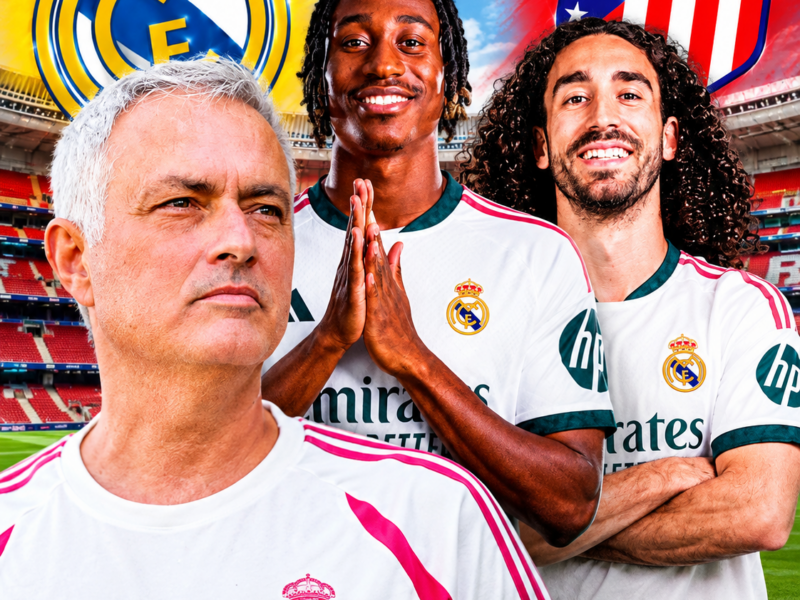
Mourinho’s Real Madrid Walk Into the Metropolitano With Their Title Hopes on the Line: Predicted Lineup, Injury Blow and the One Midfield Gamble That Could Decide the Madrid Derby
Every so often, a league season hands you a Sunday that feels bigger than its place on the calendar.
This is one of them.
Real Madrid are heading to the Metropolitano, the most hostile ground they visit outside Camp Nou, with two weeks of international break waiting on the other side.
Win, and they head into that pause breathing easy, still locked onto Barcelona’s shoulder.
Lose or draw, and those two weeks will feel like a month.
It is only September, and yet this derby has the weight of a cup final.
José Mourinho knows it, the players know it, and the fans certainly know it.
Here is everything you need to know before kickoff: the squad, the injuries, the predicted lineup, the tactical dilemma keeping Madridistas up at night, and why the bench might matter more than the starting eleven.
The Squad Mourinho Has Taken to the Metropolitano
Let’s start with the names, because the matchday squad tells its own story.
In goal, Mourinho has the usual trio: Thibaut Courtois, Andriy Lunin and Sergio Mestre.
The defensive group is deep: Raúl Asencio, Dean Huijsen, Trent Alexander-Arnold, Ibrahim Konaté, Marc Cucurella, Álvaro Carreras, Antonio Rüdiger and Denzel Dumfries.
Midfield is where things get interesting.
Jude Bellingham, Eduardo Camavinga, Federico Valverde, Aurélien Tchouaméni, Arda Güler, Bernardo Silva and Thiago Pitarch are all in the party.
Up front, Mourinho has Vinícius Júnior, Endrick, Kylian Mbappé, Carlos Espí, Brahim Díaz and Yan Diomande.
There isn’t much to debate in the call-ups.
Everyone who is fit has been picked.
The only absentees are the ones nobody expected to see anyway: Éder Militão, Rodrygo and Ferland Mendy, all sidelined with long-term injuries.
The Injury List and the Rodrygo Timeline
Militão is the most encouraging case of the three.
He is already back on the grass working with the ball, which is always the moment a long injury starts to feel finite.
Mendy is recovering little by little, though there is still no return date attached to his name.
Rodrygo is the one generating the most chatter.
The word around Madrid is that he is aiming to return in December, and if it were up to the player alone, mid-December would be the target.
The more realistic and optimistic window, though, is January.
Nobody should be rushing him.
Respecting the recovery timeline matters far more than a few extra weeks of availability.
And frankly, the team isn’t crying out for him right now.
On that flank, Mourinho already has Diomande, Brahim and Endrick, and even Valverde can be deployed there in a pinch.
The real question is whether Rodrygo will count for Mourinho once he is fit again.
The Metropolitano Problem
Now for the uncomfortable part.
Real Madrid do not like this stadium.
Since the Metropolitano opened roughly eight years ago, Madrid have won there only a couple of times.
That makes it the toughest away ground the club has faced over that stretch, behind only Camp Nou, and some would argue the gap between them is razor thin.
Atlético are a different animal at home.
Against Madrid especially, the place transforms.
The noise, the tackles, the edge, the sense that every second ball belongs to the home side: it all combines into something Madrid have struggled to solve for the better part of a decade.
Which brings us to the reason this game matters so much.
Why This Derby Is Bigger Than Three Points
Look at the calendar.
This is matchday seven, and the last game before a two-week international break.
That is a long pause, far longer than the usual week and a half.
If Madrid slip here, those two weeks turn into a slow burn.
Barcelona would likely move six points clear, and the psychological damage would go well beyond the numbers.
Barça look like a team that isn’t planning on dropping points.
The feeling around them is that they could finish with a monstrous total and score goals in absurd numbers.
Madrid, on paper, are considerably stronger than most of the teams in this league.
The trouble is that they have a habit of letting go at the wrong moments.
In a normal week, that kind of habit can be forgiven.
In a week like this one, a slip feels like a lost league.
It’s silly to say a title race is decided in September, but that is exactly how a defeat here would feel.
Winning does the opposite.
It removes the second-most dangerous away trip of the season from the schedule, keeps Madrid attached to the leaders, and sends everyone into the break believing.
There is also a tactical layer.
This match is a real test of Mourinho’s Madrid, and it comes right after the Inter game, which deserves an honest look.
The Inter Reality Check
Madrid beat Inter, and the result was worth celebrating.
But if we are being straight with ourselves, the first half in that game was a beating.
Inter had not lost since March.
They are the reigning Italian champions and a serious, physical, well-organized side.
For long stretches, they were simply better than Madrid.
The Atlético of today is not Inter, but it is the kind of opponent that will expose the same weaknesses if they exist.
That is what makes this match so useful.
It is a chance to see the true level of this team, away from home, against a hostile crowd, with no room to hide.
The Predicted Lineup
Now to the big question: who plays?
The expected eleven has Courtois in goal.
At the back, the projected line is Dumfries at right-back, Cucurella at left-back, and Konaté and Huijsen in the middle.
The midfield double pivot is Valverde and Bernardo Silva.
Bellingham plays behind the striker, Güler operates on the right, Vinícius takes the left, and Mbappé leads the line.
It is a 4-2-3-1 on paper, though as we will see, it doesn’t always play like one.
The defense is the easy part to project, so let’s take it piece by piece.
Dumfries Over Trent, and Why It Isn’t Even Close in Big Games
The right-back spot has been settled since the start of the season.
Dumfries is Mourinho’s man for the big nights.
A derby, a clásico, a Champions League tie against PSG or City: those are Dumfries games.
Trent Alexander-Arnold, meanwhile, gets the smaller occasions.
The trip to Elche was one.
Málaga was another.
Trent plays in those, and he may well feature in more games like them, but when the stakes climb, Mourinho reaches for the Dutchman.
Dumfries is also undervalued going forward.
Remember what he did to Barcelona in the Champions League semifinal in 2025.
He scored twice in that famous 3-3, then assisted Francesco Acerbi’s late equalizer.
That is not a purely defensive full-back.
He may lack the silky delivery Trent has from wide areas, but he is a genuine attacking threat who happens to defend well.
Maybe it is his defending that makes people overlook the rest.
Trent, in the meantime, has been leaving people a little cold lately.
Outside the Málaga game, his performances have been mostly passable, a solid pass mark and nothing more.
That is not nothing, though.
He remains a valuable second-half option when Madrid need a more offensive full-back, particularly if the team is chasing a result.
Mourinho likes to hold that card in reserve.
It is a sensible play, because if you’re losing and bring Dumfries off for Trent, you are theoretically getting better going forward.
Huijsen and Konaté in the Middle
There are no surprises at center-back.
Konaté and Huijsen are the starters, and unless something dramatic changes, they will remain the starters.
This is Mourinho’s pairing, and he has had no reason to break it up.
Which raises a delicious question for later this season.
What happens when Militão returns?
If history is a guide, Militão will come back the way he always does.
Not gradually, not cautiously, but at full power, as if he had never been injured, playing like the best defender in the world in his position.
Then Mourinho will have a real selection problem.
Whom do you drop?
Militão has been hurt more than once, and it is fair to wonder whether this latest injury will leave a mark.
But that is the strange thing about him.
He gets hurt, he recovers, and he comes back as if nothing happened.
He seems made of rubber.
In fact, that is part of the problem: he plays so well on his return that he ends up overused, and then he breaks down again.
For now, it is a problem for another day.
Today, Konaté and Huijsen are the pair.
Cucurella Over Carreras
At left-back, Cucurella gets the nod.
Carreras has been playing more than expected, and he deserves credit for it.
He looked shaky last season, starting well and then fading, with even Fran García reportedly taking his place at one point.
Under Mourinho, though, he looks reborn.
He is a highly usable full-back, and Mourinho clearly sees that.
But for the truly big games, Cucurella is the guy.
That is the pattern, and this derby fits it perfectly.
Carreras is a strong option off the bench or for rotation, and he might well see the pitch on Sunday.
The Midfield Puzzle
Now we reach the part of the lineup that keeps refusing to settle.
The double pivot is where I am least sure of the prediction, and I will be completely honest about that.
The talk around the club is that Mourinho’s preferred pairing for big matches is Tchouaméni and Valverde.
This is a big match, so on paper that should be the choice.
But I don’t think this game calls for it.
I think it calls for Tchouaméni or Valverde, but not both.
Here’s why.
Both are excellent at the physical side of the game.
Both cover ground, win balls and offer energy.
But with the ball, they are plain.
They don’t generate chances, they don’t dictate rhythm, and they don’t control a match.
They are good players to have, but not side by side.
If you pair them, you get two runners and no conductor.
And this match needs someone who can hold the ball.
That is why I lean toward Bernardo Silva next to Valverde.
Bernardo brings touch and composure.
Valverde can then handle the physical duties.
It is the best combination Mourinho has available right now.
The Tchouaméni Argument
That said, the counterargument deserves a fair hearing.
Tchouaméni played well in the first half against Elche next to Valverde.
Yes, it was Elche and not Atlético, but he looked good, and Madrid controlled a decent stretch of the game with him on the pitch.
Mourinho clearly likes him.
I like him too.
He is a legitimately good player, and if you put him next to a creator, like Vitinha or João Neves at PSG, he would do his job beautifully by recovering the ball and covering the ground.
That is his role, and no more.
He is not the type who will unlock a defense with a pass.
What I would love to see, and it is a bit of a wild idea, is a midfield of Tchouaméni and Bernardo with Valverde pushed out to the right.
I know this is not the ideal game to experiment, but it would be interesting to see.
It would give Madrid a purer midfield, with Bernardo pulling the strings and Tchouaméni doing the dirty work.
Maybe that is a conversation for a lower-pressure match.
The Bernardo Silva Mystery
There is a strange subplot around Bernardo that is worth unpacking.
Over the last five games, he has started only one.
He missed the Inter game because of a suspension.
He was on the bench against Málaga, and again against Betis.
Against Rayo, he started but didn’t play the whole match.
And against Elche, he did not play a single minute, even while Madrid were struggling to win the game.
That is odd.
Bernardo is a player who used to play nearly every game at City.
Physically, he is durable.
So why the reduced role?
It is possible Mourinho isn’t fully convinced by him.
It is also possible that Mourinho is simply saving him for a game like this, because not using him against Elche, with the team drawing, looked almost deliberate.
Or it could be the reverse.
If Mourinho starts Tchouaméni in this derby, the logic could be that Bernardo comes off the bench in the second half.
That is why I can’t rule out Tchouaméni starting next to Valverde.
Whichever way it goes, this is the one selection where I would not be shocked to be wrong.
Are Madrid Playing With Two Midfielders?
Here is a reality that deserves to be said out loud.
Madrid essentially play with two central midfielders and four forwards.
Bellingham is more of a forward than a midfielder.
He is superb near the area, and he is at his most comfortable in advanced positions.
Yes, he did play a stunning pre-assist to Mbappé against Elche, but that was still an attacking contribution.
Güler is another player who prefers to operate close to the box.
And then there are Vinícius and Mbappé.
So while the formation is written as 4-2-3-1, in practice it looks closer to 4-2-4.
The two players in the double pivot, whoever they are, carry a heavy load.
And that raises a philosophical question about Mourinho’s approach.
Does he want to control the ball with a more technical midfield, or does he prioritize a defensive shield with Tchouaméni and Valverde, giving up some touch in exchange for security?
Going that way would mean a return to something familiar, and it has its logic.
We will find out in the first ten minutes.
Güler on the Right, and Why He Has Earned It
On the right side of the attack, I expect Arda Güler to start.
There are two reasons.
First, he deserves it.
But more importantly, Madrid are simply better when he plays.
Lately, when Güler leaves the pitch, the team gets worse.
That is not a matter of merit, because in football merit doesn’t decide who plays.
It is about what works, and Madrid work better with him.
His form is spectacular.
Against Elche, he was one of the best players on the pitch and scored the opening goal from a free kick.
Mourinho will likely position him wide on the right, because Bellingham was playing inside against Elche.
In this game, he won’t be able to keep Bellingham in reserve for the second half the way he did against Elche.
This is not that kind of match.
Diomande, meanwhile, is likely to start on the bench.
He is still working his way back into rhythm, and Mourinho looks set to keep him in reserve as an impact substitute.
Vinícius, Bellingham and Mbappé
Up front, the three are as expected.
Vinícius on the left, Bellingham in the hole, Mbappé through the middle.
This is the gala eleven, the lineup Mourinho would field if a clásico were tomorrow.
And yet there is a sense that Mourinho isn’t entirely satisfied with Vinícius.
That is only a feeling, but it is a persistent one.
Against Elche, he took Vinícius off around the seventieth minute and brought on Diomande for the left flank, leaving Mbappé as the center-forward.
If the game isn’t flowing on Sunday, don’t be surprised to see the same move.
It makes tactical sense too.
Diomande is right-footed, which means he is more natural coming in from the left.
He has been effective on the right, but the left is where he might cut inside and do real damage.
I expect to see plenty of Diomande on that flank this season.
The Second-Half Cards
A match like this is often decided by the bench.
Let’s walk through who might come on.
Courtois will play, barring an enormous surprise.
Trent is the option if Madrid are drawing or losing, and Mourinho keeps him for exactly that kind of situation.
Rüdiger and Asencio are the emergency options at the back.
Asencio’s situation is worth watching.
He looks like Mourinho’s fifth or sixth center-back, behind Konaté, Huijsen, Rüdiger and Militão, and possibly even Tchouaméni in that pecking order.
Mourinho did say in preseason that Asencio was the most professional player in the squad, first to arrive and last to leave.
That is a good sign for his character, but on the pitch, he is a substitute for now.
The young Mario Rivas from Castilla was called up only because Asencio was absent earlier, so he doesn’t belong in this conversation.
Carreras could enter, and I wouldn’t mind seeing that.
In midfield, whoever doesn’t start between Tchouaméni and Bernardo will probably be a second-half player.
And then there is Thiago Pitarch.
The Curious Case of Thiago Pitarch
Pitarch hasn’t made his debut this season, and yet he is one of the most intriguing names in the squad.
His departure looked almost certain over the summer.
Racing Santander were linked with him, along with other top-flight clubs.
But he stayed, and the reason is simple: Mourinho asked for it.
That is even more remarkable considering that he did not play a single minute in preseason.
In fact, he arrived at Real Madrid injured after returning from the European Championship with his youth national team.
Still, Mourinho wanted him.
It isn’t surprising to me, because something caught my attention back when Xabi Alonso took over.
Alonso barely used the academy, but Pitarch was the one player he called up almost constantly, particularly early on.
He was on the verge of debuting against Talavera.
Then Arbeloa arrived, called him up as well, and gave him his debut.
He ended up playing against Manchester City and, I believe, against Bayern Munich.
By last season’s end, Pitarch was genuinely important for the team.
To be fair, I don’t think we saw the best of him.
He was a teenager thrown into a Madrid that was caught between wars and short on football, which is not an ideal environment for a seventeen or eighteen-year-old.
Now it is his second season, he has Mourinho’s trust, and the team is in a healthier rhythm.
That matters.
He has personality on the ball.
Sure, he makes mistakes at the back sometimes, but that is because he wants the ball and isn’t afraid of it.
I remember one instance where he was near the edge of the box, lost the ball and gave up a chance, I believe against City.
That fearlessness is exactly what this Madrid midfield lacks.
He might end up being the fluid, calm presence in the middle that this team has been missing.
We will see if Mourinho decides to give him minutes.
The Forwards on the Bench
Up front, Brahim Díaz is the option as an attacking midfielder if Madrid are chasing the game.
On the right flank, Endrick could get the call.
He made his debut against Elche and didn’t look bad.
He doesn’t touch the ball much, but he offers something in the second half, and I was surprised Mourinho used him at all.
The end of that Elche match was chaotic.
Madrid finished with almost everyone up front.
Brahim even ended up playing something like a full-back, and Vinícius had already been withdrawn by then.
If Madrid are behind on Sunday, expect a similar approach.
The Golden Boy of the Second Half: Carlos Espí
And that brings us to Carlos Espí, who might be the story of the season so far.
I said it as soon as he arrived: this is a striker who can give you fifteen points a season.
He has already given four in six matchdays.
He scored the goal against Espanyol that turned a draw into a win.
He scored against Elche to do the same again.
Two goals, four points, and he has barely played.
That is remarkable.
And notice what kind of goals they are.
These are not garbage-time goals in games that were already over.
He has scored the goals that won matches.
Yes, the latest one was a tap-in, an easy finish, but somebody has to be there.
Great strikers are always in the right place.
That is what wins leagues.
What makes it even better is his age.
He is very young, and his career is only just beginning.
Compare that with someone like Joselu.
I loved Joselu and will always be grateful for the season he gave us.
But he arrived at thirty-something, and he left mainly for financial reasons, because the offer from Qatar was life-changing.
You can’t blame him for that.
Espí, being so young, gives Madrid a long runway.
The same goes for what he brings to the league.
La Liga isn’t only about world-class stars like Mbappé or Endrick.
It also needs strikers in the mold of Espí, Moriki or Vodimir, forwards of the mud, who battle center-backs and always know where to stand.
Those are the players who win you games on rainy nights in small stadiums.
Espí is a pure La Liga forward, and this signing has been worth every cent.
The Opponent: An Inconsistent Atlético Who Are Always Dangerous
Now for the hosts.
Atlético arrive as they often do, which is to say inconsistently.
They sit in the upper half of the table, as their squad demands, but they tend to string together a couple of good results and then slip up with a draw or a defeat.
Yet none of that really matters against Madrid.
Last season, Atlético arrived in mediocre form, and Madrid came in flying under Xabi Alonso, having won something like ten or fifteen straight.
Atlético scored five.
It was a horrible night.
Alonso even started Bellingham while he was carrying a knock, and the whole team performed terribly.
That is what this fixture does.
The form book goes out the window.
At home, Atlético become a different team against Madrid.
They are aggressive, physical and emotionally charged.
Expect a war, with a hostile stadium and a referee whose tolerance for contact will be tested right from the opening whistle.
What Mourinho Must Get Right
This is where the game will be decided.
In a match like this, Madrid can’t afford passive spells.
They have to control the tempo, and that starts in midfield.
If Mourinho leans toward the defensive midfield, with Tchouaméni and Valverde, Madrid may be safer but less creative.
If he chooses Bernardo, he gains composure and touch and loses a bit of bite.
Neither choice is perfect.
The key detail will be how well Güler and Bellingham can link with Mbappé and Vinícius.
Those four are the core of Madrid’s attack, and everything flows from their combinations.
And if things aren’t going well, Mourinho has the perfect tools on the bench.
Diomande can replace Vinícius on the left.
Espí can come in and do what he does.
Trent can add another attacking layer at right-back.
That is a real luxury.
The Verdict
So, what is going to happen?
There is a version of this game where Madrid struggle, the crowd grows louder, and Atlético grind out a result.
There is another version where the team’s quality shows, Mourinho’s second-half changes bite, and Madrid leave with the three points.
Honestly, both are possible.
But one thing is certain: Madrid have to win.
Not to prove something to the fans, and not just for derby pride.
They have to win to stay in the title race, to avoid falling behind a Barcelona side that looks relentless, and to make the next two weeks bearable.
The lineup is mostly settled, apart from the midfield question.
The bench is strong.
The injuries are manageable.
The only thing left is the match itself.
It is going to be a war, and this is precisely the kind of night that shows what a team is made of.
For Real Madrid, that moment arrives on Sunday.









