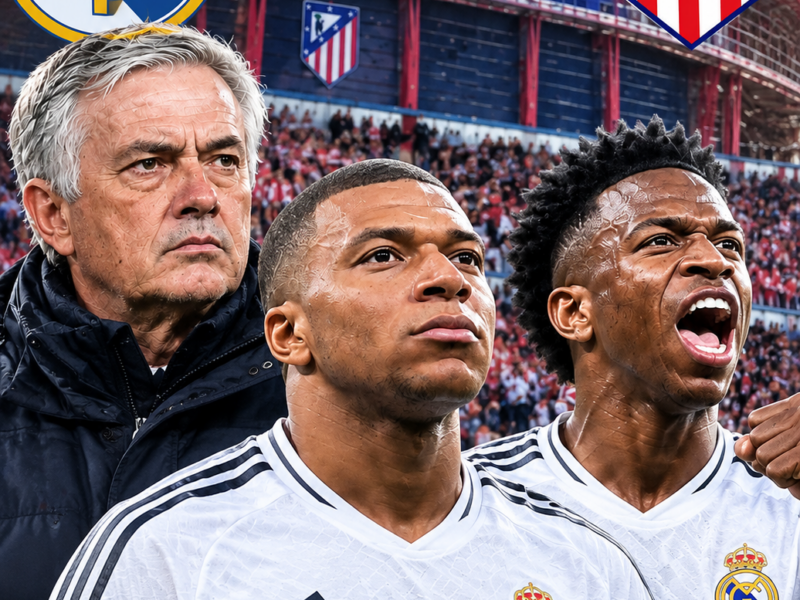
Mourinho’s Bombshell Warning Before the Madrid Derby: Barcelona’s Laporta Exposed Over ‘Club Estado’ Lies, Real Madrid’s Under-20 Glory, and the Kylian Mbappé Deal Shaking Up World Football
There is a moment in every football season when the noise gets so loud that somebody has to step in and separate fact from fiction, and this week, that moment arrived with a vengeance.
A president stood in front of cameras and dared to lecture one of the most decorated clubs in the world about financial ethics, and almost nobody stopped to ask whether he had any right to say it.
Meanwhile, across town, a teenage academy side lifted a trophy in front of 53,000 roaring fans, a global superstar quietly walked away from the brand that made him famous, and a manager who has already tasted defeat this season delivered a message that felt less like a press conference and more like a declaration of intent.
By the time you finish reading this, you will understand why this week in Spanish football has been anything but ordinary, and why Sunday’s derby against Atletico Madrid suddenly carries so much more weight than a simple three points.
Let’s start with the story that lit the fuse.
Joan Laporta’s Stunning Claims About “Club Estado” Real Madrid
It takes a special kind of audacity to stand in front of a room full of journalists and label a rival institution a “state club” while conveniently ignoring your own history.
Yet that is exactly what Barcelona president Joan Laporta did this week, framing his club as some kind of scrappy underdog fighting against corporate giants and state-backed institutions, a narrative that plays incredibly well inside the Barcelona bubble but collapses the moment anyone checks the historical record.
The phrase “club estado,” or “state club,” has become a favorite weapon for Laporta whenever he wants to paint Real Madrid as an entity propped up by political power rather than sporting merit.
It is a clever piece of messaging, and inside certain corners of Barcelona’s fanbase, it lands perfectly every single time.
The problem is that it simply does not hold up to scrutiny.
Real Madrid’s history with land rezoning around the old Ciudad Deportiva is well documented, tied to decisions made by Madrid’s city council decades ago that allowed the club to relocate its training facilities and monetize the resulting real estate.
Laporta and his allies love to point to this as proof of political favoritism.
What they conveniently leave out is that Barcelona itself has benefited from rezoning decisions on no fewer than five separate occasions throughout its history, a detail that rarely, if ever, makes it into Laporta’s public remarks.
Five times.
Not once, not twice, but five separate rezonings that directly benefited the Catalan club, including one tied to the old Les Corts stadium that was, by historical accounts, absolutely critical to Barcelona’s survival during a financially fragile period.
There was even a documented attempt at a sixth rezoning that did not materialize.
These are not conspiracy theories or fringe talking points invented by rival fans looking to score cheap points online.
They are matters of public record, easily verified by anyone willing to spend a few minutes doing basic research instead of simply absorbing whatever narrative gets fed to them through social media.
And that, really, is the heart of the problem.
Why the Narrative Machine Keeps Working
Modern football fandom lives inside an echo chamber, and nowhere is that more obvious than in the way certain claims get repeated until they harden into accepted truth regardless of their accuracy.
Send out a message painting your club as the noble underdog standing up to a corrupt establishment, and within hours it gets chopped up, repackaged, and blasted across every social platform imaginable, absorbed uncritically by supporters who have no interest in fact-checking anything that flatters their side.
It works like a meat grinder, taking raw narrative and turning it into digestible content that gets consumed without a second thought.
The most frustrating part of all this is the selective outrage that follows.
Imagine, for a moment, that it had been Real Madrid making yearly payments to a vice president of Spain’s refereeing committee rather than Barcelona.
Picture the reaction had those payments continued for years, only coming to light through investigative reporting rather than voluntary disclosure.
There is little doubt that the very same voices now cheering Laporta’s “club estado” rhetoric would be demanding investigations, calling for points deductions, and camped outside government buildings demanding the competition be suspended entirely.
Yet when it is Barcelona at the center of the so called Negreira case, involving years of payments to a former vice president of Spain’s refereeing technical committee, the reaction from large swaths of that same fanbase has been muted at best, dismissive at worst.
This is not about attacking Barcelona as an institution or pretending Real Madrid has never benefited from favorable circumstances.
It is about basic consistency, about applying the same standard to both clubs rather than manufacturing outrage only when convenient.
Historical facts do not change based on which club is more popular on a given social media trending list, and pretending otherwise does a disservice to anyone who actually cares about the sport’s integrity.
The Real Motive Behind Laporta’s Comments
None of this rhetoric exists in a vacuum, and there is a very obvious explanation for why it keeps resurfacing at particular moments.
Barcelona is currently navigating a genuinely precarious financial situation, with reports circulating that the club may need to secure yet another loan simply to finish construction on the renovated Camp Nou, now carrying the Spotify naming rights deal.
The stadium project has already run well past its original timeline and budget, and every fresh headline about additional financing requirements chips away at the feel good story the club’s leadership wants supporters to believe.
Deflection is a time tested strategy in football politics, and few executives understand that better than Laporta.
When the financial picture looks shaky, when questions about mounting debt and mortgaged future revenue streams start dominating conversation, what better way to change the subject than to manufacture a rivalry driven controversy that redirects the entire fanbase’s attention toward Real Madrid instead?
It is a tactic that has worked before, and it will likely work again, right up until the moment results on the pitch stop cooperating.
Because that is really the crux of it.
Right now, Barcelona is enjoying strong form, unbeaten domestically, scoring goals freely, and riding a wave of momentum that makes it easy to ignore the financial storm clouds gathering overhead.
But football has a brutal way of exposing everything once results turn sour.
The moment Barcelona hits a rough patch, whether that comes this season or next, all of these financial questions, all of these mortgaged future seasons through complex financial leverage mechanisms, will come roaring back into the spotlight with far less sympathy from a fanbase that will no longer have on field success to hide behind.
A Very Different Mood in Madrid: Under-20 Glory
While Barcelona’s leadership was busy manufacturing controversy, Real Madrid had genuine reasons to celebrate, and this particular one deserves far more attention than it is likely to receive.
Real Madrid’s Under-20 side captured the Intercontinental Under-20 championship this week, defeating Wydad’s youth side by a scoreline of three goals to one in front of a genuinely staggering crowd of 53,000 fans at the Santiago Bernabeu.
Let that number sink in for a moment, because a youth tournament final drawing over fifty thousand supporters through the turnstiles is not something that happens at most clubs anywhere in the world.
It speaks to the depth of the connection Real Madrid’s fanbase has with its academy system, often referred to affectionately as “La Fabrica,” the factory, a nickname earned through decades of producing talent that has gone on to shape the club’s first team and, in many cases, the global game itself.
The scenes inside the stadium reportedly matched the energy of a major first team fixture, with supporters treating the occasion with the seriousness it deserved rather than dismissing it as a mere formality.
For a club that has occasionally been criticized for prioritizing marquee signings over homegrown development, this kind of turnout sends a powerful message about where the fanbase’s priorities genuinely lie.
The match itself was not without controversy.
By multiple accounts, Wydad’s youth side approached the final with a level of physicality that crossed well beyond the boundaries of fair competition, ultimately finishing the match with three players sent off, a number that could easily have climbed higher had the officials been stricter with several other reckless challenges.
Those who have followed Wydad’s youth setup through previous rounds of the tournament suggested this was not an isolated incident but rather a pattern of aggressive, borderline reckless play that had characterized their run to the final.
Whatever the explanation, it made for an ugly spectacle at times, with tackles that had little to do with winning the ball and everything to do with intimidation.
Real Madrid’s young side, to their credit, weathered the storm.
Despite facing a talented opponent that had clearly earned its spot in the final through genuine ability, Madrid’s players maintained their composure, relied on superior technical quality, and capitalized once numerical advantage tilted decisively in their favor as red cards mounted against Wydad.
It was, by every account, a hard fought and deserved victory that showcased both the resilience and the technical polish of Real Madrid’s academy pipeline.
The Broader Conversation About Real Madrid’s Academy
This victory naturally reopens a conversation that has simmered around Real Madrid’s youth development system for years now.
There is a widely held belief, one shared even among optimistic voices inside the club’s fanbase, that Real Madrid possesses the finest academy talent pool in world football, a claim backed up by the sheer volume of technically gifted young players moving through the ranks year after year.
Where the conversation gets more complicated is around what happens to that talent once it reaches the doorstep of the first team.
The honest assessment is that Real Madrid’s pathway from academy standout to first team regular remains far from optimal.
Rather than functioning purely as a pipeline toward first team minutes, the academy has increasingly become a revenue generating operation, with the club selling off promising talents to other European sides and retaining significant sell on clauses that guarantee future income.
This year alone, Real Madrid reportedly generated substantial revenue from academy sales, including deals structured with fifty percent sell on clauses attached, turning player development into as much a financial strategy as a sporting one.
There is nothing inherently wrong with this approach from a pure business standpoint.
Every major club needs sustainable revenue streams, and academy sales represent a low risk, high margin way of generating income compared to relying entirely on ticket sales or sponsorship deals.
But there remains a legitimate hope among many observers that this financial strategy should not come entirely at the expense of actually promoting more academy graduates directly into the first team picture.
It is not an unreasonable ask, nor some fantastical demand disconnected from reality, to want the world’s best academy talent pool to produce a few more first team regulars rather than functioning primarily as a farm system for other clubs across Europe.
Kylian Mbappe’s Blockbuster Move Away From Nike
Shifting gears entirely, one of the biggest off field stories in world football this week had nothing to do with a match result and everything to do with a sneaker deal.
Kylian Mbappe has officially ended his long standing partnership with Nike, the brand that had sponsored him since he was a teenage prospect breaking through at Monaco, in favor of a groundbreaking new agreement with the sportswear company On.
This is not simply a matter of the World Cup winning forward switching which logo appears on his boots.
Reports indicate that Mbappe’s new arrangement includes an equity stake in On itself, transforming him from a paid endorser into a genuine stakeholder with skin in the company’s long term growth and success.
Given Mbappe’s well documented business acumen away from the pitch, this should come as little surprise to anyone who has followed his career closely.
This is a player who has consistently made calculated, forward thinking decisions regarding his image rights, his commercial partnerships, and his broader brand as a global icon well beyond the confines of football itself.
One name that has surfaced repeatedly in connection with this deal is Thierry Henry, the Arsenal and France legend who has maintained a close relationship with Mbappe and his family for years.
Henry’s involvement, whether as an advisor, a connector, or simply a trusted voice in Mbappe’s inner circle, appears to have played a meaningful role in facilitating this transition.
It is a fascinating example of how deeply intertwined football’s biggest names have become with the broader business and investment world, where playing careers increasingly serve as launching pads for far more ambitious commercial ventures.
From a purely financial standpoint, the numbers involved in this shift are described as substantial, reflecting both On’s ambition to compete more aggressively in the football and lifestyle apparel space and Mbappe’s own leverage as arguably the most marketable active footballer on the planet.
Whether this move ultimately pays off in the way both parties hope remains to be seen, but there is little question that it represents one of the more significant athlete brand partnerships to emerge in recent memory.
France’s Squad News and Mbappe’s Best Position
Staying on the Mbappe theme, French national team manager Didier Deschamps recently announced his latest squad selection, one that included several familiar Real Madrid faces alongside the captain himself.
Eduardo Camavinga, Aurelien Tchouameni, and Ibrahima Konate all earned call ups alongside Mbappe, reinforcing just how significant Real Madrid’s contribution to the current French national setup has become.
Deschamps also offered some interesting insight into how he views Mbappe’s optimal role within the team’s attacking structure.
According to the manager’s comments, Mbappe possesses the rare versatility to operate effectively across all three forward positions, capable of playing as a central striker, a right winger, or his more traditional role cutting in from the left flank.
Deschamps specifically noted his personal preference for deploying Mbappe on the left, describing it as the forward’s most natural habitat, the space where his instincts and movement patterns feel most instinctive rather than learned.
That said, the manager also acknowledged that Mbappe has grown increasingly comfortable operating as a central striker over recent seasons, a transition that has coincided with his move to Real Madrid and the tactical demands of playing through the middle in Xabi Alonso’s system.
This kind of positional flexibility is precisely what makes Mbappe such a valuable asset for both club and country, allowing managers to adjust their tactical setup around opposition weaknesses without sacrificing his effectiveness.
Whether Real Madrid continues to deploy him centrally or shifts him back toward the flank in specific matchups will likely remain a fluid decision throughout the season, dependent on opponent, personnel availability, and tactical matchups.
The Transfer Saga Brewing Between Madrid and Barcelona
Away from international duty and sponsorship deals, both Real Madrid and Barcelona find themselves reportedly circling the same young talent currently on Manchester United’s books.
The latest reports suggest representatives from the player’s camp have traveled to Barcelona for discussions, though the situation remains fluid with both Spanish giants said to be in active negotiations.
Earlier reporting had suggested Real Madrid held a clear advantage in the race for this rising talent, but the picture has evidently shifted in recent days, with Barcelona now appearing to be a genuinely competitive suitor rather than a distant afterthought.
This kind of transfer tug of war between Spain’s two superpowers is nothing new, but it does highlight an interesting philosophical difference in how each club typically approaches young talent acquisition.
Barcelona, driven partly by financial necessity given its ongoing debt situation, has increasingly leaned toward developing and promoting its own academy graduates rather than committing significant transfer fees to established young talents from rival academies.
This preference for internal development over external investment could ultimately shape how aggressively Barcelona pursues this particular target compared to Real Madrid, which has shown more willingness in recent windows to pay premium fees for proven young talent rather than relying solely on organic development.
How this particular transfer saga resolves remains genuinely uncertain, and supporters on both sides should brace for a story that likely develops gradually over the coming weeks rather than resolving immediately.
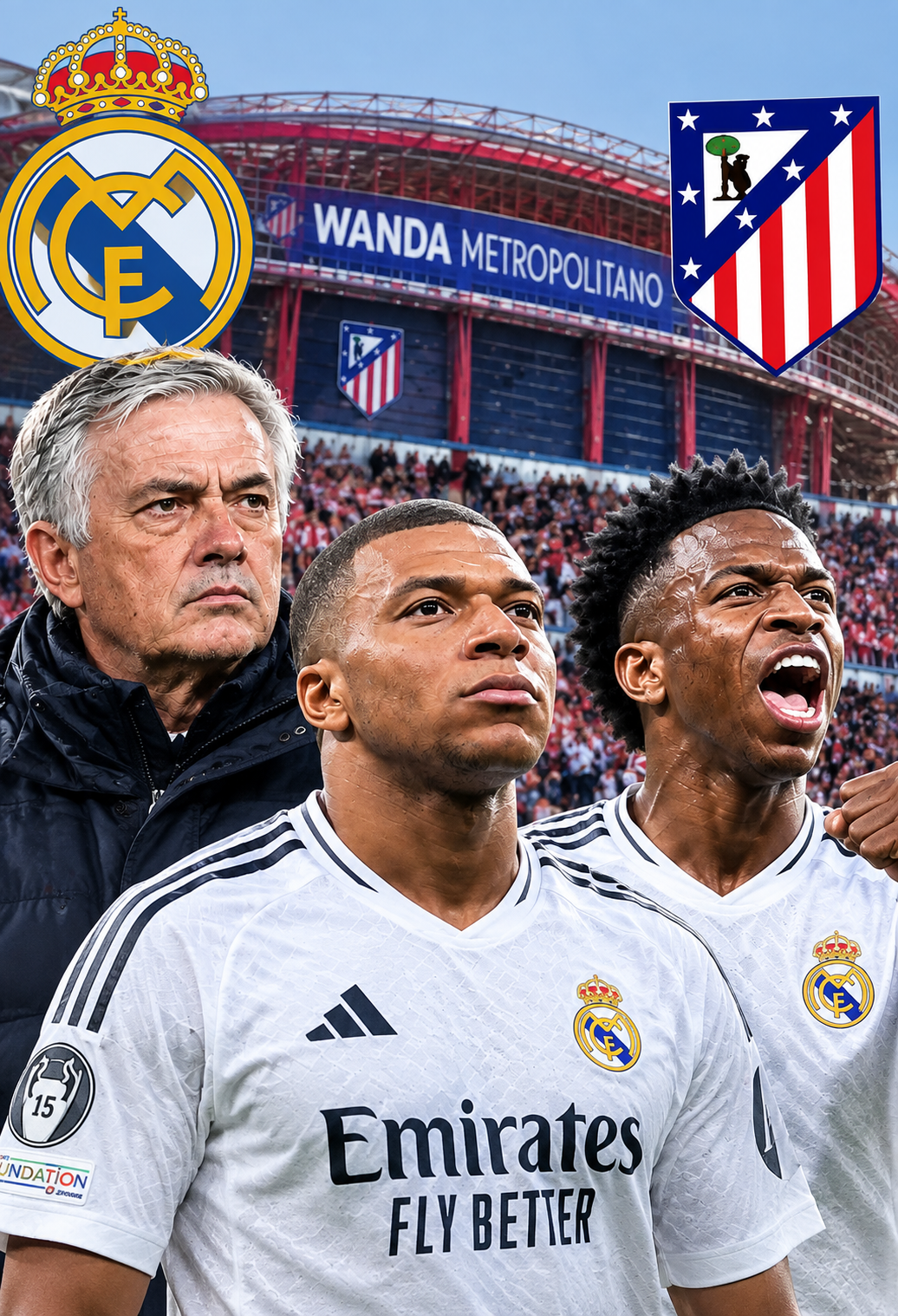
Setting the Stage: Real Madrid vs Atletico Madrid
Now we arrive at the fixture that has been looming over this entire week, a derby matchup against Atletico Madrid that carries far more emotional and tactical weight than a typical league fixture between crosstown rivals.
To understand why, you have to rewind to last season’s corresponding fixture, a match that ended in a thoroughly humbling five two defeat for Real Madrid at the hands of Diego Simeone’s side.
That result did more than simply cost Real Madrid three points.
It marked a genuine inflection point in Xabi Alonso’s managerial trajectory at the club, exposing tactical vulnerabilities and generating friction that would continue to simmer throughout the remainder of that campaign.
There were legitimate grievances about officiating decisions that went against Madrid during that match, mistakes that compounded an already difficult night, but the club’s own performance also deserves genuine scrutiny rather than blame being placed entirely on the referees.
Now, with Jose Mourinho having returned to take charge of Atletico Madrid, this fixture takes on an entirely fresh dimension.
There is a particularly interesting subplot buried in the timing of this matchup.
When Xabi Alonso took his side into last season’s derby, he arrived with an unbeaten record intact, a clean slate that added extra shine to what was, at that point, a promising start.
Mourinho, by contrast, walks into this fixture having already suffered a defeat this season, meaning the psychological framing around this match is considerably different from twelve months ago.
For Mourinho personally, many view this upcoming derby as his first genuine litmus test in his new role, an opportunity to demonstrate whether his tactical approach can trouble a Real Madrid side that, on paper at least, possesses significantly more individual quality across the pitch.
The Vinicius Question Looms Large
No conversation about this upcoming derby feels complete without addressing the ongoing questions surrounding Vinicius Junior’s form and mentality this season.
There is a widespread and completely understandable hope among Real Madrid supporters for what has affectionately become known as “Vini Prime” to make a return, referencing the electrifying, unstoppable version of the Brazilian winger that terrorized defenses during his peak seasons.
The reality of where Vinicius currently stands relative to that standard is more complicated.
For that explosive version of Vinicius to reemerge consistently, there are certain fundamentals that need addressing, starting with a renewed focus on physical conditioning and maintaining consistent mental sharpness match after match.
These are not unreasonable expectations to place on a player of his caliber, but rather baseline professional standards that any world class talent operating at his level should be striving to meet consistently.
The hope among many close observers of the club is that this derby against Atletico Madrid, given its heightened stakes and emotional charge, could serve as exactly the kind of moment Vinicius needs to reset and rediscover his rhythm ahead of the upcoming international break.
A strong, decisive performance here would send Vinicius into national team duty with genuine momentum rather than lingering questions about his form, and few stages provide better motivation than a fiercely contested derby against a manager and a club he has clashed with memorably in the past.
Mourinho Stays Coy, But the Predicted Lineup Takes Shape
True to his well established reputation for controlling the narrative around his teams, Mourinho declined to reveal any specifics about his tactical approach when questioned by journalists ahead of the fixture.
However, reporting around Real Madrid’s likely starting eleven has painted a fairly clear picture of how Xabi Alonso intends to line up his side.
According to multiple reports, Arda Guler is expected to start on the right wing, while Jude Bellingham slots into the number ten role behind the front line, a configuration that would leave Rodrygo or Franco Mastantuono, depending on interpretation of the reported name Diomande, out of the starting lineup entirely.
This particular setup places significant emphasis on the partnership between Guler and Bellingham working in tandem to unlock Atletico’s typically well organized defensive structure.
Simeone’s sides have historically been notoriously difficult to break down through conventional means, relying on compact defensive shape and disciplined positional discipline to frustrate even the most talented attacking units.
Breaking through that kind of defensive wall requires exactly the sort of creative unpredictability that both Guler and Bellingham can provide when playing at their best, combining technical quality with the vision to find pockets of space between defensive lines.
Ultimately, the collective hope is that this midfield creativity translates into service for both Vinicius and Mbappe, the two attackers whose form and sharpness will likely determine whether Real Madrid can finally exorcise the demons of last season’s humbling defeat.
Inside Mourinho’s Revealing Press Conference
Perhaps the most substantively interesting development of the entire week came not from Real Madrid’s camp but from Mourinho’s own press conference ahead of this derby.
When pressed by reporters eager to draw comparisons between Barcelona’s excellent unbeaten form and Real Madrid’s more uneven start to the season, Mourinho offered a response that managed to be both diplomatically measured and quietly pointed at the same time.
His message was direct: he expressed concern about Barcelona playing better football currently than Real Madrid, but emphasized that historically, Real Madrid does not compare itself to anyone else.
According to Mourinho, Real Madrid must fundamentally measure itself against its own standards rather than fixating on what a domestic rival happens to be doing in any given moment.
He made clear he had no intention of drawing direct comparisons to any other club, preferring instead to focus discussion on his own team, its existing shortcomings, and the areas requiring genuine improvement moving forward.
There was a subtle but unmistakable dig buried within his broader comments as well.
Mourinho noted that since returning to Madrid, he has found it strikingly rare to hear anyone say anything genuinely positive about his team, a comment that reads as both a defense of his players against what he perceives as excessive external criticism and a pointed jab at the broader media narrative surrounding his tenure so far.
This is classic Mourinho behavior, positioning himself firmly as a protector of his squad, deliberately shielding his players from unfavorable media comparisons while simultaneously reframing the broader conversation entirely on his own terms.
From a philosophical standpoint, there is genuine merit to his core argument.
Real Madrid’s stature as arguably the most successful and historically significant club in world football means that measuring success purely relative to a domestic rival’s current form somewhat undersells the institution’s own standards and expectations.
The natural, healthiest benchmark for a club of Real Madrid’s magnitude should always be its own historical performance levels and its own evolving standards of excellence, not simply whatever Barcelona happens to be doing in a given month.
That said, the intensity of the Barcelona Real Madrid rivalry inevitably pulls conversations toward direct comparison, regardless of how much any individual manager might prefer to avoid that framing.
It is simply the nature of Spanish football’s most storied rivalry, one where every result, every transfer, and every managerial comment gets filtered through the lens of how it measures up against the other side.
Mourinho’s Fascinating Tactical Insights on Defensive Blocks
Beyond the more headline grabbing quotes about Barcelona comparisons, Mourinho also offered a genuinely fascinating tactical breakdown regarding his evolving philosophy on defensive structure, one that deserves far more attention from serious football analysts than it is likely to receive.
When asked whether his thinking on deep defensive blocks had shifted over time, Mourinho gave a nuanced answer that revealed considerable tactical sophistication.
According to his explanation, his approach to defensive structure does not change based on some fixed philosophical preference, but rather adapts entirely based on the specific qualities and characteristics of the players available to him at any given time.
He referenced his time managing Inter Milan as a specific example, explaining that during that period, his squad possessed the discipline and defensive solidity to comfortably maintain a deep defensive block for the full ninety minutes without conceding, a foundation that ultimately helped carry that Inter side to Champions League glory alongside considerable individual quality throughout the squad.
That particular Inter team, by Mourinho’s own description, was resilient, defensively airtight, and built around a level of collective solidity that made deep block defending not just viable but genuinely effective as a core tactical identity.
It stands as one of the more celebrated examples in modern football history of a deep, disciplined defensive structure producing sustained continental success.
Mourinho went further, emphasizing that knowing how to defend effectively in a deep block remains an essential skill for any top level team, regardless of overall tactical philosophy or preferred style of play.
His reasoning centers on the unavoidable reality that even the most attacking, possession dominant teams will inevitably find themselves needing to defend deep during specific stretches of specific matches, whether due to fatigue, numerical disadvantage, or simply an opponent applying sustained pressure.
Even if that defensive posture only lasts ten minutes within an otherwise dominant performance, Mourinho stressed that teams absolutely need the tactical literacy and discipline to execute it competently when the moment demands it.
This is an area where Real Madrid has reportedly struggled at various points this season, making Mourinho’s comments feel almost like a subtle scouting report on his upcoming opponent, whether intentional or not.
Interestingly, Mourinho has also spoken previously about his broader preference for high pressing and aggressive ball recovery in advanced areas of the pitch, suggesting his tactical outlook is far from rigidly defensive by default.
Rather, what emerges from his comments is a picture of a manager who values tactical flexibility above all else, believing that truly elite teams need what might be described as a kind of tactical bicephaly, the capacity to switch fluidly between aggressive high pressing and disciplined deep block defending depending on match context and opponent quality.
This flexibility becomes especially crucial against elite opposition capable of exploiting even brief lapses in defensive organization, though there is a legitimate counterargument that against mid table opposition, teams should generally aim to dominate through proactive pressing rather than retreating into unnecessarily passive defensive postures.
Whatever the broader philosophical debate, Mourinho’s specific point about Real Madrid needing to sharpen its own deep block defending skills feels particularly relevant given documented defensive struggles the team has experienced at various points this season.
By his own admission, this is an area actively being addressed on the training ground, suggesting Real Madrid’s coaching staff is well aware of the deficiency and working deliberately to correct it before it becomes a more costly, systemic problem.
Putting It All Together Ahead of Derby Day
Stepping back and surveying everything that unfolded this week, a clear narrative thread emerges connecting these seemingly disparate stories.
Barcelona’s leadership continues manufacturing external controversies partly as a mechanism for deflecting attention away from serious underlying financial vulnerabilities that will eventually demand a reckoning regardless of how successful the team remains on the pitch in the short term.
Real Madrid, meanwhile, finds itself navigating its own set of challenges, from academy development philosophy debates to genuine questions about Vinicius Junior’s current form, all while preparing for what promises to be a pivotal derby fixture against a well organized, historically difficult Atletico Madrid side now under Mourinho’s stewardship.
The stakes extend well beyond simple league standings.
For Mourinho, this represents an early opportunity to establish tactical credibility against a superior talent pool through disciplined game management and strategic acumen.
For Xabi Alonso and his players, particularly Vinicius, this derby offers a genuine chance to erase the painful memory of last season’s five two humiliation and enter the international break carrying momentum rather than lingering doubt.
Add in the broader subplots, from Mbappe’s blockbuster commercial pivot away from Nike toward On, complete with genuine equity stakes reflecting his business savvy off the pitch, to the ongoing transfer tug of war for a young Manchester United talent that has both Madrid and Barcelona circling, and you have all the ingredients for a week that will continue generating conversation long after the final whistle blows on derby day.
Whatever your allegiances, whatever side of the Barcelona Real Madrid divide you find yourself on, there is no denying that Spanish football right now is delivering drama on every conceivable front, from boardroom politics to academy pitches to Champions League caliber tactical chess matches.
Sunday’s derby against Atletico Madrid stands as the culmination of all these overlapping storylines, a fixture where history, ego, tactical philosophy, and genuine sporting stakes collide in a way that few other matches on the football calendar can match.
Buckle up, because this one has all the makings of an instant classic.









