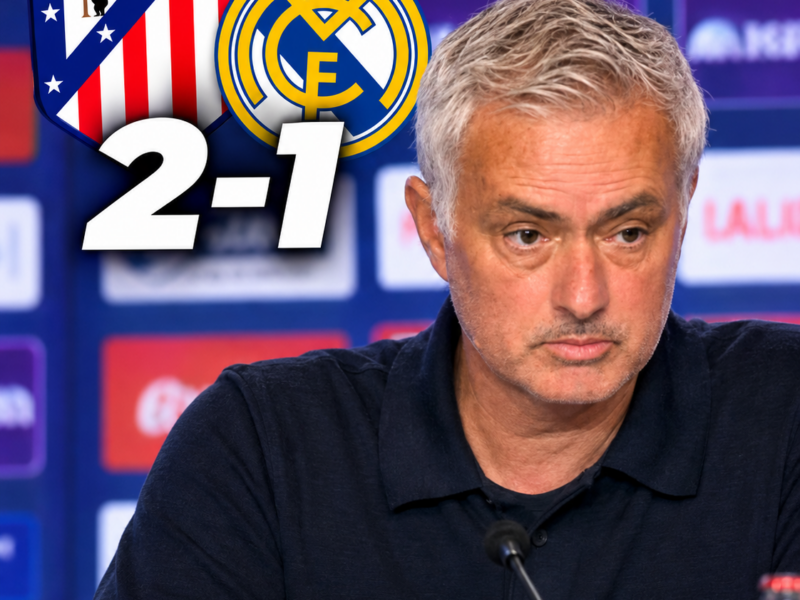
Mourinho Was Asked About Trust In Referees Days Before The Derby, His Answer Now Looks Like A Warning Nobody Caught
There is a strange kind of foreshadowing that only becomes obvious after the fact.
Just days before this explosive derby, a reporter had asked Real Madrid’s manager a fairly routine question about whether he still believed in the honesty of match officials.
At the time, it barely registered as news.
Looking back at it now, after everything that unfolded at the Metropolitano, that quiet exchange feels less like a throwaway question and more like the calm before an inevitable storm.
Here is the full, question-by-question breakdown of exactly how that storm played out inside the press room, based on the complete exchange between Real Madrid’s manager and the assembled media.
The Opening Question That Set Off Everything
The very first question of the press conference didn’t waste any time getting to the point.
A radio reporter asked directly about referee Ortiz Arias and the two disputed incidents from the first half, the challenge from Cristian Romero on Jude Bellingham and the one from Lee Kang-in on Federico Valverde.
That single question was all it took.
Before finishing his answer, the manager suggested the entire press conference could have been skipped altogether, since in his view the story of the match was obvious enough on its own, describing both incidents as clear red card offenses.
He then made a specific point about the numerical disadvantage his team had to overcome, noting that if his players struggled for nearly an hour playing with ten men, it was worth imagining how differently the match might have unfolded had Atletico also been reduced to nine.
From there, he pivoted to praising his own squad, saying he could only embrace players who had given everything and delivered what he considered a first half full of quality and character, one he believed could easily have led to a win rather than a defeat.
That set the tone for a sequence of comments where nearly every ounce of blame for the result would end up directed somewhere other than his own team’s performance.
Timing Becomes A Weapon
What came next moved the conversation away from the specific incidents and into something closer to a structural accusation.
He raised the issue of when the referee assignment had actually become public knowledge, claiming it had been known a full week in advance rather than the standard 24 hours before kickoff that he understood to be the usual protocol.
He then turned his attention to the referee’s profile itself, pointing out that this was a 41-year-old official with no international experience being handed one of the most emotionally charged fixtures in Spanish football.
His framing wasn’t subtle.
The suggestion was that assigning someone with that level of experience to a fixture of this magnitude wasn’t simply an oversight, it was almost designed to produce exactly the kind of pressure-induced mistakes he believed had occurred, describing it as a level of intensity that officials rarely have to handle in the modern game.
The VAR Official With A History
If naming the on-field referee wasn’t pointed enough, what came next raised the stakes considerably further.
He specifically named the VAR official on duty, a man he referred to as Mr. Trujillo, noting that this official had intervened to flag the first disputed incident for review but had not done the same for the second, which he considered even more obviously worthy of a red card than the first.
Then came the sharpest line of the entire section, one clearly designed to stick.
He claimed this particular VAR official had a long and well-documented history in matches involving Real Madrid, referencing incidents going back to the previous season, and suggested that while the referee on the pitch could perhaps be excused as inexperienced and overwhelmed, the same excuse could not be extended to someone with that much history in the position.
He closed that section with heavy sarcasm, offering what amounted to a mocking congratulations to the committee responsible for assigning both officials to the match.
That single passage is arguably what turned this from a standard post-match complaint into a genuine institutional controversy, because accusing an experienced VAR official of a pattern of unfavorable decisions across multiple seasons is a very different and much heavier claim than saying one inexperienced referee had a rough afternoon.
A Moment Of Unexpected Restraint
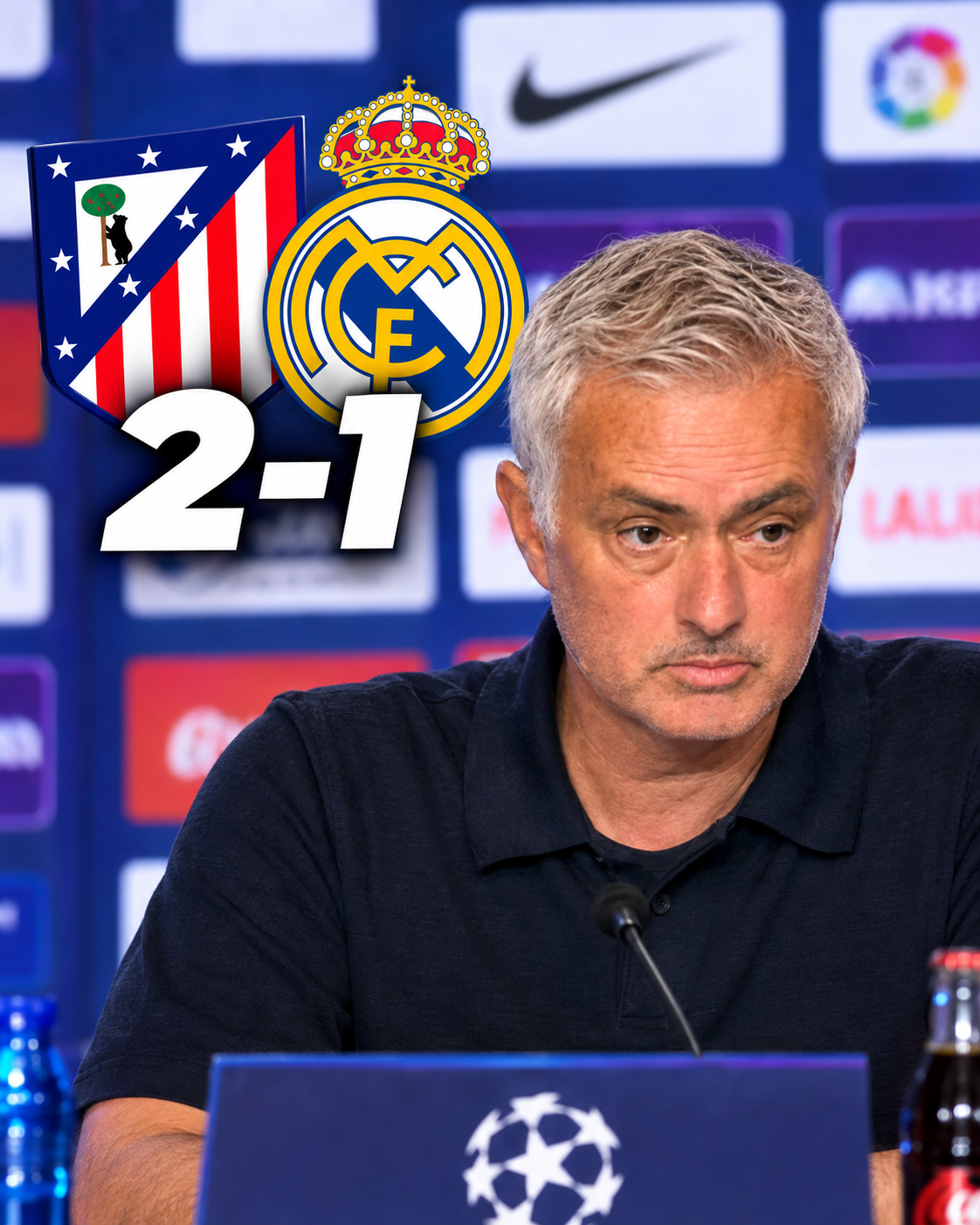
Here is where the press conference took its most surprising turn, and it’s a detail that got lost in most of the coverage that followed.
A reporter from a national radio station asked directly whether he still believed in the fundamental honesty of referees, referencing a comment he had made days earlier, and specifically asked for his opinion on whether the Huijsen red card itself had been a fair decision.
Given everything he had just said moments earlier, most people in that room likely expected an equally combative answer.
Instead, he admitted he genuinely had not yet reviewed the replay of the Huijsen incident on the video monitor available to him, and said it would be unfair for him to render a judgment on a play he hadn’t actually studied closely enough to evaluate.
He then walked through the technical nuance of the situation almost like a rules instructor rather than an aggrieved coach, explaining that if the initial contact occurred outside the box it should be a foul and a sending off, but if it happened inside the box it becomes a penalty, and that intent, such as an obvious pull of the shirt, would be the deciding factor in whether a card was warranted at all.
He closed that particular answer by returning to the numbers game, reminding the room that his team went from playing an even eleven-versus-eleven contest to defending for nearly fifty minutes with a one-man disadvantage, adding that there are no miracles in football once a team is reduced that severely, but stopping short of directly criticizing the specific call since he said honestly he still hadn’t seen it.
That distinction matters more than it might seem at first glance, because it reveals a coach willing to launch an extraordinarily pointed attack on the appointments committee and the VAR official’s history, while simultaneously showing enough restraint to admit uncertainty about the one decision that arguably mattered most to the final result.
Grading The Start Of The Season
Once the officiating questions started to wind down, a reporter shifted the conversation toward the bigger picture, asking for an honest assessment of how the season had started so far.
His response opened with ambition rather than excuses, stating plainly that the club’s target was nothing less than first place, not second, not third, not any position lower than the top of the table, and that they wanted more points than they currently had.
But he was quick to add context, arguing that late September is far too early in a long league campaign to draw sweeping conclusions, since the season is judged by how it ends rather than how it begins.
Then, almost reluctantly by his own admission, he pivoted back into referee territory one more time, listing off a series of contentious decisions from recent weeks that he felt fit into a larger troubling pattern.
He referenced a disallowed goal against Osasuna that he dismissed as laughable, a penalty decision awarded in San Sebastian that he mocked in the same tone, another penalty call involving Barcelona that he treated with equal disdain, and a non-red-card decision in a fixture against Athletic Bilbao involving a player he sarcastically described as very likable.
He then made an observation that carried real weight given his own history in Spanish football, saying he had expected to find a different league from the one he had left years earlier, but had since been told, seemingly by people around the club, that it hadn’t actually changed at all.
That admission is worth sitting with for a moment, because it frames his entire outburst not as a reaction to one bad night, but as confirmation of an expectation he had quietly been carrying since his return to the club months earlier.
Standing By His Players No Matter The Result
Even in the middle of an emotionally charged, grievance-heavy press conference, he made a deliberate point of separating his frustration with officials from any criticism of his own squad.
He said his players were leaving the stadium sad, understandably so given the result, but that he wanted them to leave with an embrace from their coach because he deeply respects how difficult their job is out on the pitch under those circumstances.
When pressed to compare this performance to an earlier defeat against Elche that had also involved red card controversy, he said he genuinely liked how his team competed in the first half of this particular derby, and that the second half, played a man down against a strong opponent, was simply an incredibly difficult situation to control possession or find rhythm in.
He described the overall feeling, despite the disappointing scoreline, as a positive one, built around pride in his players’ determination rather than any specific tactical triumph, framing it as a silver lining buried inside an otherwise negative result.
Does This Change The Title Race
One of the more pointed follow-up questions asked whether everything he had just described made winning the league title feel more complicated than he had previously believed, or whether he remained optimistic about the club’s chances.
His answer leaned into conditional optimism rather than outright confidence, saying that if his team were simply left alone to compete on equal footing with everyone else, there remains plenty of season left to make up ground.
He was careful, almost deliberately careful, to avoid suggesting any of what had happened was intentional or coordinated, saying he preferred not to entertain that kind of thinking and instead chose to view it as a case of officials making mistakes, the same way a coach or player might make a mistake during a match.
Then came a line that softened his tone just enough to avoid crossing into outright conspiracy territory, where he described the situation as unfortunate rather than sinister, framing the referee as someone who had simply been placed in a position beyond his experience level, and the VAR official as someone with what he called a rich history specifically working against Real Madrid, calling it a mistake rather than a deliberate act, though the distinction felt thin given everything said moments earlier.
The Question That Tried To Pin Him Down
The second to last question of the day tried to force a more direct answer out of him, specifically asking whether he believed Real Madrid were being deliberately harmed by officiating decisions, especially given how much he had spoken about decisions that seemed to benefit both Atletico Madrid and Barcelona this season.
He initially responded as though he hadn’t heard the question clearly, a common deflection technique used by coaches under pressure, before the reporter repeated a portion of it, specifically referencing his past reluctance to wade into the long-running Negreira scandal and asking whether he still believed the league remained tainted by it given everything he had just witnessed firsthand.
Ending On An Anticlimax
After nearly the entire press conference had been spent building toward an increasingly serious accusation against Spanish football’s officiating structure, the final answer landed with a thud rather than an explosion.
Asked directly whether the league was still stained by the Negreira affair, he gave a short, almost dismissive answer, saying that since the man at the center of that scandal is no longer present in the sport, the league could not be considered tainted by something that no longer exists within it.
It was a strikingly brief close to what had otherwise been one of the most detailed, name-naming, institution-accusing press conferences of his entire second spell in charge of the club.
Reporters in the room reportedly expected an escalation given the tone of everything that preceded it, and instead got a shrug.
Why The Contrast Matters
Reading the full exchange from start to finish reveals something that a highlight reel of his angriest lines simply cannot capture.
This was not an uncontrolled outburst from a man who lost his composure the moment a microphone appeared in front of him.
It was a carefully sequenced set of arguments, opening with the two specific incidents, escalating into a broader accusation about the appointments process, naming a VAR official’s history in a way clearly designed to generate headlines, listing off supporting evidence from recent weeks, all while still finding room to admit uncertainty about the one decision he genuinely hadn’t reviewed closely enough to judge fairly.
That structure is what makes the press conference so effective as a piece of public communication, regardless of how one feels about the underlying accusations.
It reads less like a coach venting in the heat of the moment and more like a prepared argument, delivered with just enough spontaneity and emotion to feel authentic rather than rehearsed.
What Comes Next
Given how specifically he named an individual VAR official and accused him of a pattern of behavior across multiple seasons, it would be surprising if the refereeing committee and the Spanish football federation didn’t feel compelled to respond in some form over the coming days.
There is also the matter of how Atletico Madrid and Barcelona, both indirectly referenced during his broader complaints about league-wide bias, choose to react publicly, since neither club is likely to stay silent if they feel they were unfairly dragged into a Real Madrid grievance session.
For his own club and its supporters, the more urgent question remains unchanged regardless of how this particular press conference is remembered.
Real Madrid have an international break to regroup, reflect, and potentially make the kind of personnel and tactical adjustments that several respected analysts have already argued are long overdue.
Whether that break gets used to actually solve the football problems visible underneath all the officiating noise, or simply to let the current controversy cool off before the next explosive press conference inevitably arrives, may end up defining this entire season far more than any single refereeing decision ever could.









