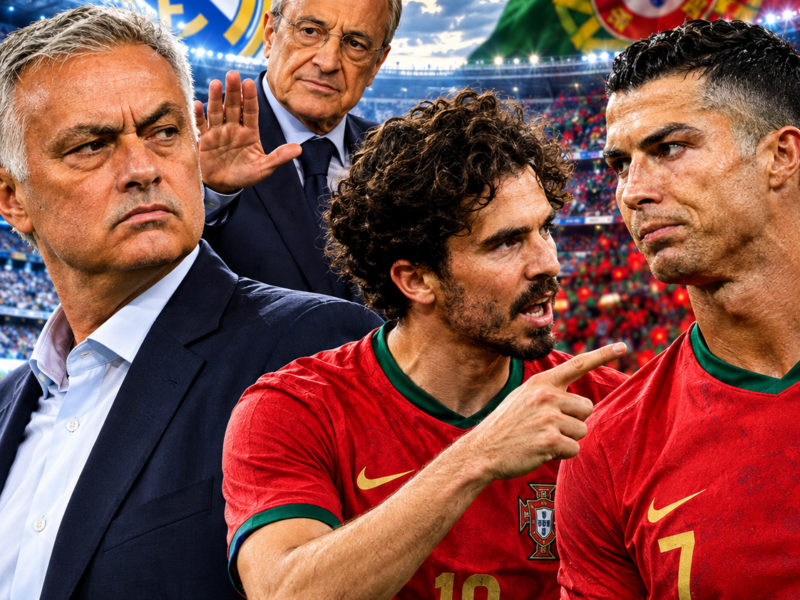
Mourinho Is “Limited” at Real Madrid, But Not for Long: The Shocking Truth Behind the Cortegana Bombshell and Vitinha’s Cristiano Dig
Some stories explode in a single sentence.
Yesterday, one of them did, and it came from the most trusted voice in Real Madrid journalism.
The claim is simple and uncomfortable: José Mourinho is not the all-powerful figure Madrid fans thought they were getting.
At almost the same moment, Portugal’s players walked into the mixed zone after a 4-2 win over Denmark, and one of them said something that set off a fresh storm around Cristiano Ronaldo.
Two stories, two superstars, one very loud day in football.
Let’s break down both, starting in Copenhagen.
Portugal’s First Night Without Cristiano
Portugal beat Denmark 4-2, and on the scoreboard that is where the story should have ended.
But this was the first match without Cristiano Ronaldo, and everyone in the building knew the questions were coming.
The Danish side did not ignore the moment either.
Rasmus Højlund celebrated his goal in Cristiano’s signature style, a tribute to a player who has shaped a generation.
The commentator’s view is that it was a perfect gesture, and he has long argued that the best tributes come from outside rather than from within.
That point carries extra weight here, because some Portuguese supporters turned up wearing shirts with Jorge Jesus’s name on them.
Then came a moment that, in his opinion, was unnecessary.
After the final whistle, Højlund reportedly gave Jorge Jesus a light shove as the coach went to greet him, as if to say “move aside.”
A small gesture, but in a charged atmosphere, small gestures become headlines.
A Dressing Room That Closed Ranks
What stood out most in Portugal’s post-match comments was how disciplined everyone sounded.
Jorge Jesus dodged several questions in his press conference and kept returning to the same message: the team is growing in what it does.
Cristiano himself had only made one reference to the situation, in brief remarks to Portuguese public television RTP before the game at Parken.
According to those remarks, he will explain everything after the final match.
He said he has been in football for many years, that he did not do anything that should have changed how things were handled, and that he will not hide or run from the subject.
For now, he chose silence.
His teammates mostly followed the same script.
Renato Veiga was the most revealing, because he told reporters about the communication policy inside the camp.
He said he is very close to Cristiano and has a lot of affection for him, but that he has been told he cannot talk about him.
That is a remarkable thing to say out loud, and it raises an obvious question.
If the federation wants players to stay quiet on the topic, why put so many of them in front of the microphones?
Nuno Mendes kept things strictly on the pitch.
He said the team is focused on what it has to do next, which is winning at the Dragão, and that the coach has taught them to concentrate on football.
His message was that players can only play, the rest does not depend on them, and that anyone is welcome in the group.
Rúben Dias took a similar line, saying the most important thing is the team and that the squad needed to rest and prepare for the next match.
Not everyone dodged the subject completely.
Leão Wears the Seven
Rafael Leão inherited the number seven shirt for the night, and he treated it with respect.
He called the experience very special and described Cristiano as an idol.
He also explained that the number carries a personal meaning, since it matches the birth date of his children.
His summary was simple: he tried to enjoy it with his teammates, and the most important thing was that Portugal played a good game.
It was a clean, classy answer, and it did not give anyone a headline.
That cannot be said for what came next.
The Vitinha Comment That Lit the Fuse
Jorge Jesus tried to lower the temperature first.
He said nobody can take away what Cristiano represents, calling him an icon whose status is not up for debate.
He also acknowledged that in the coming days everyone will be talking about the Cristiano case again.
His own advice, according to the commentator, is the part worth remembering: you have to know how to handle a player like that.
Not necessarily play him, but handle him.
Then Vitinha spoke.
Asked whether the squad managed to stay out of everything that happened off the pitch, he first gave the standard answer, that they tried to focus on the match and succeeded.
But elsewhere he went further, and it was reported as a dart aimed at the situation.
The line was that Jorge Jesus’s work is paying off, and that he thinks he is being “too clear.”
He added that the coach’s work is starting to show, that things are going well, and that this is how the team wants to continue.
Read in context, the commentator takes it to mean that Portugal is doing well precisely because Cristiano is not in the team.
That is a loaded interpretation, and he is careful to say these are statements that can be misinterpreted.
But he does not hide his reaction either.
He was annoyed.
Why the Words Matter More Than the Message
The commentator makes it clear that he is not questioning Vitinha’s quality as a footballer.
That is not up for debate.
His issue is with the way the message was delivered.
If a reporter asks you about Cristiano and your answer is that the coach is doing it right, the implication is hard to miss.
It sounds like saying that leaving Cristiano out is working well for us.
And the commentator is blunt about his own view of the football side of it.
In his opinion, the team does better without Cristiano at this stage, because at his age he was no longer contributing what he once did.
He also stands by what he said in a previous video, which is that when a player no longer matters, you have to know how to set him aside.
But this is where he draws a line.
The player in question is a historical legend, the best Portugal has ever had.
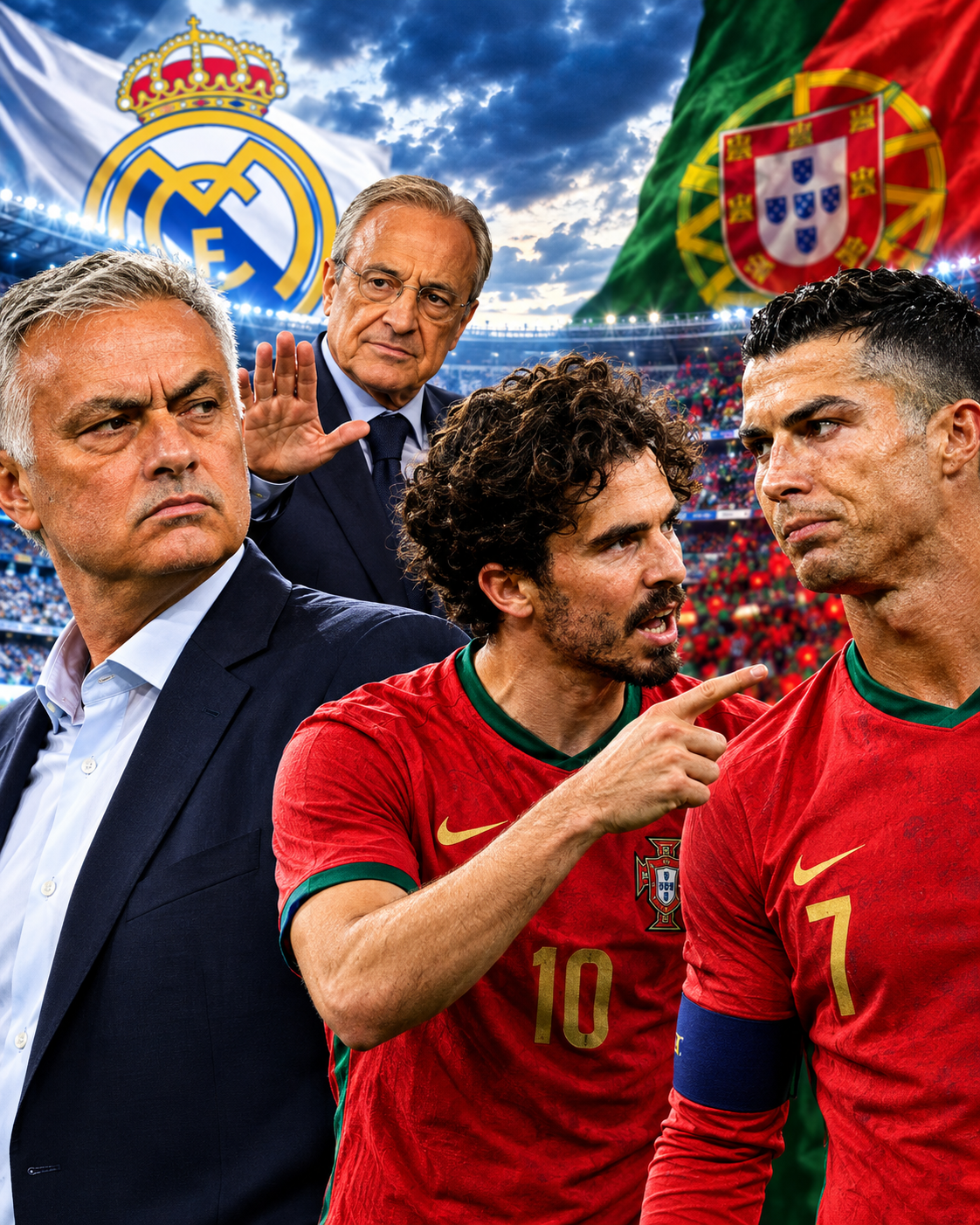
That demands a different vocabulary.
He even offers a version of the statement he would have given a “10 out of 10.”
Something like: Cristiano has given us so much, he will always be a reference point for us, he is our best player in history, but at this point the coach made the right decision.
Same conclusion, completely different tone.
He anticipates the obvious objection, that statements are just words and what matters is what happens on the pitch.
His answer is that respect matters, not only for Portugal but for football, which Cristiano has given everything to.
You can think something privately, he says, but you have to know how to express it.
Ramos Steps Into the Spotlight
Gonçalo Ramos also had plenty to say.
He told reporters that outside issues do not change the importance of a match, and that victory matters most, even if it is always good to score and assist.
He praised the new coach, saying the ideas are clearer and that players know exactly where each teammate is, in defense and attack.
He also said he loves playing this way, because it suits his style, with many balls recovered in dangerous areas.
There is one detail the commentator wants you to remember.
Ramos is the player who inherits Cristiano’s place in the team, not the shirt, which went to Leão, but the role.
So naturally, he is the one with the most reason to be happy.
Another point worth noting is that so many players spoke, given what Renato Veiga said about the federation not wanting them to discuss the subject.
The commentator finds it hard to take at face value.
He also links Vitinha’s comments to a pattern, recalling how João Neves was criticized at the World Cup for remarks that could also be read in relation to Cristiano.
His read is that these statements are partly a show of unity behind the coach.
Backing the coach, in the end, is what matters.
But as he puts it, words say a lot.
Now to Madrid: The Cortegana Bombshell
If the Portugal story is about tone, the Madrid story is about power.
Mario Cortegana, described by the commentator as the gold standard of Real Madrid journalism, appeared on another creator’s channel and discussed Mourinho.
His message, as summarized in the video, is that Mourinho is limited at Real Madrid.
It confirms what the commentator has been saying for weeks.
He has repeatedly argued that Mourinho is not the Mourinho he expected, that he does not seem to have real authority, and that something is off.
But there is a big difference between a YouTuber sharing an opinion and the journalist with the most information about the club saying the same thing.
That is what makes this moment significant.
The commentator points out that when Cortegana says something, he is right about 90 percent of the time, or at least on the mark.
And he adds it to other threads he had already followed, including comments from other reporters about things happening behind the scenes that are not good.
Put it all together, he says, and there is not much left to debate.
Why Would Mourinho Accept This?
The question that surprises him most is why Mourinho accepted the job without full power.
His theory is personal rather than tactical.
He believes it comes down to Mourinho’s friendship with Florentino Pérez, who gave him a chance when his career looked like it was winding down.
He compares it to Carlo Ancelotti’s return to Madrid after Everton.
For a coach in that phase of his career, being at Madrid is a prize in itself.
The cost, in the commentator’s view, is initiative.
A coach who feels lucky to be there is less likely to push for hard decisions.
He admits he has covered this in dozens of videos and does not want to repeat himself.
But his central point stands.
This is not the Mourinho who was promised.
The Hope Hidden in the Warning
Here is the twist, and it is the part that gives the story its drama.
Cortegana argues that the situation could change, and it all hinges on the Clásico.
Imagine Madrid loses and Barcelona goes nine points clear.
The pressure would become unsustainable, and some voices would demand Mourinho’s head.
But then Florentino and the board would face a brutal question: who do you bring in?
The commentator runs through the list.
Jürgen Klopp is with Germany.
Zinedine Zidane is with France.
Carlo Ancelotti is with Brazil.
Xabi Alonso is at Chelsea.
Álvaro Arbeloa is at Fulham.
The usual names are all off the table.
And anyone willing to come in, he suggests, would be a nobody who happened to be available.
So the logic goes like this.
Florentino would have no choice but to double down on Mourinho and give him real power, the kind he had in his first spell.
The Decisions Mourinho Is Dying to Make
What would that power look like?
The commentator has a specific list in mind, and it begins with a bombshell.
Mourinho, he believes, is dying to move on from Vinícius Júnior.
He also mentions Camavinga as someone Mourinho could not bench the way he might have liked.
The thinking is that Florentino told him not to push them away, because there is nobody else to sign.
Then he lists the bolder moves he imagines a fully empowered Mourinho making.
Benching Vinícius.
Playing Brahim.
Starting Güler instead of Bellingham.
Putting Mbappé on the wing.
He is careful to say this is not information from Cortegana.
That part is his own speculation.
Cortegana’s point is only that Mourinho could end up with the kind of power he had before.
A Disaster Before a Decision
The commentator finds this sad, and he explains why.
One of the things that excited him about Mourinho’s return, beyond his affection for the man, was the idea of a coach with real power at Madrid again.
He argues that since Mourinho left, no coach has truly had that, and he doubts the claim that Zidane had it in his second spell.
So the return looked like a chance to change that.
Instead, in his view, nothing has changed.
And the pattern is the one Madrid fans know too well.
A disaster has to happen before decisions get made.
In his words, he hopes Barcelona beats Madrid in the Clásico, though not by a thrashing.
Just a defeat, enough to force the club’s hand.
If Madrid ends up nine or twelve points behind, he says, the board might finally decide that sporting decisions are needed.
That is when Mourinho gets a voice and a vote.
What This Really Means
The commentator takes no pleasure in being right.
He admits there are times he is wrong and times he is right, and on this one he says he was right.
Mourinho was not being himself, and now the most reliable journalist in the Madrid press has said it.
He is also clear that the style of play is simply Mourinho.
What is missing, he argues, are the decisions.
Until they arrive, he says, Madrid will not look like the team it could be.
So Madrid’s problem, according to this view, is partly one of authority.
A coach with limited powers, a board that is hesitant, and a squad with stars who are hard to move.
Whether the Clásico becomes the moment everything changes remains to be seen.
The Bottom Line
Two stories, one theme.
In Portugal, it is about how you speak about a legend when you are moving on from him.
In Madrid, it is about what happens when a manager is hired for his authority but does not seem to have it.
Both come down to power, respect and timing.
And both will be tested very soon.
What do you think?
Is Mourinho truly limited at Real Madrid, and does the Clásico decide his future?
And did Vitinha cross a line with his comment about Cristiano, or is the commentator reading too much into it?
Leave your take in the comments, because this conversation is only getting started.









