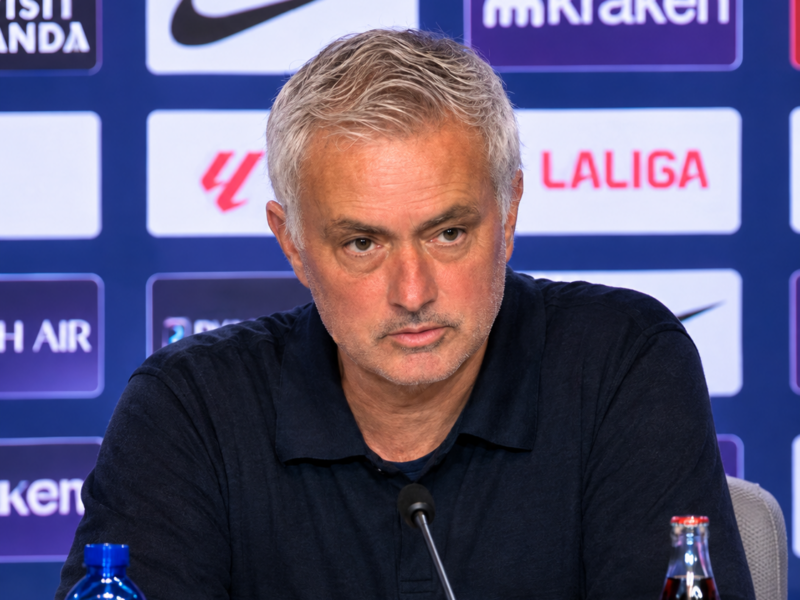
Mourinho Explodes: Inside Real Madrid’s Wild Post-Derby Press Conference That Left La Liga Talking For Days
Imagine walking into a room full of reporters with nothing but a folded sheet of paper tucked under your arm, and using it to blow up an entire narrative before a single question is even asked.
That is exactly what happened at the Metropolitano Stadium after one of the most heated Madrid derbies in recent memory.
What followed wasn’t just a coach venting about a tough loss.
It was closer to a piece of theater, one that will be replayed, dissected, and argued about across Spain for weeks to come.
By the time the man walked out of that room, he had turned a football result into a referee scandal, reopened old wounds about officiating bias in La Liga, and somehow found time to take a jab at one of Spanish football’s most notorious controversies almost as an afterthought.
This is the story of that afternoon at the Metropolitano, why it happened, and why it might end up defining the rest of Real Madrid’s season.
A Derby That Was Decided By More Than Just Goals
On paper, this was round seven of the 2026/27 La Liga season, a fixture that always carries extra weight no matter where the two Madrid clubs sit in the table.
Atletico Madrid came away with a 2-1 win over their city rivals at home, a result that lifted them above Real Madrid and into second place.
The win sent Real Madrid tumbling down to third in the La Liga table, with Atletico leapfrogging them into second and Barcelona pulling six points clear at the top just seven games into the new season.
Yahoo Sports
That gap to Barcelona is the kind of number that turns up the temperature around any manager, and this manager in particular has never needed much help generating heat.
The flashpoint of the match itself came just after halftime.
Real defender Dean Huijsen was sent off in the 52nd minute after bringing down Atletico’s Giuliano Simeone inside the box, a decision confirmed by a VAR review.
Goal.com
Alejandro Grimaldo stepped up and calmly converted the resulting penalty to put the home side in front.
From there, Atletico doubled their advantage before the final whistle, with Jonathan David finding the net to make it 2-0.
Real Madrid pulled one back late through a towering headed effort from Antonio Rudiger off a Bernardo Silva free kick, but by then the damage on the scoreboard, and apparently in the coach’s mind, had already been done.
On the surface it reads like a fairly straightforward story: one team lost a man early in the second half, and the extra numbers eventually told.
But that surface-level explanation is not the version anyone walked away talking about once the final whistle blew.
The Moment Everything Changed: A Folded Sheet Of Paper
Post-match press conferences after a derby loss are usually predictable.
A coach praises effort, admits mistakes, mentions fine margins, and moves on to the next fixture.
This one broke that script within the first ten seconds.
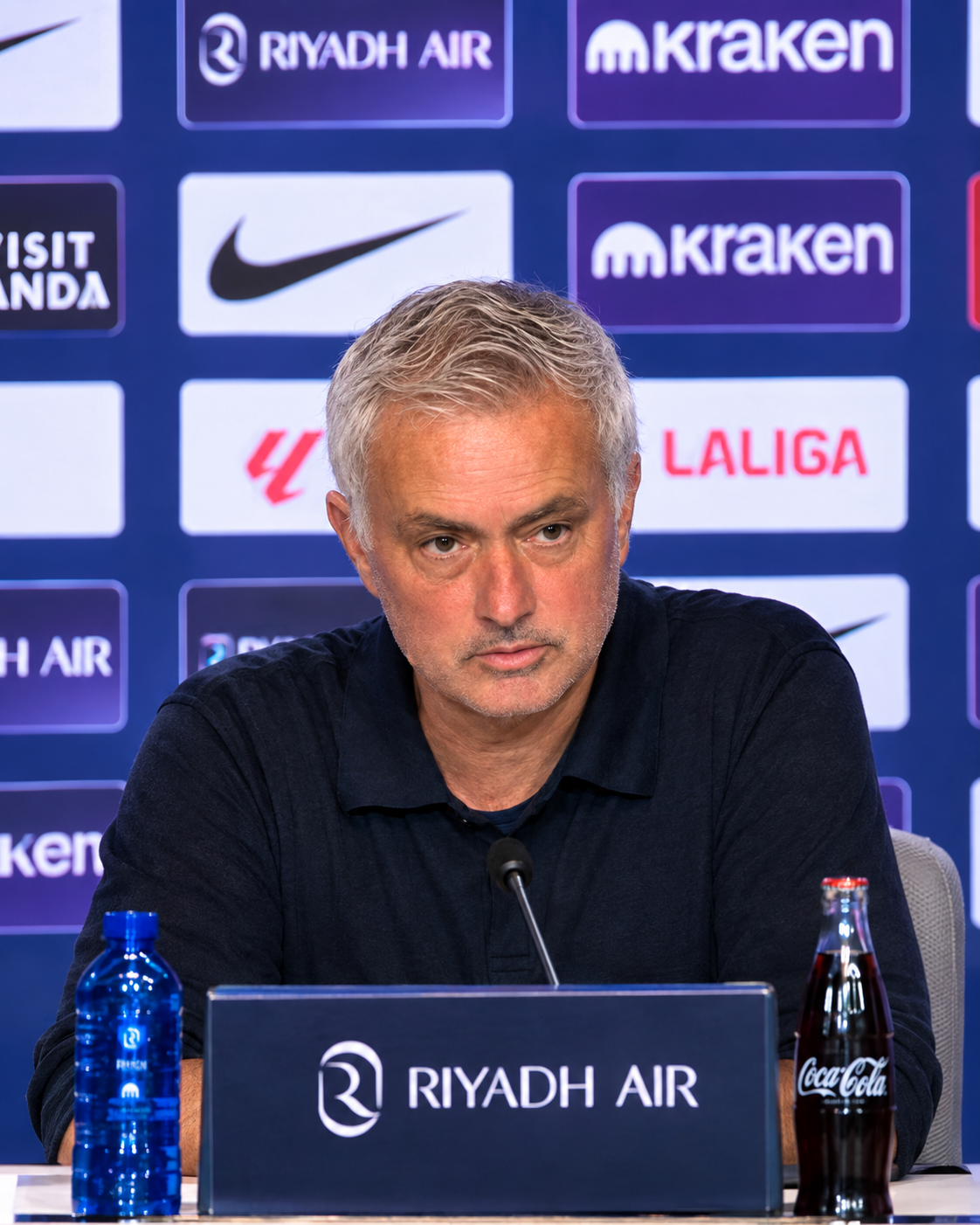
Before a single question had even been fully asked, the Real Madrid boss reached for a piece of paper he had brought into the room himself, printed with two split images side by side.
He held it up and said the team could have skipped the press conference entirely because the story of the match was right there on that page, describing what he saw as two clear red card offenses that had gone unpunished.
Yahoo Sports
He then pointed out that his team had already struggled to cope playing a man down for the better part of an hour, and wondered aloud what the scoreline might have looked like if Atletico had also been reduced to nine players, as he believed they should have been.
From that point, whatever question had originally been intended for him became irrelevant.
What followed was, by several accounts, a rant that stretched somewhere between five and eleven minutes depending on which outlet’s stopwatch you trust, delivered in a tone that was controlled, articulate, and unmistakably furious underneath the surface.
He made a point of praising his own players before turning the page toward the officials, saying he could only embrace his team for the way they competed in a first half he described as full of class and personality.
There was no criticism directed inward, no mention of Real Madrid’s own sluggish, uninspired football for large stretches of the ninety minutes.
Every ounce of blame was reserved for the men in the middle.
Breaking Down The Two Incidents That Sparked The Fury
To understand why this outburst carried so much weight, it helps to walk through exactly what the two disputed images actually showed.
The first involved Atletico’s Cristian “Cuti” Romero, who was accused of stepping on Jude Bellingham’s leg during a challenge in the first half.
The second and more heavily emphasized incident involved Atletico forward Lee Kang-in, who appeared to step on Federico Valverde’s ankle in a moment that the match officials never sent to pitchside review.
Yahoo Sports
According to Real Madrid’s own account of the situation, the referee had actually gone to the monitor to review the Romero incident and still opted against a red card, which only added fuel to the argument that this wasn’t a case of an official simply missing a fast-moving passage of play.
Real Madrid’s official statement afterward accused the referee of poor officiating overall and specifically called out both the Romero and Kang-in incidents as decisions that shaped the outcome of the match.
Yahoo Sports
Whether every neutral observer agreed that both challenges were automatic red cards is a separate conversation, and Spanish football media were split in the immediate aftermath, with some pundits describing the Kang-in incident as far more clear-cut than the Romero one.
That split matters, because it is part of why the press conference generated so much discussion rather than being dismissed outright as a sore loser’s tantrum.
There was enough genuine controversy in the officiating to give the outburst some oxygen, even among people who otherwise have little sympathy for this manager’s long history of blaming referees.
Naming Names: The Referee At The Center Of The Storm
It is one thing to say the officiating was poor.
It is another to specifically call out the referee by name, his age, and his lack of international experience in front of a room full of cameras.
He directed sharp criticism at referee Miguel Angel Ortiz Arias and the committee responsible for appointing him to such a high profile fixture.
Sky Sports
He pointed out that the officiating body had assigned a 41 year old referee with no international experience to handle one of the most emotionally charged fixtures on the entire Spanish football calendar.
Sky Sports
The framing wasn’t just that a mistake had been made.
It was that the mistake was almost inevitable given who had been chosen to officiate a fixture of that magnitude, essentially accusing the appointments committee of setting the referee up to fail, or worse, doing so deliberately.
He didn’t stop at the man on the pitch either.
He also referenced the VAR official on duty that day, noting that he had been called in to review the first red card incident but seemingly not the second, which he considered to be the more obvious of the two.
Real Madrid CF
This detail is important because it shifts the criticism from a single referee having a bad day to what he was implicitly suggesting was a systemic breakdown involving multiple officials across multiple layers of review.
That is a much heavier accusation, and it is exactly the kind of framing that gets a club fined, gets a federation talking, and gets pundits filling hours of television time.
Real Madrid The Club Doubled Down
What made this moment different from a typical manager meltdown is that the club itself didn’t try to distance itself from the comments.
Quite the opposite.
Real Madrid released an official statement after the match describing the defeat as being marked by what they called disastrous officiating from Ortiz Arias, criticizing the failure to send off Romero for the Bellingham incident despite a pitchside review, as well as the missed Kang-in challenge on Valverde.
Yahoo Sports
The statement went further, arguing that both of those decisions shaped a match that was ultimately decided in the second half in the home side’s favor.
When a club’s official communications channel echoes the coach’s grievances almost point for point, it stops looking like one man’s individual outburst and starts looking like a coordinated institutional message.
That detail sparked its own side conversation among Spanish football insiders about who actually orchestrated the timing and delivery of the printed photographs, whether the club’s staff had prepared the material in advance, and whether the manager was simply the messenger for a broader institutional grievance that had been building well before this particular derby.
Regardless of who printed the page, the manager was the one who chose to walk in and use it, and he owned every word that came out of his mouth afterward without hesitation or apology.
A Pattern, Not An Isolated Incident
Anyone who has followed this manager’s career closely will tell you that dramatic press conferences aren’t new territory for him.
What was more revealing on this occasion was how calm his tone had been across the earlier weeks of the season, right up until this particular explosion.
Beyond the two disputed red cards, he brought up a string of other contentious calls from recent weeks, including a disallowed goal against Osasuna, a penalty decision in San Sebastian, another penalty call in a match against Barcelona, and a non-red-card decision in a game against Athletic Bilbao that he felt had been handled leniently in favor of the opposition.
Goal.com
Listing out that many separate incidents in one sitting is a deliberate rhetorical strategy.
It reframes a single questionable red card decision as the latest data point in a pattern, rather than an isolated mistake that could simply be chalked up to a bad day at the office for one match official.
Whether that pattern genuinely exists or whether it is a case of selective memory built around decisions that went against his own team is, again, a matter of perspective.
But the strategy worked in the sense that it dominated the news cycle in Spain for the better part of a week, well beyond what a single result seven matchweeks into a season would normally warrant.
The Negreira Question: A Moment Of Restraint That Said More Than Rage Would Have
After several minutes of pointed, detailed criticism aimed squarely at the officials, a reporter asked what many in the room had clearly been waiting for.
The question referenced the ongoing Negreira scandal, the long-running case involving payments made by Barcelona to companies connected to a former vice president of Spain’s refereeing technical committee, and asked whether Spanish football, and by extension the League itself, remained tainted by it.
Given the tone of everything that had preceded it, many expected an explosive, direct answer that would dominate headlines for weeks.
Instead, his response was almost dismissive in its brevity, saying simply that the individual at the center of that case was no longer around, and that if he was no longer around, the League could not be considered tainted by him.
Real Madrid CF
That measured, almost shrugging answer stood in sharp contrast to the intensity of everything that came before it, and it caught a lot of people off guard.
Some pundits interpreted it as a deliberate choice to avoid wading into a legal and political minefield that involves an ongoing case with real consequences for a rival club, preferring instead to keep his fire focused on this specific match and this specific referee.
Others saw it as something close to a missed opportunity, given how loudly the topic has hovered over Spanish football coverage for months, and how much louder his comments on every other refereeing grievance had been just moments earlier.
There is also a broader point worth making here, one that has nothing to do with punditry and everything to do with a basic principle that gets lost far too often in football media.
A manager is allowed to see things differently than the people who run public communications for his own club, or from a rival club’s ownership, or from any other stakeholder in the sport.
Nobody should have to pretend that disagreement on a sensitive topic is scandalous just because it doesn’t match the loudest voice in the room.
Reading The Match Itself: A Poor Real Madrid Performance Hiding Behind The Referee Narrative
Strip away the theatrics of the press conference for a moment and look purely at the ninety minutes of football, and a less flattering picture for the visiting side starts to emerge.
Several respected voices in Spanish football media who watched the match closely noted that Atletico had actually adapted well to a version of Real Madrid that looked short on ideas well before the sending off changed the complexion of the game.
The first half, even at eleven versus eleven, was low on genuine chances from either side, with neither team stringing together the kind of fluid, incisive attacking sequences you would expect from two clubs occupying the top four places in the league.
If anything, Atletico’s introduction of a fresh midfield body around the half hour mark appeared to tilt momentum slightly in the home side’s favor even before the red card arrived, adding attacking impetus and defensive solidity that had been missing in the opening exchanges.
That detail matters because it complicates the simplest version of the post-match narrative, the one where a single refereeing decision single handedly cost a superior team all three points.
The uncomfortable truth being pointed out by several analysts is that this Real Madrid side has spent much of the current campaign winning matches primarily on individual talent and moments of brilliance from elite players, rather than through a consistently coherent team structure or attacking rhythm.
Pressing intensity has reportedly come in bursts rather than sustained waves, appearing for twenty or thirty minute stretches before fading noticeably, which is not the identity most fans expected when this particular manager returned to the touchline.
There have been individual bright spots, with certain younger players showing clear improvement compared to the previous campaign, but the collective attacking cohesion that fans hoped a managerial change would bring has, according to critics, been slow to materialize in any consistent way.
None of this excuses genuinely poor officiating if it did in fact occur, and the evidence suggests at least one of the two disputed incidents was a legitimate grievance worth raising.
But it does mean that framing the entire ninety minutes purely around two missed red cards, while conveniently sidestepping any discussion of the team’s own attacking shortcomings, is a choice, not an objective retelling of events.
Why This Particular Return To The Touchline Makes The Story Even Bigger
It’s worth stepping back and appreciating the broader context of why this particular figure walking into a press room with printed photographs generates so much more attention than it would if almost anyone else had done it.
He returned to Real Madrid this past summer, taking charge again after previously managing the club between 2010 and 2013.
GB News
A managerial return of that nature always comes loaded with nostalgia, high expectations, and inevitable comparisons to both his own first spell in charge and to the managers who have occupied that dugout in between.
His first stint was famous for exactly this kind of confrontational relationship with referees, with the football establishment, and occasionally with his own club’s ownership, so in a strange way this outburst wasn’t really a surprise to anyone who remembers those years.
It was, if anything, a reminder that character does not fundamentally change just because a person spends over a decade away from a particular job.
There is a version of this story where a first time manager, someone without that history, delivers the exact same speech using the exact same printed photographs, and it barely makes a ripple beyond domestic Spanish sports pages.
Because of who delivered it, and because of the vivid, deliberately theatrical nature of physically bringing printed images into a press conference, this became an international story within hours, translated and repackaged across dozens of countries and languages by the following morning.
The Bigger Picture: What This Means For The Rest Of The Season
Every dramatic press conference eventually fades from headlines, but the underlying football problems it was designed to distract from generally do not disappear quite so quickly.
Real Madrid now sit in third place, a gap of six points behind a red hot Barcelona side and now also trailing Atletico, with a long, grueling league campaign still ahead of them.
An international break arrives shortly after this fixture, which several commentators noted might actually work in the club’s favor by giving emotions time to cool before the next round of domestic action resumes.
That kind of buffer matters, because had another high stakes match been scheduled just a few days later, there was a real fear among people close to the club that the next press conference could have escalated even further rather than calming down.
The longer term question being asked across Spanish football media isn’t really about this one specific defeat.
It’s about whether this derby ends up marking a genuine turning point in the way this particular Real Madrid side is perceived this season, similar to the way a previous manager’s own difficult afternoon at this exact stadium last season became a symbolic before-and-after moment for that entire campaign.
Analysts covering the club seem split on whether this defeat represents a similarly dramatic inflection point or something closer to one bump on what has already been described as an emotional rollercoaster of a season, filled with ups, downs, and now an unmistakably fiery public moment that will follow this group of players and their manager for weeks to come.
What does feel certain, regardless of which interpretation proves correct, is that the version of this manager fans have started to see reappearing, the one willing to walk into a room with printed evidence and a prepared monologue rather than the calmer, more diplomatic figure from the earlier weeks of the season, is not going away quietly.
Anyone expecting a swift return to measured, diplomatic press conferences after a bad result may want to reconsider that expectation, because as more than one experienced observer close to the situation put it in the hours after the final whistle, that fiery temperament has always been part of his nature, no matter how long it stays dormant between eruptions.
What Happens Next
The immediate aftermath will likely include disciplinary scrutiny from the Spanish football federation, given how directly and specifically an individual referee was targeted by name in a nationally broadcast setting.
There is also likely to be a formal response from the refereeing committee, whether that comes in the form of a public statement defending their appointment process or a quieter internal review of how officials are assigned to marquee fixtures.
Barcelona, given that they were indirectly referenced through both the Negreira question and previous comments about lenient treatment in matches against them, may also choose to respond publicly in the coming days, adding another layer to an already crowded news cycle.
For Real Madrid supporters, the more pressing concern beyond all of the noise is whether their team can actually close the gap at the top of the table once the football resumes, because printed photographs and passionate speeches, however justified they might be, have never actually put points on the board.
The manager himself made that same point indirectly when he said the club wants nothing less than the top of the table, not second, not third, not any position that leaves them looking up rather than down at their rivals.
Turning that ambition into results starting with the very next fixture after the international break will ultimately matter far more than any single press conference, no matter how many headlines it generated or how many times the footage gets replayed on highlight shows across the football world.
For now though, the story of this particular derby weekend belongs entirely to a folded piece of paper, two contested tackles, and a manager who has never needed much encouragement to remind everyone exactly why his press conferences have been appointment viewing for the better part of two decades.









