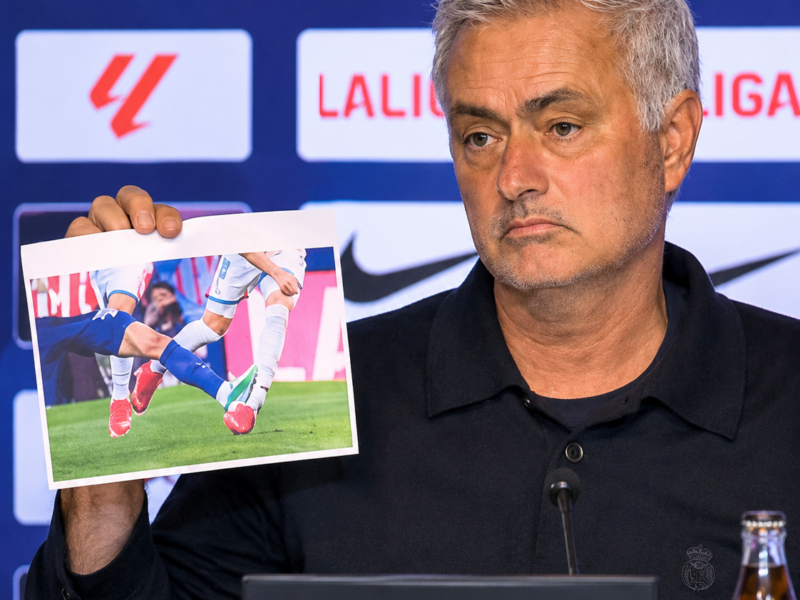
Mourinho Explodes After Madrid Derby: “The Referee Committee Should Be Embarrassed” — Real Madrid Boss Rips La Liga Over Two Missing Red Cards In Explosive Post-Match Rant
Some managers walk into a post-match press conference looking for headlines.
José Mourinho, after Sunday’s derby at the Metropolitano, walked in looking for blood.
Not the blood of his own players, who he had nothing but praise for. The blood of an entire refereeing appointment system that he believes handed his team an impossible mission from the moment the fixture list was published a week in advance.
Because according to Mourinho, this was never really a fair fight in the first place.
It was, in his own framing, Real Madrid playing eleven against ten for large stretches of the afternoon, a scoreline of missed red cards that never made it onto the actual scoreboard, and by his count, it should have been even worse than that.
“I Have To Limit Myself To Hugging My Players”
Mourinho opened his remarks the way he so often has throughout his career whenever he feels his team has been wronged by officiating, by refusing to even engage with the tactical detail of the match itself.
Asked to break down what actually happened on the pitch, he essentially declined the invitation. The story of this derby, he said, was clear red cards and the difficulties his side had to overcome playing a man light against opponents who, by his count, should have been reduced even further.
His actual words, delivered in his familiar blend of Portuguese and Spanish that has become something of a Mourinho press conference trademark over the decades, carried a specific, almost mathematical framing of the afternoon. If Real Madrid struggled playing eleven against ten, he argued, then people should try to imagine what fifty minutes of eleven against nine would have looked like for his opponents.
Given that framing, Mourinho said there was really only one thing left for him to do at full time. Limit himself to embracing his own players, a group he described as having delivered a first half of genuine class and personality, a performance strong enough, in his view, to have deserved victory rather than the outcome the team ultimately walked away with.
It was, in other words, a masterclass in the specific art of the post-match deflection, praising his own group extensively while making unmistakably clear where he believed the actual outcome of the match had been decided.
A Pointed Jab At Who Actually Won
Mourinho’s next line carried the kind of dry, needling humor that has defined his press conferences for two decades across four different countries, and it landed exactly where he intended it to land.
Asked, essentially, who should be happy with how the derby had gone, he offered a two-part answer that managed to praise his opponents while simultaneously undercutting the legitimacy of their result in the very same breath.
Obviously, he said, the people at Atlético Madrid have reason to be happy, because they are the ones taking home the points.
But the people who should really be happy, he continued, are the members of the refereeing appointment committee, because in his estimation, the whole process behind Sunday’s officiating had been strange from the very start.
It is a familiar Mourinho rhetorical move, one he has deployed against officials, rival clubs, and football associations across his entire managerial career. Never quite accuse anyone directly of corruption or bias. Simply lay out a sequence of facts, note how unusual they seem, and let the assembled press room draw its own conclusions.
On Sunday, that sequence of facts centered on two specific men, and Mourinho methodically worked through his grievances with both of them.
The Referee Nobody Expected
The first target of Mourinho’s post-match dissection was the man who had been holding the whistle throughout the derby, and his complaint began not with anything the referee actually did during the ninety minutes, but with a decision made an entire week before kickoff.
According to Mourinho, the identity of the officiating team had already been known internally a full week ahead of the fixture, despite being formally announced to the public only 24 hours before kickoff, standard practice across most major leagues, but a detail Mourinho clearly felt was worth flagging given everything that followed.
The referee assigned to what is, by any measure, one of the biggest and most emotionally charged fixtures on the entire Spanish football calendar was, according to Mourinho, a 41-year-old official with no international refereeing experience on his résumé.
Mourinho did not frame this as a coincidence. He framed it as a decision that, on its face, seemed to invite exactly the kind of chaos that ultimately unfolded, a comparatively inexperienced referee thrown into an occasion carrying an entirely different level of pressure and scrutiny than anything he would typically encounter in a routine midtable fixture.
And once the whistle blew, Mourinho argued, that pressure visibly got the better of him. The Real Madrid manager described a referee who had arrived at the Metropolitano and, in his assessment, simply could not cope with the intensity of the atmosphere and the stakes of the occasion, a kind of pressure Mourinho suggested modern football rarely produces anymore in its purest, most suffocating form, but which a Madrid derby still reliably delivers.
His sympathy for the official, if that is even the right word for it, came with a pointed and unmistakable conclusion attached. A referee without the experience or the standing to handle an occasion of this magnitude, in Mourinho’s view, simply should not have been given the assignment in the first place, regardless of how the pressure of the day ultimately affected his decision-making.
The VAR Official With “History”
If Mourinho’s criticism of the on-field referee carried a note of something almost like sympathy buried underneath the frustration, his second target received no such courtesy.
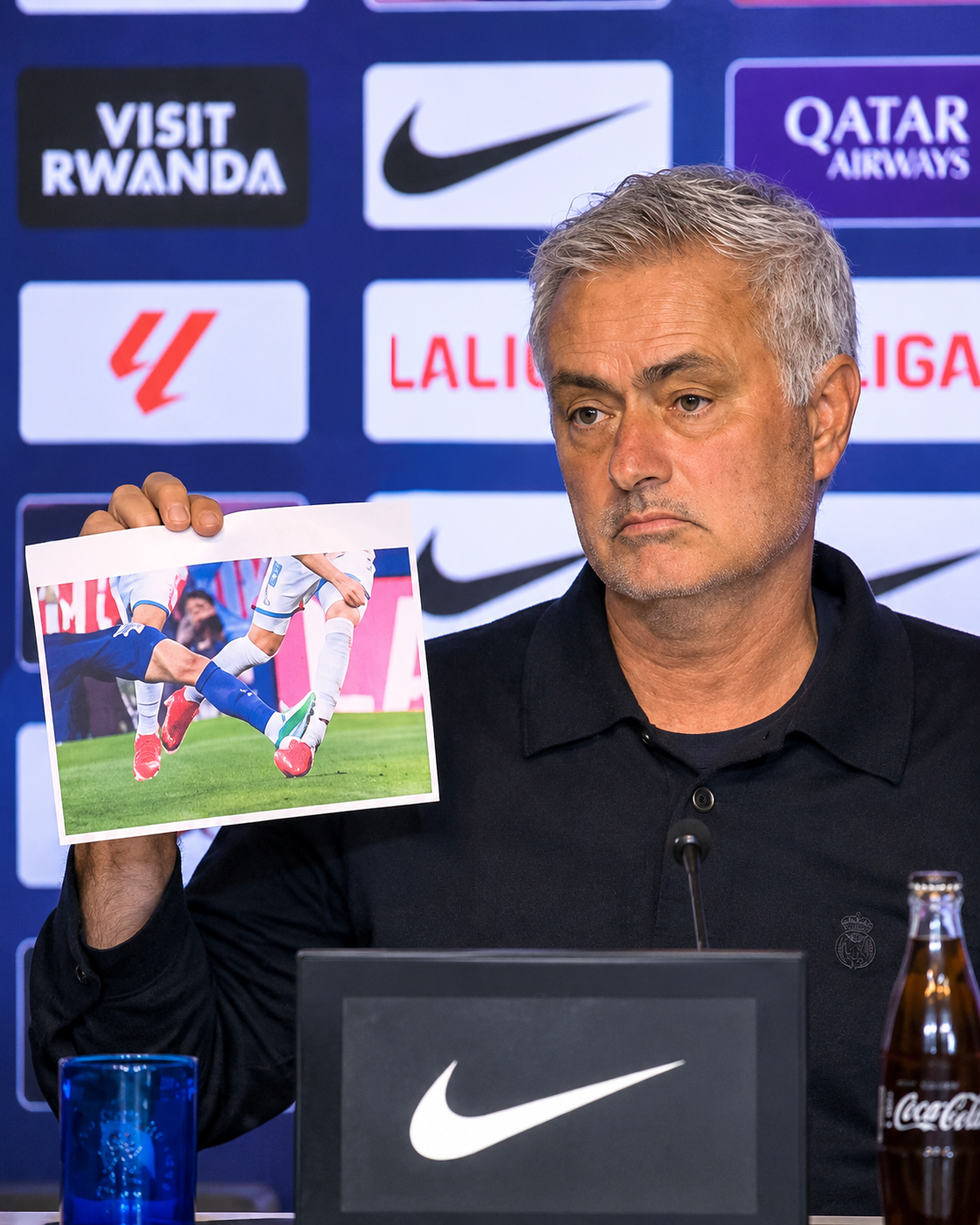
The Real Madrid boss turned his attention to the video assistant referee overseeing the match from the review booth, a match official he identified by the surname Trujillo, and here his language shifted from disappointment into something considerably sharper.
Mourinho invoked history, and he was specific about what he meant by it. According to him, this particular VAR official had a documented past connection to Real Madrid matches, including a Copa del Rey fixture against Real Sociedad from the previous season, a case Mourinho suggested still lingers in the club’s institutional memory.
The implication embedded in that reference was not subtle. Mourinho was, in effect, arguing that this was not simply a case of an inexperienced official struggling on a difficult day, the more generous framing he had extended to the referee on the pitch, but something closer to a pattern, a specific individual whose track record in matches involving Real Madrid had, in his eyes, already raised questions before this derby had even kicked off.
His closing argument tied both grievances together into a single, damning conclusion aimed squarely at the people who make these appointments rather than the officials themselves. Pairing an inexperienced referee whose entire résumé consists of smaller, lower-stakes fixtures with a VAR official carrying what Mourinho characterized as a loaded history involving his own club was, in his words, a combination that should leave the entire refereeing appointment committee feeling embarrassed.
It is worth being precise about exactly what Mourinho was and was not alleging here. He stopped short of claiming outright bias or deliberate wrongdoing from either official individually. His argument was structural, aimed at the people who build the officiating roster for marquee fixtures, questioning the wisdom, if not the motives, behind pairing this particular referee with this particular VAR official for a match carrying this much weight.
Whether Spanish football’s governing bodies see it the same way remains to be seen, but Mourinho’s framing all but guarantees the appointment process for this derby will now receive its own separate round of scrutiny in the days ahead, layered on top of the individual officiating decisions that had already dominated conversation before he ever stepped in front of the microphones.
A Vintage Mourinho Performance, In Every Sense
For anyone who has followed Mourinho’s career across Porto, Chelsea, Inter Milan, Real Madrid’s first spell, Manchester United, Tottenham, and Roma, Sunday’s press conference will have felt instantly, almost comfortingly familiar.
This is a manager who has built an entire public persona, stretching back more than two decades, around exactly this kind of pointed, carefully constructed post-match grievance, one that manages to simultaneously praise his own players, needle his opponents, and cast doubt on the officiating apparatus, all without ever quite crossing the line into something that would draw a disciplinary charge for outright defamation.
The mathematics of his eleven-against-nine framing will not sit well with everyone, particularly Atlético Madrid supporters who will point out, fairly, that their own players absorbed a punishing volume of first-half cautions and complaints of their own throughout the same ninety minutes. Simeone’s side, after all, had their own grievances about the flow of cards shown against them well before Mourinho ever reached the microphone.
But that has always been the nature of a Madrid derby, and always been the nature of Mourinho specifically. Both benches walk away convinced the officiating conspired against them, and somewhere in the middle of those two dueling grievances sits whatever actually, objectively happened on the pitch, a version of events that rarely gets much airtime once the press conferences begin.
What is beyond dispute is this. Real Madrid’s opening weeks under Mourinho’s second spell in charge have already produced a genuine officiating firestorm, a debate over refereeing appointments that has reached all the way up to how assignments are made a week in advance, and a manager who, three months into a three-year contract, has already reminded all of Spanish football exactly why Florentino Pérez brought him back in the first place.
Not for his substitution timing. Not for his tactical innovations.
For moments exactly like this one, when a result goes against Real Madrid and someone needs to stand in front of a room full of cameras and make absolutely certain the conversation does not end with the final whistle.









