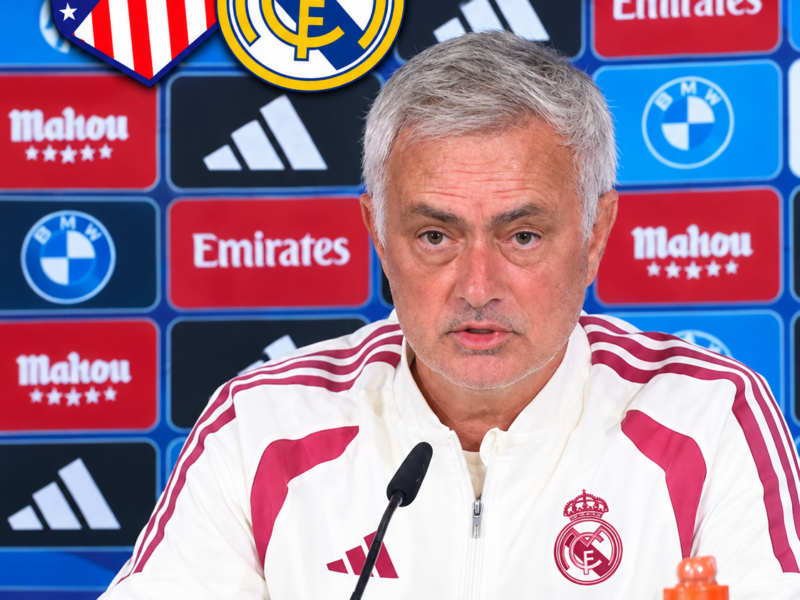
Mourinho Admits “I Don’t Know If I’ll Manage It” Before the Madrid Derby, and His Words About Simeone Say Even More
More than 25 years on the touchline, a dozen cities, and more derbies than most coaches will ever see.
José Mourinho has sat through nearly every kind of press conference there is.
Yet the night before Real Madrid faced Atlético Madrid, he still managed to leave the room with everyone talking.
He dodged one question with a single sentence, and he answered another with a warmth that surprised even the reporters who have followed him for years.
In between, he gave the most revealing look yet at how he sees his second spell at the Bernabéu.
Here is everything he said, and what it tells us about the man and the moment.
A Week Packed With Press Conferences
This was the third time in a week that Mourinho had faced the Spanish media.
The first session, on Monday, ended with him walking out and remarking that it was strange nobody had asked about the penalties.
That comment hung in the air all week, and one reporter brought it up again on the eve of the derby.
Mourinho smiled it off and said it was too late for that now.
A full round of matches had passed since then, he pointed out, and there were plenty of other questions he could have been asked.
The Real Madrid squad has been running on fumes.
The derby was their second away game of the week and their third match in roughly eight days.
Mourinho has now been in charge for seven or eight official matches, and he made it clear he was asking for patience, even as he insisted results still had to come.
A Coach Who Refuses to Be Defined by One Tactic
The first question of the day went straight to the heart of Mourinho’s reputation.
A reporter reminded him that he had said before the Elche game that he does not like his team defending in a low block.
Then came the bigger question.
After more than 25 years in coaching, how has his thinking on high and low blocks changed?
Mourinho separated two things that fans often blur together.
One is the football a coach dreams of playing in every phase of the game.
The other is what a coach can actually do with the players in front of him.
He said he has always tried to adapt to the strengths of his squad, and that a quality that works for one group can be a weakness for another.
Then he reached back to his Inter days.
That team, he said, could have sat in a low block for 90 minutes and been perfectly comfortable.
They could have stayed there for three days, he added, and nobody would have scored.
It was a striking reminder of what a Mourinho side can look like when the personnel fits.
But this is a different team, and his message was more nuanced than a simple yes or no.
Asked whether he likes defending deep, he said he likes knowing how to defend deep.
His reasoning is hard to argue with.
Over the course of a match, every team is dragged into those moments.
Sometimes it lasts two or three minutes, sometimes ten, sometimes twenty.
When it happens, you need to know how to survive it.
Mourinho said that is exactly what Real Madrid are working on.
It is not what he wants his team to be, he stressed, but he wants them to have the humility to accept that those spells will come in La Liga and in the Champions League alike.
And when they do, he said, they have to know how to stay in the fight.
Why a Derby Is Not a Bigger Game for Him
Next came a question that might have tempted another manager into a big speech about rivalry and destiny.
At this stage of his career, a reporter asked, does he get more motivated by a clásico or a derby?
Mourinho’s answer was almost disarmingly simple.
He is motivated every single day.
He said he understood the question was asked respectfully and wanted to answer it with the same respect.
His career, from the first day to the last, will always be the same, he explained, and age and experience do not change who he is.
Playing Villarreal next, he said, motivates him just as much as a clásico or a derby.
In terms of motivation, it makes no difference to him.
That does not mean he treats these games casually.
He was quick to say that derbies are culture and history, and that they carry something extra because of it.
But when the subject is motivation, he said, the answer is the same as always.
Every day.
The Derby That Shocked Him Most
Then a reporter asked the question that unlocked Mourinho’s memory.
He has lived derbies in Lisbon, Porto, London, Milan, Madrid, Rome, Istanbul and Manchester.
Which one hit him hardest?
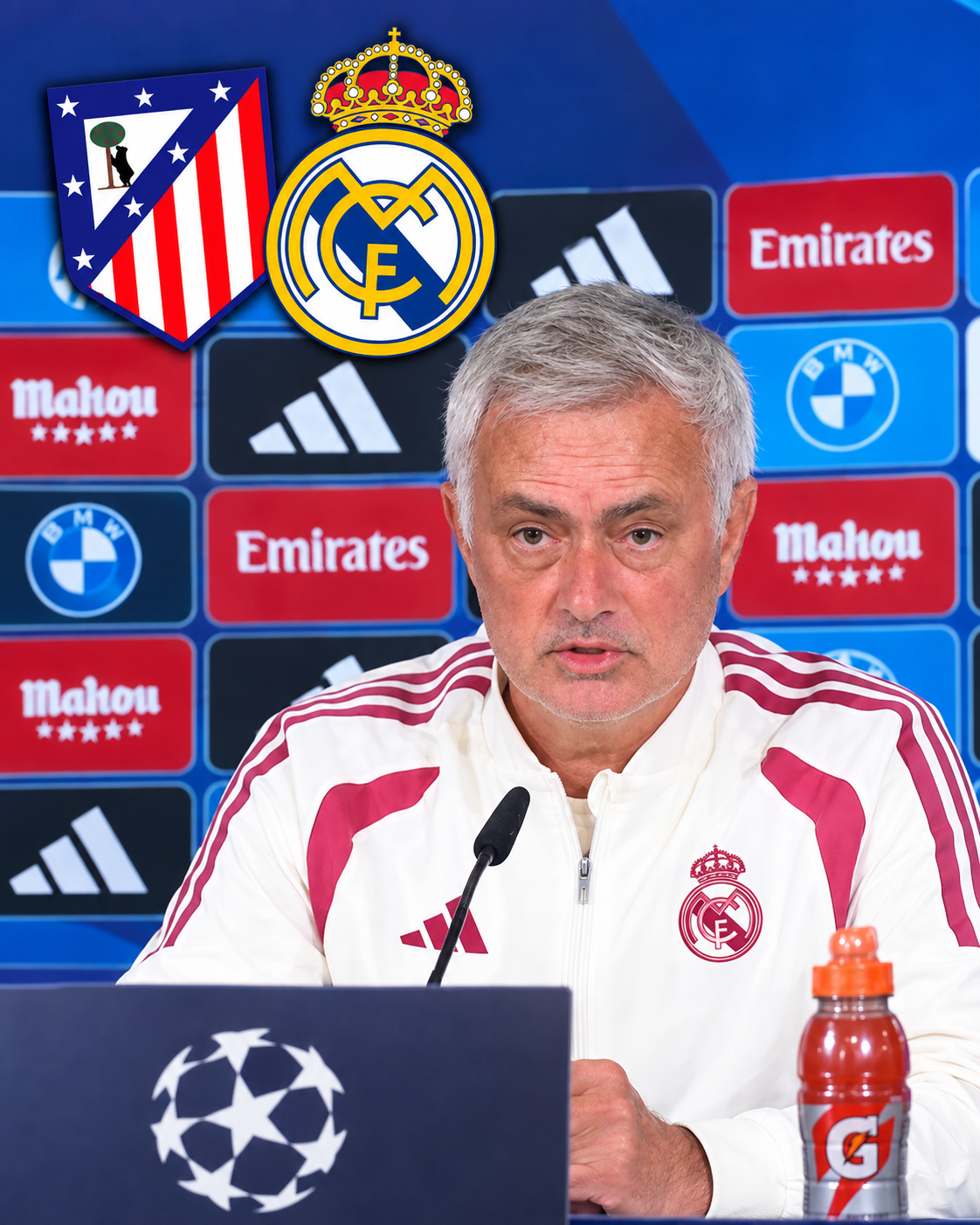
Mourinho said it is hard to choose, because the moment you put on a club’s shirt, you start to feel like a supporter.
You start to feel what the game means to the people around you.
He said there is no derby where the week before the match passes without someone stopping you in the street to talk about it.
There is always someone telling you to beat the enemy.
You have two options in that situation, he explained.
You can isolate yourself completely from the outside world, or you let the message reach you.
Every one of those derbies was special.
But the one that surprised him most, because he did not see it coming, was Milan against Inter.
He had expected a derby with plenty of hatred, the kind that usually comes with these rivalries.
Instead, on the day of his first Milan derby, he saw couples walking hand in hand, one wearing one club’s shirt and the other wearing the other.
He saw a father with two sons, one supporting Milan and one supporting Inter.
The real hatred in Italian football, he said, lives a bit further north.
Portugal is a different story, he added, and he called it mission impossible.
As for Turkey, he said, he would not even get started.
A Message to Simeone
Then came the moment many people had been waiting for.
A reporter noted that Diego Simeone had declared himself an admirer of Mourinho in his own press conference before the derby.
The reporter also reminded Mourinho of something he said in 2014, after Chelsea’s Champions League semifinal against Atlético.
Back then, Mourinho had argued that a coach should not be judged on whether he has won the Champions League, and that many great coaches never have.
Mourinho brushed off the old quote with a shrug and a smile.
He said that over the course of a long career, everyone says foolish things.
He said this goes for all coaches, not only him and Simeone.
We all say things shaped by the moment, he explained, and sometimes we even say them strategically.
But what matters in the end, he said, is whether you respect the other person or you don’t.
Then he told a story that revealed more about his view of Simeone than any compliment could.
Years ago, he said, he was asked whether he would take part in a documentary about Diego.
He did not think for a minute.
Simeone knows exactly how he feels and what he thinks, Mourinho said.
And then came the line that will probably follow both men all week.
Rivals again, but comrades in war.
The International Break Problem
The derby also comes right before an international break, and Mourinho made no effort to hide his feelings about it.
A radio reporter noted that Spain’s national team coach, Luis de la Fuente, had criticized the new Nations League format, with four matches packed closely together.
Club coaches, the reporter said, do not seem to like it either.
Was there a common denominator?
Mourinho answered like a man who has run out of ways to complain about the calendar.
What can we do, he asked, except adapt?
Then he laid out the logistics of the problem.
Several of his players will stay behind, while others will fly around the world to play for their countries.
Some of them will return only two, three or four days before the next match.
He mentioned Valverde flying in from Korea as one example.
The Europeans, he pointed out, are dealing with four demanding games against opponents of similar quality.
Spain plays England, France plays Turkey and Belgium, and none of these matches are easy.
For Real Madrid, the problem is even worse because another match arrives three days after the break, followed by a Champions League date with Roma.
Yet Mourinho also framed it as a sign of strength.
It means his club has excellent players, and those players are wanted by their national teams.
His plan is to keep a close eye on every minute they play.
He said he will try to be as clinical as possible in managing them, even though not every national team coach shares training data.
The Tchouaméni Question
One of the players staying behind is Aurélien Tchouaméni, and it raised eyebrows.
A reporter reminded Mourinho that he had recently described Zidane, the France coach, as a sensible man.
Yet Tchouaméni had not been called up, even though he had just played 87 minutes against Elche and looked ready to play two more games.
What did Mourinho make of the decision?
He was careful to distance himself from it.
He said he had no influence on the call whatsoever.
He had not contacted Zidane, and Zidane had not contacted him.
The situation caught him a little by surprise, he admitted.
But he explained what he understood had happened.
The coach and the player had spoken directly and reached the conclusion that the best thing for Tchouaméni, after the derby, would be time to do the preseason he never had.
Zidane had told the player he counts on him for the future, and both men agreed on the plan.
For Real Madrid, Mourinho said, that is a privilege.
After the Atlético match, Tchouaméni will get a few days of rest, followed by a stretch of proper training that lets him get stronger for what lies ahead.
What Grade Does He Give Himself After 100 Days?
Mourinho hit a milestone on the eve of the derby.
It had been exactly 100 days since Real Madrid named him as their new coach.
A reporter asked whether everything had gone as he planned, and whether he would give himself a grade.
His answer was pure Mourinho.
The grade he gives himself, he said, is that he has given his maximum, because he cannot give more.
That does not mean the work is finished.
He said he must keep giving the maximum to improve every day, at every level.
Then he made a point about his profession that says a great deal about how he sees his job.
For him, a coach’s work is not only about training and playing games.
It is far more global than that, and it has much more influence on the construction of a club, especially its football side.
Choosing who plays, making substitutions and running the matches, he said, is the basic part.
So he will not give himself a number, and he will not call it perfect or negative.
The grade is the maximum, and that is how he will continue.
Good Outcome Only
Another reporter tried to frame the derby as a turning point.
Last season, Real Madrid arrived at the Metropolitano at this stage having won everything.
The defeat there last year hurt the team badly and shaped the season that followed.
This time they arrive in good form, with only one loss, at Sevilla.
Could this match be a turning point, for better or for worse, and an exam of these first 100 days?
Mourinho refused the premise.
He said he is not pessimistic and does not want to think in terms of good or bad outcomes.
The journalist can ask the question both ways, he said, but as a coach he answers only one.
He only answers for good, and he hopes it goes well.
The Metropolitano Problem
The sharpest question of the day came from a Spanish television reporter.
At the Metropolitano, the reporter said, Real Madrid have won only two of their last 11 games since Atlético moved there.
That is a surprising number given the overall history between the clubs.
Mourinho had also admitted earlier in the week that he was worried about his team switching off while ahead in matches.
So how will he make sure the players are fully switched on from the first minute?
His answer was strikingly honest.
He said he does not know if he will manage it.
The intention is there, he said, both his and the players’, but he cannot promise how it will turn out.
He does not know whether he will succeed as a coach, and he does not know whether the players will succeed as players.
What he could say is that the team has tried to find windows to work on the things that need fixing, even in a schedule this crowded.
He described his stay at the club as a process.
Coaches who spend one, two, five or ten years at a club keep talking about process, evolution and time to improve, he pointed out.
His group has been together for only a few months, and has played seven or eight official matches.
There is a lot to improve, he admitted, but results must come at the same time.
The team trained the day before, he said, and again after the reporters left that day.
They have confidence in themselves, but they also have the humility to know they must keep working.
The Referee and the Timing
Mourinho was asked about another topic that tends to explode before big games, and his answer was carefully diplomatic.
He noted that the referee for the derby had been known for a week, which he called a little strange.
But he said he prefers to believe that the appointment came because the referee has quality and enough experience for a match with this emotional weight.
He does not like talking about referees before games, he said, and this one has his full confidence.
After the match, he added, we will see.
But before it, the confidence is total.
Another reporter noticed that Mourinho had scheduled his press conference late, after Simeone had already spoken.
Was that deliberate?
Did he want to hear what Diego said about him first?
Mourinho said he did not even know when Simeone’s press conference was.
The morning had not worked for his team, he explained, because there was training to do and meetings with players.
After training, he had rushed out in a sprint to watch as much as he could of a match at the Bernabéu.
He could not see what advantage there would be in speaking before or after Simeone.
Vinícius, Mbappé and a Very Short Answer
A reporter asked about Vinícius, who had joked on social media that he hoped his aim would be better in this match.
Was the derby especially important for the Brazilian?
Mourinho answered that it is equally important for everyone.
Perhaps the players who have been at Real Madrid longer, and who remember the negative history against Atlético, feel something extra.
But he did not think so.
Everyone in the group is aware of how difficult the game is, he said, and a derby is culture and history.
The city and the sport give it extra meaning, but the match matters just as much to Vinícius as it does to anyone else.
Then came a question about Kylian Mbappé’s explanation of a recent shirt controversy at Real Madrid.
Mourinho’s reply was one of the shortest of the entire session.
I talk about football, he said.
That was all.
Playing Beautiful Football or Winning
One of the most interesting questions came from a radio reporter who pointed at Barcelona.
Barça, he said, seem to play beautifully, while Real Madrid struggle a bit more, even though they create plenty of chances.
Sometimes his team switches off and the opponent even has more possession.
Does that worry Mourinho?
Can a team be happy and win without playing beautifully and without holding the ball?
Mourinho started by refusing the comparison.
Historically and culturally, he said, Real Madrid cannot compare themselves to anyone.
So he would not compare his team with any other.
He preferred to talk about his own club, and he said he is happy to talk openly about its problems and what needs to improve.
He added that in his second spell, he has noticed that it is getting harder and harder to hear anything positive about Real Madrid.
But the team keeps working with humility, he said, fully aware of its problems and just as aware of its power, both individually and collectively.
Then he made the case for his players by pointing to three recent matches.
In three games, Real Madrid found themselves needing to score in the closing minutes, either to win or to draw.
Each time, he said, they finished with tremendous physical and psychological strength, and with total commitment and determination.
Against Elche, they were leading 2-0 and were level by the 80th minute or so, which he called not normal.
But it is also not normal, he said, that the team changed within three or four minutes, went after the game, created a chance, then another, and scored to win.
He pointed to the Betis game as well, where the team was losing by a goal.
They had the physical and mental strength, the heart and the determination, he said, to score an incredible goal, miss a penalty and still have enough left to try everything for the remaining minutes.
That, to him, is the real strength of this squad.
It is the strength of a group.
He said the league is a marathon, not a highway with no obstacles, and Real Madrid will be there.
What He Thinks of Atlético
The final question of the day came from a radio reporter who asked where Mourinho places the Atlético squad.
Is it close to Real Madrid and Barcelona, or below them?
Mourinho said he did not want to compare squads.
He was not going to compare Oblak with Courtois, or Romero with Rüdiger.
That, he said, is not the way he looks at it.
What he sees is a strong squad with many solutions and a great coach who knows exactly what he wants.
He said it is a coach who picks players he likes, players who are his face and his DNA, after many years of work.
To Mourinho, this is a team that will be fighting for the league title.
That was his closing message, and it may have been the most telling of all.
The Real Message Behind the Words
Read closely, the press conference was a study in a coach trying to lower the temperature while raising the stakes.
He refused to call the derby bigger than any other match, yet he spoke about derbies with reverence.
He refused to grade himself, yet he made sure everyone knew he was giving everything.
He admitted he does not know whether he can fix the team’s habit of switching off, and that kind of honesty is rare in the hours before a game like this.
He praised Simeone as a comrade in war and described Atlético as a title contender, which sounds like respect and also like a warning.
He defended his players against the noise, and he stopped short of pretending everything is perfect.
And through it all, he kept coming back to the same idea.
Real Madrid are a work in progress, and the job is to keep competing while that work goes on.
The derby would show how far that work had come.
For Mourinho, the answer to every question, in the end, was the same.
He hopes it goes well.









