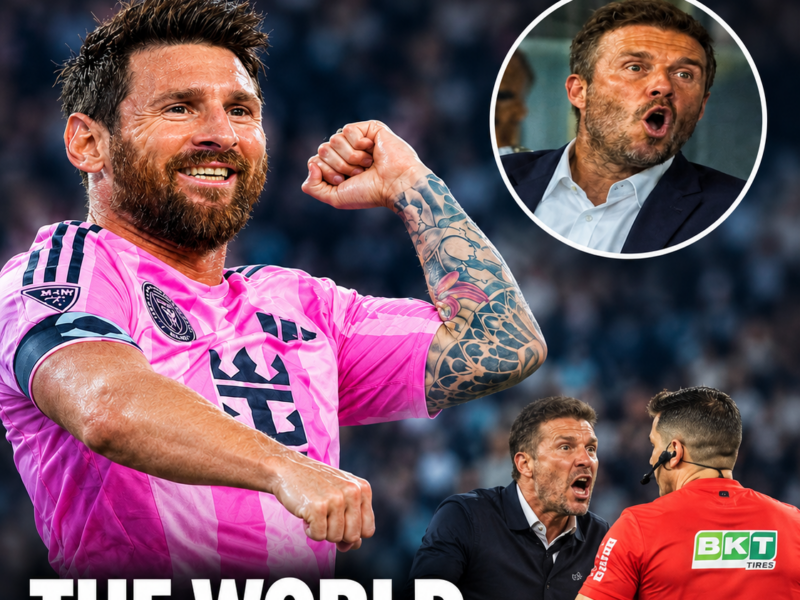
Messi Is 39 and Still Scoring Like Magic While Ronaldo Faces Discipline and Vinícius Sees Red: The Weekend Football Can’t Stop Talking About
Years ago, someone predicted that Lionel Messi would be finished with football by thirty.
He is now thirty-nine, he just finished a night that fans are calling historic, and the old prediction is being dug up and thrown back at the people who made it.
That clip is only the first sign of how loud this weekend has been.
In one corner of the football world, a legend is still producing moments that feel impossible. In another, a rival icon is tangled in a dispute with his national federation.
And in Madrid, a red card for Vinícius Júnior has turned a win into a full-blown argument.
One passionate Barcelona-supporting YouTuber pulled all of it together in a single video, recorded right after a live stream, and he did not hold back.
What follows is a look at the three storylines, the case he builds around them, and where his claims are opinion rather than established fact.
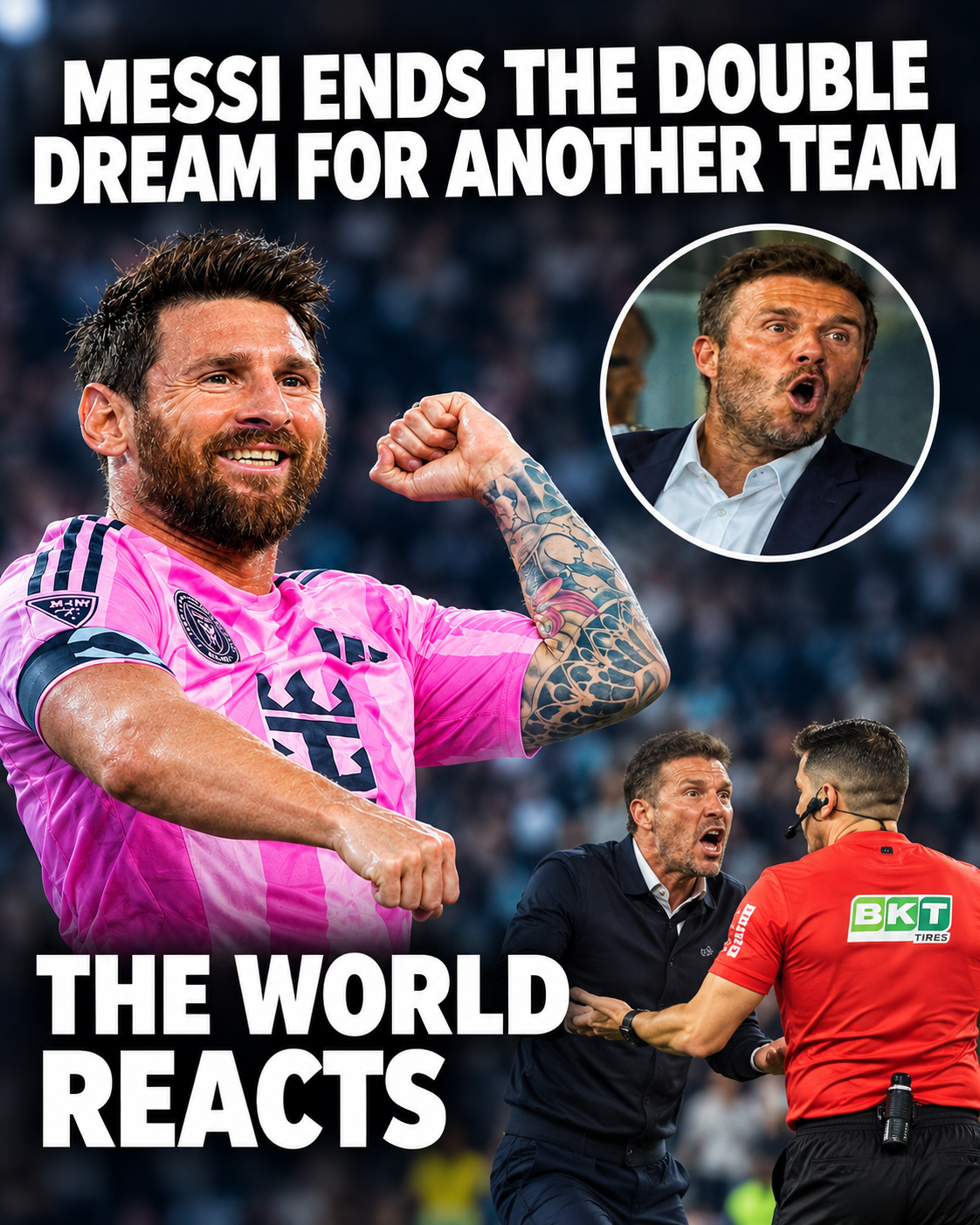
Start with the night that set the tone: Inter Miami’s 4-0 win.
According to the creator, Messi scored twice, and Luis Suárez added two more. The veteran strikers combined for all four goals in a performance he describes as total control.
He admits he almost missed it. A power problem at his home had thrown off his schedule, and viewers in his live chat had to remind him the match was on.
He watched anyway, after the stream ended, and he says the experience was exactly what he expected: pure enjoyment.
For him, watching Messi is personal. He says he cried when Messi said goodbye to the Argentine national team, and he expects to cry harder when the player eventually retires from the game.
The reason, in his words, is that what Messi does cannot be repeated.
He leans heavily on the numbers, and the numbers are hard to argue with.
He cites 934 career goals for Messi. Add the assists, and he says the total of goals created comes to roughly 1,360.
He also mentions a perfect 10 out of 10 rating, which he says Messi has now earned for the 58th time in his career. The rating source is not named in the video, so treat it as a fan-cited figure.
The point he keeps returning to is sustainability. Holding a world-class level for so many years, he says, is something very few players in history have managed.
Then he reaches the argument that drives much of the video: the 1,000-goal milestone.
Messi, he insists, is not chasing it. In his view, the records simply arrive for him without effort or obsession.
He contrasts that directly with Cristiano Ronaldo, who he says is desperate to hit one thousand.
It is a loaded comparison, and a familiar one. Ronaldo’s supporters see relentless drive. Messi’s supporters, like this creator, see a player who does not need to count.
Interestingly, he says he hopes Messi gets there too. His reasoning is that it would leave the other camp with nothing left to say.
He also takes a swipe at how Messi’s assists are treated. When a Madrid fan commented that supporters now want to count assists, he fired back that these are assists made by the greatest provider in football history.
His argument is that assists are part of scoring. Removing them, he says, would erase half of what makes the player special.
Whether you agree depends on how you weigh goals against creation, and that is a debate that has been running for fifteen years without a winner.
He goes further on the competition between the two stars, and here the language gets sharp.
He claims Ronaldo has been retired in everything but name for years, and says the Portuguese forward only scores from penalties or close-range finishes.
That is a harsh assessment, and one that many Ronaldo fans would reject immediately. Ronaldo has remained a prolific scorer well into his late thirties, whatever the style of the goals.
Still, it shows how this rivalry works. Every goal by one player is measured against the other, and every criticism has a counter-criticism waiting.
Which brings us to the story the creator calls a farewell gone wrong.
He says Messi left the Argentine national team through the front door, with a send-off worthy of the best player of his generation.
Ronaldo, in contrast, is described as being pushed out indirectly by Portugal. The creator uses the word tantrum, and he does not soften it.
According to his account, Ronaldo released a statement on the same day as Messi’s farewell, trying to take attention away from it. When that did not work, he allegedly followed up with a message aimed at Messi.
None of that is verified in the video. It is the creator’s reading of events, and a reader should weigh it as perspective rather than record.
What he presents as more concrete is the disciplinary angle. He says the Portuguese Federation has opened proceedings after Ronaldo left a national team training camp.
The reason he gives is a clash with coach Jorge Jesus. In his telling, the coach refused to publicly rank Ronaldo alongside Maradona and Pelé, and the player reacted badly.
That motive is the creator’s claim, and it is a pointed one. The reported camp departure and the federation’s response are what the story rests on.
He adds that the sanction will probably be short, because Portugal cannot afford to lose its biggest commercial draw for long.
He mentions sponsorship deals with brands such as Puma as part of that calculation. It is a plausible argument, since national teams do weigh marketing value, but it is still his inference.
His final shot is the one he clearly wanted to land. He says Ronaldo no longer contributes with his legs, refuses to say goodbye, and keeps playing because he is chasing a thousand goals.
Fans of Ronaldo would say the opposite. They would point to his goals for club and country, and argue that a competitor of his level has earned the right to choose his own ending.
Having handled the two biggest names, the video pivots to Madrid.
The creator says he had covered this on his live stream, but wanted to show it again for viewers who missed it. The subject is Vinícius Júnior’s red card.
The sequence, as played in the clip, goes like this. Vinícius had a goal ruled out after a review, and the referee, Díaz de Mera, then showed him a red card.
The reason was a hair pull earlier in the play, when the winger was driving toward the byline with Bellingham nearby.
The commentary in the clip captures the confusion in the stadium. Commentators struggle to say what happened, fans seem stunned, and nobody appears sure what the decision means.
One line stands out. The broadcast notes that Vinícius had been the hero of the match, and then he was the one walking off.
The video then plays a debate in which analyst Pedro Martín gives a careful answer. According to the rules, he says, it is a red card.
But he adds that it seems absurd to him, and that he does not like what the rules have become.
A colleague on the panel points out that a player was recently dismissed for something similar in the women’s game. Another speaker says a hair pull hurts, but that does not automatically make it a sending-off.
That exchange is a good summary of the whole debate. People can agree on what the rulebook says and still disagree about whether it should say it.
The creator has no such doubts. He says Madrid supporters and their media are acting as if nothing makes sense, and he treats their reaction as theater.
He also targets Aurélien Tchouaméni, who said after the match that he did not understand what was wrong with the referees over the red card, and that the important thing was the win.
The creator reads that as evidence the midfielder is out of touch. A fairer reading is that a player talking after a victory is simply downplaying a controversy.
Either way, the line gives the video one of its better pieces of ammunition.
Then the creator turns toward Kylian Mbappé, and this is the most interesting part of the video.
He argues that a section of Madrid supporters has never forgiven the forward, and that some do not even want him to win the Ballon d’Or.
His comparison is with how Barcelona’s fans treat Lamine Yamal. In his view, Yamal is protected because everyone knows the club depends on him.
That is a sharp observation about how stars are treated. Some players are given room to fail, while others are judged on every miss.
Mbappé, he says, has been top scorer in everything he has played, and has made mistakes like anyone else. He adds that Madrid cannot afford to lose him.
The logic is practical. If Vinícius, Bellingham and Rodrygo are not producing, then Madrid needs Mbappé’s goals more than ever.
Now comes the part of the video that is pure fun, and it is built around a clip.
It shows a Spanish sports show from the summer Mbappé arrived, where the panel called the signing the best in football history. One of them calls it a weapon of mass destruction.
Another panelist corrects him, saying the weapon would be aimed at rivals and not at the dressing room.
The same clip includes predictions that sound very different today. One speaker says Madrid should finish twenty points ahead of Barcelona, and another says Barcelona has no chance against Madrid.
The creator revels in it. He says the phrase about the dressing room turned out to be prophetic, even though it was meant as a joke.
This is a favorite tactic of football media on all sides: dig up what people said when they were certain, and replay it when things change.
It works because football punishes certainty. A confident prediction can age badly in a single season.
The creator goes on to say that Barcelona fans are happy. They are enjoying the idea that Madrid is one defeat or one draw away from a crisis.
He says friends who support Madrid have gone quiet online. In his view, they sense that another trophyless season may be coming.
Then comes his boldest claim: Barcelona could win the treble, and the only thing that can stop them is the referees.
He points to previous Champions League seasons, where he believes Barcelona was cheated. He adds that if the same decisions had gone against Madrid, the competition would stop.
That is a conspiracy-flavored claim, and it is not backed up in the video with specific evidence. It is a fan’s grievance, and it should be read that way.
Every club’s supporters keep a list of decisions they believe cost them. Few of those lists survive a neutral review.
Still, it explains the emotional logic of the video. For this creator, everything connects: Messi’s greatness, Ronaldo’s decline, Madrid’s trouble and the referees who he thinks tilt the table.
So how much of it holds up?
The Messi material is the strongest. Fans can verify the goals, and the career totals are widely discussed, even if the exact counts vary depending on the source.
The Ronaldo material is more mixed. A federation inquiry is a concrete event, but the motives behind it are interpretation, and some of the language is plainly mockery.
The Vinícius material is the most nuanced. A red card for a hair pull is technically in line with the rules, as even the panel conceded, and yet many viewers find it hard to defend as a sending-off.
The Mbappé section raises a real question about how a club’s fans treat its biggest stars, and it is worth thinking about regardless of which side you support.
And the treble prediction is a reminder of how fragile confidence is. It was only a few months ago that Madrid’s media was predicting a twenty-point gap in the other direction.
The creator ends the way he always does. He asks his audience for opinions, thanks the viewers who earned a shout-out, and signs off with a Barcelona slogan.
It is the ritual of a fan speaking to other fans, and that is exactly what makes it entertaining.
Just keep in mind what you are watching. It is a passionate argument, and passionate arguments rarely leave room for the other side.
What we do know is simple. Messi is still delivering at an age when most players have long since stopped, and the debate over his place in history shows no sign of slowing down.
Ronaldo’s situation with Portugal will play out in public over the coming weeks, and the federation’s decision will tell us more than any video can.
And Vinícius will return to the field with a ban behind him and a Clásico ahead, carrying the same question that follows him everywhere.
Is he a victim of the rules, or a player who keeps testing them?
Where do you stand? Is Messi’s late-career form the greatest of all time, or does the Ronaldo case still have a say? Tell us in the comments.









