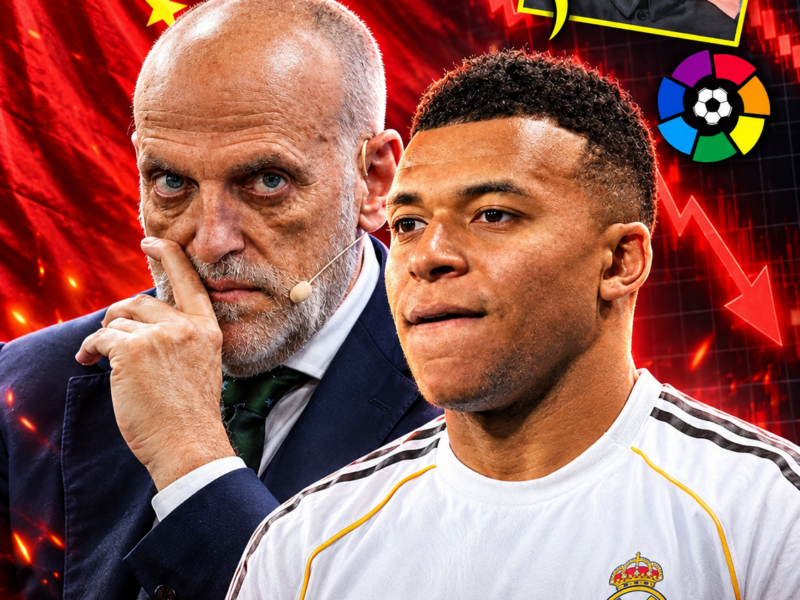
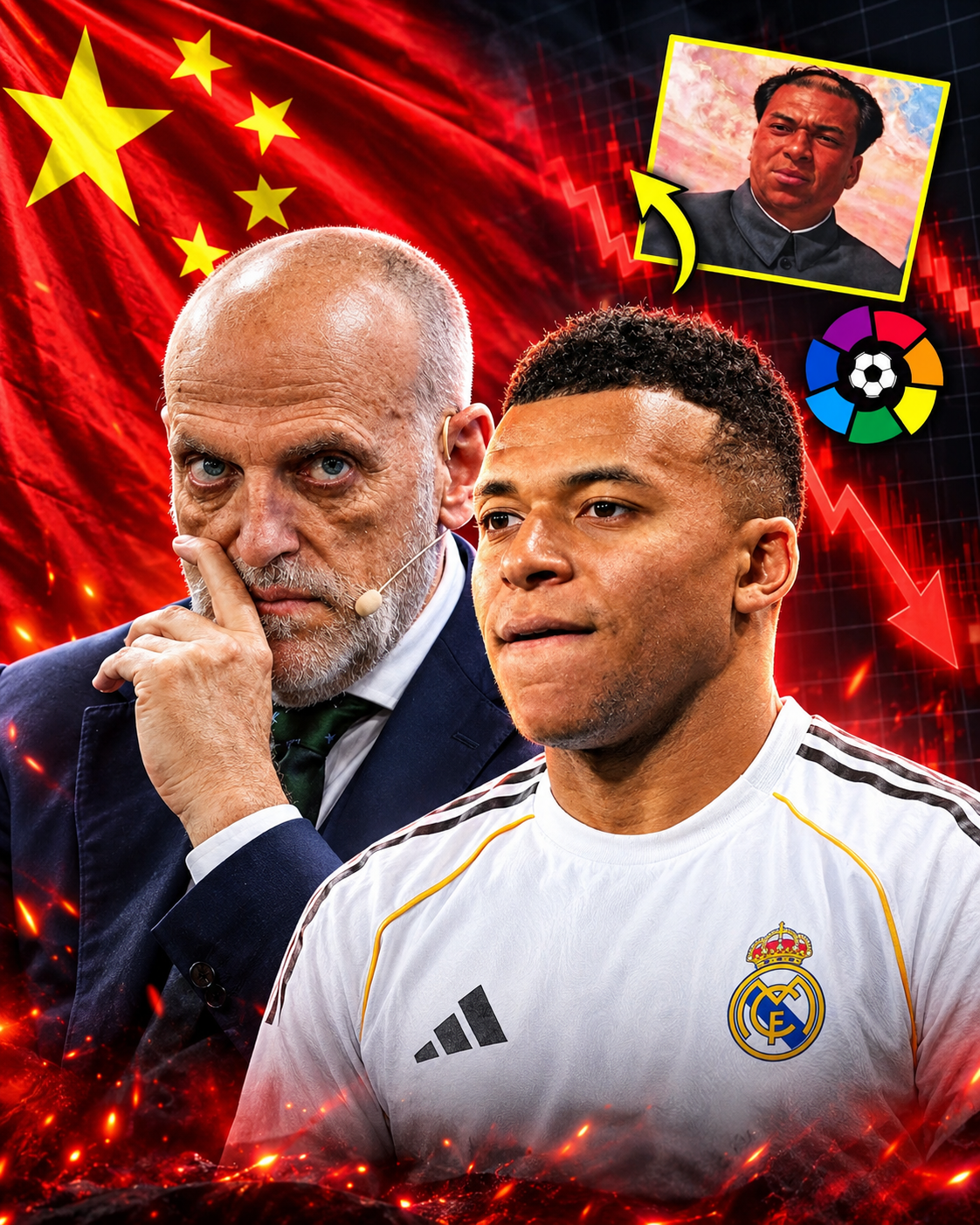
MBAPPÉ CAUSES AN EARTHQUAKE IN CHINA AS CULÉS HUMILIATE THEMSELVES AFTER EL CLÁSICO
It was supposed to be the morning after the glamour. Instead, it turned into one of those rare days when European football’s soft underbelly was laid bare: money, memes, geopolitics and old rivalries, all tangled together in a single news cycle. On the latest edition of Special One, the hosts opened with the kind of tongue-in-cheek flourish the show is known for. With the Ballon d’Or gala still hanging in the air, they joked that the studio might as well have been in London, because their guest of the day was none other than Lamine Yamal, the teenager who is, in their words, at the peak of his life and making the difference in the biggest games.
Yamal, ever the showman, played along. He explained that he had gone to bed with a terrible flu and woken up looking exactly as he did on camera, a line delivered with a straight face and no further elaboration. The hosts were quick to point out that his off-pitch style is now causing as much of a stir as his football. One of them, Iñigo, even turned up dressed in the Barcelona winger’s spirit, in what he insisted was a completely unintentional coincidence. He, too, claimed to have gone to bed with a bad flu and woken up that way, and he admitted it was “very uncomfortable.” Then the laughter stopped, and the real business of the day began.
The subject was China, and the “mess” that had erupted there overnight.
By the account given on the show, most of the football conversation that day was still nursing a Ballon d’Or hangover. Some were mocking Yamal’s look, others were quietly celebrating that Rodri had taken the trophy, and almost everyone had an opinion on the result. Then a new storyline cut through the noise. Kylian Mbappé had appeared on The Bridge Show, a podcast hosted by Aurelien, and during a relaxed chat he joked with his friends about a meme that circulates widely on social media, in which fans nickname him “Kylian the Dictator.”
What Mbappé said, by the hosts’ description, was light, self-aware and delivered in the tone of a conversation among friends. The France international appeared to be laughing at the meme, not endorsing anything. Yet within hours the remark had acquired a global dimension that nobody on the show believed it deserved.
Iñigo laid out his reading of events in measured terms. He acknowledged that a certain camp always argues that Mbappé weighs every word he says, and that the controversy could therefore have been deliberately provoked. He did not buy that. In his view, the player was trying to humanize an image that often feels carefully manufactured, in a podcast setting where he could speak loosely. He was convinced that Mbappé makes that sort of joke with his closest friends all the time, and that the teasing is harmless. In his words, the real problem was not the remark itself but the chain of reactions that followed, which he called “truly outrageous.”
The alternative view, which the hosts did not dwell on but which was easy to infer from the reaction abroad, is that a global superstar cannot expect to be treated as just another voice at a dinner table. Anything said into a microphone, however casual, can be clipped, translated and recirculated in contexts the speaker never intended. Critics of that school would say that fame comes with a duty of care, and that a joke about dictators, in a country where the topic is politically sensitive, was always going to be risky. Whether one considers that fair or not, it is the logic that appears to have driven events.
The practical consequences were swift. According to the show’s account, the Chinese side reacted to Mbappé’s comments by announcing that although it holds the capacity to exploit La Liga’s television rights on Chinese territory, it would, with immediate effect, stop broadcasting any Real Madrid match for as long as Mbappé is part of the squad. That is a heavy decision. Real Madrid is one of the most recognizable sporting brands on the planet, and for years it has been among the main attractions for foreign audiences tuning in to the Spanish league.
The response from the league’s top official was just as swift. Javier Tebas, president of the Professional Football League, issued a public statement that the hosts played to camera, line by line. In it, he said La Liga “deeply regrets” Mbappé’s words and the discomfort and offense they caused in China. He went on to offer, on behalf of the competition, “sincere apologies to the Chinese people,” before emphasizing the many years of respect, trust and cooperation that, in his telling, link Spanish football with Chinese authorities, sports institutions, broadcasters and millions of fans.
The statement then widened its lens. Tebas said the league could not allow “the actions of an individual” to tarnish that relationship or to harm the more than twenty clubs competing in its professional divisions, nor the millions of fans in China. He added that La Liga was taking every measure within its reach and working directly with partners and representatives in the country to overcome the situation. His closing message was one of reassurance: the commitment to China, its people and its institutions remained firm, and a relationship built over so many years could not be damaged by a single incident.
It is, by any standard, a striking text. A league president publicly distancing the competition from one of its own marquee players, and doing so in the language of institutional contrition, is not something football fans see every day. The hosts of Special One certainly did not let it pass quietly.
The presenter who read out the statement made it plain that, in his opinion, the issue was not only what Tebas said but the sheer length and style of the message. He described the communiqués issued by the league’s president as “infamous bricks of text” and joked that the man outdoes himself every day, before saying he would leave that topic for another occasion.
Then came the sharper edge. The presenter argued that there was a glaring contradiction. Barely two weeks earlier, he said, Tebas had publicly compared Real Madrid’s communication policy to the propaganda methods of Goebbels. The presenter’s point was that someone who had, in his view, tarnished all of Spanish football with such language was now complaining that a footballer’s joke endangered the image of the league. He said it was no longer a case of Tebas crossing the red line but of crossing “the black line,” and he concluded that the league’s president had completely lost touch with reality.
It is worth noting that this is the opinion of the show’s hosts, who are openly sympathetic to Real Madrid, and that the earlier remark attributed to Tebas has been a point of contention in its own right. Supporters of the league would argue that Tebas has long been blunt in his criticism of clubs, including Madrid, and that his role is to defend the competition’s commercial interests, not to avoid friction. They would add that the Chinese market is delicate, that diplomatic sensitivities are real, and that a league executive who ignored a potential broadcasting crisis would be failing at his job. On that reading, an apology is not a sign of weakness but the standard reflex of an organization protecting a commercial partner.
The hosts, however, were having none of it. For them, the incredible part was the scale. A young player makes a joking comment in a podcast. That comment provokes a reaction in China. The reaction lands on the league. And the president of the league, who in their telling had just accused Madrid of Goebbels-style communication, ends up apologizing to the Chinese on behalf of a Real Madrid player. “It’s all incredible,” one of them said, and the show kept returning to that note of disbelief.
One of the more interesting threads of the discussion concerned what Real Madrid itself had done, or rather, had not done. The club, the hosts noted, had not come out with any statement on the matter, and they did not expect it to. They defended that position as correct. In their view, Madrid was effectively saying that it would not swallow this particular pill, because the comments were made by one of its players outside club facilities, outside the club’s institutional image and in a relaxed conversation. The matter, in this reading, belonged to the league.
They went further, and this is where the analysis turned strategic. According to the hosts, the episode proves something Real Madrid should already know: that Tebas is far more vulnerable than he appears. They argued that as soon as his pocket is touched, he wobbles, and that Madrid should therefore act with greater force in its dealings with the league. If he feels cornered, they said, he has to “kiss the ground.” It is a combative view, consistent with the channel’s long-standing line, and it is plainly one side of an ongoing institutional feud between the club and the league.
The other side of that feud would tell a different story. League officials have repeatedly defended their governance of the competition, their financial controls and their international strategy, and they would argue that the interests of the twenty clubs in the top divisions are not the same as those of a single powerful member. Whether Madrid’s silence is a calculated power play or simply prudence is something the club has not clarified.
The show then put up a graphic to explain why, in its view, Tebas moved so fast. The chart broke down the league’s income from television rights. On screen, a bar showed 1.121 billion euros, close to 60 percent of the total, coming from the exploitation of those rights inside Spain. A second bar showed 748 million euros coming from the rest of the world.
The hosts then drew attention to the detail they considered most revealing. Out of those 748 million euros in international income, they said, none belong to China. In other words, the Chinese market, at least as a source of broadcasting revenue, is not currently contributing to La Liga’s balance sheet in a meaningful way. And yet it was the market that prompted the league’s president to apologize so quickly and so publicly.
The presenter did not hold back in explaining why. In his harsh phrasing, the league’s president moves for one thing only: the money, the business, whatever keeps him in his post. The more neutral interpretation is that China represents potential rather than present revenue. A country with a vast football audience and growing media appetite is precisely the kind of market a league wants to cultivate, and a rights deal that has been acquired but not yet fully exploited is an asset worth protecting. League executives, if asked, would very likely frame it that way, as long-term planning rather than panic.
Still, the hosts saw a different imbalance, and it was one that troubled them more than the apology itself.
The question they posed was simple. How can the Professional Football League wobble so much over a few relaxed remarks by Mbappé among friends, they asked, while on the very day it came out that another major club had allegedly paid the vice president of the referees’ committee for at least twenty years, the reaction seemed so much more muted? The reference was to the long-running Negreira affair involving FC Barcelona, which the presenter described as the second-biggest team in the competition having “corrupted the system.”
That is a heavy accusation, and it has to be handled carefully. Barcelona has consistently denied that the payments to the former referees’ vice president were intended to influence matches, and has argued that they were for technical reports and advisory services. The matter has been the subject of judicial and sporting proceedings, and its legal outcome is a separate question from the editorial stance of a YouTube show. The presenter’s remarks should therefore be read as an expression of his indignation about what he sees as a disproportionate response to Mbappé compared with a scandal he considers far more serious, not as a statement of established fact.
What can be said is that the contrast clearly struck a nerve. He confessed he was running out of words, and that he felt the competition was losing touch with reality. He also wondered aloud how the media ecosystem around the league would respond. Iñigo, for his part, said he had yet to see the reaction from the league’s “employees,” as the hosts put it, meaning the radio and television outlets they consider friendly to Tebas. His prediction was that they would come out apologizing, then agree with the league president and then criticize Mbappé. In his words, the whole affair was “absolutely disproportionate” and once again portrayed a bunch that is “impossible to deal with.”
That last phrase is the show’s shorthand for a certain camp of rivals and critics, and it set the stage for the second half of the program.
Having dispatched the China saga, the hosts changed gear. Once the institutional “bunch,” showered with league money in their telling, had been dealt with, there was another group they wanted to address, those they described as “not playing with a full deck.” The presenters promised that the next segment was dedicated to the viewers, and that anyone at home who had been expecting a settling of scores would not be disappointed. The hosts told the audience to put on their tuxedo, like Lamine Yamal, and to pin on a little flower, because they were about to be on screen.
The tone was unmistakably playful. The show has been through, as one host put it, a few complicated months, and he said this was the moment to settle some accounts that would leave the people at home with a good laugh.
The first target of the segment was a recurring one: the supporters and commentators of FC Barcelona, whom the show calls “Culés.” Under a banner reading “the School of Athens,” an ironic reference to the famous painting of the great minds of antiquity, the hosts rolled a series of clips in which Barça-leaning commentators discussed the upcoming Clásico. The joke, as Pesqui explained it, was that the show had always wondered whether history could ever gather so many brilliant minds in the same space and time, and that it had finally found its answer.
One of the clips featured a panel in which a participant said the situation would have a negative impact on Real Madrid. Another asked whether it would be worse for Madrid that Barça had lost. The answer given on screen was emphatic, “much worse,” because Barça, the speaker believed, had an opportunity that Sunday to do real damage, not just collect three points. Another speaker said Madrid was “going to the dentist” while Barça was going to the amusement park, and he asked that his team show no compassion at all. In his vision, a 2-0 lead should be followed by a third goal, then a fourth, a fifth and a sixth, without pause.
The most memorable portion, however, was a fantasy scenario in which the speaker said he would like to “humiliate” the opponent. He mused that a 5-0, the famous manita, would be the ideal result, and that from then on his team should simply pass the ball around. He even said he would not score the sixth. In his telling, he would reach the sixth, turn around as Maradona once did, pick the ball up and declare that his team was not scoring “because we don’t feel like it.”
The studio erupted. One host re-enacted the moment, gesturing with raised hands as if the climax were near. Another said that what these people do every day is closer to a comedy film than to football analysis, comparing it to Dumb and Dumber. And the point of the segment, as the hosts framed it, was a simple one: how good it is to be a Real Madrid fan, because the club always comes back and always provides moments like this.
It is worth stepping back to note what is actually going on here. Pre-match bravado is a staple of football punditry on every side, and the clips shown were chosen by a show whose entire purpose is to ridicule rival fans. Barça supporters would very reasonably argue that a talk-show panel is entertainment, not a formal statement from the club, that exaggerated predictions are part of the genre, and that Madrid-aligned channels produce plenty of equivalent material. Both camps have a long tradition of overheated rhetoric, and neither holds a monopoly on it.
The next page of the “School of Athens” brought another excerpt. In it, a Barça-leaning analyst argued that the gap between the two clubs was “abysmal.” He pointed to Barcelona’s run of nine consecutive league victories, the best start in the history of the competition, and said that on the coming Sunday the team could break the absolute record. In his reading, the only side to have caused Barça problems had been the European champion, Paris Saint-Germain, thanks to an extremely intense game with very high pressure and strong physical and tactical demands. Barça, he said, would not face that kind of examination against Real Madrid.
He went on to say that the most Madrid could aspire to was to lose by a few goals and then try to sell it as coming out stronger, nine points behind in the table.
What happened next, according to the hosts, is the whole point of the segment. They said that the result, a Real Madrid victory at the Camp Nou, was precisely the opposite of what the clip had predicted. Madrid had come out “strengthened,” they joked, because they had “danced all over” their rival. They also did the arithmetic with relish: Madrid, in their telling, is now just two points away from the top, or three, because with three more points the head-to-head record would hand it the lead.
One host paused to make a more serious observation, and it is the sort of remark that gives the show its edge. He said the real contrast was in the level of demand between the two clubs. At Madrid, he argued, nobody would ever produce a talk show full of that kind of bravado, and certainly not after a heavy defeat at the Parc des Princes. When Madrid lost in Paris, he recalled, a mini-crisis broke out and everyone took shots at the club. Meanwhile, he said, the Barça-leaning commentators had enjoyed the luxury of an entire week in which they claimed they would put a dozen goals past their rivals and turn around on the goal line once it was 5-0.
There is room for disagreement about that characterization. Defenders of the Barcelona media sphere would point out that Madrid-aligned programs have their own record of triumphalism, that confidence ahead of a derby is normal, and that a single result, however emphatic, does not erase a league campaign in which Barcelona was on a record-setting run. They would also note that nobody in football is immune from being contradicted by events on the pitch.
Nonetheless, the hosts were convinced that the result marked a turning point. One of them previewed the week ahead, saying that the former Madrid player Collins was due on the show for a consultation the following day and promising that the video would be spectacular. His forecast for the rivals was blunt: he thought Barça’s circle would self-destruct. He said he knew them, and that they had peaked in the weeks leading up to the derby. In his view, the hatred toward Madrid is so visceral that it drives them to make bold pre-match statements and, once they have hit rock bottom, they crumble because they run out of arguments. Real Madrid, he added, is their whole life.
He concluded that the audience would have a lot of fun for the rest of the season.
Pesqui added a psychological twist. According to him, the people he calls “Narnians” live in a movie detached from reality. They give a series of speeches at the start of the season, and then they watch events fail to match the story they had mentally constructed. The result, he said, is like banging one’s head against a wall, which is bound to make anyone uncomfortable. To prove the point, he rolled another clip.
The clip in question dated from the summer, and it was a prediction of a different kind. In it, a Barcelona-leaning commentator told his audience that the club’s best signing of the season was not any of the players brought in, naming Gordon, Alejami and Rodrygo in passing, but José Mourinho. This, he said, was Barça’s best signing. Two and a half months later, he added, he had to admit he had fallen short, because time was proving him right. His reasoning was that Mourinho was an outdated coach, sixteen years without a Champions League, thirteen without a league title, practically bounced from every place he had been lately and leaving almost every club on bad terms. The squad he had inherited, in the commentator’s judgment, was far weaker than the one he had between 2010 and 2013. And what time was showing, he said, was that Mourinho had come to do what he did in 2010: stir things up and tarnish the competition.
Iñigo’s reaction was a mixture of sympathy and glee. He said he was starting to feel sorry for them. The thinking, as he laid it out, was that these commentators arrive with a pre-programmed idea, in this case that the Portuguese coach is the best thing that could happen to Barcelona, and then Mourinho delivers an absolute masterclass on their own turf and leaves them practically speechless. At that point, he joked, there is nothing left to do but conclude that you are living in the Matrix.
He then produced a statistic he had been saving. The last time José Mourinho lost to Barcelona, he said, was in 2012, in a Spanish Super Cup match. For a coach described as hopelessly outdated and as the best signing for the opposition, he suggested, that was not a bad record.
The argument is, of course, a selective one, and Mourinho’s critics would be quick to say so. His career since the early 2010s has included both triumphs and bitter exits, and a Clásico result, however convincing, does not settle the debate about where he stands among the game’s great coaches. His supporters would counter that results are the only currency that matters, and that Madrid’s performance at the Camp Nou speaks for itself. As is often the case in this sport, both readings are comfortable for the people who hold them.
The hosts could not resist the metaphor that, in their view, best explained the rivalry. Whatever the commentators might believe, they said, the pattern repeats itself endlessly. Barcelona’s supporters get a little cocky, Madrid returns and takes a bite out of them, they are sent back to the bottom, they get cocky again, try to climb and are bitten once more. It is a loop, they said, and the white shark keeps feeding.
Pesqui took the image to its logical, and comic, extreme. If he were one of the people in the clips, he said, he would leave Spain for a month and a half, and it would not even cross his mind to show his face. He would look for a cave in Antarctica, light a fire and stay there for three months until the competition was over. His conclusion was affectionate in its cruelty: they never learn.
Iñigo then returned to the Clásico itself, and to a point he felt had been buried under the news of the week. In his view, the true feat was yet to be properly analyzed, and he promised that the show would do so during the following days. Echoing a famous Mourinho turn of phrase, he said it smelled like Negreira, but in this case it smelled like a disaster. He reviewed what he described as Barcelona’s last three matches. The first was the game against Betis, which, as he put it, the Catalan side would have been on the edge of losing had they not cheated. The second was the trip to Paris, where they were thrashed practically while walking. The third was the Clásico, where, as had been said during the live broadcast, Mourinho played exactly the game he wanted from the first minute to the ninetieth, while Real Madrid gave Barcelona a masterclass.
The Betis allegation deserves a clear label: it is the presenter’s opinion about a refereeing or match-related controversy, and it is not a finding of any sporting body. Barcelona supporters, and the club, would reject the suggestion outright. They would also point out that every club in the league can list decisions that went for or against it over a season, and that a run of nine straight league wins is not something that happens by accident. The hosts, naturally, see it differently, and the fact that these opposing narratives are told with equal certainty on either side is a reminder of how deep the divide runs.
With the recording already past the seventeen-minute mark, the presenters said they had set aside space for some breaking news. This time, they promised, it would come from a journalist.
They introduced the item with a wink. Having dealt with the opponents, they said, it was now time to look at their own ranks, at all the supposed Madridistas who, in their view, flirt with or even adopt the Barcelona thesis. And they began with a figure they described as unpopular on the channel who had, this time, apparently done his homework.
On screen appeared a post from the journalist Sergio Valentín, whom the show jokingly calls “Sergio Cowardin.” He wrote that, according to information from Picón, an item that, in his words, set off “many alarms,” Florentino Pérez had told his inner circle that he already had a replacement in mind for José Mourinho if things did not improve. The name, according to the post, was Didier Deschamps.
The hosts treated it as a gift. They called it top-tier, informative journalism, saying Spain was on another level, and they asked what could be said of a report that surfaces right before the most important match of the season. Iñigo declared that the author was a Pulitzer in the making, and said he was about to head to Barajas airport to see whether he could spot Deschamps arriving to take over from Mourinho. The credibility of the information, he added, was incalculable.
It should be stressed that nothing in the show’s account suggests the claim was confirmed by Real Madrid or by Florentino Pérez himself, and the club had not commented on it as of the recording. The report appears to rest on a single chain of sources, and the hosts clearly regarded it as implausible. The journalist, for his part, was presenting what he described as information he had received, which is a normal part of sports reporting even when the information later turns out to be wrong. Readers can draw their own conclusions about how much weight a rumor deserves when it is published ahead of a major game.
There was one more target, and the presenters approached it with the weary tone of people who have said the same thing many times. Another Madrid club member, they said, had come out after the Clásico, after what they called a turning point, with an opinion they could not let go.
The clip showed a commentator, whom the hosts have nicknamed “Fatiguita” Serrano because of the number of outlets in which he appears, discussing the Real Madrid goalkeeper Andriy Lunin. The commentator said he stood by his view that Lunin is among the fifty best goalkeepers in the world, and then argued that Lunin was the one keeping Barcelona in the game. He recalled a save from Gerard Martín and a near-post stop from Gordon in the first half, adding that Lunin looked very nervous with the ball at his feet. To his eye, the Ukrainian seemed like a backup goalkeeper, and not a bad one, but there were goalkeeping pairs of a higher level than the one Madrid had. He said he was sure the club was already working on a succession plan for Thibaut Courtois, whom he hoped would stay a long time, and that the idea would be to bring in a keeper so that Lunin remained a substitute.
To the hosts, this was baffling. One of them said the commentator had been given a lot of leeway already, noting that there was another clip in which he explained that he himself had played as a goalkeeper and understood the position. But he felt the matter could not simply be left there. The man, he said, makes his living from this. He is in every medium imaginable, on the radio at eight in the morning and still on it at eleven at night, working a great deal and, in the presenter’s phrase, saying one thing in the morning and the opposite in the evening.
The presenter’s main complaint was one of proportion. After what he called an ode to football at the Camp Nou, after Madrid’s tactical beating of Barcelona across a long list of game parameters, the commentator’s takeaway was how weak Lunin was and how poor the goalkeeping duo was. He argued that Lunin deserved more respect, recalling that in the season when the Ukrainian had to step up and play regularly, Madrid won the Champions League, with significant performances against teams such as Leipzig and Manchester City. In his opinion, Lunin is an impeccable professional, and he added that Mourinho, who knows a thing or two about codes, praises him day in and day out.
Then the discussion widened into a broader grievance. The presenter said that if it were up to this commentator, who, he claimed, had voted for Riquelme in the club’s election, the club would be in a different place. He also remarked that Riquelme had been seen having dinner with Joan Laporta at the Clásico. He said he would not go to collect an inheritance with people like that.
Fair-minded viewers might observe that a goalkeeper assessment is the kind of subjective judgment on which reasonable analysts disagree. Calling a player a good backup, while hoping the starter stays for years, is hardly a scandalous opinion, and many analysts compare second-choice goalkeepers across leagues as a matter of routine. The hosts, however, took the timing, immediately after a famous win, as evidence of what they consider a habit of looking for the negative.
The broader point the hosts wanted to make was about solidarity, or the lack of it. Real Madrid, they said, is such a great club that nobody can beat it, not even its own associates. They described the week as historic, a genuine turning point, and told their audience that they could smell a lot of fun from now until the end of the season. They urged viewers to enjoy it, because there are, in their words, enough bad actors in the equation who strike from outside the ranks and from within, and very few people stand on the front line. Moments like these, they said, deserve to be celebrated with unbridled euphoria, because that is what they have, and that is how things are around them.
Stripped of the jokes and the costumes, the day’s events were an unusual mix. A footballer’s off-the-cuff remark on a podcast was said to have led a foreign broadcaster to pull a club’s matches. A league president issued a lengthy apology on behalf of the entire competition. A club chose silence. A television chart illustrated how little of the league’s international income currently comes from the market at the heart of the dispute. And in the middle of all this, two famous rivals prepared for, played and then argued about the most-watched fixture in Spanish football.
What is clear is that each camp reads the same facts in opposite ways. To the Madrid-aligned hosts of Special One, the Mbappé affair exposes a league president who is more vulnerable than he looks, a double standard in the treatment of institutional scandals and a pattern of rival bravado that collapses on the pitch. To their critics, the same facts show a channel that thrives on mockery, that selects its clips to suit its story, and that treats rumors and rivalries as proof of a larger conspiracy. To the league, it is about protecting a commercial relationship. To the Chinese side, it is about respect. To Mbappé, if the hosts’ reading is right, it was a joke among friends.
There are loose ends enough to keep the conversation alive for days. Real Madrid has yet to say anything about the broadcast ban. The league has not detailed what its measures with partners in China will entail. Barcelona must now respond to a heavy defeat after its record run, and its supporters will have to explain how the talk of a 5-0 turned into a lesson of the opposite sort. And the question of who, if anyone, will replace Mourinho, a question that on the evidence of the show nobody at Real Madrid has actually raised, will keep being asked by those who need it to be asked.
For now, the hosts ended where they began, in a good mood. They asked viewers to leave a like and some hype, to share their opinions in the comments on everything discussed, and to subscribe, because, as they put it, it is free. Those small gestures, they said, help the channel keep growing at the astonishing pace of recent weeks and months. Then came the farewells, a few cheerful goodbyes and a promise to return in the next episode









