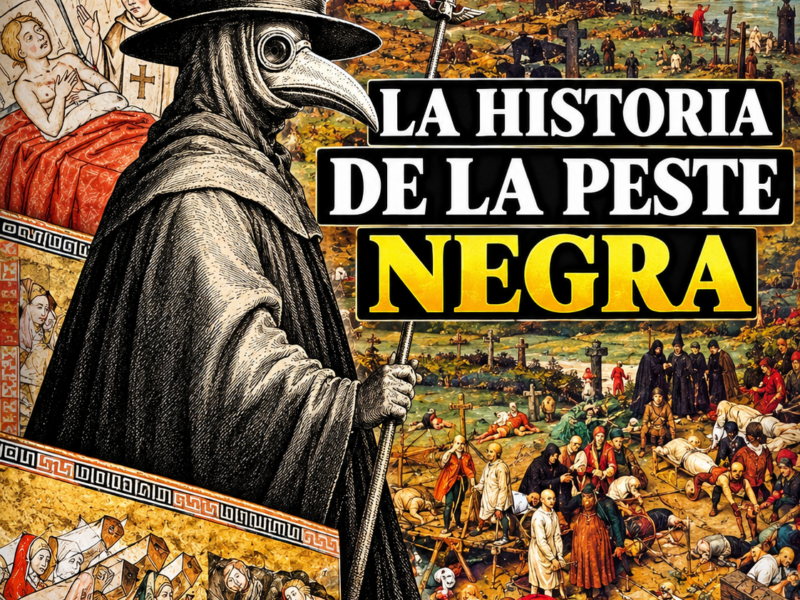
The Complete Story of the Black Death: The Epidemic That Devastated Europe
October 1347. Twelve Genoese galleys slowly enter the port of Messina, on the island of Sicily. No one comes out to greet them with joy.
Those watching from the dock discover that many sailors lie dead on the rowing benches. Those who still breathe have bodies covered in black swellings and ooze an unbearable stench.
The authorities order the ships to leave the port at once. It is already too late. The disease has landed in Europe.
Over the following six years, between 1347 and 1353, that scourge will sweep across the entire continent. From Sicily to Norway, from Lisbon to the plains of Russia. Millions of people will die, and entire villages will stand empty.
The fields will fill with weeds, and the cemeteries will not be able to keep up with so many bodies. This is the complete story of the Black Death, the epidemic that devastated Europe.
We will see where it really came from, what route it followed to that Sicilian port, and why the most prosperous trade routes in the world became the road to catastrophe. We will also see how it changed medieval society forever.
But we will also speak of what historians still debate. For centuries, certainties were repeated that we now know to be false, and modern science has found, in distant graves and in 700-year-old dental remains, clues that force us to rewrite the beginning of this story.
One question will stay with us until the end. If the disease had long existed among wild animals in Asia, what happened in the fourteenth century for it to suddenly leap to human beings and cross half the world?
To understand it, we must begin with the Europe that received it.
Around the year 1300, the continent was living through the most populated moment of the entire Middle Ages. For three centuries, a somewhat warmer climate, new agricultural techniques, and land reclaimed from forests and marshes had allowed the population to grow without pause.
It is estimated that Europe then had more than 70 million inhabitants, although the exact figures are estimates and specialists do not agree on the margins. What is clear is that there were more people than ever and that many fields were already being cultivated to the limit of what was possible.
The pressure was felt. Peasants worked ever smaller plots, divided among sons and grandsons. A single bad harvest was enough to leave a family on the brink of hunger.
And the bad harvests came. Between 1315 and 1317, torrential rains rotted the grain across much of northern Europe. Chronicles of the time speak of soaring prices, of people eating whatever they could find, and of villages that lost a considerable portion of their inhabitants.
Historians call that episode the Great Famine. It was not the plague, but it left a weakened population. Many researchers maintain that it prepared the social ground for what was to come, though not all agree on how much it mattered.
The cities, for their part, grew as best they could. Florence, Venice, and Genoa had reached tens of thousands of inhabitants, and some, as is believed to have been the case with Paris, far exceeded that figure.
The streets were narrow and unpaved. Waste was thrown into the canals or directly into the street. Animals lived alongside people, and granaries, full of grain, attracted thousands of rats.
Houses shared walls, and whole families slept together in a single room, often on straw. Fleas and lice were constant companions.
No one in that Europe knew that microbes existed. Medicine relied on the texts of the ancient Greeks and on the theory of the humors, according to which the body was made up of four fluids whose imbalance caused disease.
It was thought that many epidemics were born from corrupted air, the so-called miasma, arising from swamps, decomposing corpses, or certain positions of the stars. It was an explanation consistent with what was known, and it would prove completely useless against what was approaching.
For what was approaching had long been in the making at the other end of the Eurasian continent.
The bacterium responsible is called Yersinia pestis. It is a microorganism that lives naturally in populations of wild rodents, such as marmots and certain steppe squirrels, and is transmitted among them by fleas.
For centuries, perhaps millennia, the bacterium circulated in those reservoirs while affecting almost no one. The disease reached humans only when a hunter or shepherd came into contact with an infected animal, and outbreaks remained limited to one area.
For a long time, it was debated where and when the decisive leap occurred. Hypotheses pointed to China, Mongolia, the Caucasus, and India. Until a few years ago, no one could prove anything.
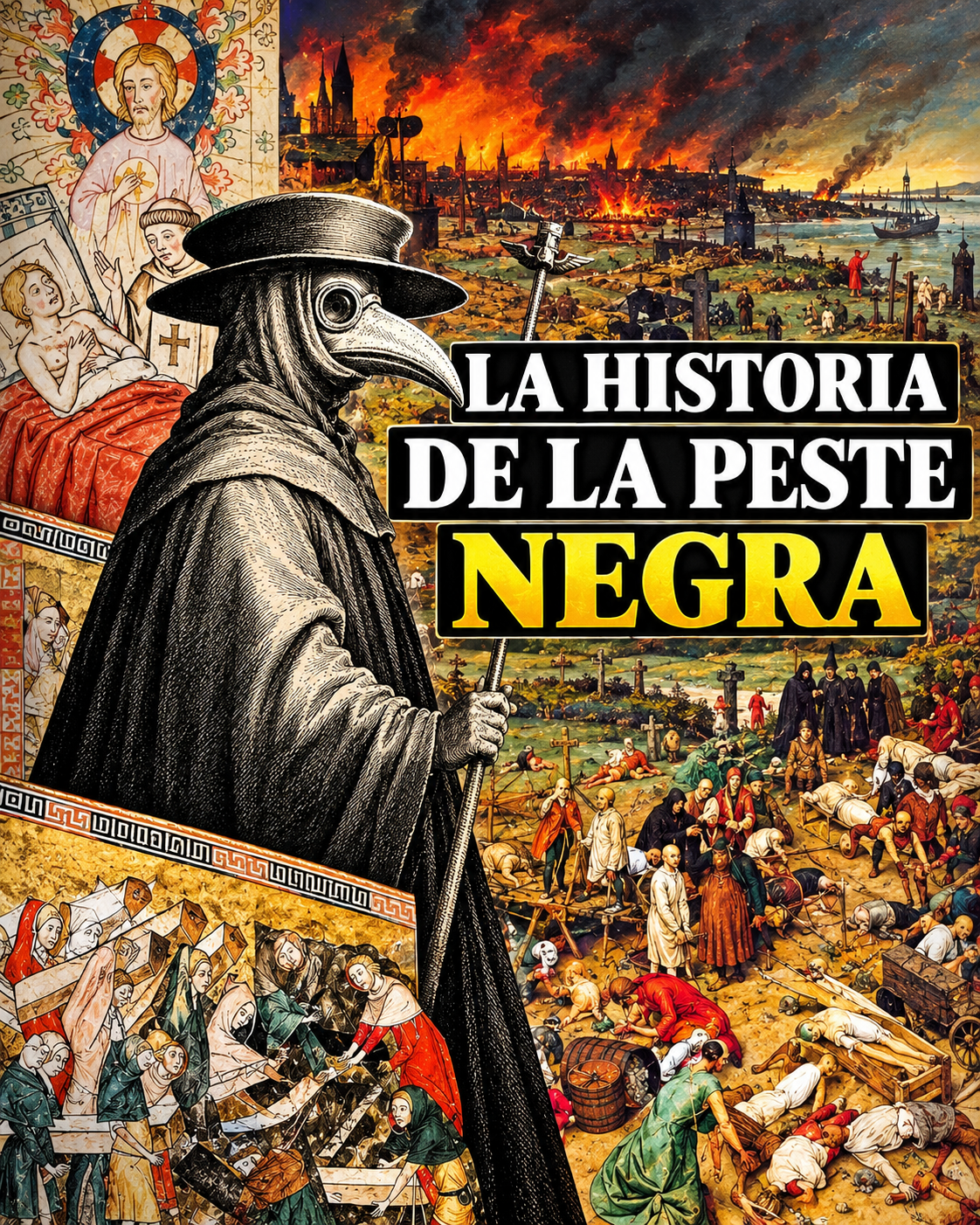
Then a clue appeared in an unexpected place: the region of Lake Issyk-Kul, in present-day Kyrgyzstan, at the foot of the Tian Shan mountains. There, two Christian cemeteries belonged to a community that lived beside the caravan route.
Since the late nineteenth century, archaeologists had documented that those graves bore many inscriptions dated 1338 and 1339. One of them, written in Syriac, indicated that the person buried had died of a pestilence.
For decades, those gravestones were a curiosity, a tempting hint without definitive proof.
The proof came in 2022. An international team of researchers analyzed the genetic material preserved in the teeth of several skeletons from that cemetery and found traces of Yersinia pestis.
When they compared that genome with those of modern and ancient strains, they concluded that the variant sat exactly at the point on the bacterium’s family tree from which, shortly afterward, the strains that would cause the Black Death in Europe branched off. In other words, the bacterium from the Issyk-Kul graves appeared to be, genetically speaking, a direct ancestor.
There is one more detail: the modern plague strains closest to that point are found today in rodents of that same mountainous region.
This does not prove that the epidemic began in exactly that valley, and the authors themselves said so cautiously. What it does show is that there was a plague outbreak there in 1338, that the bacterium belonged to the right lineage, and that the Tian Shan region is, so far, the firmest candidate for the origin of that lineage.
Some specialists continue to point out that, with so few ancient genomes available, there could be other equally old foci that we do not yet know about. It is one of the open debates.
What we do know is what surrounded that lake. Issyk-Kul lay on one of the branches of the Silk Road. Through those mountain passes traveled merchants, mules laden with cloth and spices, furs and slaves, messengers and soldiers.
Any infection that passed from a rodent to a person, or from a flea to merchandise, had one of the great highways of the medieval world within reach.
And that highway was more connected than ever. In the thirteenth century, the Mongols had created the largest land empire in history. Although it had already fragmented into several kingdoms, the so-called Pax Mongolica continued to facilitate the movement of people and goods from the Pacific to the Black Sea.
Caravans crossed Central Asia in times unthinkable a century earlier. Italian merchants, above all Genoese and Venetians, had established trading posts on the shores of the Black Sea, where they bought what arrived from the interior: silk, spices, slaves, and grain.
The most important of those Genoese trading posts was Caffa, on the Crimean peninsula, present-day Feodosia. It was a fortified, wealthy, and cosmopolitan city, from which ships laden with goods departed for Constantinople and the ports of the Mediterranean.
It was under the nominal authority of the Golden Horde, the Mongol khanate that dominated the northern shores of the Black Sea. That dependence generated constant tensions.
In 1346, those tensions erupted. A conflict between Italian merchants and local residents led to a confrontation that brought the army of Khan Jani Beg to besiege Caffa.
Here appears one of the best-known and most debated episodes in the entire history of the epidemic. According to the account of an Italian notary named Gabriele de Mussis, who wrote years later and was not in Caffa, the besieging army suffered an outbreak of plague that decimated it.
The Mongols, the story continues, decided to turn their own dead into a weapon. They placed the corpses in catapults and hurled them over the walls so that the disease would spread among the defenders.
The surviving Genoese, terrified, are said to have fled in their ships, carrying the disease across the Mediterranean.
It is a scene of enormous power, and for generations it was cited as the origin of the epidemic in Europe. But today historians treat it with great caution.
De Mussis wrote far from the scene, with secondhand information, and his text contains details that do not fit what we know about how the bacterium is transmitted. A corpse thrown over a wall is not the usual route of contagion, which depends above all on fleas.
Many experts consider the account a dramatized version of something simpler: that the disease was present in the siege area, affecting both sides, and that the ships leaving Caffa may have carried infected rats, fleas, and grain westward.
What seems solid is the general chronology. The plague struck the Black Sea region around 1346. It had come from the interior of Asia, probably following the caravan routes and the migrations of the steppe rodents themselves, and found in Caffa and other ports a perfect starting point for crossing the sea.
From Crimea, merchant ships sailed southwest, bound for Constantinople. It is very likely that the disease reached the Byzantine capital in late 1346 or early 1347.
Byzantine sources describe it in detail. The emperor and writer John Cantacuzenus, who lost one of his sons to it, left a description of the symptoms that matches astonishingly well with what is known today about plague. He spoke of high fever, dark spots on the skin, and a mortality that did not distinguish between rich and poor.
From Constantinople, the disease spread across the Aegean toward Alexandria and the coasts of Syria and Palestine. Maritime trade did the rest.
Ships knew neither quarantines nor sanitary borders. Every port was an open door, and every galley laden with grain or cloth could carry, without anyone knowing, tiny passengers hidden among the sacks.
And so we arrive at the moment with which this story began. In October 1347, the fleet of Genoese galleys that docked at Messina carried the disease aboard.
The Sicilian chronicler Michele da Piazza recorded what happened. According to his account, the sailors carried the sickness in their bodies, and those who spoke with them contracted it immediately. The city authorities expelled them, but it was already too late: the disease had entered the houses.
Da Piazza tells how the inhabitants, terrified, began to flee Messina and that their flight only spread the illness to other towns on the island.
While Sicily burned with fever, the expelled fleet kept sailing. Some ships headed for Genoa, their home city. Others reached Pisa, Marseille, and other ports of the western Mediterranean.
In Genoa, the population, forewarned, tried to repel the galleys with arrows. It was no use. The disease appeared in the city in January 1348.
In Venice, the great commercial republic of the Adriatic, the plague arrived almost at the same time. The Venetian government, which already had some experience regulating the arrival of ships, tried to halt its advance with isolation measures. It was a brave effort, but also an insufficient one.
In Marseille, which had received the disease in November 1347, thousands died within weeks. From there, the contagion went up the Rhône valley, advanced toward Avignon, and spread across the south of France.
In Italy, it spread from the ports to the interior with a speed that surprised everyone. At the beginning of spring 1348, the disease reached Florence.
Florence was then one of the richest cities in Europe. Bankers, wool merchants, artisans, and artists lived together in a space of narrow lanes and fortified palaces.
It was in that city that a writer named Giovanni Boccaccio witnessed the effects of the disease and left one of the most famous descriptions that survive.
In the introduction to his work The Decameron, Boccaccio explains that the plague did not manifest as it had in the East, where, as he put it, a nosebleed was a sure sign of death. In Florence, he wrote, it began in both men and women with swellings in the groin or armpits.
Some were the size of an ordinary apple and others like an egg. The Florentines called them gavoccioli. Afterward, the disease spread through the body, and later black or livid spots appeared on the arms, thighs, and other parts.
Most died, he said, within three days of the first signs appearing, and many without fever or any other symptom.
That description matches what we now call bubonic plague. The lumps, called buboes, are lymph nodes inflamed by the infection. The bacterium enters the body through the bite of an infected flea, travels through the lymphatic system to the nearest node, and multiplies there with violence.
But the disease could manifest in other forms. In the septicemic variant, the bacterium invades the bloodstream directly, and the patient can die within hours, even before the lumps appear.
In the pneumonic form, which attacks the lungs, contagion can occur from person to person through the droplets expelled when coughing, and it is almost always fatal if untreated.
Today, with antibiotics, plague is a treatable disease. In 1348, nothing of the kind existed.
Boccaccio recalls how fear broke the most basic bonds. Neighbors avoided the sick. Relatives abandoned one another, and even parents hesitated to care for their children.
Funerals lost their ceremony. Bodies were carried out of houses and piled in front of doors, and the dead received fewer honors than a goat would in ordinary times.
Boccaccio adds a phrase that would become famous: many who had breakfasted with their friends in the morning would dine that same night with their ancestors in the other world.
One nuance should be pointed out. The Decameron is a literary work, and that introduction is a carefully constructed text. But other independent testimonies, such as the chronicles of Matteo Villani, who continued the work of his brother Giovanni, himself killed by the epidemic, confirm the magnitude of what happened.
It is estimated that Florence lost between half and three-quarters of its population in a few months, although the exact figures vary according to the researcher.
How did the medicine of the time react to something like this? With the tools it had.
In October 1348, King Philip VI of France requested a report from the Faculty of Medicine of the University of Paris, the most prestigious medical institution in Europe. The Parisian masters drew up an opinion that combined observation and astrology.
They held that the main cause was a conjunction of the planets Saturn, Jupiter, and Mars, which occurred on March 20, 1345, and which had corrupted the air and the vapors of the earth and sea.
They recommended avoiding southern winds, keeping houses ventilated, eating in moderation, shunning hot baths, which they believed opened the pores to poisoned air, and not consuming too much fruit or fish.
It was a serious text, written by intelligent people with the knowledge of their time. But it started from a mistaken premise, and for that reason its advice could not work.
Other physicians came close to the truth without knowing it. Guy de Chauliac, surgeon to the pope in Avignon, survived the disease and wrote a very complete description of its two forms: the one that attacked the lungs and the one that produced swellings.
He observed that the pneumonic form was faster and deadlier, and that contagion between people seemed evident. He himself admitted that physicians were almost useless and that many preferred not to visit the sick, out of fear or so as not to ruin their reputations.
Chauliac says that he carried out his duty for fear of shame, though with constant dread.
In Avignon, Pope Clement VI, whose court had settled there, made a decision that today we would call common sense. Following the advice of his physicians, he isolated himself in his chambers, surrounded by large fires that he kept burning day and night.
It is not known with certainty whether the fire protected him by reducing the fleas or whether it was simple chance. But the pontiff survived, while a good part of his entourage fell ill.
At the same time, Clement VI organized the burial of the victims. He consecrated the Rhône River so that corpses could be thrown into its waters, and he maintained active relief work for the afflicted, which earned him the respect of many chroniclers.
Some Italian cities tried more radical methods. Milan, ruled by the Visconti family, adopted severe isolation measures. According to tradition, when the disease appeared in three houses, they were ordered sealed with their inhabitants inside.
If the account is accurate, it was a cruel measure. But Milan seems to have suffered less than other neighboring cities, although historians debate how much was due to that policy and how much to other factors, such as location and population density.
In time, the accumulated experience would give rise to an institutional invention that would survive for centuries. In 1377, the Republic of Ragusa, on the Adriatic coast, ordered that ships coming from infected areas wait 30 days before disembarking.
Later, other cities extended that period to 40 days, the Italian quarantena, from which our word “quarantine” comes. Venice would later found the first organized lazaretto.
The method remained empirical, with no correct theory behind it, but it worked better than any physician’s recipe.
Meanwhile, the disease did not stop. From Marseille and the south of France it advanced northward along valleys and roads. In the summer of 1348 it reached Paris, where chroniclers speak of hundreds of deaths each day.
The monk Jean de Venette, who lived nearby, wrote that the mortality lasted about two years in France and that there were so many dead that enormous pits were opened in the cemeteries, where bodies were stacked by the dozens.
He also said something very significant: that more poor people than rich died and that, curiously, in many houses all the inhabitants vanished.
Across the English Channel, England awaited news from the continent with anguish. It did not have to wait long. In June 1348, the disease landed at the port of Melcombe, on the south coast.
According to some chronicles, it arrived on a ship from Gascony. From there it advanced toward Bristol, where mortality was enormous, and toward London, which it reached in autumn of that same year.
During the winter, the epidemic seemed to subside. With the spring of 1349, it returned with terrifying force.
In London, new cemeteries were opened to bury the dead. One of them, in the East Smithfield area, has been excavated by modern archaeologists. There, hundreds of skeletons were found carefully arranged in rows, which shows that, even amid the catastrophe, many communities tried to maintain order and respect for their dead.
From the analysis of teeth from those skeletons, one of the first complete genomes of the bacterium of that era was obtained in 2011. It was direct scientific proof that Yersinia pestis was the cause of the Black Death, something some researchers had been doubting for years.
From England, the disease passed to Wales, Scotland, and Ireland. In Ireland, a Franciscan friar named John Clyn, who lived in Kilkenny, wrote an especially moving testimony.
He described how the sickness ravaged the country and how he feared being one of the last survivors. He even left blank parchment in case someone lived to continue his chronicle. That was how far the desolation in his community went.
The manuscripts do not say what became of him afterward, and it is assumed he died shortly after.
In 1349, the disease reached Scandinavia. One tradition tells of an English ship laden with wool, its entire crew dead, running aground near Bergen, Norway, and that the contagion began there.
Although the tale has elements of legend, it is certain that plague reached the Norwegian kingdom that year and spread rapidly. From there it passed to Sweden, Denmark, and then the Baltic. In 1352 it reached Russian lands, and the chronicles of Pskov and Novgorod already speak of the disease.
Meanwhile, through southern and central Europe, the epidemic advanced along the Rhine valley, through the Alpine passes, and across the territories of the Holy Roman Empire.
On the Iberian Peninsula, plague arrived in 1348 at the ports of the Crown of Aragon and of Castile. Alfonso XI of Castile was one of the few European monarchs to lose his life to the disease, during the siege of Gibraltar in 1350. The records of Barcelona, Valencia, and Mallorca show devastating peaks of mortality.
For those who lived through those months, the experience was hard to comprehend. Death came quickly, without warning, and spared neither age nor station.
In the Tuscan city of Siena, a chronicler named Agnolo, known as “the Fat,” left one of the most chilling accounts of that time. He recounted that the mortality began in May 1348, that it was something cruel and terrifying, and that no one knew how to escape.
The dead were so numerous that there was no one to bury them. And he added, with disarming simplicity, that he himself buried his five children with his own hands.
He wrote that in many places great pits were dug where bodies were thrown by the hundreds, covered with a thin layer of earth, so that dogs dug them up to devour them. No one wept for the dead, because everyone expected death for themselves.
The bells that traditionally announced each death stopped ringing in many cities. It would have been a continuous tolling.
The priests who were to administer the last sacraments fell ill alongside their parishioners. In some English dioceses, the records show that half of the parish clergy died within a few months, which forced the hurried ordination of priests, sometimes with minimal preparation.
It was even authorized that, for lack of priests, the faithful could confess to laymen and even to women, something unthinkable under normal circumstances.
In the countryside, the picture was no less grim. Peasants, who lived scattered, seemed at first glance better protected than city dwellers. They were not.
The disease entered the villages through merchants, pilgrims, and rats traveling in grain carts. Many rural communities lost most of their inhabitants.
Over the years, archaeologists and landscape historians have identified hundreds of abandoned villages in England, Germany, and other countries, vanished or reduced to a few houses. It is true that not all were depopulated by the plague alone, since some were already in decline, but the epidemic was in many cases the final blow.
Animals also suffered the consequences of the human catastrophe. Herds, without shepherds, scattered or died in the fields. Crops, with no one to gather them, were lost in the furrows.
Chroniclers speak of wandering sheep and cattle without owners, and of farms with their doors open and empty.
With fear growing, people sought explanations, and those explanations sought culprits. For many believers, the disease was divine punishment for the sins of humanity.
From that conviction was born one of the most striking phenomena of the age. The flagellants were groups of men, and sometimes women, who traveled through cities in procession, chanting penitential hymns and whipping their backs with leather scourges tipped with metal spikes, to atone for the sins of the world and appease the wrath of God.
They followed strict rules, with public ceremonies that drew crowds. They arose in Hungary and Germany, spread through the Low Countries, and came to gather thousands of participants.
At first, the ecclesiastical authorities tolerated them, but little by little the movement became uncontrollable. Some flagellants began to question the authority of priests, to preach on their own, and to incite the crowds.
In October 1349, Pope Clement VI formally condemned the movement, and various princes and cities banned it. In time, the practice faded, though it left its mark on European religious memory.
There was, however, a far darker consequence. In many regions of Europe, a rumor arose that Jewish communities had poisoned wells and springs to cause the epidemic.
There was no proof whatsoever. Today historians agree that it was a completely false accusation, fed by fear, by old prejudices, and, in some cases, by the debts the accusers owed to Jewish moneylenders. But in the climate of panic, the accusation spread rapidly.
The first attacks were recorded in southern France and Catalonia in early 1348. They then spread toward the Rhine valley and the German and Swiss territories.
In January 1349, trials were held against members of the Jewish community in the German lake region, and under torture, confessions were obtained that were then circulated to other cities as supposed confirmation.
In February 1349, in Strasbourg, hundreds of people from the Jewish community lost their lives in one of the gravest episodes of that wave. In other cities, such as Basel, Mainz, Cologne, and many more, entire communities were destroyed or expelled.
There were voices that opposed it. Pope Clement VI published two documents in 1348 in which he condemned those accusations. He pointed out that Jews also died of the disease and that the epidemic affected even regions where they did not live. He asked bishops to protect the Jewish communities.
Some municipal magistrates tried to halt the violence and in certain cases paid a high political price for it, but elsewhere popular pressure was impossible to contain.
Historians note that in several cities there were attacks even before the plague arrived, as a preventive measure, which shows to what extent anticipatory fear could turn into violence.
It is one of the darkest chapters of that time, and remembering it clearly is part of understanding what happens in a society when panic replaces reason.
When the epidemic, after six years of advance, began to recede around 1353, Europe was left contemplating the damage. And here arises the question that has most occupied historians: how many people died?
There is no single answer, because the records of that era are incomplete. Chroniclers tended to exaggerate, and the figures they offer are usually symbolic.
Modern historians work with more reliable documents: parish registers, tax lists, wills, land contracts, and appointments of new priests. With those data, regional estimates have been made and then extrapolated to the continent as a whole.
The traditional view, defended for decades, holds that between a third and a half of the European population disappeared in those years. Some more recent studies, such as those of the Norwegian historian Ole Benedictow, defend higher figures, close to half or even somewhat more.
Other researchers consider those numbers too high and propose somewhat lower figures, at least for certain regions.
In 2022, a study based on fossil pollen grains from across Europe suggested that the impact was not uniform. According to its authors, some areas of central and eastern Europe, such as parts of Poland, Bohemia, and Hungary, may have suffered less than others, while Italy, France, Spain, and Greece endured greater devastation.
That research has opened a debate, and other specialists maintain that pollen alone is not enough to measure human mortality.
What seems indisputable is the enormous local variation. Some cities lost more than half their inhabitants, and some villages disappeared entirely. Other areas, such as certain regions of the Low Countries or Bohemia, escaped with more moderate losses.
In general terms, it is estimated that the European population took between 100 and 200 years to recover its previous numbers. The epidemic did not go away entirely: it returned in waves during the rest of the fourteenth century and the following centuries, and each new outbreak prevented a rapid recovery.
And here begins the most fascinating part: the world that remained afterward. Because a catastrophe of that magnitude not only took lives but altered the rules of the economy, society, and belief.
To understand it, we must remember how medieval Europe worked. In most of the continent, land belonged to lords, nobles, or religious institutions, and was worked by peasants who, in many cases, were tied to it.
They were serfs: people who could not leave their lord’s domain without permission and who had to pay rent, hand over part of the harvest, and work set days on the master’s lands.
It was an unequal but stable system, sustained by an abundance of labor. When hands were plentiful, bargaining power rested with the lord.
The plague inverted that equation. Suddenly workers were scarce. There were fertile fields with no one to till them, mills without millers, and workshops without artisans.
The survivors discovered that their work was worth far more than what they were paid. Many peasants began to demand higher wages or to leave their lords to work elsewhere for those who offered better conditions.
In the cities, laborers and artisans demanded wages that in some cases doubled those before the epidemic.
Landowners and authorities reacted with alarm. They wanted to return to the previous situation.
In England, King Edward III issued in June 1349 the Ordinance of Labourers, a decree that required every able-bodied man and woman under 60 without means of support to accept work at pre-plague wages. It forbade workers from leaving their employer early and punished those who offered or accepted higher pay.
Two years later, Parliament reinforced the measure with the Statute of Labourers of 1351, which established harsher penalties and fixed maximum wages more precisely.
The laws existed. Enforcing them was another matter. Workers continued to seek better conditions, and many employers, desperate to hire, paid above what was permitted.
Court records of the time show an avalanche of cases for noncompliance, proof that the rule was being broken on a large scale.
In the long run, real wages rose across much of western Europe and the standard of living of many peasants improved. A paradoxical effect of one of the greatest tragedies in history.
Lords had to yield in other areas. Some reduced rents to retain their peasants. Others converted labor obligations into money payments.
In time, in England and other countries of western Europe, serfdom began to lose strength. Historians debate to what extent the plague was the direct cause of that change and how much of it was already taking shape. But almost all agree that the epidemic accelerated the process decisively.
In eastern Europe, something different happened. There, lords responded to the labor shortage by tightening conditions for peasants. The result was what some historians call a “second serfdom,” which would last for centuries.
It is an example of how the same crisis can produce opposite results depending on the power of each social group.
The accumulated tension finally exploded in 1358 in northern France. A peasant uprising known as the Jacquerie, born of discontent over taxes, the plundering of the Hundred Years’ War, and social inequality, spread across several regions and was suppressed with extreme harshness by the nobility.
More than two decades later, in 1381, England experienced the Peasants’ Revolt, an uprising of thousands who marched on London under the leadership of Wat Tyler. They demanded an end to unjust taxes, the abolition of serfdom, and a less unequal society.
The revolt was crushed and its leaders executed, but King Richard II was unable to fully restore the old burdens.
Historians do not attribute these episodes solely to the plague. They were the result of multiple factors, such as war, taxes, and social tensions. But the world the epidemic had created, with workers aware of their value and authorities determined to reimpose control, was undoubtedly a breeding ground.
The plague also transformed spiritual and cultural life. The Church, which had been the great consolation of medieval society, emerged battered. Many of the faithful wondered why God permitted so much suffering and why neither prayer nor penance had stopped the epidemic.
The death of so many priests weakened parish organization, and the need to replace them quickly lowered, in some cases, the level of clerical training.
At the same time, more personal forms of religiosity emerged, with a strong emphasis on preparing for death, pious donations, and the founding of chapels and hospitals.
Art reflected that obsession. In the fourteenth century, and above all in the fifteenth, the theme of the danse macabre spread, in which skeletons or corpse-like figures lead people of all social classes, from the pope to the peasant, in an inevitable dance.
Images of decomposing corpses on tombs multiplied, and the triumph of death became a common motif. Art historians debate how much of that sensibility was directly due to the plague and how much to other factors, but it is hard not to see the epidemic’s imprint on that iconography.
The catastrophe also left its mark on the urban landscape. In Siena, for example, the inhabitants had begun an ambitious project to enlarge their cathedral and make it the largest in Christendom.
The plague, with its toll in lives and resources, halted the work. The unfinished walls can still be visited today as a testimony to what might have been.
Elsewhere, the loss of skilled artisans altered the pace of construction and trade, and the need to save labor, according to some historians, spurred the search for more efficient methods and the use of new techniques.
For centuries, the Black Death was a story told solely through texts. Today, science allows us to read it also in the very bodies of the victims.
We have already seen that the genomes extracted from teeth in London and other cemeteries confirmed that the bacterium Yersinia pestis was the cause. Those analyses have allowed researchers to reconstruct its family tree and verify that the 1348 strain is the ancestor of many of the strains that caused later epidemics around the planet, including the third pandemic that began in China in the nineteenth century.
And there is another finding that continues to generate debate. In 2022, a team of researchers analyzed the genetic material of hundreds of skeletons from London and Denmark, both from before and after the epidemic.
They found that, among the survivors, certain variants of an immune-system-related gene called ERAP2 were more frequent than among those who died. According to their calculations, people carrying two copies of a certain variant had a notably higher probability of surviving.
If confirmed, it would be one of the clearest pieces of evidence of natural selection in humans documented over so short a span.
Other geneticists urge caution, because the sample is limited and the exact mechanisms are not entirely clear. But the idea that the epidemic left a mark on the European genome itself is one of those that has drawn the most attention.
The discussion also remains open about how it spread so fast. For a long time, the traditional explanation pointed to rats and their fleas. But some researchers have noted that the speed of the Black Death’s advance, in the dead of winter and in cold-climate regions where rats are less active, is hard to explain by that mechanism alone.
A study published in 2018, based on mathematical models applied to mortality records from several European cities, proposed that contagion may have occurred in large part through fleas and lice living on the human body and in clothing, from person to person, without rats being the main vehicle.
Other specialists maintain that rodents undoubtedly played a central role and that several mechanisms probably operated at once. There is no definitive answer.
The same is true of the debate over the scale of mortality, the role of climate and prior tensions, the true size of the economic impact, and the way each region experienced the crisis. These are living debates, and each new discovery adds nuance.
But there is something the records, the genomes, and the ruins of abandoned villages make clear. The Black Death was not a mere episode of suffering: it was a turning point.
A world built on an abundance of labor and the unquestioned authority of a few suddenly faced millions of absences and had to reinvent itself. Wages rose, the bonds of serfdom loosened, and cities learned lessons of hygiene and isolation that would change the way epidemics were confronted.
And the mentality of an entire generation was marked by the certainty of how fragile life is.
It all began with tiny fleas in the mountains of Central Asia, with a handful of graves beside a lake, with caravans crossing deserts, and with twelve galleys entering a Sicilian port one October morning.
It was the trade route, the same one that brought wealth and splendor to Europe, that also brought the catastrophe. And that paradox, that of an increasingly connected world discovering that its ties can also be a path for the worst, is the most unsettling lesson of those six years.
In 1353, the epidemic receded. The fields were still there, the ports were still there, the cathedrals were still standing. But those who walked those streets were no longer the same.
And the Europe that awoke from that nightmare did not resemble the one that had entered it. A new era had begun, without anyone knowing it.









