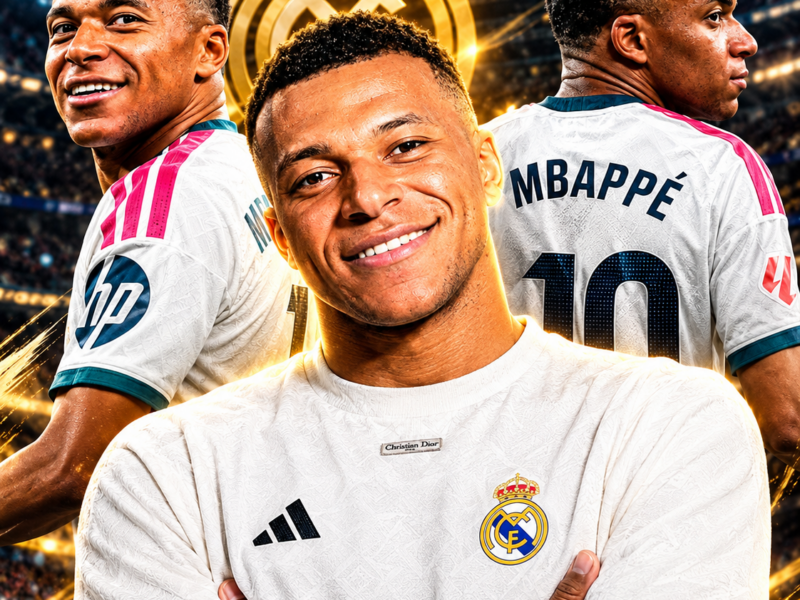
Kylian Mbappé Breaks His Silence On Real Madrid, Florentino Pérez, And The Ballon d’Or Race In A Raw New Interview That Changes Everything Fans Thought They Knew About Him
There is a poster that still hangs, faded at the corners, on the wall of a boy’s bedroom in a Paris suburb.
It has been there for more than fifteen years.
The boy who taped it up is now a grown man standing in the tunnel of the most famous stadium on earth, but somewhere inside him, that kid never left the room.
For the first time since he pulled on the white shirt of Real Madrid, Kylian Mbappé sat down for an extended, unguarded conversation in Spanish media, and what came out of it was not the polished, cautious athlete the world has grown used to.
It was something closer to a confession.
He talked about Florentino Pérez the way people talk about someone who saved them.
He talked about goals the way an addict talks about the next fix.
He talked about the Ballon d’Or in a way nobody expected, and about Spain’s World Cup humiliation of France with a bluntness that startled even the journalists sitting across from him.
By the time the interview ended, one thing was clear.
The kid with the poster on his wall had finally said, out loud, what he has apparently believed his entire life.
Real Madrid was never just a club he joined.
It was always the destination.
Why This Interview Landed So Differently
Athletes give interviews constantly, most of which vanish from the news cycle within a single afternoon.
This one did not, and the reason has less to do with who conducted it than with the timing and the subject himself.
Mbappé has spent much of his career being talked about rather than talking, his contract sagas and transfer dramas narrated by insiders, leaked reports, and secondhand sources rather than by his own voice.
This particular conversation, described by those covering it as his first extended sit-down with a Spanish-language outlet since officially becoming a Real Madrid player, carried an entirely different weight because of that scarcity.
For two years, fans and pundits alike have tried to read Mbappé through fragments, through post-match soundbites, through body language captured on broadcast cameras during difficult stretches of form.
Suddenly, here was nearly an hour of him speaking at length, unprompted by a single dramatic headline, simply answering questions about his life inside the club.
That alone made it must-watch material for anyone following Spanish football closely, and it explains why two experienced analysts spent an entire broadcast segment picking apart nearly every sentence he uttered.
A Confession Fifteen Years In The Making
Long before Kylian Mbappé became the most expensive teenage prospect in the history of French football, before Monaco, before Paris Saint-Germain, before three World Cups, there was a bedroom wall with a picture of Cristiano Ronaldo taped above the headboard.
That detail is not new to anyone who has followed his career closely.
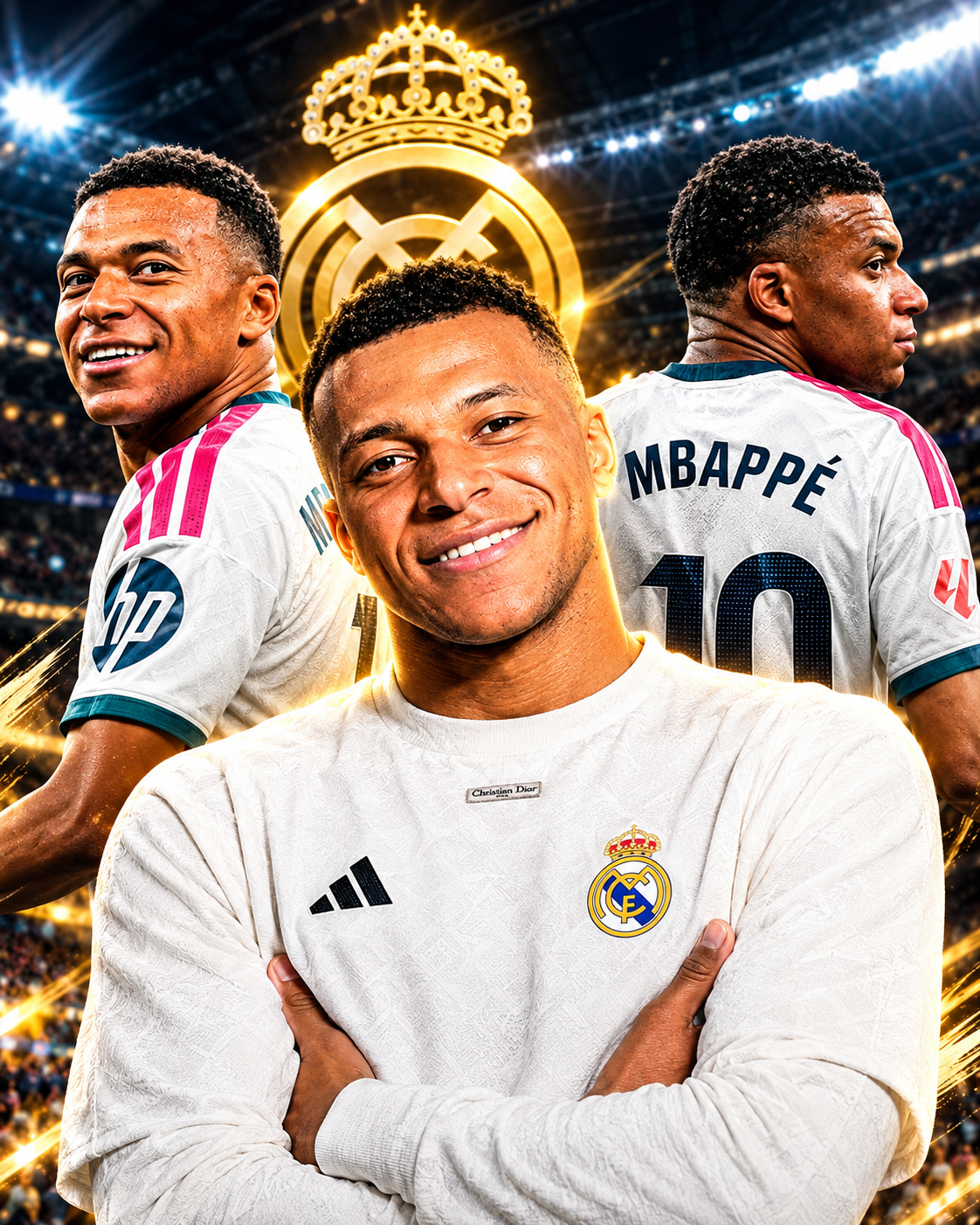
What is new is hearing Mbappé himself connect that image directly to the emotions he says he feels walking through the Santiago Bernabéu today.
In the interview, he did not hedge.
He did not offer the usual diplomatic answer athletes give when asked whether a new club finally feels like home.
Instead, he described a sense of calm in Madrid that he says he never fully had in France, a claim that landed with real weight given everything that unfolded during his final, chaotic seasons at Paris Saint-Germain.
Two football analysts, breaking down the interview afterward on a Spanish sports program, seized on that comparison almost immediately.
One of them put it simply.
Mbappé has been a Madridista his whole life, and you only need to look at his childhood photo albums to know it.
The other agreed, adding that the path to Madrid was never a straight line, that it curved and doubled back on itself for years, but that the destination was fixed from the very beginning.
That is the shape of the story Mbappé wants people to believe now, and after listening to him speak, it is hard not to.
Remembering How Complicated The Road Actually Was
It is worth pausing here to remember just how long and strange that road to Madrid really was, because the interview only makes emotional sense against that backdrop.
Real Madrid pursued Mbappé for years, not months, chasing a signature that seemed close on at least two separate occasions before slipping away at the final hour.
There was the summer transfer window that ended in heartbreak for Madridistas when Mbappé instead signed a lucrative renewal with Paris Saint-Germain, a decision that triggered public frustration from Florentino Pérez himself at the time.
There were the following two seasons in Paris, which by most public accounts grew increasingly uncomfortable, marked by benchings, disputes over image rights, and a relationship with the club’s ownership that appeared to deteriorate in full public view.
Through it all, Real Madrid waited, refusing to walk away permanently even after being burned once already.
That is the context that makes Florentino’s patience, as described earlier in the interview, so remarkable, and it is also the context that explains why Mbappé’s gratitude in this conversation felt less like a scripted talking point and more like genuine relief finally being allowed out into the open.
He is a player who spent years being pulled in different directions publicly, and for the first time in a long while, he sounded like someone who has stopped pulling.
The Boy Who Would Not Speak Ill Of Paris
For all the emotional weight of his Real Madrid comments, Mbappé was careful, almost deliberately careful, not to trash the club that made him a global superstar.
He used an old Spanish expression to describe his approach to talking about Paris Saint-Germain, one that translates roughly to not spitting upward, meaning he refuses to disrespect the place that built his career even as he closes that chapter for good.
It is a small linguistic choice, but it tells you something about how he wants to be remembered.
He is not interested in burning bridges publicly, even bridges he clearly needed to cross to get where he wanted to go.
Instead, he redirected the conversation toward Florentino Pérez, and this is where the interview turned genuinely revealing.
Mbappé said plainly that nobody needed to convince him to sign for Real Madrid.
The desire was already there, fully formed, requiring no sales pitch.
But he went further than that, praising Florentino for something much harder to quantify than ambition or wealth.
He credited the Real Madrid president with understanding the different, often difficult situations Mbappé found himself navigating throughout his years in Paris, situations that stretched, in his own words, beyond football itself.
What Florentino Understood That Nobody Else Did
To appreciate why that praise matters, you have to remember what those years in Paris actually looked like from the outside.
Contract standoffs that dragged on for what felt like entire football seasons.
Public fallouts, benchings, transfer sagas that repeated themselves so many times journalists eventually joked that the story had become an endless book that refused to reach its final chapter.
Through all of it, Florentino Pérez waited.
That patience, according to the analysts dissecting the interview, is not typical of how the Real Madrid president usually operates.
One of them pointed out that Florentino is famously unwilling to engage in prolonged power struggles with players, that his instinct when someone shows the slightest hesitation about wanting to be at the club is to walk away rather than chase.
His own words, paraphrased from years of public statements, essentially boil down to this: anyone who truly wants to wear the Real Madrid shirt should never have to think twice about it, and the club has no patience for indecision or games.
Yet with Mbappé, Florentino broke his own pattern, absorbing rejection after rejection, delay after delay, because the conviction that this particular signing mattered never wavered.
Mbappé, for his part, appears to understand exactly how unusual that patience was, and the gratitude in his voice, according to those who watched the interview, was unmistakable.
Numbers That Explain The Hunger
To understand why Mbappé speaks about goal droughts the way other people speak about genuine crises, it helps to look at the raw scale of what he has already produced across his career.
He arrived in Madrid already established as one of the most prolific finishers of his generation, a player who had spent nearly a decade at the very top level scoring at a rate most forwards never sustain even for a single standout season.
Three World Cups, a title lifted, a final reached, and a semifinal loss, all before turning twenty seven, form a résumé that most players would consider a complete career on its own.
Layer his club record from France on top of that, seasons in which he regularly finished among the top scorers not just domestically but across the entire continent, and the picture becomes clear.
This is a player whose internal benchmark was calibrated years ago against numbers most forwards never approach, which is precisely why three or four quiet matches feel, to him, like alarm bells rather than statistical noise.
That context matters because it reframes his obsession not as arrogance but as a kind of internal accounting system, one built from a decade of evidence that tells him underperformance, even briefly, is not supposed to be part of his story.
Living With Obsession
If the Florentino section of the interview revealed Mbappé’s sense of loyalty, the section on goal scoring revealed something rawer, something closer to compulsion.
Journalists asked him how he feels during a scoring drought, the kind every striker eventually experiences even at the highest level.
His answer surprised people, not because it described anxiety, which would have been the expected response, but because of the scale involved.
He said a slump of three or four games without scoring starts to eat at him, an admission that reveals just how demanding his internal standard has become.
For context, plenty of elite forwards would consider three or four scoreless matches a minor blip, barely worth mentioning.
For Mbappé, it apparently registers as a crisis worth confronting on camera.
He added that he has learned to coexist with that pressure rather than run from it, framing the outside noise, the criticism, the questions, as something he has come to welcome rather than dread.
The analysts drew an immediate parallel to Cristiano Ronaldo, the same player whose poster once hung above Mbappé’s childhood bed.
They noted that while the two players’ statistics and playing styles will always invite comparison, the far more accurate parallel is mentality.
Both players, they argued, share an almost obsessive relationship with the very next match, treating whatever just happened, good or bad, as already irrelevant the moment the final whistle blows.
The Athletic Bilbao Lesson
To illustrate the point, one of the analysts pulled up a specific memory from Mbappé’s early days in Madrid.
During his first season with the club, he went roughly four matchdays without finding the net, a drought that, by the standards of most attacking players making a difficult adjustment to a new league, would barely register as newsworthy.
Mbappé, however, reportedly described those four games as feeling like an eternity, a sensation the analyst likened to someone convinced that three consecutive quiet matches already constitute a full-blown crisis.
That anecdote captures something essential about how Mbappé is wired.
He needs to score, not occasionally, not eventually, but constantly, almost as though the act itself validates his presence on the field.
The pressing question, and the one the analysts spent real time wrestling with, is whether that hunger functions as a strength or eventually becomes a liability once real pressure arrives.
Their conclusion, reached somewhat hesitantly, was that it has to be treated as a virtue, the same way it was for Cristiano Ronaldo across nearly two decades at the top of the sport.
The challenge for Mbappé, they agreed, is converting that individual hunger into collective success rather than letting it curdle into something isolating.
The Missed Chance That Won’t Leave His Head
One detail from the interview lingered with the analysts more than almost any other.
Mbappé reportedly described the way a single missed scoring chance during a match can consume his thinking, lodging itself in his head until he essentially demands another opportunity just to erase it.
That kind of fixation carries an obvious cost.
Carrying a missed chance into the next sequence of play, the next half, sometimes the next match entirely, is not a mentally sustainable habit over an eighty game season.
But Mbappé has apparently already lived through the consequences of that fixation once, and he referenced it directly.
He brought up a missed penalty against Athletic Bilbao from the previous season, a moment that became a turning point not because of the missed kick itself but because of what he said afterward.
At the time, he admitted publicly that he had hit rock bottom, that the pressure of his move to Real Madrid had become something he was carrying without having found a way to set it down.
He used the phrase about still wearing shackles at the club, a striking admission from a player earning that kind of transfer fee and that kind of salary.
According to the analysts, verbalizing that struggle functioned almost like a release valve, and Mbappé himself seems to believe that speaking about a problem out loud is often the first real step toward solving it.
No Numbers, No Limits
Perhaps the single most quotable moment of the entire interview came when journalists pressed Mbappé about specific goal targets for the season.
They referenced reports that his head coach had privately mentioned a benchmark of fifty goals, a milestone that would be extraordinary even by his own standards.
Mbappé’s response was immediate and, according to those covering it, delivered with real conviction.
He said that assigning a specific number to his goal output would be the same as placing a ceiling on himself, and that he refuses to think that way.
It was not an isolated comment either.
Roughly a week earlier, ahead of a Champions League fixture against Inter Milan, he had been asked a slightly different version of the same question, one that framed the choice as forty goals with trophies versus sixty goals without them.
His answer then carried the same underlying philosophy, just phrased differently.
He said trophies obviously come first, that there was never any real debate there, but that his personal approach to scoring goals is to let every single one fall naturally rather than negotiating some kind of quota in his head.
He explicitly rejected the idea of trading away goals for team success as if the two were separable, insisting instead that scoring as much as possible is simply his way of contributing to the collective effort.
The word renounce, he made clear, does not exist in his vocabulary.
A Crowded, Wide Open Race
Before diving into how Mbappé handled the Ballon d’Or question, it is worth appreciating just how unusually competitive this particular race has become.
Unlike years dominated so thoroughly by a single towering favorite that the outcome felt like a formality months in advance, this cycle has been described repeatedly as one of the most open in recent memory.
No single candidate has separated himself so decisively that the conversation feels settled, which means every public comment from every contender carries outsized weight with voters still weighing their ballots.
That openness is exactly what made Vinícius Júnior’s comments land as hard as they did just days before Mbappé’s own interview, and it is exactly what made observers brace for some kind of competitive response.
Instead, Mbappé chose restraint, a decision that, according to the analysts, reads very differently in a genuinely contested race than it would in a year where the winner was already a foregone conclusion.
Turning Down A Two Man Race
Football rivalries thrive on head to head narratives, and few storylines write themselves more easily than a duel for the sport’s most prestigious individual honor.
Just days before this interview, Real Madrid’s own Vinícius Júnior had made headlines with comments that seemed to position the Ballon d’Or race as essentially a contest between himself and Mbappé, calling the two of them the best players in the game at the moment while also making a case rooted in merit and fairness.
It would have been easy, maybe even expected, for Mbappé to seize that framing and run with it.
Instead, when asked directly about the award, he offered something almost the opposite of what many anticipated.
He said, in essence, that what he actually wants is for the Ballon d’Or to return to the Bernabéu, a phrasing that pointedly avoided naming himself as the intended recipient.
The analysts picked up on that distinction immediately, describing it as a deliberate choice to speak collectively rather than personally, a tone notably softer than what many had braced for after Vinícius’s comments.
One analyst admitted he had expected something far more pointed from Mbappé on this subject, and that the restraint on display actually improved his opinion of the interview as a whole.
Why The Softer Answer Was The Smarter One
The reasoning the analysts offered for why this shift in tone mattered went beyond simple diplomacy.
They argued that Mbappé’s prior public defenses of his own Ballon d’Or credentials, while entirely within his rights to make, had started to feel repetitive, an argument that had already been made and remade without adding anything fresh to the conversation.
By pivoting toward the fans, toward the institutional weight of Real Madrid, toward what a trophy like this would mean for a stadium that has gone a long stretch without seeing one of its own lift it, Mbappé introduced a new ingredient into a narrative that was starting to feel stale.
There was also a sharper strategic dimension to the shift, one rooted in how voting actually works for an award like this.
When a candidate publicly eliminates or diminishes rivals, it can create resistance among voters who do not want to reward what reads as excessive self-interest.
By refusing to frame the race as a binary choice between himself and anyone else, Mbappé effectively signaled confidence in his own case without alienating the very voters he needs.
The analysts also floated a more psychological read, suggesting that an athlete who appears too visibly consumed by an individual award can inadvertently generate a kind of quiet backlash, a sense among observers that the hunger has become uncomfortable to watch.
Mbappé’s own phrase during the interview, describing his best advocates as his own feet rather than his own words, seemed to reinforce that same instinct toward letting performance speak instead of rhetoric.
Echoes Of An Older Rivalry
The analysts also flagged something else buried inside Mbappé’s Ballon d’Or answer, a historical echo he may or may not have intended.
For nearly two decades, the sport’s biggest individual award was dominated by a rivalry so intense and so personal that it eventually became a genre of its own, one player at Real Madrid and one at Barcelona, each collecting trophies almost in direct response to the other.
That dynamic produced incredible football, but it also produced years of genuinely toxic discourse, fan bases weaponizing statistics against each other, and a narrative environment where every conversation about either player eventually collapsed into a referendum on the other.
One of the analysts explicitly invoked that history, noting that he and countless other observers have watched that particular movie play out for years already, and suggesting that repeating it with different names attached holds little appeal.
Mbappé, whether consciously or not, declined to reboot that formula.
By refusing to frame his own candidacy as a direct confrontation with a teammate, he steered the conversation away from a script that Spanish football, and football in general, has arguably already exhausted.
Settling The Score With Spain
The conversation eventually turned to international football, and specifically to the recent World Cup, where Mbappé’s France side reached the semifinals before running into a Spanish team that many observers, including neutral ones, considered the most dominant force in the tournament.
Journalists asked him directly to weigh in on that comparison, given his own history of lifting one World Cup and reaching the final of another.
Mbappé did not dodge the question or offer a diplomatically vague non-answer.
He used a phrase that translates roughly to giving Caesar what belongs to Caesar, acknowledging without qualification that the team which beat his own deserved the credit for their consistency and dominance throughout the tournament.
It was a notably direct admission for an athlete of his stature, and the analysts said as much, pointing out that Mbappé showed no hesitation, no defensive hedging, in crediting an opponent that eliminated him on one of football’s biggest stages.
They tied that tournament run to a broader point about how Spain’s title run functioned almost like a rebuke to individual brilliance, a demonstration that a unified, cohesive team can outlast a collection of the sport’s most spectacular individual talents.
One analyst described it as proof that no single player, however gifted, beats a team that has fully committed to functioning as one unit.
A New Era Begins
The France national team has since entered a new chapter under a new head coach, and the analysts predicted that a player with Mbappé’s level of ambition would already be looking past the recent disappointment and toward reclaiming the throne Spain currently occupies.
But for now, they agreed, the honest and mature response was simply to acknowledge what actually happened on the field, without excuses and without deflection.
That willingness to give an opponent credit, even a devastating one, fits into the same broader pattern the interview revealed again and again.
Mbappé, whatever else people think of his game or his personality, appears to have developed real command over how he communicates in public, in a language that is not even his native tongue.
The analysts returned to that point more than once, noting that his fluency in Spanish, his comfort with idiomatic expressions like giving Caesar his due, reflects years of deliberate preparation rather than natural accident.
It is, in their words, the mark of someone who has consciously built himself into a figure comfortable at the center of the biggest stages in the sport, starting from a very young age.
A New Era Begins, Continued
There is also a personal dimension to that loss worth noting, one the analysts touched on only briefly but that adds another layer to Mbappé’s willingness to credit Spain so openly.
He has now experienced the full emotional range international tournaments can offer, from lifting the trophy as a teenager to watching it slip away in a final decided by the finest of margins, to being eliminated at the semifinal stage by a team playing a fundamentally different, more collective style of football.
That range of experience appears to have shaped how he talks about the sport more broadly, less focused on individual heroics as the ultimate currency and more attentive to the mechanics of a team that functions as a genuinely unified unit.
It is not a coincidence, the analysts suggested, that a player capable of praising Spain’s collective discipline so unreservedly is also the same player using words like communion and unity to describe what he wants to rebuild with his own fanbase back in Madrid.
The two threads, international humility and domestic diplomacy, appear to be pulling from the same well of self-awareness.
Bridging A Divided Bernabéu
Perhaps the most emotionally loaded section of the interview involved the whistles.
Anyone who has followed Real Madrid closely over the past two seasons knows the noise has not always been kind, not to the team collectively and, at moments, not to Mbappé individually.
Rather than dismiss that criticism or grow defensive about it, Mbappé chose a strikingly conciliatory tone, describing the whistles less as personal attacks and more as a natural expression of the demanding standards that come with representing this particular club.
He said, in effect, that failing to understand that dynamic would be a serious mistake on his part, because criticism, at a club with Real Madrid’s history, functions as a form of respect rather than rejection.
Not holding a team like Real Madrid accountable when results fall short, he argued, would actually be doing the club a disservice, and the same logic applies to himself individually.
That framing matters given the specific context Real Madrid has lived through.
The club endured a stretch of roughly twenty four months without a major trophy, arriving right as Mbappé joined a squad that had, in the years immediately prior, won practically everything available to it.
The timing was almost cruel, a title drought beginning just as the sport’s most coveted free transfer finally arrived in the white shirt.
What The Fans Are Really Asking For
According to the analysts, Mbappé’s public acknowledgment of that timing, his willingness to accept a share of responsibility for a stretch of results that predates and postdates his own arrival, represents a genuine act of self-awareness rather than empty diplomacy.
One analyst described the dynamic bluntly, saying that the Bernabéu has picked up on a certain coldness inside the locker room, a perception that certain players go about their business without fully carrying the emotional weight of losses and draws the way the fanbase does.
Mbappé’s answer, they argued, functioned almost like a mea culpa aimed directly at that perception, an attempt to say clearly that he understands exactly where the frustration comes from and that it is not really about any single match.
Instead, he framed it as an accumulated weight carried over from two difficult seasons, a burden the current squad inherited rather than created entirely on its own.
From there, according to the analysts, his message shifted toward something more forward-looking, essentially asking the fanbase to move forward together, arguing that Real Madrid cannot realistically compete for trophies without genuine unity between the stands and the pitch.
That last point, the idea that Bernabéu energy functions almost like a competitive advantage in its own right, became a running theme for the rest of the discussion.
The Ghost Of Joselu
To illustrate exactly how real that dynamic can be, one of the analysts brought up a specific, still vivid memory from a Champions League semifinal against Bayern Munich, a tie remembered largely for a pair of dramatic late goals.
He recalled being inside the stadium the night the first of those goals went in, describing the sensation of watching the entire ground seem to physically lift the team forward.
His argument was that the goal itself did not truly belong to the player who scored it, at least not entirely.
It belonged to the stadium, to the collective roar that visibly rattled the opposing team in real time, turning nervous legs into something the away side could not overcome.
That, the analyst said, is precisely the atmosphere Mbappé and this current Real Madrid squad need to rebuild, not through words but through results that slowly restore the emotional bond between the players and the people in the stands.
Nobody pretended that bond could be manufactured through a single interview or a single gesture.
But the analysts agreed that Mbappé at least understands what needs to happen, and understanding, they suggested, is usually the necessary first step.
A Locker Room Under The Microscope
The perception of coldness inside the Real Madrid dressing room, raised almost in passing during the broadcast, deserves more attention than a single sentence, because it has been a recurring theme in Spanish football coverage for the better part of two seasons.
Reports throughout that stretch described a squad still adjusting to life after the departure of several key leaders from the club’s most recent golden era, veterans whose presence had provided both tactical stability and emotional glue in the dressing room.
Into that vacuum arrived a wave of new signings, Mbappé chief among them, tasked not only with performing on the field but with somehow replicating the intangible leadership qualities of players who had spent the better part of a decade together.
That is an enormous, arguably unfair burden to place on any newcomer, let alone one still adjusting to a new league, a new language, and a new set of expectations attached to arguably the single most scrutinized shirt number in world football.
Framed that way, Mbappé’s comments about accepting responsibility for the fanbase’s frustration read less like simple humility and more like someone consciously stepping into a leadership void that the club, by its own admission, has struggled to fill since its last triumphant era ended.
Facing The Derby, And The City That Has Never Seen Him Win There
With the interview winding toward its final stretch, conversation shifted to the most immediate test on the calendar, a derby against Atlético Madrid played at their own stadium.
Mbappé has never scored against Atlético in that particular fixture, and he has never won a match played on their home ground, a statistic the interviewers raised directly.
Rather than deflect, he reportedly embraced the challenge, saying that he actually enjoys the pressure that comes with difficult away fixtures, framing those exact moments as where real leadership gets tested and proven.
The analysts saw this as consistent with everything else revealed throughout the conversation.
They described the ideal version of Mbappé not as a player who simply bares his teeth aggressively, but as a figure capable of making himself larger precisely in moments designed to make opposing players feel small.
That, in their assessment, is the essential definition of leadership at a club with Real Madrid’s history and expectations.
One analyst added a small, almost amusing detail, noting that Mbappé seemed to have done his homework ahead of time, casually mentioning that he had already scored against every single club in Spanish football, a comment that revealed both his confidence and his awareness of the specific numbers that follow him around.
The Weight Of A Rivalry Derby Carries
Derbies against Atlético Madrid occupy a strange emotional space within Spanish football, distinct even from the traditionally larger spectacle of facing Barcelona.
There is a specific, almost personal intensity to a Madrid derby, an intimacy born from two clubs sharing the same city, the same streets, and often the same extended families split across allegiances.
Atlético’s own home stadium has built a reputation over the years as one of the most hostile away environments in Spanish football, a venue where visiting stars with sterling records elsewhere have historically struggled to find any rhythm at all.
Mbappé walking into that specific atmosphere with zero career goals and zero career wins in that fixture is not a minor footnote, it is precisely the kind of statistic opposing fans wait all season to chant about.
His stated eagerness to embrace that challenge rather than downplay it, according to the analysts, fits the broader pattern of a player who seems to have decided that leadership means actively seeking out the moments most players would rather avoid.
Whether that confidence translates into an actual breakthrough performance remains to be seen, but the willingness to talk about it publicly, on record, before the match has even kicked off, is itself a notable departure from the more cautious version of Mbappé fans grew accustomed to during his final seasons in Paris.
What Real Madrid Needs From Him, And What He Needs From Real Madrid
As the interview approached its conclusion, the analysts posed the same closing question to each other that the original interviewers had essentially spent the entire conversation building toward.
What exactly does Mbappé need from Real Madrid, and what does Real Madrid need from him in return.
One analyst offered a fairly stark answer, arguing that Mbappé is in no position to demand anything further from the club at this stage.
Instead, he suggested, the obligation runs almost entirely in the other direction, with Mbappé owing the club a return on the extraordinary patience and opportunity Real Madrid extended to him throughout a transfer saga that dragged on for years.
He pointed out that few, if any, other clubs in world football would have tolerated the length and complexity of that pursuit, reinforcing just how significant Florentino’s original commitment to signing him really was.
The other analyst agreed but framed the mutual obligation slightly differently, landing on a single word that both sides ultimately need from each other.
Titles.
Both Real Madrid and Mbappé, he argued, are chasing the same outcome, but the club specifically needs Mbappé to embrace a leadership role that goes beyond individual scoring output, becoming the organizing force around which the current era of Real Madrid can be built.
What The Analysts Got Wrong Before Watching
Both analysts admitted, in different ways, that this interview had corrected some of their own preconceptions heading into it.
One acknowledged expecting a far more direct, almost combative response on the Ballon d’Or question, something closer to what Vinícius had offered days earlier, and was surprised to hear something so measured instead.
The other admitted expecting a more guarded, less forthcoming Mbappé overall, someone who would stick to safe, rehearsed answers about trophies and hard work without offering much genuine insight into his internal state.
Neither expectation held up.
Instead, they described watching a version of Mbappé that reminded them of earlier stages in his career, before the exhausting final years in Paris seemed to flatten some of his openness into something more guarded and transactional in front of cameras.
That shift back toward candor, however incremental, was treated by both analysts as one of the more meaningful subtext of the entire conversation, arguably more significant in the long run than any single quote about goals or trophies.
A player who is comfortable being honest in public, they suggested, is generally a player who is comfortable with where he currently stands, and comfort, at a club with Real Madrid’s relentless standards, is not something to take for granted.
The Poster Comes Back Into Focus
By the time the interview reached its final moments, that childhood detail, the picture of Cristiano Ronaldo taped above a young boy’s bed in the outskirts of Paris, resurfaced one more time in the analysts’ closing remarks.
They described Mbappé as the galactic centerpiece of an already star-studded roster, a phrase meant to capture how much weight now rests on his individual performance inside a locker room already filled with world class talent.
Everything individual, one of them argued, ultimately has to funnel into something collective, because raw statistics alone will never earn a player the kind of lasting affection reserved for figures who actually delivered silverware.
Mbappé, according to both analysts, is fully aware of that reality, which is precisely why his public language keeps circling back to the future rather than dwelling on what has already been accomplished.
The boy who once stared at that poster every night, dreaming about a stadium he had never set foot in, is now the man standing inside it, trying to prove he belongs among the names the poster represented.
Whether he gets there, whether the goals eventually translate into the specific trophies that transform a great individual career into a legendary one at this particular club, remains an open question that only time, and a great many more matches, can answer.
But for the first time in a long time, the man wearing the shirt sounds like he genuinely believes the answer will be yes.
The Bigger Picture
Stepping back from the specifics of the interview, what makes this moment significant is not any single quote or any single admission.
It is the cumulative picture that emerges when you put all of these pieces together, the Florentino gratitude, the goal-scoring obsession, the Ballon d’Or restraint, the blunt respect for Spain, the conciliatory tone toward a sometimes frustrated fanbase, and the eagerness to face Atlético on hostile ground.
Taken individually, each of these moments might seem like a minor footnote in an otherwise ordinary press cycle.
Taken together, they paint the portrait of a player who has clearly done a great deal of thinking about his own position at this club, about the weight of the shirt he now wears, and about exactly what it will take to be remembered the way he wants to be remembered.
Real Madrid has seen plenty of gifted individual talents pass through its doors over the decades, some of whom left with adoration intact and others who departed under a cloud of unmet expectation.
Mbappé, by his own account in this interview, understands precisely which category he is determined to belong to.
The rest, as both analysts acknowledged, will be decided not in interviews but on the field, match by match, trophy by trophy, starting with a derby he has never won and continuing through whatever comes after it.
For a player who insists he refuses to put limits on himself, that ongoing, unresolved chase may be exactly the kind of story he wants to be telling.
Reading Between The Lines Of A Career In Motion
Interviews like this one tend to age in interesting ways, revisited months or years later either as proof of genuine self-awareness or as a cautionary example of words that aged poorly against results.
It is too early to know which category this particular conversation will eventually fall into.
What can be said with more confidence is that Mbappé used this platform deliberately, choosing his moments of vulnerability, his moments of restraint, and his moments of bluntness with what appears to be real intention rather than improvisation.
He praised the man who waited years to sign him without hedging.
He admitted to an almost uncomfortable relationship with his own scoring standards without pretending otherwise.
He declined an easy opportunity to escalate a rivalry with a teammate over the sport’s most prestigious individual honor.
He gave a beaten opponent full credit on the international stage without a trace of bitterness.
He accepted a share of responsibility for a fractured relationship between his club and its supporters rather than deflecting it entirely onto circumstances beyond his control.
And he looked directly at the one fixture where his personal record remains blank and said he wants exactly that kind of pressure, not less of it.
Individually, none of those moments guarantees anything about what happens next on the field, where football results have a well-earned reputation for ignoring even the most sincere pregame intentions.
Collectively, though, they describe a player who sounds like he has stopped auditioning for the role of Real Madrid’s next great number and has instead started actually trying to live inside it.
The poster is still on that bedroom wall back in Paris, faded a little more with each passing year.
The boy who put it there is no longer waiting for his chance.
He is already standing inside the stadium the poster once represented, and after this interview, it sounds like he finally believes he belongs there.









