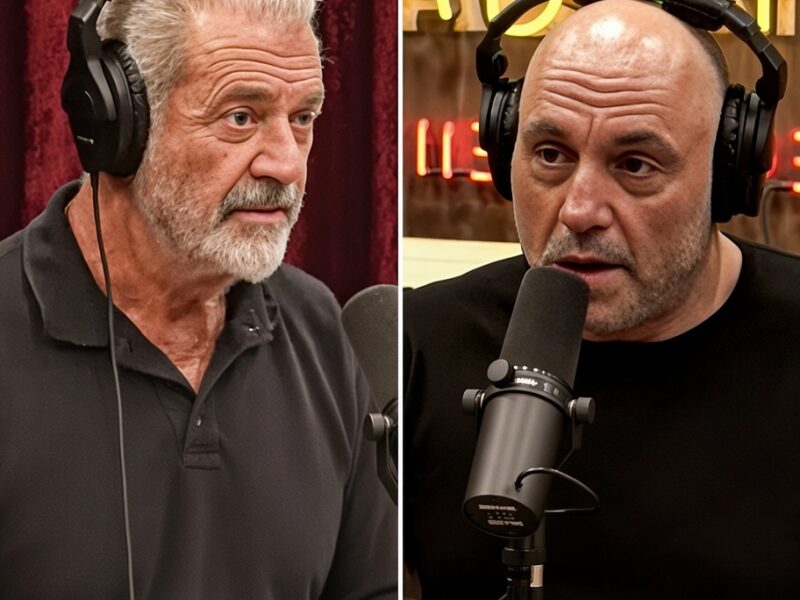
Joe Rogan Reacts to Mel Gibson’s Revelation About The Passion of the Christ
Mel Gibson was a guest on Joe Rogan’s podcast and talked about the sequel to The Passion of the Christ. The first film, as the conversation goes, was a crazy movie because it was truly great. Yet somehow there seemed to be resistance.
There are all these books, the Bible, the various Gospels, with which people are thoroughly familiar. What if a single conversation suddenly brings everything to light? What Hollywood is allegedly trying to conceal?
Gibson explained that a resurrection film carries a similar obligation to its predecessor. It is a profound story. Then, as the account describes it, the mood shifted: the jokes fell silent, and the room went quiet.
The host, who had already heard confessions from presidential contenders and whistleblowers, appeared visibly shaken. Whatever Gibson revealed, it was not about marketing, nostalgia, or controversy for its own sake.
Yes, there had been a lot of resistance, Gibson said, in essence. Anyone who ever delves into the subject realizes it is something heavier, something that lingers. Because this film was never supposed to exist.
When Gibson announced the project, the studios, according to his account, did not go along. They closed doors, sounded the alarm, and even questioned his sanity. Not because the film was expensive or risky, but because of the story and the power it contained.
What followed was a struggle behind closed doors. A filmmaker stood alone against an industry that was suddenly afraid of a story it could not control.
To understand what Gibson wanted to achieve, one has to go back to the beginning. The Passion of the Christ was not meant to be just another biblical epic with bombastic camerawork and predictable dramaturgy.
Gibson wanted something more unvarnished, more honest, more intense than anything audiences had experienced until then. He immersed himself in the four Gospels, Matthew, Mark, Luke, and John, and studied every verse, every nuance, every detail of the last hours of Jesus’s life.
He did not stop there. He drew on other biblical texts and created an overall picture that shows not only what happened but also the spiritual struggle, the human cost, and the divine meaning behind every moment of suffering.
In the conversation, Gibson made his position clear: if Jesus did not rise from the dead, then the whole thing is a fraud. There is no third possibility in between. The film was meant to demand something from the audience, not passive entertainment but engagement with questions of faith, sacrifice, and redemption.
The opening scene sets the tone immediately. We are in the Garden of Gethsemane, with darkness surrounding us on all sides. Jesus kneels in prayer while his closest companions, Peter, James, and John, fall into deep sleep.
The vulnerability is palpable. Here the Son of God is fully God and yet fully human, and he sweats blood under the weight of humanity’s sins. Then Satan himself appears, creeping through the shadows and whispering doubt.
A snake emerges, but Jesus crushes its head under his heel. It is a deliberate callback to Genesis, to the very first promise of redemption.
Every shot, in Gibson’s understanding, is full of meaning, every shadow deliberately placed, every line of dialogue carefully chosen. This is not a film to watch casually with popcorn. It demands that the viewer lean forward and engage with something greater than themselves.
While Gibson was developing this artistic vision, he was fighting on many fronts at once. In the conversation with Rogan, he spoke about Hollywood’s attitude toward Christian stories.
He described a pattern, a double standard: films about other religious traditions are often treated respectfully and with nuance, whereas Christians are frequently viewed with skepticism, sometimes with hostility. Projects are then regarded as old-fashioned, too serious, or out of touch with reality.
Gibson claims to have felt this resistance firsthand. Studios that should actually have financed a project by an Oscar-winning director reportedly got cold feet. Colleagues who had worked with him for years kept their distance.
The message, he said, was unmistakable: this story was unwelcome, and so was the man who wanted to tell it. Critics of this account point out that Hollywood has in fact produced biblical films and that Gibson’s difficulty in securing financing was never fully documented. His supporters counter that precisely these rejections support his claim.
Gibson’s Catholic upbringing meant that the film was not just professional ambition for him but a matter of the heart. He spoke of a very ambitious work stretching from the Fall of Man to the death of the last apostle, one whose writing took a very long time.
He could not give up, even when it would have been commercially sensible to turn to a safer project. By his own account, he often financed the film himself when traditional backers failed to materialize, and assembled a team that shared his vision and did not fear controversy.
Out of this came something unexpected: a film that became one of the most successful R-rated films of all time and showed that audiences hungered for exactly the kind of uncompromising storytelling that Hollywood had claimed nobody wanted to see.
Then the conversation took a darker turn. Gibson began to talk about an institution he loves: the Catholic Church and the painful truths behind its ancient walls. For someone raised deeply Catholic, these were not easy admissions.
He had come to realize that silence in the face of corruption is not devotion but complicity. He spoke carefully but clearly about figures such as Theodore McCarrick, a former cardinal who was dismissed from the clerical state over abuse allegations.
Children were harmed, and instead of justice there was protection for perpetrators: transfers to new parishes and legal maneuvers to evade responsibility.
According to the report, Gibson’s disappointment reached into the highest circles. He had hoped Pope Francis would usher in a new era of transparency, but instead found more institutional self-preservation.
The Church, which began with radical messages of love and sacrifice, had in many respects become just another power structure, more concerned with protecting itself than serving the weak.
Gibson described it as two churches existing simultaneously: one that sincerely tries to live out its founding principles, and another that operates in secret and pursues goals unrelated to its spiritual mission.
He pointed to odd historical moments, such as a papal election in the 1950s in which both black and white smoke supposedly rose, and to the choice of name by Pope John, who bore a name previously used by an antipope.
Historians largely interpret these episodes differently. The smoke is attributed to technical problems and misunderstandings, and the reuse of a papal name is not regarded in Church history as evidence of a conspiracy. Gibson’s listeners, by contrast, see in them hints of opaque institutional politics.
According to the report, what was especially powerful was Gibson’s tone. It was neither bitter tirades nor conspiracy theories, but grief: the grief of watching a beloved institution fail to live up to its own ideals.
He noted that the Vatican, as a sovereign state, makes accountability nearly impossible. Priests accused of abuse were often merely transferred rather than criminally prosecuted. Cases in the United States, including in Illinois, are known in which the accused continued to serve in new parishes.
From the report’s perspective, speaking these truths meant risking estrangement from the community that shaped him. But staying silent felt like a betrayal of something even more important.
At that moment, the story goes, Rogan’s emotional reaction became visible. The weight of the truth, its sincerity, and the courage to express it publicly broke through his usual distance as an interviewer.
Tears reportedly welled up in his eyes. The conversation left typical podcast dynamics behind and became more intimate, more genuine, more human.
This account comes from a dramatized retelling, and how powerful the scene actually was is hard to judge from the outside. Anyone who watches the video themselves can form their own impression.
Let us return to the film. When The Passion of the Christ hit theaters, critics were sharply divided. Roger Ebert, arguably the most influential film critic of his generation, gave it four stars and called it the most violent film he had ever seen.
Ebert, himself raised religious, wrote that he had only truly understood the depth of Christ’s suffering through Gibson’s unflinching portrayal. Other critics such as Richard Corliss praised its sincerity and artistic ambition, and Armond White compared Gibson’s direction to that of Carl Theodor Dreyer, a master of spiritual cinema.
But there were also dissenting voices. Before its release, a joint committee of the US bishops and the Anti-Defamation League reviewed the script and expressed serious concerns.
They feared that the depiction of Jewish religious leaders pressuring Pilate toward crucifixion could reinforce dangerous historical stereotypes that had fueled antisemitism for centuries. The Catholic Church itself had rejected such interpretations at the Second Vatican Council in the 1960s.
The committee feared the film could jeopardize decades of interreligious dialogue. Gibson countered that his intention was to show humanity’s collective responsibility for Christ’s death, not to single out a particular group.
Scholars also noted that the film contains scenes with no biblical or historical basis, such as Judas being tormented by demonic children. Gibson’s response: it was artistic interpretation to convey spiritual truths, not a documentary reenactment.
Some viewers found the film deeply moving and spiritually transformative. Others considered it needlessly violent and theologically problematic. Few remained neutral.
The intensity of the debate only heightened public interest. Church groups organized mass screenings, clergy gave sermons about it, and the media dissected every shot.
The production was also anything but ordinary. Jim Caviezel, who played Jesus, reportedly endured excruciating physical pain. The cross he carried weighed around 13.6 kilograms (30 pounds) and dislocated his shoulder during one take.
During the scourging scenes, he was struck twice by the whips. His pain was not acted, and that raw intensity carried over onto the screen.
Then, it is said, lightning struck. Assistant director John Michelini was reportedly struck twice during filming, and Caviezel himself is said to have been struck during the crucifixion scene as well, though he was unharmed.
In the biblical tradition, lightning symbolizes divine power and judgment. Were these accidents or something else? Skeptics remind us that outdoor shoots are frequently exposed to thunderstorms and that such incidents need no supernatural explanation. Others on set saw more in it.
The film score also contributed to the impact and earned the project an Oscar nomination. According to the reports, the changes went far beyond the physical.
Luca Lionello, who played Judas Iscariot, reportedly began filming as an atheist and left as a believer. Maia Morgenstern, who played Mary, was secretly pregnant during filming, a quiet symbol of death and resurrection.
Gibson also reported miraculous healings: a six-year-old girl with severe epilepsy was said to have remained seizure-free for a month after filming, and others had senses restored.
Whether divine providence, coincidence, or psychological transformation, these events gave actors and crew the feeling of being part of something far greater than a film. They have not been independently confirmed.
One scene embodies Gibson’s vision in particular: after the crucifixion, Jesus’s body is laid in Mary’s arms, an allusion to Michelangelo’s Pietà in St. Peter’s Basilica. The composition captures grief and grace, human suffering and divine purpose.
Despite all the controversy, or perhaps because of it, the film reached a huge audience. It grossed over 600 million dollars worldwide and became one of the most successful R-rated films of all time.
People did not see it only once. They came back again and again, bringing family, church groups, and friends. The box office contradicted the industry’s belief that religious content does not sell.
The impact reached far beyond ticket sales. The film sparked discussions in churches, synagogues, mosques, and secular circles. Pastors used it as a teaching tool, theologians argued over its merit, and families wrestled with the question of whether children should see such violence.
What comes next? The Resurrection. Gibson continues to engage with the themes that shaped The Passion of the Christ. In the interview with Rogan, he said that he and screenwriter Randall Wallace had been working on it for six to seven years.
It is meant to be an even more ambitious project, not in conventional linear form but as a cosmic exploration of the struggle between good and evil. Gibson wants to show how this moment in history connects to everything before and after it.
For him, the Gospels are not myth but history, attested by the testimony of the apostles, who preferred to die rather than recant. His question is, in essence: who dies for something they know to be a lie?
Critics respond that conviction alone is not proof and that people die for their beliefs for many reasons. The Resurrection remains for many the most difficult aspect of faith.
Gibson admits to having accepted these claims for a long time because others believed them. Over time, he sought his own understanding. He wants neither to reach those already convinced nor to confirm existing beliefs, but to prompt skeptics and believers alike to ask questions about existence, meaning, and life after death.
The new project is also meant to be deeply historical: the world into which Jesus was born, with its political tensions, religious expectations, and cultural realities. He does not want to portray the apostles as perfect saints but as flawed, complex human beings.
At its core, he wants to dramatize the ultimate mystery of the Christian faith: death does not have the last word, and love triumphs over hate.
For Gibson, it is said, this is not about commercial success or professional vindication. He is prepared to accept criticism and resistance because he is convinced that certain truths must come to light.
So what is the hidden truth that allegedly moved Joe Rogan to tears? According to the video’s reading, it was not just one revelation but several: the lonely fight against an industry that did not want to tell the story, the shadows within the Church, and the mysteries on set.
At the same time, the story is a reminder that people still create art for reasons beyond profit and that the most controversial stories are often the ones that get talked about the most.
The film itself still divides people more than two decades after its release. Some see it as a masterpiece of spiritual cinema; others consider it problematic because of its violence, its historical liberties, and its potential to reinforce harmful stereotypes.
Both perspectives have their merits. Great art often provokes strong reactions precisely because it touches something deep that cannot simply be dismissed.
Whether one shares Gibson’s theology, appreciates his artistic choices, or finds his statements about Hollywood and the Church convincing is, in the end, less important than the willingness to engage with the questions his work raises.
The conversation between Mel Gibson and Joe Rogan showed that behind every controversial film lies a human story of struggle, sacrifice, and unwavering commitment to a vision. It was a reminder that the institutions we trust can harbor corruption that needs to be exposed.
And it showed that authentic vulnerability can move hearts even in difficult, controversial figures. The hidden truth is hidden no longer: it lies there for anyone willing to look, to listen, and to be touched by stories that cost something.









