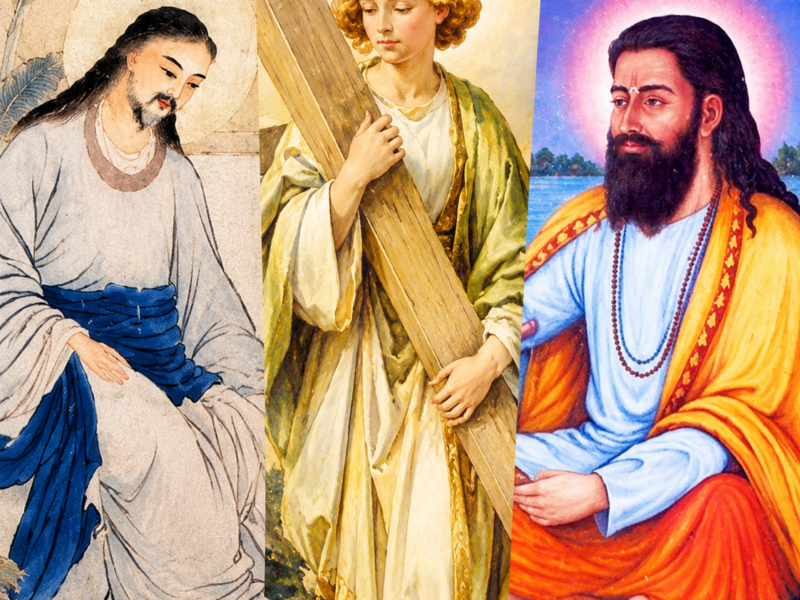
Jesus Vanished for 18 Years: The Shocking Legends of a Secret Journey to Japan, Britain, and India
Imagine a man whose name is spoken by more than two billion people on Earth.
Now imagine that for eighteen years of his life, nobody wrote down a single word about him.
Not a sentence. Not a rumor. Not even a vague hint.
That is exactly what happened to Jesus of Nazareth.
Christianity is practiced by roughly 31 percent of the world’s population, which makes Jesus arguably the most famous and influential figure in recorded history.
And yet, for such an important man, we know startlingly little about how he lived.
Open the New Testament to the Gospel of Luke and you will find him at age 12, sitting in the Temple in Jerusalem, calmly debating rabbis who are twice, three times, even five times his age.
Turn the page, and he is 30 years old, standing in a river, waiting to be baptized.
What happened in between?
Scripture does not say.
Scholars call this blank stretch the lost years, or the missing years, of Christ.
And where scripture falls silent, legend rushes in.
Some say a teenage Jesus crossed deserts and mountains to study with the sages of India.
Others say he sailed to the misty hills of Britain with a wealthy uncle.
And in a remote mountain village at the northern tip of Japan’s main island, people will point to a burial mound topped with a wooden cross and tell you that Jesus himself is buried there.
It sounds absurd at first.
But before you dismiss it, consider what each of these stories actually claims, and what supposedly backs them up.
Some of it is thin.
Some of it is strange.
And some of it, frankly, is hard to explain away.
Think about what eighteen years really means.
From age 12 to age 30 are among the most formative years in any human life.
It is when a child becomes an adult, when beliefs harden, when a purpose takes shape.
Jesus was crucified at around 33, which means those missing years make up more than half of his entire life.
Then, at 30, he walks back into history carrying a message, a mission, and what appeared to be supernatural power.
Where did it all come from?
Who taught him?
What did he see, and what convinced him that he was the Son of God?
Mainstream scholarship has a quiet, practical answer: he was probably working as a carpenter.
But there is no scriptural or historical evidence for that, only passing references that may have been meant to make him relatable to ordinary people.
And it does not explain how a village tradesman turned into one of the most powerful spiritual voices the world has ever heard.
So the theories have piled up over the centuries.
The most daring ones suggest that Jesus traveled to distant lands in Europe and Asia on a long journey of self-discovery, studying under gurus, sages, and master teachers until he finally understood his purpose.
The obvious objection comes fast: there is no way a young man from Judea could have made journeys like that.
But history says otherwise.
In the first century, travel by land and sea was far more common than most people imagine.
Merchant routes crisscrossed continents, and caravans and ship crews were always looking for hands.
A young traveler could have joined one easily.
Even within the Christian tradition itself, Thomas, one of the original twelve disciples, is said to have journeyed all the way to India around the year 50 A.D.
If Thomas could make that trip, the argument goes, so could Jesus, just a few decades earlier.
So let’s follow the legends.
We will start with the strangest one of all.
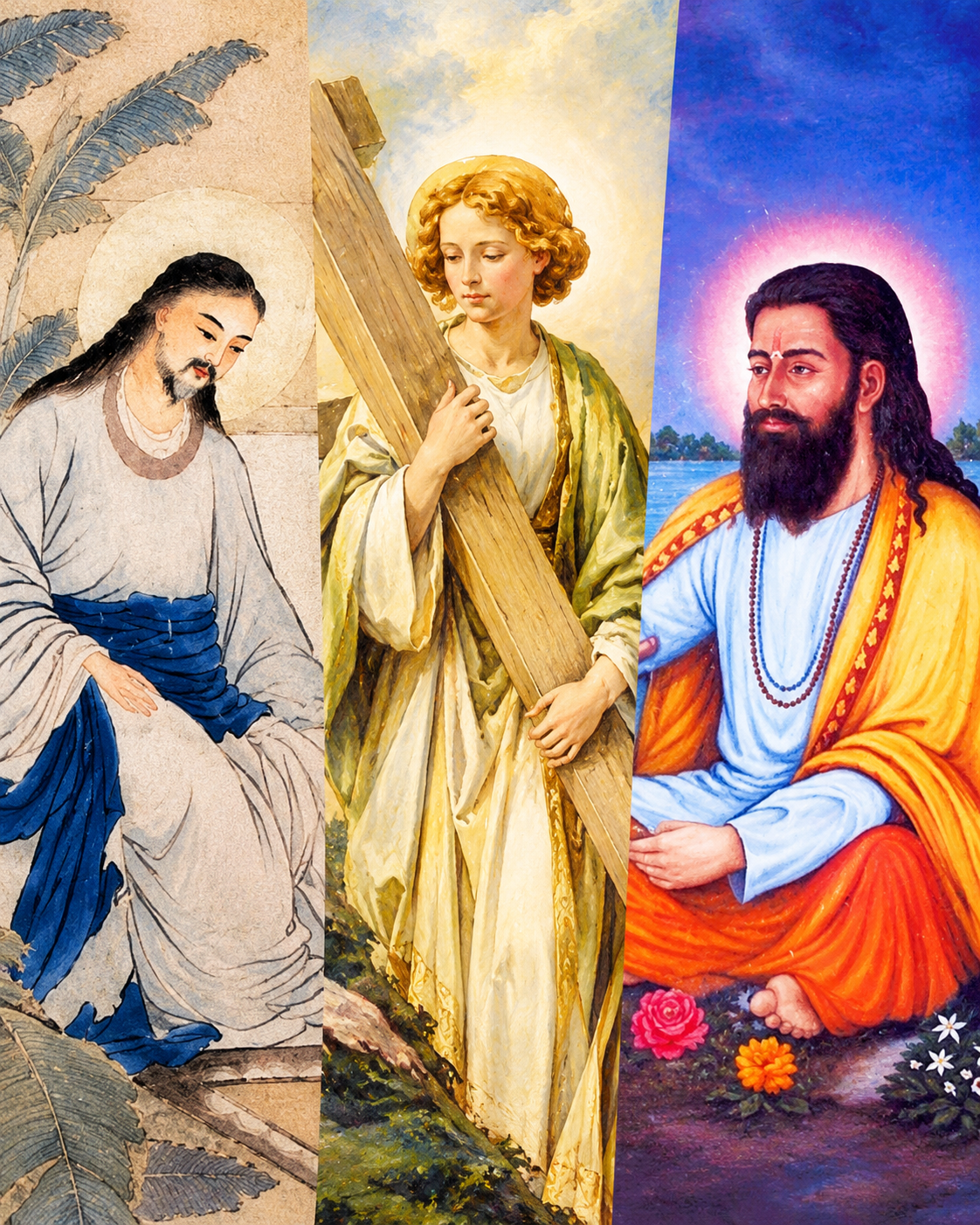
High in the north of Japan’s main island, there is a quiet mountain village called Shingo.
Fewer than 3,000 people live there, and most of them are farmers.
There is no church within 30 miles.
Only one resident identifies as Christian, and everyone else is Buddhist or Shinto.
And yet this sleepy, forgettable place guards one of the most extraordinary legends on Earth.
The villagers say Jesus Christ did not simply visit Japan during his missing years.
They say he came back.
According to the legend, Jesus escaped the cross.
His younger brother, a man named Isukiri, quietly took his place and died in his stead.
Yes, the legend gives Jesus a brother the Bible never mentions.
And then the real Jesus fled, crossed the world, and lived out the rest of his life in Shingo.
It is ridiculous.
It is arguably heretical.
And the village takes it completely seriously.
Today, anyone willing to make the trip can visit the grave of Jesus in Shingo, see related artifacts, and walk through an entire museum devoted to the story.
Historical records show the legend has existed in the village for at least a few hundred years.
The villagers insist it goes back almost two thousand.
And the proof, they say, lies in a set of ancient writings known as the Takenouchi Documents.
The documents surfaced in 1936, unearthed near Shingo and said to be around 1,500 years old.
But they were not the original.
They were supposedly a transcription of something far older: the last will and testament of an elderly, dying Jesus, along with his reflections on his life in Japan.
That original scroll, the story goes, was written in a mystical, divine script.
It had to be.
Jesus would have lived during Japan’s Yayoi period, when Chinese characters had not yet arrived and the islands had no written language of their own.
Generations passed the scroll down until someone finally copied it into modern Japanese and Chinese characters.
Then the original was lost.
Eventually, the copy was lost too.
Until 1936.
The Shingo museum credits the rediscovery to archaeologists from an international society for the research of ancient literature.
The reality was a bit more colorful.
It was a small band of treasure-hunting seekers: a Shinto priest, a mystic historian, and a Christian missionary.
The man at the center of it all was the priest, Kiyomaro Takenouchi, who took full responsibility for the find.
It did not go well for him.
In the early 1900s, Japan enforced strict laws against religions other than Shinto, and the documents were considered profane.
In April of 1936, Takenouchi was formally charged with blasphemy.
A local court found him guilty in 1942.
The case then climbed all the way to Japan’s Supreme Court, which found him not guilty.
But victory came at a brutal price.
Authorities confiscated nearly 4,000 items declared sacred treasures, including the Takenouchi Documents.
No one ever saw them again.
The building that stored them was destroyed in a Tokyo air raid during World War II.
All that remains today is a replica.
But the replica is enough to tell the story, and it is a startling one.
According to the documents, Jesus traveled to Japan to study theology when he was just 21.
He landed at a port on the west coast, where a great master met him and led him to the foot of Mount Fuji.
There, he learned the religious and philosophical beliefs of ancient Japan.
He threw himself into the culture completely: the customs, the food, the languages.
He studied for years, until he was 30.
Then he made the immense voyage home to Judea.
When he spoke of Japan to the people there, he never used its name.
He called it simply a sacred land.
From that point, the documents retell the familiar story of his ministry, all the way to the moment the Roman authorities sentence him to death.
And that is where the story splits away from the Bible.
Isukiri steps forward and takes Jesus’s place on the cross.
Because he played the role of the Messiah, the legend says, his name was erased from scripture, to protect the sanctity of Jesus’s sacrifice.
Free at last, Jesus began a journey almost impossible to imagine.
He trekked through the frozen wastelands of Siberia, a distance of more than six thousand miles.
He sailed to the Japanese city of Hachinohe.
Then he rode an ox cart up into the mountains of Shingo.
He carried only two keepsakes: the severed ear of his brother Isukiri, and a lock of hair from his mother, Mary.
In Shingo, Jesus took a new name, Daitenku Taro Jiraia.
He married a farmer’s daughter named Miyuko, and the two had three children.
He spent the rest of his days farming garlic and helping the poor.
The villagers even remembered what he looked like.
Thin gray hair, with a bald spot on top of his head.
A coat with many folds.
And a distinctive nose that earned him the nickname long-nosed goblin, which the villagers meant affectionately.
This Jesus performed no miracles.
He simply lived a long and peaceful life, and died at the age of 106.
The villagers followed the burial customs of the time.
They laid his body on a hilltop, exposed to the elements for four years.
Then his bones were bundled and buried in a mound.
His brother’s ear and his mother’s hair were given their own graves beside his.
You can visit it today: an ancient burial mound, topped with a wooden cross, ringed by a picket fence.
Because the remains are considered sacred, the grave has never been excavated.
No DNA analysis has ever been done.
Which leaves a question that is hard to shake.
If it is not Jesus in that grave, who is?
His supposed descendants are said to still live in the area.
The best known is the Sawaguchi family, who, ironically, are not Christian but Buddhist.
Here is the part that makes skeptics hesitate.
The legend of Jesus in Shingo is older than the 1936 rediscovery of the documents.
And the village has always been a cultural oddity.
In ancient times, its people followed traditions that looked alien to the rest of Japan.
The men wore toga-like robes.
The women covered themselves with shawls.
Babies were carried in woven baskets.
And the treatment of newborns was especially strange.
They were wrapped in cloth embroidered with a design reminiscent of the Star of David.
Their foreheads were marked with a charcoal cross, believed to protect them as a holy talisman.
Then there is the language.
The dialect of Shingo and its surrounding region is unusual, and some say it echoes ancient Hebrew.
In Hebrew, the words for mother and father are ima and abba.
In Shingo, they say abba and aya.
Even the village’s old name raises eyebrows.
Before it was renamed Shingo in 1955, it was called Herai, which sounds remarkably like the Japanese word for Hebrew.
Today the legend is the village’s identity.
Every spring, women in kimonos dance and chant around the grave in a ceremony called the Christ Festival.
Thousands of visitors make the pilgrimage each year.
And in 2004, the ambassador of Israel, Eli Cohen, visited Shingo and honored the grave with a plaque written in Hebrew, acknowledging ties between the village and Jerusalem.
Is there something behind this bizarre tale?
Maybe.
But notice the problem.
In this version, Jesus only reached Japan at 21.
That leaves nine more missing years, beginning at age 12.
And that brings us across the sea to Britain.
The British story is less about Jesus himself and more about his wealthy uncle.
The Bible never says that Joseph of Arimathea was Jesus’s uncle.
But traditions that grew up in ancient Britain insist he was.
In scripture, Joseph of Arimathea appears briefly, and he matters enormously.
He is a rich man and a secret disciple.
After the crucifixion, it is Joseph who gets permission from the Romans to take Jesus’s body down from the cross.
He lays it in a tomb he had bought for himself.
That brief appearance sparked centuries of speculation.
Who was this man, really?
Like the missing years of Jesus, the gaps in his story filled up with legends.
Two details kept surfacing.
First, that Joseph of Arimathea was the brother of the Virgin Mary.
Second, that he had made his fortune as a tin merchant, with mining operations in Britain.
Why Britain?
Because British tin was highly prized by the ancient Jews and by their Phoenician predecessors.
Now consider the timing.
The Bible never says when Mary’s husband, Joseph, died.
It only says he vanishes from the story, and by the end of the missing years, Mary is dressed as a widow.
Suppose Joseph the carpenter died when Jesus was twelve or thirteen.
That kind of loss could have shaken a boy loose from his home.
And an uncle with ships and trade routes might have stepped in to fill the gap.
He might have taken his grieving nephew along on one of his long voyages to Britain.
It is speculation, but it is not nothing.
An old Cornish legend says that Joseph of Arimathea came in a boat to Cornwall and brought the child Jesus with him, and that the boy taught him how to extract tin and purge it of its impurities.
Somerset keeps an equally ancient tradition, that they arrived in a ship of Tarshish at the Summerland and stayed in a place called Paradise.
The Summerland is Somerset.
And Paradise, according to old writings, is a name once given to the town of Glastonbury.
That is why most British lore centers on Glastonbury.
Even Queen Elizabeth II acknowledged it, visiting in 1965 and describing it as a Christian sanctuary so ancient that only legend can record its origin.
According to the legend, Joseph and the twelve-year-old Jesus planted a wooden staff in the ground at Glastonbury.
It took root immediately and burst into flower.
It may have been Jesus’s first miracle.
A descendant of that tree, the Glastonbury Thorn, is said to stand there still, blooming with white flowers twice a year.
The two supposedly stayed long enough to build something together.
A small church that grew into a great abbey, said to be the greatest in all of Britain, because it was built by the hands of the twelve-year-old Lord.
Kings, saints, and heroes were buried there for more than a thousand years.
But what was a boy doing in Britain beyond helping his uncle with business?
Remember where we last saw Jesus before the gap.
He was in the Temple in Jerusalem, debating rabbis for three days straight.
A child that hungry for theology might well have gone looking for the wisdom of the Druids.
Their religion reached back at least 400 years before Jesus was born, and Britain was a center of learning, where master Druids taught astronomy, mathematics, and theology.
He may have gone to learn from them.
Or he may have taught them something himself.
Here, the story turns murky.
The Druids kept no written records.
Their doctrine was oral, and their rules forbade writing down sacred knowledge, so not a single one of their teachings has survived in their own words.
Nearly everything we know comes from outsiders: Greeks, Romans, and later Irish sources.
So yes, a lot of this is speculation.
But the accounts that do exist contain something eerie.
One of the core Druid beliefs, according to those sources, was a single ultimate deity divided into a trinity.
A creator of the past.
A conserver of the present.
A re-creator of the future.
The three aspects carried the names Belen, Taran, and Yesu.
And Yesu, the third, is the one that stops you cold.
He was depicted as a carpenter, perhaps because so many Druids were woodworkers.
He was described as a coming savior.
And he was also called Jesus.
All of this supposedly predates the birth of Christ.
Put it side by side.
Jesus is part of a holy trinity: Father, Son, and Holy Spirit.
He is a prophesied savior.
He was a carpenter, or at least raised by one.
And in Hebrew, his name is pronounced Yeshua.
It is a strange parallel, and it fits with legends that the young Jesus was welcomed at Glastonbury as the fulfillment of a Druid prophecy, and that he astonished their masters with wisdom coming from the mouth of a child.
If that meeting ever happened, the Druids left no record of it.
So what evidence exists for Jesus in Glastonbury?
Frustratingly little.
There was certainly an ancient abbey at Glastonbury, possibly built around the time of Christ.
Historical sources record it, though no one knows exactly when it was built.
In 1184 A.D., a devastating fire destroyed it.
Two years later, a grand new chapel rose on the site.
Then came the worst luck an investigator could ask for.
A large crypt was dug beneath the new chapel, wiping out any archaeological evidence that might have dated the original building to Jesus’s lifetime.
The other great piece of evidence, the original Glastonbury Thorn, is gone too.
It was cut down and burned in 1647, during the English Civil War, to stop Christians from venerating it as a holy relic.
Beyond those two lost pieces, there is nothing.
And still the legend lives.
It has been woven into one of Britain’s most beloved songs, Jerusalem, drawn from a poem by William Blake, which begins by asking whether those feet, in ancient time, walked upon England’s mountains green.
Now let’s leave the green hills of England and travel to the roof of the world.
In 1887, a Crimean Jewish adventurer named Nicolas Notovitch was exploring the Himalayas in the region of Ladakh, in India.
Without warning, his horse misstepped.
Horse and rider crashed to the ground, and Notovitch’s right leg shattered.
His Nepali porters lifted him into a saddle and carried him to the nearest refuge, a remote Buddhist monastery twelve hours away.
It was the ancient Hemis Monastery.
The monks took him in and cared for him with remarkable kindness.
He stayed for a month and a half, becoming close friends with the chief lama while his leg healed.
And during that time, he said, he learned of a sacred treasure hidden there.
A place so remote, the monks said, that no Western visitor had been seen in decades.
In his travel journal, Notovitch wrote that the chief lama brought him two large volumes, their pages yellowed with age, and read to him the biography of a figure named Issa, which he carefully transcribed through an interpreter.
The text was titled The Life of Saint Issa, Best of the Sons of Men.
Issa is the classical Arabic name for Jesus, and the one used for him in the Quran.
According to the text, Issa left Jerusalem in secret at the age of 13 to seek spiritual wisdom from the wider world.
He joined merchants traveling the Silk Road.
Early on, he met Buddhist and Hindu monks whose long debates about the mystical nature of the universe captivated him.
He followed them to northern India, to the region of Sindh.
The scrolls say he intended to improve and perfect himself in the divine understanding, and to study the laws of the great Buddha.
But he did not settle with the Buddhists first.
He spent six years in the ancient city of Rajagriha, studying the Vedas, the earliest Hindu scriptures, under Brahmin priests.
And that is where the trouble began.
Issa insisted that all people are created equal, and that skin color or social class had no bearing on how a soul would be received in the afterlife.
That did not sit well with the caste system.
His life was threatened.
At age 19, Issa escaped into the Himalayas and eventually found the Buddhist monastery at Hemis, the very place where Notovitch would recover nearly 2,000 years later.
There he studied under great masters, moving ever closer to enlightenment.
At 29, Issa felt ready.
He started home to Jerusalem by way of Persia, carrying the spiritual knowledge he wished to share with his people.
In 1894, Notovitch published the story as The Unknown Life of Jesus Christ.
The backlash was immediate and savage.
Scholars laughed.
The German orientalist Max Müller wrote that if Notovitch was a gentleman and not a liar, then the monks of Ladakh and Tibet must be wags who enjoy mystifying inquisitive travelers.
Müller later claimed to have written to Hemis Monastery.
He said the reply stated that no Westerner had visited in fifteen years, and that the manuscript did not exist and never had.
Critics concluded that Notovitch had invented everything.
But that was not so simple.
One of his own detractors, Sir Francis Younghusband, confirmed that Notovitch was in that very region of the Himalayas at the exact time he claimed.
Younghusband still thought the manuscript was a forgery, but he admitted meeting Notovitch there just a week or so before his supposed stay at Hemis.
And until the day he died, Notovitch never changed his story.
He publicly named the people he had met in Kashmir and Ladakh.
He offered to return to Tibet with recognized orientalists to verify the text.
Nobody took him up on it.
He died in 1916, never having proved that the manuscript existed.
But the mockery sparked curiosity.
In 1922, the prominent Hindu guru Swami Abhedananda, a colleague of Max Müller’s, set out for Hemis with a clear goal: to expose Notovitch’s lie once and for all.
He spoke with the chief lama at length.
Then the lama left the room.
When he returned, he was carrying the very manuscripts that had been shown to Notovitch.
The swami was stunned.
The lama also confirmed that Notovitch had stayed at the monastery for a month and a half while his leg healed.
Forty verses of the document were translated, and they matched Notovitch’s earlier translation.
Then came a new twist.
This was not the original, the lama said, but a copy.
The original scroll had been moved for safekeeping to Marbour Monastery, near Lhasa in Tibet.
It had been written in Pali, a sacred Indo-Aryan language that predates the time of Christ by three centuries.
And the lama revealed one more thing.
Jesus, he said, had not only spent years of his youth there.
After the crucifixion and resurrection, he had not ascended into heaven.
He had returned in secret to Hemis, gathered disciples, and lived until old age.
The original scroll was written three or four years after his death, compiled from the accounts of those disciples and the local Tibetans who knew him.
Two years later, in 1924, the Russian painter, writer, and archaeologist Nicholas Roerich arrived at Hemis during his multi-year expedition through the Himalayas, which ran from 1925 to 1929 and was backed by U.S. funding.
Roerich was a serious mystic and an endlessly curious man, and he too was shown the Life of Saint Issa.
He estimated it was at least 1,500 years old.
Like the swami, he had verses translated, and they later matched Notovitch’s version.
But Roerich added something more important.
Far from Hemis, villagers and porters told him parallel legends of a holy youth named Issa, who traveled with merchants from Palestine to the Himalayas in ancient times and returned home after mastering the esoteric secrets of Hinduism and Buddhism.
If that account is accurate, then the manuscript cannot be dismissed as a prank by the monks of Hemis.
The legend lived in the folklore of the whole region.
Two more witnesses came in 1939.
Gloria Gasque, who would become president of the International Vegetarian Union, and Dr. Elizabeth Caspari, who would help bring Montessori schools to the United States, were close friends and bold adventurers.
They spent nearly a year preparing for a grueling tour of the Himalayas.
They set out with 112 ponies, twelve servants, and an extremely well-paid translator, visiting remote monasteries to learn the ways of Himalayan Buddhists.
At Hemis, they stayed four days and built trust with the chief lama.
Then, one day, the monastery’s librarian and two other monks approached them.
They were holding an ancient parchment, pressed between smooth wooden slabs and wrapped in rich cloth woven with golden thread.
Under the lama’s watch, the librarian unwrapped it and spoke only a few words.
These books, he told them, say your Jesus was here.
Gasque and Caspari were the last people ever to see the document.
Later that year, Swami Abhedananda died.
His disciples returned to Hemis and learned that the Life of Saint Issa had gone missing, to the horror of everyone there.
It was never found.
So was it authentic?
Did it ever truly exist?
We may never know.
But if Buddhism shaped the young Jesus, you would expect to find fingerprints.
At first glance, the two faiths could hardly be more different.
Christianity centers on a supreme being.
Buddhism has no such belief.
Jesus called himself the Son of God.
The Buddha, Siddhartha Gautama, rejected the label of a deity and forbade his followers to worship him.
Jesus taught his followers to choose good over evil.
Siddhartha urged his disciples to walk a middle path between extremes.
And yet the parallels are hard to ignore.
Both men gathered disciples to spread their message.
Both taught through simple parables that ordinary people could understand.
Both preached that the common man was spiritually equal to the rich and the educated, and neither judged followers by wealth, occupation, ethnicity, or caste.
Both urged their followers to help the less fortunate, especially the poor and the disabled.
And both share an origin story that shaped their deepest teachings.
Each left home in the prime of life and walked alone into the wilderness, seeking truth through hardship.
Siddhartha sat beneath a sacred fig tree, where Mara, a demonic celestial king, tried to seduce him with material promises and visions of beautiful women.
Jesus fasted in the desert, where Satan tempted him with bread to end his hunger, and with power over all the kingdoms of the earth.
In both stories, there are temptations of worldly pride and the cravings of the flesh.
In both, the temptations fail.
And in both, the man returns to the world with extraordinary wisdom, and a ministry begins.
None of this proves that Saint Issa and Jesus were the same person.
But it does open a door.
Perhaps the teacher from Nazareth drew on the core ideas of Buddhism and wove them into his own message.
So where does that leave us?
Japan, Britain, and the Himalayas.
Three legends, three continents, one missing stretch of time.
Skeptics will point out that the Takenouchi Documents were lost before they could be properly studied, that the Glastonbury evidence was destroyed centuries ago, and that the Hemis manuscript vanished just when it might have been tested.
Many scholars regard all three stories as folklore or outright fabrication, and that is a fair point to hold on to.
But the idea that a young Jesus might have left home to chase wisdom is not as far-fetched as it sounds.
Look closely at the final scene before the gap.
In the Gospel of Luke, a twelve-year-old Jesus separates himself from his family without telling them.
He walks into the Temple and spends three days seeking the wisdom of the rabbis.
When his frantic parents, Mary and Joseph, finally find him, his answer is almost unnervingly calm.
Why were you looking for me?
Here is a boy who was hungry for wisdom and unafraid to go off alone to find it.
Anything could have happened in the eighteen years that followed.
The truth about what shaped him may be buried in a mound in a Japanese village, in the ruins of an English abbey, or in a lost scroll somewhere in the Himalayas.
Or it may be lost for good.
But the question remains.
What turned a child into a man, and that man into the Son of God?
Almost two thousand years later, we are still searching for the answer.









