Inside the Deadly Feast and Forgotten Battle Hidden in the Explorers’ Own Journals
The trees began to move before the giant did.
It was the morning of October 18, 1539, and an army of Spanish soldiers stood in the ruins of an abandoned village, tired and hungry and deep in a wilderness no European had ever mapped. Six hundred men and slaves had marched four thousand miles to reach this place.
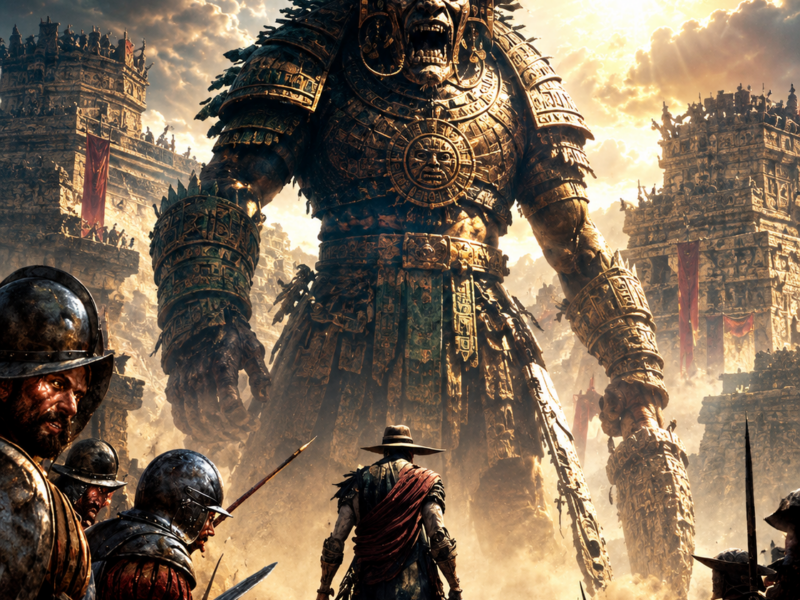
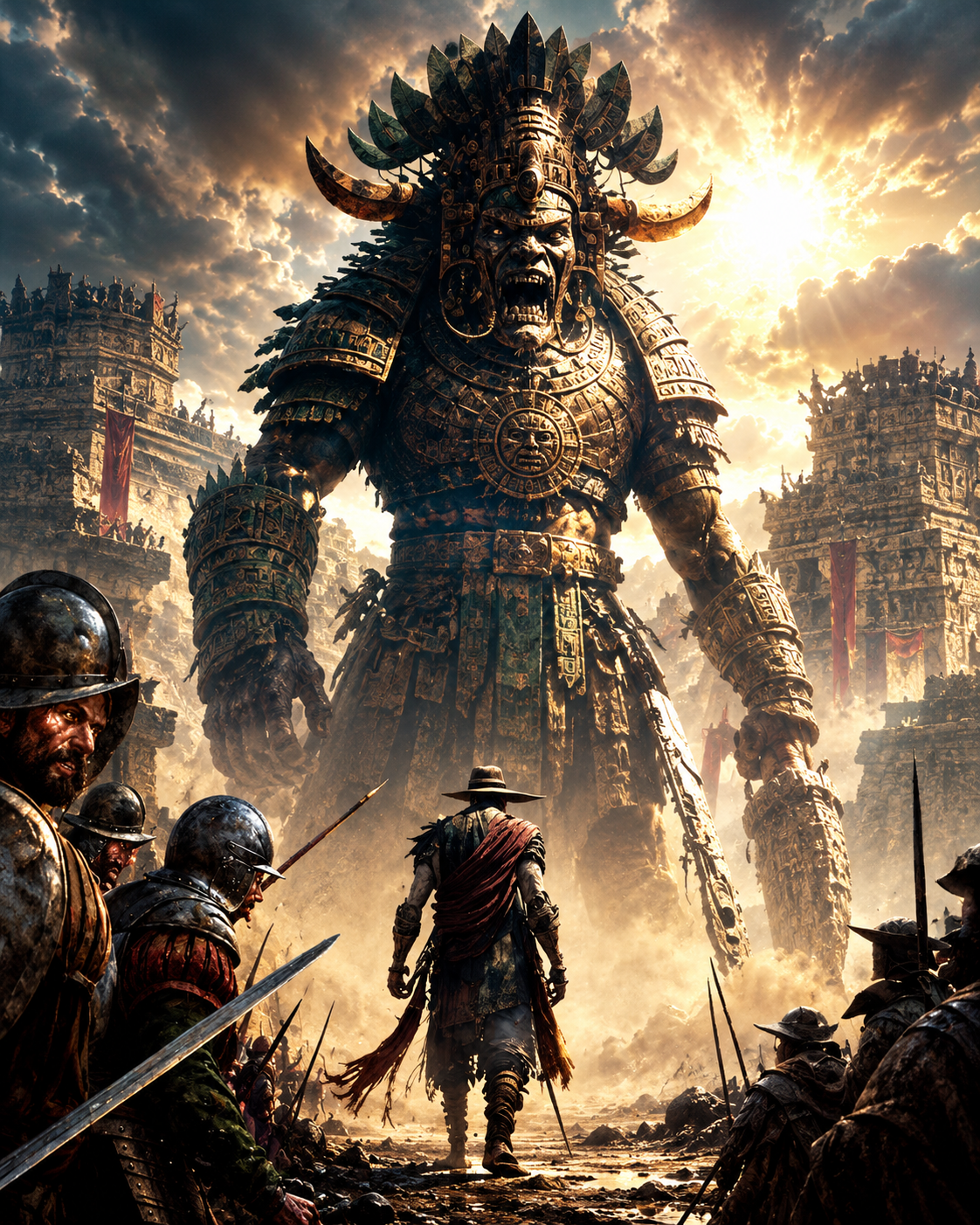
Then the shaded forest ahead of them began to rustle, branches shifting and parting, and something huge stepped out into the light.
The expedition’s secretary, a careful, observant man named Tomás Reyes, wrote down what he saw while his hands were still shaking.
“We stopped, struck dumb with amazement. A great giant stood before us. The heads of our tallest men reached only to his breast.”
He was a native warrior, impossibly tall, and he walked straight toward the captain of the army, Alonso Varga, and stared down at him with calm, unblinking eyes.
In rough, broken Spanish, he gave his name.
He was called Black Heron. He was the son of the great Chief Tascalan, who had heard of the strangers and wished to meet them. A feast was being prepared in their honor.
Varga was a hard man. He had built his fortune on gold, plunder, and the sale of slaves captured from native tribes. News of his expedition had been racing ahead of him through the forests for months.
But he was also hungry, and so were his men.
So, against every instinct he had, he accepted.
He did not know that he was following a giant into one of the deadliest encounters in recorded history.
The City in the Forest
For three days, the Spaniards followed Black Heron through dense woodland.
Then the trees thinned, and they stepped out into a sunlit clearing. In front of them rose a settlement surrounded by towering walls of heavy logs, lashed together with massive vines.
It was the capital of Chief Tascalan. The people called it Mabara.
It was not a village. It was a city.
Inside the walls, the soldiers counted more than eighty houses, some very large, with walls of dried mud and roofs sealed with river cane and giant palm leaves. Black Heron led them through the streets toward a tall, shaded mound at the far end.
On top of it sat the chief.
A hundred warriors of ordinary height stood guard around him on every side. When Black Heron approached, the old man rose to greet his son.
Varga and his men stopped dead.
Tascalan was taller than Black Heron by at least two feet.
Reyes struggled to find the words.
“A giant mightier than his son, with big-boned, sinewy limbs like a gnarled, leafless tree. He towered high above us. His speech was couched in fair expressions, yet beneath it I detected undertones boding little good to me or mine.”
The chief turned to the crowd of Spaniards and swept a hand toward the largest house in the village. Food was waiting.
The Feast
Inside, it was everything the starving army had dreamed of.
Fresh meat. Bread. Drink. Beautiful women danced and sang and played flutes. The soldiers ate until they could barely stand, and for hours the great hall rang with laughter.
But slowly, as the wine wore off, Captain Varga began to sober.
He looked around the room and realized something was wrong.
Chief Tascalan was gone.
It was almost night. Varga rose and stepped outside to look for him, leaving his secretary behind in the hall.
Inside, Reyes felt the mood change.
“The old women and the children were all gone. I glanced above and saw countless scowling faces peering from the rafters and loopholes. I saw their crafty warriors slipping spears and bows and arrows beneath leaves of palm. I knew, though late, the deadly danger that encompassed us.”
The music stopped. The dancing stopped.
Outside, in the gathering dark, Varga spotted the chief standing near the entrance of the city. The grounds had been cleared of everyone. The giant was about to leave.
It was an ambush.
Varga screamed for his men to defend themselves.
They poured out of the hall just as the sky filled with arrows. A hail of shafts came down on them from the rooftops and the walls, and within minutes, two hundred of the Spanish soldiers lay dead.
The rest fought their way through and escaped into the forest.
The Battle of Mabara
At first light, the survivors gathered and planned their revenge.
They returned to Mabara and attacked the barricade. They hacked at the great logs with axes until the wall finally gave way, and then they stormed the city.
What followed was a massacre.
The soldiers set the buildings on fire. They killed more than two thousand five hundred of the city’s people. And in the middle of the chaos, they found Black Heron and cut off his head.
The fighting lasted nine hours. By the end, the whole tribal capital had burned to the ground.
History would remember it as the Battle of Mabara.
But Varga was not satisfied. When the smoke cleared and the ashes were searched, there was no sign of the chief.
Tascalan’s body was not among the dead.
The Spaniards assumed that the giant chief had slipped away into the forest, and for weeks they combed the countryside looking for him. They found no trace of the man.
They did find the mounds.
All across the region, they stumbled upon huge man-made hills of earth, just like the one on which the chief had sat to greet them. They were monuments of an old and organized civilization.
But Tascalan was never found.
A few months later, Captain Varga came down with a fever and died, and his body was lowered into the great river.
The survivors of the expedition made their way back to Spain. And when they delivered their report, they confirmed what other captains had said before them.
Giants were real, and they lived in the Americas.
A Pattern in the Records
The Spanish soldiers were not the first to say it.
Many of the most famous and influential explorers of the New World had met giants and written about them. Some of the encounters were hostile and bloody. Others were warm and peaceful.
The tribes varied widely in appearance and customs. The only real difference from ordinary people, in most accounts, was their size.
It is tempting to dismiss those reports as sailors’ tall tales. But there is a problem with that.
The same men who described the giants also gave us some of the most reliable discoveries of the era.
The captain whose army was ambushed at Mabara was the first European to reach the great river that cuts through the heart of the continent. The navigator who first met the giants in the south was the one who realized that the vast land he had found was not part of Asia, but an entirely New World. Another explorer mapped the Gulf coast with remarkable accuracy. And the circumnavigation of the globe by a master navigator is often called the most significant voyage ever undertaken.
All of those facts have been confirmed, and all of them come from the same records that mention giants.
Why would historians trust the maps and doubt the men who drew them?
Let us look at the accounts, one at a time.
The Footprints on the Sand
Long before the army marched into Mabara, an Italian navigator named Lorenzo Bellini reached a small Caribbean island in the year 1499.
He was a few years behind the first voyage to the New World, but he was the first to meet the giants.
His ships had run low on fresh water. A party went ashore to search, and, walking along the beach, they found something that stopped them in their tracks.
Footprints. Enormous ones, pressed into the wet sand.
“We reasoned,” Bellini wrote in his journal, “that if the other limbs were in proportion, then these must be very big men.”
They followed a trail inland for about two leagues and a half. There they came upon a village of twelve houses. It was empty, except for five women. Two were old, and three were young girls.
They were so tall that the sailors simply stared.
Bellini did what European explorers of the era tended to do. He accepted hospitality from his hosts without a second thought, and immediately began scheming with his men to kidnap the three girls.
The plan fell apart when the men of the village came home.
“When they entered, some of our fellows were so frightened that for a moment they thought they were done for. Each of them was taller, even upon his knees, than I was standing straight. They were of the stature of giants.”
The sailors froze.
Bellini quickly changed course. Through gestures and soft words, he told the villagers that his men were peaceful travelers, curious about the world. He judged it wise to leave without any trouble.
The giants followed them all the way to the beach.
They stayed until the last sailor had climbed into the boat.
The Golden Giants of the Great River
In 1519, another Spanish captain, Pedro Alvarado de Lena, sailed into the region where Varga’s army would later be ambushed, near the mouth of a great river in what is now the southeastern United States.
He landed at a large settlement of native villages.
The people who lived there, he reported, were a race of giants, ten to eleven palms in height. They were covered with gold ornaments and jewelry.
And they were extraordinarily kind.
They offered the Spaniards food and a place to rest. They helped them repair their equipment. Alvarado de Lena noted something else, too. Living alongside the giants was a population of people of unusually short stature, small as the giants were large.
The Spaniards stayed for some time and left without incident.
In the report he sent to the governor of Jamaica, Alvarado de Lena spoke highly of both peoples.
It was a pleasant exception.
Because the next story ends very differently.
The Dancing Giant
The year was 1520, and the master navigator Fernão de Sarmento had set out on the first expedition ever to sail around the world.
His chronicler was a quiet, meticulous Italian scholar named Matteo Corsini, who wrote down everything he saw. Thanks to him, we have one of the most detailed accounts of a giant encounter ever recorded.
By October, more than a year into the voyage, the fleet had entered the narrow straits at the southernmost tip of South America. It was a land of glacial waters, grassy deserts, and cliffs dusted with snow. At first, the crew was awed.
Then the weather turned.
Storms of rain and wind and lightning battered the ships, until Sarmento had no choice but to anchor in a sheltered harbor. They stayed for six weeks.
Corsini wrote what happened next.
“We had spent two whole months in this harbor without seeing anyone, when one day, quite without warning, we saw on the shore a huge giant. He was naked, and he danced, leaped, and sang, throwing sand and dust upon his head. He was so tall that even the largest of us only came to the middle between his waist and his shoulder. His eyes were ringed with yellow, and on the middle of each cheek was painted a heart.”
Sarmento ordered one of his men to walk toward the giant and to dance, leap, and sing in return, as a sign of friendship.
The giant stopped. He marveled at the sailor, and then, according to Corsini, he grew afraid. He pointed at the sky.
He seemed to believe that the strangers had come from heaven.
The Gesture at the Sky
The crew followed the giant back to his village.
There, the other tall members of the tribe greeted them with the same peculiar gesture. As the sailors approached, the giants began to dance and sing, and each raised a single finger toward the sky.
Six days later, an eight-foot giant approached a few of the sailors. He touched his own head, then his face, then his body. Then he did the same to the sailors.
Afterward, he lifted his hands toward the sky.
The sign appears in the account again and again. With nearly every giant the expedition met, the same gesture.
What were they trying to say?
Were they claiming a connection to the heavens? Or were they asking whether these pale strangers had come from the sky, as if other visitors had come that way before? Those with an interest in ancient visitors will find a lot to chew on here.
Sarmento’s men spent several weeks in the village. They got into a few scrapes.
In one comic moment, a sailor brought a mirror from the ship and handed it to a giant, hoping to show him just how large he was. It backfired spectacularly.
“The giant, seeing himself, was greatly terrified,” Corsini recorded, “and leaped back so violently that he threw four of our men to the ground.”
The Patagonian giants, as the crew came to call them, were friendly, but they were jumpy around reflections.
The Trick
But Fernão de Sarmento was a conqueror at heart.
Having seen giants with his own eyes, he became obsessed with the idea of taking two of them back to Spain as proof. And he came up with a scheme.
Corsini admitted that it was a cunning trick, though he insisted it was necessary. The giants, he wrote, were so strong that they would have killed the Spaniards if they tried to take them any other way.
The trick was simple. Lead a few giants to an isolated spot. Shower them with metal gifts, like knives, scissors, bells, and mirrors. And while they were busy with the shiny presents, slip shackles around the legs of two of them and tell them it was jewelry.
“These giants took great pleasure in seeing the fetters, and were sorry that they could not hold them in their hands, because their hands were already full. But when they saw the bolt across the fetters being hammered to rivet it shut, they were afraid. The captain made signs to them that they should suspect nothing.”
At that moment, the other giants realized what was happening.
They shouted at the sky. Then they attacked, killing one of Sarmento’s men. But the sailors had guns, and the giants, seeing they were outnumbered, ran for reinforcements.
In the confusion, Sarmento and his crew fled to their ship with the two chained giants and sailed away.
It was then that the captain gave the giants their name.
He called them the Pataganos, and the land they came from he called the Land of the Big Feet.
The Captives
On the ship, Corsini watched his captives with a mixture of fascination and pity.
Each of the two giants ate a basket of hard biscuit and drank half a pail of water in a single gulp. They also ate rats, he noted, without skinning them.
Within a few weeks, both captives were dead.
They had fallen terribly ill, and no one could save them.
The expedition itself was cursed. Not long afterward, Sarmento would face one mutiny after another, and he would finally die on a distant beach, struck by a poisoned arrow, his last sight the backs of his own crewmen as they left him to the enemy.
Of the entire fleet, only twenty-two men made it home.
Matteo Corsini was one of them. And his meticulous notes on the Pataganos would become the most famous giant encounter in recorded history.
Why Do We Believe the Maps but Not the Men?
Consider what kind of records these are.
They are the diaries and logbooks of the greatest explorers of their age. Their discoveries, from rivers to coastlines to continents, were later confirmed by others and are now taught in every school.
And yet the passages about giants are almost always dismissed.
When they are not dismissed outright, a standard explanation comes up. The Europeans of the 1500s, historians say, were short. Skeletal analysis shows that their average height was about five and a half feet.
That is true. But it hardly helps the skeptic.
If a man of five and a half feet found that the tallest of his crew reached only to the chest of a stranger, then the stranger was somewhere between eight and a half and eleven feet tall.
For perspective, the tallest human in medical history stood just under nine feet, and he did so because of an extremely rare condition. A whole tribe at that height would not be ordinary people.
It would be a race of giants.
None of this would have surprised the people who already lived in the Americas.
The Priest Who Listened
Native traditions had always spoken of giants, and the earliest written records of those traditions date to the 1500s.
Many of the best sources come from a single man.
In 1544, a seven-year-old Spanish boy named Matías Roa moved with his family to the central valleys of the continent. He grew up among the remaining native people. He learned their language fluently, and he learned to read their ancient picture-writing.
Over the years, Roa became one of the few Europeans the elders trusted.
Their empire had been shattered by conquest and by terrible diseases that killed more than eighty percent of the population. Few of their stories had been written down before the survivors began to disappear.
The elders chose Roa to preserve them.
So he spent three decades of his adult life living in their community, recording their words. The resulting book is probably the most important surviving account of the old beliefs of that people.
It is also where he first learned the story of the giants.
The Seven Caves
According to the tradition, there is a place deep inside the Earth called the Seven Caves.
Seven tribes were born there, and one of them was the Valley People, the nation Roa lived among. At some point in the distant past, all seven walked out of the caves and onto the surface of the world.
They kept painted books recording what they found when they emerged.
Roa described them.
“When the six tribes had settled in the upper world, they recorded in their painted books the kind of land and the kind of people they found. The books showed two peoples, one from the west of the snow-covered mountains, and the other from the east, where the great cities stand. The people of the east were giants. The Kinamet, which means men of great stature.”
The giants, in other words, were already there.
They had lived on the surface long before the seven tribes arrived from underground. And their story reached back to the very beginning of the world.
The Four Suns
The Valley People believed that the world had been created and destroyed several times.
Each age was called a sun, and each ended in catastrophe.
In the first sun, the god known as the Smoking Lord threw himself into a great fire and created the first people from his own ashes. They were giants. The other gods gave them acorns to eat.
But the Smoking Lord had a rival, the Plumed Lord, and a long feud grew between them. In a fit of rage, the Smoking Lord sent jaguars to Earth, and they tore the giants to pieces. None survived.
The first sun lasted exactly 676 years.
The second sun also lasted 676 years. It ended in hurricanes and floods, and those who survived by climbing into trees were turned into monkeys.
The third sun was shorter, only 364 years. It was in this age that the giants were made again. And this time, they were better. Stronger and faster, with a new name, the Kinamet.
The word can mean either men of great stature or the old ones.
A scholar of the old traditions once estimated that they stood over ten feet and weighed more than six hundred pounds.
But the Kinamet had a flaw. They refused to worship the gods who made them.
The gods were furious, and they destroyed the world again, this time with a rain of fire and ash.
Yet the Kinamet were tougher than their predecessors. Part of their population survived into the next age, the fourth sun, which lasted another 676 years.
And in that age, the gods grew determined to be done with them. The two rivals put aside their feud and joined forces for the worst catastrophe yet, a flood that covered the entire world.
Nearly all life was lost.
According to the old text, the giants either drowned or were turned into fish. Only seven escaped, by fleeing into caverns.
When the waters receded, one of them, a giant named Xelan, whose name means the architect, went to a place called Cholam. There he built an artificial hill in the shape of a pyramid.
It was a refuge for himself and his six brothers.
The Buried Mountain
Most people have never heard of the Great Pyramid of Cholam.
It is the largest pyramid in the world by volume, about 4.45 million cubic meters, nearly double the size of the famous pyramid at Giza. It was built more than 2,200 years ago.
And the only reason it survives is because its builders hid it.
When the Valley People heard that a Spanish army was approaching, they made an enormous effort to bury the whole structure beneath earth and shrubs.
It worked.
When the Spaniards arrived in 1519, they looked at the site and saw a hill. A very large, rather interesting hill. They thought it would be the perfect place to build a church.
Friar Roa wrote down the legend of a great pyramid built by giants, but no one believed him.
Over the centuries, the soil eroded away. In the early twentieth century, long after the age of conquest, the pyramid was revealed to the world.
Archaeologists have been studying it ever since, and they have found something odd.
The Great Pyramid is not a single structure. It is six pyramids, stacked one on top of another. The topmost was built around the ninth century. Each one below it is older.
Only the first three have been explored. The other three have been seen only with ground-penetrating radar.
And the radar showed something else.
Deep beneath the pyramid is a vast network of tunnels. At least five miles of them have been mapped, and archaeologists suspect there are more below. No one knows where they go, or what they connect to.
It fits, in an uncanny way, with the legend that a giant emerged from the inner earth to build the first pyramid.
The Tower to the Gods
In most versions of the story, Xelan built the pyramid as a sanctuary for the seven surviving Kinamet, a place to start a new era.
But in some versions, the giant architect went further.
He kept building. Higher and higher, as if he wished to reach the heavens themselves, the realm above the clouds, where the gods lived who had tried to destroy his people.
That might explain the six stacked pyramids.
At some point, the tower grew a little too tall for comfort. The gods noticed, and they decided to stop him.
Friar Roa recorded the end of the story.
“Irritated at the daring of Xelan, the gods hurled fire upon the pyramid. Many of the workmen perished. The work was abandoned, and the monument was afterward dedicated to the Plumed Lord.”
Many died, but not all.
The giant architect and many of his brothers and sisters survived. And the Kinamet went on to build more than a dozen monuments and great cities, including a magnificent capital that we will come back to, because something very big happened there.
But first, they would meet the enemy that destroyed them.
The War on the Giants
The enemy was human.
They were the seven tribes of the Seven Caves, the same peoples who had emerged from underground in the ancient past. According to Friar Roa’s records, the war against the giants was fought between the tenth and thirteenth centuries, when the Valley People, the last of the seven to leave the caves, joined the others and entered the land.
Roa put it plainly.
“When the new nations came, the giants showed no resistance or anger, but fled toward the hills and hid there. The others were enraged at the coming of the invaders and tried to defend their land. The invaders fought with the giants until they killed them or drove them from the country.”
The giants had size and strength. They fought tooth and nail for their homeland.
But the seven tribes formed an alliance, and the Kinamet were already few. More than a thousand were killed.
A surviving codex shows one of the images. A giant is disemboweled, roped, and dragged into a fire by warriors. It was painted by a native artist in the middle of the sixteenth century, and it is far too graphic to reproduce here.
Some of the Kinamet threw themselves from cliffs rather than face torture. Others fled on foot, and were hunted down and killed.
But it was widely believed that some escaped. Into mountains. Into caves. Onto remote islands.
And a persistent rumor said that a large group had migrated north, into what is now northern Mexico and the southern United States.
That could explain a curious fact. Most of the giant encounters recorded by European explorers occurred in precisely those regions.
The Friar’s Own Eyes
The Valley People did not hide the giants. They spoke of them as history.
But Friar Roa did not simply hear about giants. By his own account, he saw one.
“It cannot be denied that there have been giants in this country. I can affirm it as an eyewitness, for I have met men of monstrous stature here. I believe there are many in the city who will remember, as I do, a giant native who appeared in the procession of the feast of Corpus Christi. He wore yellow silk, carried a halberd on his shoulder and a helmet on his head, and he was all of three feet taller than the others.”
It is a small detail, and a striking one.
The Valley People and the Kinamet had once been mortal enemies. But somewhere along the way, a few giants had been accepted as allies and subjects of the empire. A giant in a procession, dressed like a lord, walking among ordinary men.
Roa was not the only witness to such things.
And the most carefully documented of all took place in the capital.
The City of the Giant Hero
The city was called Tenokan.
It was the largest, richest, and most powerful city in the whole region, with a population of between two and three hundred and fifty thousand. In its time, it ranked among the largest cities on Earth.
According to the old myths, it had been founded by a giant.
His name was Tenok, and he was one of the seven Kinamet who survived the great flood. So it may be fitting that when the city faced its final hour, a giant would be its greatest hero.
In 1521, a Spanish army under Captain-General Beltrán de Orozco laid siege to Tenokan.
Orozco is remembered today as the man who destroyed the empire. The siege lasted seventy-five days, and it was one of the most brutal in history.
The Valley People called up their strongest fighters to defend the capital.
And in his report to the king of Spain, Orozco singled one out.
Among the defenders, he wrote, was a warrior of gigantic stature, named Tzilcan. Every stone he threw brought down its target. All of the Spanish archers and musketeers aimed at him, and his great height made him easy to pick out.
They could never defeat him.
The Goliath of the Valley
Today, Tzilcan is sometimes called the Goliath of the empire.
Multiple witnesses agree that he stood well over ten feet tall. He is remembered as one of the three greatest heroes of his people.
His weapon of choice was boulders.
He hurled them at the Spanish invaders and crushed so many of Orozco’s men that the army marked him as Enemy Number One.
What makes this encounter special is the quality of the record. Tzilcan was documented by both sides, by the Spaniards who fought him and by the Valley People who fought beside him.
An elder who survived the siege told his story in the native tongue.
“The great captain Tzilcan came, bringing three great stones, of the kind used for building walls. He carried one in his hand, and the other two hung from his shield. He hurled these stones at the Spaniards. He scorned his enemies, Spaniards and natives alike. They all shook with terror at the mere sight of him. When the Spaniards learned how dangerous he was, they tried desperately to kill him. They attacked him with swords and spears, fired crossbows at him, and tried everything else they could think of.”
None of it worked.
Most reports say that bullets and arrows had little effect on him. He held back the invaders for weeks.
He even mocked them.
He fought without armor and without a helmet, decorated with brightly colored feathers, shell necklaces, and golden lip ornaments, as if the whole battle were a festival he was hosting.
The Siege That Won the War
In the end, the Spaniards never defeated Tzilcan directly.
They won the war by a different strategy.
They could not break through the stronghold while the giant guarded it, so they surrounded the city on every side, cut off every supply route, and slowly tightened the noose.
The famine that followed was terrible. The people ate leather, wood, and bricks. There was almost no rain and no clean water, so they drank from contaminated sources, and thousands died of dysentery.
Then smallpox arrived.
It tore through the city like fire, one of the most contagious diseases in history, and it killed on a scale that no army could have achieved.
The Goliath of the Valley, as far as anyone can tell, was never killed by a Spanish weapon.
But somewhere in those walls, in the final days of the siege, he met his fate. Perhaps hunger took him, or thirst, or dysentery, or the sickness.
After Tzilcan fell, the Spanish army advanced.
It was not long before the few remaining defenders surrendered.
The fall of Tenokan was the end of an empire, and it changed the course of history forever, for better or worse.
What the Records Say
Step back from the battle for a moment and look at what we have.
On one side, there are Spanish soldiers, writing their reports for a king. On the other, there are native elders, speaking in their own language to a priest, and painting their own books.
They did not coordinate. They did not read each other’s accounts. They did not even speak the same language.
And yet, when it came to Tzilcan, their descriptions matched.
That agreement is what makes the story so hard to wave away.
It indicates that the witnesses were describing something real, and that the thing they saw was a man of enormous size, fighting with stones, who held off an army.
If that is true, and giants were not fantasy but history, then there is a great deal more to investigate.
There are the mounds scattered through the forests of the southeast, and the village whose chief was never found. There is the gesture at the sky, repeated by every giant a navigator met. There are the footprints on an island beach and the golden giants beside the great river.
And there is a pyramid with six pyramids inside it, and a tunnel network beneath that no one has explored.
Perhaps the most unsettling thing about the giants of the Americas is not that so many people saw them.
It is that so many of those people were the ones who gave us the maps we still use.
We trust their coastlines. We trust their rivers. We trust the routes they sailed, the latitudes they recorded, and the cities they described.
It is only when they mention the giants that we suddenly decide they must have been mistaken.
Somewhere, in a forest in the southeast, there may still be a mound that no one has opened.
And somewhere in the earth beneath a pyramid in the south, there is a tunnel that leads to a place no one has seen.
The old people said that the giants fled into the hills and hid there.
Maybe nobody has ever thought to look hard enough.









