I Was Still Healing When My Amish Husband Said My Duties Had Already Returned
“Your Duties Have Already Returned”: An Amish Mother’s First Weeks of Recovery
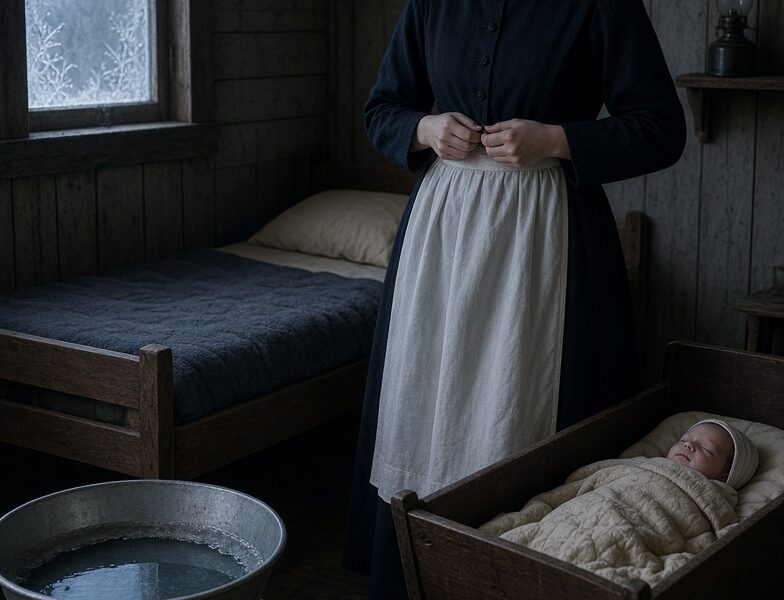
The wash water had gone cold beside the bed, and I remember staring at the thin skin of ice beginning to form around the edge of the basin because it was easier to look at that than at my husband.
I was still sore when I stood, still moving carefully, still waking in the night with that deep pulling ache that reminded me my body had not finished healing. Our baby was twelve days old. I had slept perhaps three hours in pieces the night before.
And that morning, while I was fastening the front of my dress with hands that would not quite stop trembling from tiredness, my husband said, “Your duties have already returned.”
He did not raise his voice. That almost made it harder. He said it as if he were telling me the milk pail needed rinsing or the stove needed another piece of wood. Something ordinary. Something settled.
I looked at him and realized that he believed the matter had already been decided. Not by me. Not by how I felt. But by the fact that enough days had passed for everyone around us to expect life to look normal again.
I wish I could tell you I answered him immediately. I did not.
I stood there in the half-light with our newborn breathing in the cradle and wondered when everyone else had decided I was well enough.
My name is Katie. I grew up in an Old Order Amish home, and I share these stories because people often see the simple dresses, the farms, the buggies, the family tables, and they imagine they understand what life feels like from the inside. Sometimes they do. Sometimes they do not.
If you have ever had someone expect you to be back to normal before you felt ready, you will understand why that morning has stayed with me.
The Long Night of Birth
I had given birth less than two weeks earlier, after a labor that began before sunrise and carried all the way into the dark.
I remember the clock because I kept looking at it even though I had no reason to. At 4:20 in the morning, I was kneading bread when the first pain made me grip the edge of the table. By noon, I had stopped noticing the clock. By evening, the room smelled of hot water, clean cloth, lamp oil, and the sharp soap my mother always kept wrapped in brown paper.
When my daughter finally cried, it was the sweetest sound I had ever heard. But I was too tired to cry with her. I just closed my eyes.
Afterward, everyone moved around me with purpose. The midwife checked the baby. My mother changed the bedding. My husband stood by the window with both hands hanging uselessly at his sides, looking younger than I had ever seen him.
People say a baby enters a family in one moment. That is true in one sense. But the mother does not step out of that moment finished.
I did not.
The Morning After
The next morning, I felt as if every muscle from my shoulders to my knees had been pulled apart and tied back together differently. Sitting hurt. Standing hurt. Laughing hurt. Even lifting the baby from the cradle required planning.
Still, there was breakfast to be made, clothes to be washed, animals to be checked, and three younger children from my husband’s sister staying with us for two days because their mother had come to help.
No one was cruel about it. That is important for me to say.
My mother told me to stay down. My sister brought soup. A neighbor sent bread. For the first few days, people protected me from work almost like they protected the baby from cold air.
But help has a way of thinning out.
The first day, there were six women in and out of the house. By the fourth, there were two. By the seventh, one. By the tenth, I could hear the buggy wheels of the last visiting aunt fade down the lane and knew the house was ours again.
That was when the invisible clock started ticking.
The Invisible Clock
No one put a number on the wall. No one announced that I had reached the end of recovery. But I felt expectations returning one small thing at a time.
First, it was breakfast. Then laundry. Then carrying the coal bucket because my husband had already gone outside. Then walking to the line with a basket against my hip while the baby slept indoors.
Each task looked tiny by itself. Together, they became my old life, arriving before my body had caught up.
The strange thing is that I helped it happen. I wanted to prove I was fine. I wanted my mother to stop looking at me with concern when she visited. I wanted my husband to see a capable wife, not someone who needed to be watched.
I wanted the kitchen swept before anyone could offer. I wanted the bread to rise properly. I wanted to stop being asked how I felt because every time someone asked, I had to decide whether to tell the truth.
Most of the time I said, “I’m doing well.”
Those words were easier. They closed the subject.
On the eleventh day, I washed diapers before sunrise. The water was steaming when I began and nearly cold when I finished. I remember leaning both hands against the washstand afterward because the room tilted for a moment. I waited until it stopped. Then I carried on.
“A Body Does Not Heal Because the Calendar Is Impatient”
That evening, my mother came by with a jar of applesauce. She watched me cross the kitchen once, slowly, and said only one sentence.
“A body does not heal because the calendar is impatient.”
That was my mother. She could say something once and leave it sitting in the room long after she was gone.
I laughed a little because I did not want her to know how close those words came to making me cry.
My husband heard her, too. He was cleaning mud from his boots by the door. He did not answer. At the time, I thought he understood.
The next morning showed me he did not—at least not in the way I needed him to.
The Morning of Twelve Days
Our daughter had been awake at 1, then again at 3, then again before 5. I had finally slept for perhaps forty minutes when I heard the stove door open.
My husband was already dressed for the barn. The room was blue with early morning light. Frost covered the lower corners of the window. The baby made those tiny squeaking sounds newborns make before they wake fully.
I moved to sit up and immediately felt the ache low in my body. It was not sharp. It was heavy—a warning more than an injury. I stayed still another few seconds.
My husband turned and looked at me.
“You staying in bed again?” he asked.
There was no anger in it. Just surprise.
I told him I needed a little more time before starting breakfast. He nodded, but he looked toward the clock. That look hurt more than the question.
A few minutes later, I got up anyway. I fed the baby. I put water on the stove. I sliced yesterday’s bread and fried eggs. I moved slowly enough that by the time he came in from the barn, breakfast was later than usual.
He ate without saying much. Then, while I was washing one plate, he said he thought things should be returning to normal.
I asked what he meant.
He said, “The house, the meals, the washing, us.”
That final word was quiet. I knew exactly what he meant by it, and I also knew I was not ready.
What I Had Been Taught
In our community, marriage was spoken about with modesty. There were things women discussed with mothers or sisters and things that stayed behind a closed door.
I had been taught that a husband and wife belonged to one another, that marriage meant service, patience, sacrifice, and faithfulness. Those words can be beautiful. They can also become heavy when one person uses them without asking what the other person is carrying.
I told him I was still hurting.
He looked genuinely confused. “But you’re up,” he said.
That sentence has stayed with me for years.
But you’re up.
To him, standing meant healed. Cooking meant healed. Hanging diapers meant healed. Smiling at visitors meant healed.
He could see what I was doing, but not what it cost me to do it.
“Being on My Feet Doesn’t Mean I’m Finished Healing”
I said, “Being on my feet doesn’t mean I’m finished healing.”
He rubbed his hand across the back of his neck and looked toward the cradle.
He was not a monster. I want to be careful about that because memory becomes dishonest when we flatten people into one moment. He was 23. I was 18. Neither of us knew very much about childbirth beyond what we had observed from the edges of other people’s homes.
Men were not usually included in the conversations women had about recovery. The women knew. The men knew something, but often in outlines. A baby came. The mother rested. Then life resumed.
My husband had grown up watching his own mother return to work quickly after each baby. What he had never seen were the moments behind the pantry door when she braced herself against a shelf, or the evenings when another woman quietly finished the laundry for her.
He had seen the surface and thought the surface was the whole truth.
But not knowing something does not make the pressure disappear.
The Words That Changed Everything
I told him I needed more time.
He answered with the words I still remember exactly.
“Your duties have already returned.”
I can still hear how calm he sounded. My first feeling was shame—not anger. Shame.
I wondered whether I was weak. I wondered whether other wives recovered faster. I wondered whether my own mother had done more by day twelve. I wondered whether I was failing in the first weeks of being a mother because I could not be a wife, mother, cook, and farm helper at full strength all at once.
That is one of the hardest things about expectations. When they are repeated long enough, they start speaking in your own voice.
I dried my hands on my apron and asked him who had told him that.
He frowned. No one had to.
I asked again. Had the bishop said something? His father? His mother? Another man?
He shook his head. He said that married life had responsibilities and that we could not put everything aside indefinitely.
Indefinitely.
Our baby was twelve days old.
I looked at the cradle and felt something inside me change. Not a dramatic rebellion. Not a speech. Just a line becoming visible. I realized that if I kept saying yes to prove I was good, no one would know where my actual limit was.
So I said, “Then today, my duty is to heal.”
The Hour of Fear
He did not answer. I expected an argument. Instead, he picked up his hat and went outside.
For almost an hour, I was terrified of what would happen when he came back.
That fear is difficult to explain because nothing had happened yet. The house was quiet. The baby slept. The stove popped. I sat in the rocking chair with a blanket over my knees and listened to every sound from the yard.
I had been raised to avoid unnecessary conflict. Harmony mattered. Respect mattered. A wife did not make a habit of challenging her husband in front of others. I had not challenged him in front of anyone, but my heart still raced as if the whole church district had heard me.
A Mother’s Practical Love
Around 9, there was a knock. It was my mother. She had come for the empty applesauce jar—which was an excuse, and we both knew it.
She took one look at my face and set the jar back on the table without asking for it.
I told her what he had said. I expected her to defend him, at least partly. Instead, she sat across from me and asked, “What did you tell him?”
When I repeated my answer, she nodded once. That was all.
Then she asked me whether I had a fever, whether the pain was worsening, whether I was bleeding more heavily than the day before, whether I felt dizzy.
She was practical. She did not turn it into a lesson about marriage. She treated my body as something real, not symbolic.
Before she left, she told me she would send my sister after lunch to help with washing, and she said I should speak to the midwife if the pain continued. That simple reaction gave me more courage than any speech could have.
“I Just Don’t Know How Long This Is Supposed to Take”
My husband came back in around 10:30. There was straw stuck to one sleeve. He washed his hands at the basin and stood near the stove for a while.
Finally, he said, “I didn’t mean you were lazy.”
I told him I knew.
He said, “I just don’t know how long this is supposed to take.”
That was the first honest sentence of the morning.
I said, “Neither do I. But I know I’m not ready because I am the one inside this body.”
He sat down. We talked longer than we had talked about anything since the baby was born.
I told him about the dizziness at the washstand. I told him how much it still hurt to sit in certain positions. I told him I was afraid every time I carried a full basket because the pulling sensation became stronger afterward. I told him the nights were not rest, even if I was technically in bed for eight hours.
He listened, but I could see him struggling with a picture of marriage he had never examined. He had believed good husbands worked hard, provided, stayed faithful, led the family, and expected their wives to keep the household. In many ways, he was doing exactly what he had been taught. So was I.
The problem was that neither set of lessons had taught us what to do when a real human body disrupted the pattern.
Small Help, Real Help
At noon, my sister arrived. She was 16, thin as a fence rail, and completely uninterested in our tension. She walked in, tied on an apron, and said, “Mama says I’m washing and you’re sitting.”
That almost made me laugh. She filled the tubs and worked through the diapers while I held the baby.
My husband passed through the kitchen twice. The second time, he stopped and helped carry the water out. It was a small thing, but I noticed.
That evening he made the fire without being asked. The next morning he fried the eggs badly enough that the edges turned brown and crisp, and he apologized as if he had ruined the whole meal.
I ate them anyway.
Not a Perfect Couple
We did not suddenly become a perfect couple. That is not how change works.
He still got impatient. I still pushed myself too hard. There were days when I resented him for not seeing what seemed obvious, and days when he resented me for changing the rhythm of the house without giving him a clear date when it would return.
We had another conversation about closeness several days later. This time he asked instead of assumed. I said I was not ready. He looked disappointed, but he said, “All right.”
That all right mattered to me. It was not romantic. It was not poetic. It was simply respect arriving in a place where expectation had been standing.
Healing on My Own Timeline
The midwife checked on me later that week and told me healing was not a race. She gave practical instructions and reminded me to rest more than I thought I needed. I followed about half of that advice at first—which was still more than I had been doing.
By the third week, I could move without thinking about every step. By the fourth, I could carry a basket without that deep pulling sensation. By the fifth, I realized I had gone an entire morning without measuring myself against the woman I had been before giving birth.
That felt like freedom.
Pain That Needs to Justify Itself
Looking back now, the hardest part was not the pain. It was the belief that pain needed to justify itself to other people before it counted.
I thought if I could stand, I should work. If I could smile, I should be grateful. If I could cook, I should be fully recovered. If my husband was patient in some ways, I should not complain about the ways he was not.
That kind of thinking can make a person disappear inside her own life.
I do not believe marriage is built by keeping score over who gives more. I do believe love requires seeing the person in front of you clearly enough to know when duty has become pressure.
There is a difference between serving someone and erasing yourself for them.
I did not understand that difference at 18. I understand it better now.
Understanding My Husband
And I understand my husband better, too.
He was not trying to become a cruel man. He was repeating what looked normal to him. But normal is not always the same as right for the moment you are living through.
Sometimes a family has to learn a new rhythm because one person is sick, grieving, exhausted, pregnant, healing, or simply unable to carry what they usually carry.
That does not mean the family has failed. It means the family is real.
What Trust Requires
My mother’s sentence is still the one I return to.
A body does not heal because the calendar is impatient.
I would add something now that I could not have said then.
Neither does trust.
Trust grows when you can say, “I am not ready.” And the person who loves you hears a truth, not a rejection.
That morning, when I told my husband my duty was to heal, I thought I was risking peace in our home. What I was really doing was giving us a chance to build a better kind of peace—one that did not depend on my silence.
A Question for You
Before I go, I would like to know this.
Have you ever had someone expect you to recover faster than you could? And what finally made them understand?
Maybe it was a conversation. Maybe it was a doctor’s word. Maybe it was a mother who spoke plainly. Or maybe they never understood, and you had to learn to honor your own body anyway.
You can answer in the comments—in as much or as little detail as you want. You do not have to explain everything. Sometimes, just knowing somebody else understands is enough.
About This Story
This is one of the stories from The Katie Journals, exploring the quiet, complicated, beautiful, and sometimes difficult parts of Amish life that people rarely see from the road.
My new book, The Ninth Day, is out now. It is the first book in The Katie Journals, and if you would like to read it, you can find the link in the description.
If you want to hear more stories about what life inside an Amish home can really feel like, you can subscribe and come back for the next one.
End of Article









