I Told My Amish Husband I Was Still Bleeding, He Said a Wife’s Duty Comes First
The Basin
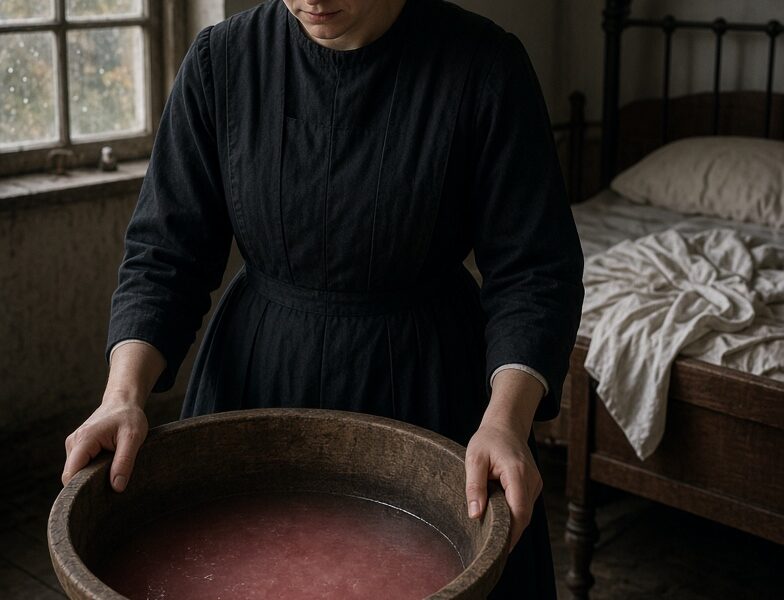
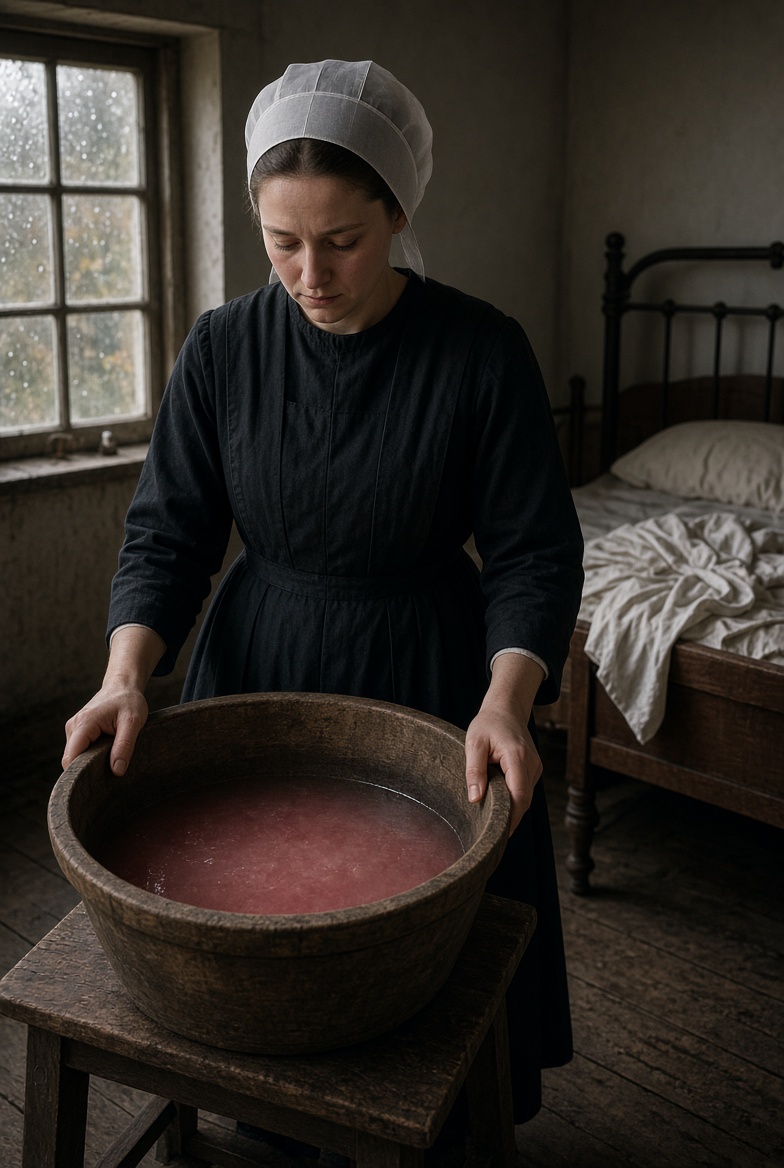
The water in the wash basin had turned pink again, and I could hear my husband taking off his boots on the other side of the bedroom door.
I held the edge of the basin with both hands, waiting for the dizziness to pass. When he asked why I had not put out the lamp, I told him the truth. I was still bleeding.
He looked at the folded nightdress beside the bed and said very quietly that a wife’s duty came first.
I remember the sound of his boots hitting the floor more clearly than I remember my own answer. That frightens me a little even now.
My name is Katie. I grew up in an Old Order Amish home where much of what matters is taught without anyone making a speech about it. You watch your mother. You listen to the older women. You notice what gets discussed at the table and what is never said aloud.
I tell these stories because sometimes the parts we keep quiet are the very parts another woman needs to hear. If you have ever struggled to say that something was wrong when everyone expected you to carry on, I hope you will stay with me and tell me, if you wish, what helped you find your voice.
The Autumn When Everything Changed
It happened in the autumn during a week when rain had soaked the lane so thoroughly that our shoes brought mud into the house no matter how carefully we scraped them. I had been married long enough to know which step in the hallway creaked beneath his weight and not long enough to understand that I could disagree with him without becoming a bad wife.
Our kitchen was narrow, with a shelf for the jars and an old clock that gained a few minutes every week. I kept meaning to set it right. There always seemed to be one more thing that needed doing before I could climb onto a chair and reach it.
The bleeding had started after a pregnancy ended much earlier than we had hoped. I will not pretend I can tell you exactly what happened inside my body. I couldn’t have explained it then. I knew only that I had begun with cramps, then pain that bent me over the kitchen counter, and afterward an emptiness that seemed too large for such a little house.
I was not ready to call it grief at first. I told myself I had not known the child long enough, but I had already counted months on my fingers. I had already wondered whether there would be enough winter blankets. Hope takes up space even when no one else can see it.
The Days That Followed
The first day, I worked until I could not. On the second, I stayed in bed for part of the morning and felt guilty about the bread dough waiting beneath its cloth. By the third, I had convinced myself I was improving because I could stand without holding the table.
Then I began bleeding heavily again.
Some hours it slowed. Other hours it left me shaky and cold. I was tired in a way sleep did not fix. I would bend to pick up a dropped clothespin and have to hold on to the doorframe before I stood straight. I knew enough to be afraid, but I did not know how much fear I was permitted to say out loud.
Our life taught us to notice who needed help. A neighbor with a broken wagon axle would find three men at his gate before supper. A sick child might have a pot of soup delivered before the family could ask for it. Yet a woman’s private pain could disappear into the ordinary work of a household.
Nobody had told me I was forbidden to speak. It was more complicated than that. I had learned to be careful about being considered troublesome, and I mistook that caution for goodness.
The Man I Married
My husband had been raised to think of duty as something solid, like the fence posts he set in spring. You did a task because it belonged to you, not because you felt ready. In many ways, that made him dependable. When a storm tore shingles from the washhouse roof, he climbed up before breakfast and repaired it. When his father needed help bringing in hay, he went without complaint.
It would be easy sitting here today to paint him as cruel in every part of his life. That would not be the truth of how I understood him then.
What hurt me was that his notion of duty seemed to stop at the edge of my body.
The Evening He Came In
That evening, I had warmed water on the stove and carried it in a pitcher to the bedroom. The room smelled faintly of soap, damp wood, and the wool blanket folded at the foot of the bed. A gust rattled the window latch. I had changed my clothes twice already. I was worried about staining the bedding, worried about leaving a mark he would see, worried about the cost of another length of cloth if I ruined what we had.
Such small worries can crowd around a larger danger until you almost forget which one deserves your attention.
When he came in, I said I was not well. I said I had been losing blood again. He did not shout. I want you to understand that part. He spoke as though he were reminding me of a chore I had overlooked.
A wife had obligations, he said, even when life was difficult. We had said vows. We were not supposed to let every hardship change the order of our home.
He used words I had heard in sermons and at family tables, words that usually meant faithfulness and patience. Hearing them used against my own fear made the room feel unfamiliar.
Asking for What I Needed
I told him I needed rest. I told him I was frightened. My voice sounded small, so I said it a second time.
He turned away to hang his coat. There was a long moment in which neither of us spoke. I remember watching rain move down the glass and thinking that if I just explained myself more clearly, he would suddenly understand.
I believed the problem was my explanation. I had not yet considered that a person can hear you perfectly and still refuse to take what you say seriously.
He reached for the lamp, and I asked him to leave it burning. I wanted light. I wanted to be able to see his face when I spoke. Then I said something that felt almost forbidden.
“I cannot do what you are asking tonight. My body is not well. I need help.”
The words were plain, but my heart was racing as if I had slammed a door in church.
The Silence That Followed
I had expected anger. What followed was worse in a quieter way. He looked disappointed, as though my weakness had become a personal failure. Then he moved to his side of the bed without answering me.
I stayed awake listening to the weather. The clock in the kitchen marked each hour with a thin metallic click. I tried to persuade myself that the silence meant I had won an argument. It did not feel like winning. I had asked for care and received distance.
In the darkness I began reviewing every ordinary kindness I had offered him. Every meal when I had a headache. Every early morning when I had risen before the sky brightened. As though there were a ledger somewhere that might prove I deserved to be treated gently for one night.
The Longest Night
Near morning I got up to fetch fresh clothes and felt the floor tilt beneath me. I sat on the edge of the bed until the spinning eased. When I stood again, a sharp wave of pain caught me below my waist. I was afraid to lie down and afraid to stay standing.
The rain had stopped. Outside the yard was so still that I could hear water dripping from the eaves into a bucket.
My husband was asleep. I thought of waking him, but I could already hear the questions I imagined he might ask. Was it really that bad? Hadn’t I been better yesterday? Could it not wait until morning chores were done?
This is where I wish I could tell you I was brave immediately. I wasn’t.
Trying to Be Normal
I washed my face, changed my dress, and went to the kitchen. I moved a pan from one end of the stove to the other simply because moving something felt more useful than standing there frightened. I measured flour. Then I stared at it, unable to remember how much I had put in the bowl.
It seems strange now that I tried to make breakfast while I was unwell. But habits are powerful. The whole house had taught me that morning work began whether or not I was ready.
At the table he noticed I had not eaten. I said my stomach hurt. He said I should try something warm. It was ordinary advice, almost tender. For a moment I wanted to believe the night before had been a misunderstanding.
But when I told him again that I had been bleeding, his eyes fell toward the window, and I saw the same impatience return. He asked whether I intended to call my mother about every private difficulty in our marriage.
The question stung because I had already thought of her. I had been stopping myself from asking her to come.
My Mother
My mother did not know everything about my marriage, and there are things I never told her. She was a practical woman who could mend a torn apron while talking about the weather. When we were children, she always checked a fever twice—with the back of her hand and then with a thermometer if she could get one. She trusted what a body was telling her.
Yet I was old enough now to be someone else’s wife, and I was frightened that reaching for my mother would make me look like a child running home because life was hard.
The Walk
By late morning I had made my choice. I wrapped a shawl around my shoulders and walked toward the neighboring home where I could ask for someone to carry a message.
The lane was wet and deeply rutted. The air smelled of leaves beginning to rot. I remember counting fence posts to keep my attention on something other than the weakness in my legs. At the fourth post I stopped. At the seventh I turned and looked back at our house.
Nothing about it had changed. Smoke rose from the chimney. The door was shut. Yet for the first time I understood that a peaceful-looking house can contain a person who is not safe or well.
The Neighbor
Our neighbor saw me before I reached the porch. I did not give her the story of the argument. I said I had been bleeding for several days, felt faint, and needed help reaching someone who could examine me.
Her expression changed at once. She brought me inside and seated me near the stove. There was no debate about whether I was being dutiful enough. There was no long conversation about marriage. She brought water and asked how long I had felt weak. Then she arranged for me to get medical attention.
The simplicity of her response nearly made me cry.
The Ride
I remember the ride more than the examination. The wheels struck every rut, and I held a folded blanket against my middle. At one point I was ashamed that other people had to stop their work because of me. That shame feels difficult to explain unless you have lived among people for whom usefulness is treated almost like a language of love.
To need help can feel like forgetting how to speak. But it was not a failure that day. It was how I got where I needed to go.
The Examination
A medical professional examined me and explained that the bleeding and dizziness could not be dismissed as ordinary recovery. I needed treatment and observation. I will not turn that day into medical instruction because every woman’s circumstances are different. I can only tell you that getting assessed mattered and that I had waited longer than I should have.
The person speaking to me asked direct questions about how much blood I had lost, how much pain I had felt, and whether I felt safe returning home. It startled me that she could ask all three in the same steady voice.
I had prepared myself to answer questions about my body. I had not prepared to answer questions about safety.
The Question of Safety
For several seconds I looked at my hands. Then I said, “My husband believed his needs came before my recovery.”
I spoke slowly, as though the words might change meaning when I said them to someone outside the household. No one laughed. No one accused me of disloyalty. The woman simply told me that I was allowed to refuse intimacy, that illness was not a test I had to pass, and that someone who cared for me should take my bleeding and pain seriously.
I had heard the words care and duty all my life. I had never heard them placed in that order.
She asked whether I wanted help making a plan for the next few days. I said yes before I could think of a reason to say no. I needed a place where I could rest, and I needed someone who would not ask me to prove that rest was necessary.
My Mother Came
That afternoon, my mother came. She smelled of fresh bread and cold outdoor air. She brought a clean shawl, an extra dress, and a small packet of the things she knew I would forget. She did not demand an explanation in front of strangers. She sat beside me and held the packet while I took a drink of water.
When I finally told her what my husband had said, she was silent a long while. Then she gave me one sentence I have carried with me ever since.
“A promise to care for someone is not permission to hurt them.”
She did not raise her voice. She did not dress the words in scripture or make them sound grand. She just said them.
I think part of me had been waiting for an older woman to give me permission to believe what my own body had been telling me all along.
The Questions That Came
I rested away from home for a time. I needed recovery, and I needed space to think.
The hardest part was not the physical distance. It was how many questions arrived with it. Would people think I had abandoned my duties? Would they say I had told outsiders private family matters? Would my husband speak to me honestly if I returned?
I knew there were people who loved us both and wanted everything repaired quickly. The trouble with quick repairs is that sometimes they cover the crack without changing what caused it.
The Conversation
My husband came to speak with me after I was feeling stronger. The afternoon was gray and cool, and the room smelled of boiled potatoes from the kitchen. We sat across a small table. I could see that he was uncomfortable.
He spoke first about the work waiting at home and about how much he had managed without me. I listened, and then I asked whether he understood why I had left.
He said he had not realized how sick I was.
I told him that I had said it plainly more than once. That was the moment that mattered to me—not whether he had guessed correctly, but whether he could admit that he had been told and had chosen not to listen.
His Side
He looked down at his hands. He said he thought I was rejecting him.
I explained that I had been frightened for my health and grieving a pregnancy we had both wanted. I had not been trying to punish him. I needed him to see me as a person in pain, not as a role that had failed to perform.
He said very little after that. There was no sudden scene where every misunderstanding dissolved and we embraced while the clouds broke. The conversation ended with work still to be done between us. Some truths require more than one afternoon.
About Forgiveness
People sometimes ask whether I forgave him. It is a fair question, but it is not the first question I would ask a woman in that position.
First, I would ask whether she was well, whether she was safe, whether she had someone who would believe her without requiring a perfect explanation.
Forgiveness is not a substitute for changed behavior, and it does not require a person to return to a place where her boundaries will be ignored.
I had to learn that there could be room in my heart for faith and compassion without making my own suffering invisible.
Untangling What I Was Taught
I also had to untangle the things I had been taught from the things I had assumed.
I know Amish families who care for someone who is ill with astonishing patience. I have seen husbands sit beside hospital beds and leave fields unfinished when a wife needed them. I have seen neighbors arrive with meals and fresh bedding for weeks.
What happened in my marriage was not proof that every Amish husband thinks the same way. It was a choice made by one person, and it harmed me. I tell it because it would be just as dishonest to hide behind the goodness I have known and pretend that harm cannot happen in a close community.
The Word “Only”
In the weeks after, I began noticing how easily I used the word “only” when I spoke about myself.
I am only tired. It is only a little pain. I only need to sit down for a minute.
Those phrases seemed polite, but they shrank what was happening. When someone asked how I felt, I practiced answering without taking away the seriousness first.
I am still weak today. I need to rest. I am not ready.
Each answer felt awkward in my mouth. Over time, awkwardness became a kind of strength.
A Morning of Quiet
There was a morning later that winter when I stood alone by the kitchen window looking at frost along the lower edge of the glass. I had a cup of warm water in my hands. For a little while, I did nothing useful. No dough was rising, no washing was waiting beside my feet. The room was quiet, and I was not afraid of the quiet.
I remember thinking that I had spent much of my life measuring peace by whether anyone was disappointed in me. But peace that depends on never disappointing another person is not a peace you can keep. There will always be a day when your body says no, or your heart is worn out, or you simply need to tell the truth.
No Neat Ending
I cannot give you a neat ending in which one conversation turned my marriage into something entirely different. Real life seldom grants endings like that.
I can tell you that I stopped treating my husband’s disappointment as the final word on whether I had done wrong. I sought medical care when I needed it. I let trusted people know when I was struggling. I learned that the promises made in marriage must be carried by two people, not placed like a burden on the back of one.
For the Woman at the Washbasin
I think often of the young woman who stood by that washbasin holding her breath, afraid to stain a sheet and afraid to speak.
I wish I could sit beside her for just a moment. I would not lecture her about being stronger. She was already using every bit of strength she had to get through the day. I would tell her that being frightened does not mean she is weak, and that needing care does not make her a burden.
Most of all, I would tell her that her body does not stop belonging to her when she marries.
If You Are Hearing This
If you are hearing this while recovering from a loss, or while living with someone who makes you feel guilty for saying no, I hope you will speak to someone you trust. If you are bleeding heavily, feeling faint, or worried about your recovery, please seek medical attention rather than trying to endure it alone.
You do not need to make your experience sound worse to be believed, and you do not have to make it sound smaller to keep someone else comfortable.
I learned those truths slowly. I am sharing them plainly because I wish someone had told me sooner.
A Note Before You Go
Before I go, I wanted to tell you that my book, The Ninth Day, has recently come out. It is the first book in The Katie Journals, and if you would like to spend a little more time with these stories and the world I grew up in, the link is in the description.
Thank you for being here and listening so carefully. If you would like to hear more of my stories, please subscribe.
And tell me in the comments, if you feel comfortable sharing: who first taught you that asking for help was a sign of courage, not weakness?









