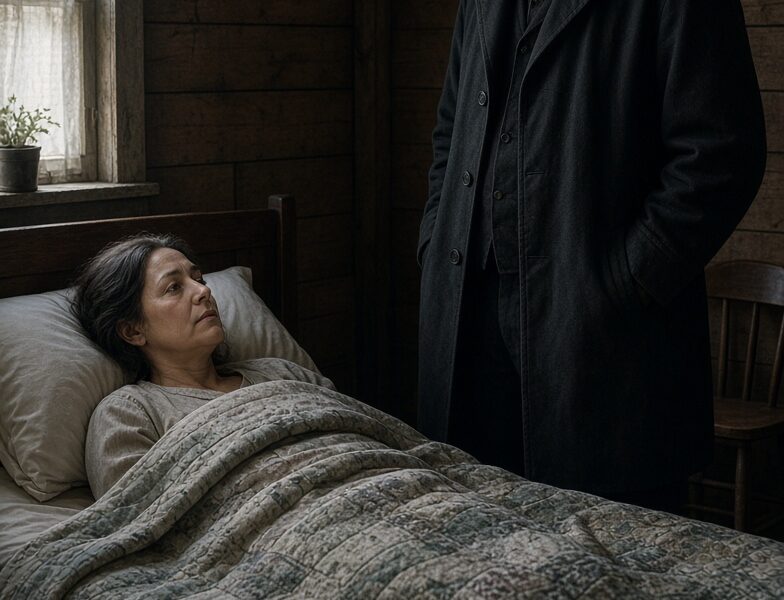
I Stayed in Bed One Morning Without Permission, My Amish Husband Made Sure It Never Happened Again
The morning I stayed in bed, I wasn’t sick. I wasn’t injured.
I wasn’t in labor with another woman’s child, the way I sometimes am—called out before the rooster even considers his duty, walking through cold mud to some farmhouse where a woman is squeezing her husband’s hand and trying not to scream. That would have been a reason. That would have been allowed.
No. That morning I stayed in bed because I was tired. Bone tired. The kind of tired that lives behind your eyes and in your hip joints and makes you feel, just for a moment, like your body belongs to someone who has been running it too hard for too long.
I stayed in bed because for one brief, quiet moment before full waking, I forgot what I was supposed to be doing and who I was supposed to be doing it for. And then I remembered and I stayed anyway. Four minutes, maybe five.
You would think I had set fire to the barn.
My name is Rachel. I have been married to Eli for nineteen years. We have six children, four living at home, two grown and in households of their own now, and a farm that demands more from the body than I think God originally intended when he put the idea of farming into someone’s head.
I am a midwife. I have been since I was nineteen and Miriam Stoltz grabbed my hand during her third delivery and wouldn’t let go of it. And afterward, her mother said I had a gift and I should train with the district’s midwife, who was then an elderly woman named Edna with hands like paddles and a patience I have spent my entire adult life trying to imitate.
I tell you all of this so you understand what kind of woman I am. I am not a woman who stays in bed. I have never in my adult life been a woman who stays in bed past the first light. And even before I was married, I was up early because the dairy doesn’t care what your feelings are on the matter.
I rise. I build the fire or I stoke it. I start the oats. I wake whoever needs waking. I move. That is what I do.
So when I say that I stayed in bed that morning, I need you to understand that it wasn’t a habit or a character flaw or a sign of something deeper gone wrong in me. It was one morning. One morning in nineteen years.
It had been a hard week. I won’t make more of it than it was, but I will say it plainly—hard. I had attended two births, one straightforward, one not. And the one that wasn’t had kept me at the Byler farm for eleven hours. Most of that time standing, some of that time praying in a way that is less like talking to God and more like grabbing him by the collar.
The baby came. Mother and baby both fine. I walked home in the early morning dark because Eli hadn’t known when to come fetch me, which was fair because I hadn’t known either.
The Byler delivery had been the kind that visits you afterward. The baby had been turned and I had spent the better part of three hours working with the mother through positions, coaxing the child around, doing the quiet focused work that midwifery sometimes is and that I cannot explain to anyone who hasn’t done it.
There is a space you go into during a difficult birth. Not quite prayer, not quite pure function—something between them. You are very present and you are very calm, and underneath the calm is a kind of wire pulled tight.
When it’s done, when the baby is breathing and the mother is weeping with relief and the husband is in the doorway with his hat in his hands looking like the world has just been remade—which it has—when all of that is done, you gather your things and you walk home, and the wire slowly uncoils, and that takes time. That kind of tired doesn’t leave in a night.
That was Thursday.
By Saturday, I had also helped Mama Troyer. She isn’t my mother—everyone calls her Mama Troyer. I had helped her put up forty-seven quarts of tomatoes because her daughter-in-law had a sprained wrist and couldn’t do the lifting.
Forty-seven quarts is not a small thing. My back knew it by evening. My hands knew it by the time I blew out the lamp. I’ve done enough canning in my life that it’s mostly muscle, but muscle has a limit, and I had found mine somewhere around the fortieth jar.
Mama Troyer fed me supper for the help, which was kind, and talked the entire time, which was also meant to be kind, and which I received as such, even though by that point in the week I would have given something real for an hour of quiet.
Sunday was church. I am not someone who finds church a rest. I know some women do, and I understand it—the sitting and the being somewhere that doesn’t require you to do anything. But for me, church means the children are in my keeping in a public setting, which requires its own kind of attention.
Jonas had a cold and I spent most of the service keeping him from embarrassing himself or us. We got through it.
Monday was washing day because washing day doesn’t move for church or anything else. It never has in the history of washing days and it won’t start now. I had help from Leah, who was a good worker when she applies herself, and she applied herself that day, which I noted and was grateful for. We were done by afternoon, which is a good Monday.
Tuesday I made the week’s bread and mended a fence with the two oldest boys still at home because a post had rotted through and the pigs had opinions about the matter that nobody had asked for. The bread I could do in my sleep. The fence was two hours in the cold with a post hole digger and mud that had not made up its mind about freezing.
Wednesday morning I lay in bed for four minutes and listened to the birds outside the window.
Eli was already up. I knew this because the sounds of the house had already shifted. The particular quiet that comes after someone has moved through it. He had been in the kitchen. I could smell the suggestion of the fire being stoked. Could hear the oldest girl Leah beginning her own movements somewhere near the cook stove.
I lay there and I looked at the ceiling and I thought about nothing. That was the whole of it. I thought about nothing. I listened to the birds.
And then I heard his step on the stair.
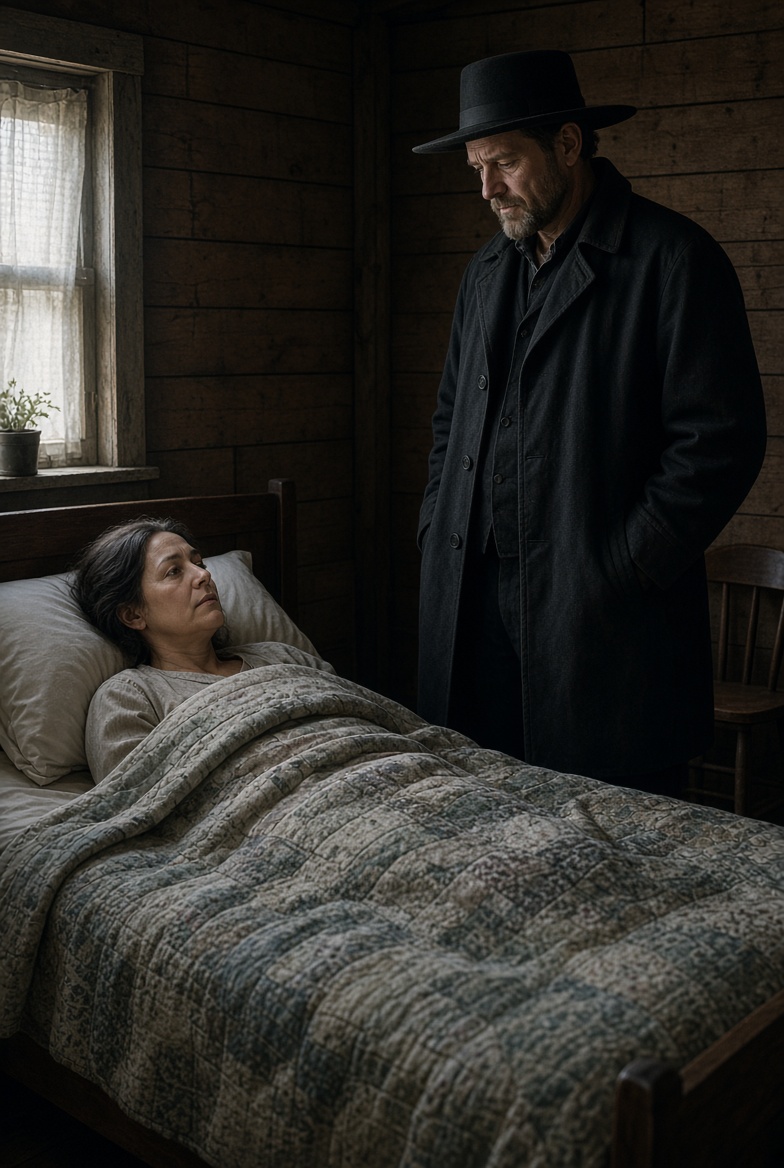
Eli’s step is something I could identify in a room full of men walking. Heavy on the heel, a particular rhythm, not slow, not fast. Purposeful in a way that means he has already decided something before he gets to where he’s going.
I have heard that step for nineteen years and I know all the versions of it. There is the step that means he’s coming to bed. The step that means something’s wrong with an animal. The step that means he wants to tell me something he’s already rehearsed. That morning, it was the step that means he has already decided something.
He came through the door. He didn’t knock. It’s his room. He doesn’t knock. And he stood at the foot of the bed, and he looked at me.
I was on my back with the quilt still pulled up, just looking at the ceiling, awake, not ill, just still.
“Rachel,” he said.
That was all. Just my name. But with Eli, just your name can hold a whole sermon.
“I’m coming,” I said.
“You’re not,” he said. “You’re lying there.”
I sat up then. I wasn’t going to have the conversation lying down. There’s a dignity to these things, even when you know you’re on the wrong side of them. I sat up and pushed my hair back and looked at him.
He’s a tall man, Eli, not heavy, but solid in the way that farm work makes men solid. All of it useful, none of it decoration. He had his barn coat on already, which meant he’d already done a portion of the morning chores, which meant I had let him do them alone.
I felt the first lick of guilt then. Not for staying in bed—I still don’t think four minutes warranted what followed—but for the chores. That was real.
“I was resting,” I said. “I’ll start the morning. Leah has the fire.”
“Leah is a child,” he said.
“Leah is sixteen,” I said. “She knows the fire.”
He didn’t raise his voice. Eli almost never raises his voice. This is the thing people who don’t know him well would misunderstand. They would think a quiet man is a gentleman. And in many ways, Eli is gentle. He is gentle with the animals. He was gentle when we lost the baby between Ruth and Jonas. Sat with me in the dark and didn’t try to explain it away the way some men do.
He is capable of gentleness. But quiet is not the same as gentle. And that morning, he was very quiet.
He told me that a wife rises with her husband. He told me that the morning belongs to the family and that I had left the family to manage without me. He told me that Leah should not have to carry what was mine to carry.
He said all of this in the same even voice he uses to explain to the boys why something needs doing a certain way. Not unkind, exactly, but without any particular concern for whether it landed softly.
I want to be precise about this because I think imprecision would be unfair. He didn’t say, “You’re selfish.” He didn’t say, “You’re lazy.” He said what he observed, which was that I was in bed while the household had needs and that this was not acceptable in the way he runs things.
There’s a narrowness to Eli’s expectations that can feel, depending on your disposition and the hour, either like a reliable wall or like a too-tight coat. That morning, it felt like the coat.
But I can recognize, at the remove of years, that the wall is also real, and that a wall you can count on is worth something, even when you resent its position.
I sat on the edge of the bed, and I listened, and I did not argue. This is a thing I’ve learned in nineteen years. There are arguments worth having, and arguments that are done before they begin, and you have to know which is which.
What he was saying wasn’t wrong, even if the weight he was giving it felt larger than the thing deserved. I had stayed in bed. The family had managed. No harm had come to anyone. But I had stayed in bed, and that was the fact we were dealing with.
There was also a part of me, the part that had been awake since before Eli, listening to the birds and thinking about nothing, that knew he wasn’t entirely wrong about the Leah piece.
Leah is capable, more capable than she knows, and more than I sometimes let her show. But she is sixteen, and the household shouldn’t hinge on her capability before I’m even downstairs. That was a real thing. I could be honest about that.
“I hear you,” I said, when he’d finished.
“Good,” he said, and then he went back downstairs.
I thought that was the end of it.
I dressed and came down and took over the cookstove from Leah, who handed me the spoon with the particular expression of a sixteen-year-old who’s trying not to have an opinion about what’s happening. I finished the oats. I set the table.
Eli came in from the barn with mud on his boots, and the younger boys behind him, and we sat down to breakfast and said grace and ate, and nobody said anything about the morning.
I thought that was the end of it.
It wasn’t.
What Eli did was quiet and methodical, and I say this with full knowledge of how it sounds. It was effective. He didn’t punish me in any dramatic fashion. He didn’t take anything away or add anything sharp to my days. What he did was more subtle than that and more Eli.
He started waking me.
Before that Wednesday, Eli rose when he rose and I rose when I rose. And these things had always happened within fifteen minutes of each other. Close enough that the household ran.
After that Wednesday, Eli began waking me when he woke. He would simply say my name—Rachel—and then he would get up and the expectation was established without discussion. It was not said. It was simply true.
The first morning this happened, I thought it was coincidence. The second morning, I understood it was not. By the fourth morning, I knew that this was the thing he had decided, that quiet step on the stair notwithstanding, before he ever came through the bedroom door that Wednesday.
He had decided that I needed a structure I apparently couldn’t maintain on my own.
There is something I should tell you about how I experienced this. Which is that at first, I experienced it as surveillance. That is the most honest word I have for it. The sense of being watched over in a way that assumed I couldn’t be trusted to perform a function I had been performing without incident for the better part of two decades.
I’m a grown woman. I have delivered more than a hundred babies. I have managed illness in this house—not just the children, but Eli himself during a winter three years ago when he had something wrong with his chest that the doctor couldn’t fully name and that frightened me more than I let on.
I managed that. I have managed things this man doesn’t know I’ve managed because managing is what I do and I do it quietly.
So to be woken like a child who might oversleep school—yes, it chafed. I won’t dress it up.
But now here’s where I have to be honest with you, because I am a woman who values honesty above most things and I think these stories do nobody any good if they’re only told one way. Part of me was angry. Of course part of me was angry.
But I also knew. I knew without wanting to know it that the tiredness I’d been carrying that week hadn’t come from nowhere. It had come from a pattern. A way I have of taking on the thing in front of me and then the next thing and then the next, never stopping to say, “I need to stop.”
Never making that declaration because making it feels like weakness or like asking for something I’m not owed or like leaving a gap that will be filled by someone who has less capacity for it than I do.
Eli knows this about me. He has known it longer, I think, than I’ve known it myself. He has watched me work past what I should for long enough that he can see before I can when the line has been crossed.
I don’t know when he started tracking it. It wasn’t a conversation we had. But somewhere in the middle of our marriage, somewhere between the third child and the fourth, maybe, or during that hard year when both the harvest and my mother’s health failed at the same time—somewhere in there, he began watching.
And his solution was not soft, and it was not offered with an explanation or wrapped in anything gentle. But it was, in its way, attending to the real thing. He didn’t say, “You’re exhausted, rest.” He said, “We rise together.”
And in that together, there is a kind of tether. Because when he wakes me, and I wake, I am not alone in it. The morning is shared. The weight of the household is not something I pick up by myself in the dark. It’s something we walk into at the same moment, side by side, which is what we promised to do, and which, if I’m honest, I had been quietly doing alone for longer than that one Wednesday.
I don’t know if he understood it that way. He’s not a man who explains his reasoning in those terms. But I’ve had nineteen years to translate.
The morning waking has continued, by the way. It is still how things are. I won’t tell you I woke to it every day with gratitude. Some mornings I would have given a good deal to have four more minutes with the ceiling and the birds.
But I wake, and he’s there. And we move through the early dark together, and the house comes alive around both of us at the same time. There is something in that I didn’t know I needed.
I delivered a baby last spring—a young woman, first child, frightened in the way that first-time mothers often are, which is completely reasonable given what they’re undertaking. Her husband was in the other room, and she asked me, in the way women sometimes ask when they’re between contractions and thinking clearly again, whether marriage gets easier.
I thought about it. I didn’t give her the answer people often give, which is, yes, it does, you’ll find your rhythm. I don’t think that’s entirely true, and I don’t think it’s helpful.
What I said was that marriage doesn’t get easier so much as you get better at reading the language of it. That every marriage has its own language—the things that are said directly and the things that are only ever said sideways and the things that are never said at all but are communicated through actions so small that an outsider would see nothing.
And learning that language, really learning it, takes the whole of your life. You’re still learning it when you’re old. You go to your grave still finding new words.
She looked at me like this was not the comfort she’d been hoping for. And then another contraction came, and she stopped wondering about marriage entirely, which is probably just as well. But I meant it. I believe it.
The title of this story, as I’ve thought of it—in the way you think of your own experiences, looking back and trying to name them—is something like the morning I stayed in bed and what came from it. And what came from it was not what I expected.
I expected a correction and silence, the return to normal. What I got was a shift. A small, permanent, unannounced shift in how we move through our mornings.
Eli never apologized for how he spoke to me that morning. He didn’t need to, I think, because he didn’t say anything untrue. He said I had left the family to manage without me. And that was fair, and I knew it was fair.
But I also never apologized for those four minutes with the ceiling. Because I think I needed them. And I think he knew I needed them. And I think the way he handled what came after was, in his way, an acknowledgment of that. A structure built around the exhaustion instead of a demand that the exhaustion not exist.
This is not a story I have told many people. You don’t tell stories like this in our community. It’s too private, too small. The kind of thing that happens in a bedroom on a Wednesday and shapes a marriage and never goes further than the two people it happened to.
But I find, in this strange way I have of talking, that I want to tell it. I want to say, “This is how it was. This is how it is.”
A man with a particular step on the stair and a particular way of deciding things before he gets to where he’s going. A woman who knows the difference between the arguments worth having and the arguments that are done before they begin.
Nineteen years, six children, forty-seven quarts of tomatoes and an eleven-hour labor and a rotted fence post and the birds outside the window on a cold morning. This is what a marriage looks like from the inside. Not all of it. Just one Wednesday and the mornings after.
We had supper last week, just the two of us, which happens rarely enough that it feels like something. The younger ones at her sister’s for the night, and Leah away helping with a new cousin, and Eli and I sat at the table with the lamp between us and ate without much talking.
This is comfortable between us now. The silence is full rather than empty. I learned that distinction early in marriage—that silence can go either way, depending on what’s living in it.
At some point, he said, without looking up from his plate, “You looked tired this week.”
“I’m fine,” I said, because I am always fine. This is a reflex.
He looked up then. “I know you’re fine,” he said. “I said you looked tired.”
There’s a difference, his eyes said, and I knew there was, and I knew he was watching for it, the way he watches for it now, the way he has watched since that Wednesday. Not managing me—just watching. Keeping account of something I am constitutionally unable to keep account of myself.
“The lab delivery was hard,” I said.
He nodded. “Sleep tomorrow,” he said.
Not sleep in. He knows better than to say sleep in. I wouldn’t. And he knows I wouldn’t. And the fiction of it would have felt like something less than the truth. Just sleep tomorrow, meaning we will go to bed earlier. Meaning, I see that you are running low, and I am adjusting accordingly.
“All right,” I said.
And we did. And I felt, going to sleep that night, as cared for as I know how to let myself feel. Which is still not as much as he probably intends, but more than I used to. More than I would have known to receive before nineteen years of being married to this man with his quiet voice and his decided step and his particular way of saying my name when he needs me to hear something he doesn’t want to have to say twice.
The morning after I stayed in bed, I got up with the dark before he came to the door, before the birds had properly started. I had the fire going and the water on before anyone else was down.
And when Eli came into the kitchen, he looked at me for a moment and said nothing. He didn’t need to. I knew what he was saying. And he knew I knew.
And that, as much as anything, is what nineteen years sounds like.
—
The thing about a marriage that has been running for nearly two decades is that it develops its own weather system. Some seasons are fair and some are not, and you learn to read the sky of it the way a farmer reads a coming storm—not with alarm, but with a kind of practical attention.
That Wednesday was a squall. Small, contained, over almost before it began. But it left a mark on the ground, and the ground held it.
I want to tell you about the weeks that followed, because that’s where the real story lives. Not in the four minutes I lay there listening to the birds, and not even in Eli’s quiet sermon at the foot of the bed, but in the slow, unspoken rearrangement of our days that came after.
It started, as I said, with him waking me. But that was only the first thread.
By the second week, I noticed other things. Small things. The coffee already made when I came down, which had never happened before in nineteen years—not because Eli wouldn’t have done it, but because it had never occurred to either of us that he might.
The kindling already split and stacked by the stove. The water bucket already full. The milk already strained and set in the cooler.
He didn’t announce any of it. He didn’t say, “Look what I’ve done.” He simply did these things in the early dark while I was still finding my way down the stairs, and by the time I arrived in the kitchen, the morning was already half-built.
I didn’t know what to do with it at first. I’m not a woman who knows how to receive. I’m a woman who knows how to do. Giving is easy for me. Receiving feels like standing still while someone else runs, and standing still has never been something I’ve been good at.
So I did what I always do when I don’t know what to do. I worked harder. I got up earlier. I tried to beat him to the kitchen, to have the fire going before he got there, to reclaim my territory.
He never said anything about it. He just kept waking me—”Rachel,” in the dark, that single word—and then getting up, and then going downstairs, and then having the coffee made before I got there no matter how fast I moved.
It took me a while to understand that this wasn’t a competition. He wasn’t trying to prove anything. He was simply doing what he does, which is to decide something and then act on it with the same steady purpose he brings to everything else.
The thing he had decided, I came to understand, was that the morning would no longer be mine alone to carry. It would be ours. Shared. A thing we built together, even if neither of us had the words to say so.
—
There was a Sunday in late October, maybe six weeks after that Wednesday, when the thing shifted again.
We had come home from church and the children had scattered—the boys to the barn, the younger ones to the yard to run off the energy that the sitting and the being good had stored up in them. Leah was helping me with dinner, and Eli was in the front room with the newspaper, which he reads slowly, the way he does everything, as if the words might not stay put if he rushes them.
I was at the stove, and I was tired. Not the bone tired of that week in September—a different tired, the ordinary tired of a Sunday afternoon after a full morning of keeping children in their church clothes and making sure no one spilled anything on their good coats.
I said something to Leah about needing to sit down for a minute, and she said, “I’ve got the potatoes, Mama,” and I went and sat in the rocking chair by the window and closed my eyes.
I didn’t mean to fall asleep. I never mean to fall asleep in the middle of the day—it feels like a thing a woman with my responsibilities shouldn’t do. But the chair was warm and the sun was coming through the window and I closed my eyes just for a moment, and then I was gone.
When I woke, the light had shifted and my back was stiff and the house was quiet. Leah was still in the kitchen, the potatoes done and something else on the stove, and Eli was standing in the doorway between the front room and the hall, looking at me.
I sat up quickly, embarrassed, the way you are when you’ve been caught doing something you weren’t supposed to be doing.
“I fell asleep,” I said.
“I know,” he said.
“I didn’t mean to.”
“I know that too,” he said, and there was something in his voice—not amusement, not quite, but the nearest thing to it that Eli allows himself. “Dinner’s ready. Leah finished it.”
I got up and went to the kitchen and we all sat down and ate, and nobody said anything about me falling asleep in the chair, and afterward Eli said, “You’re going to bed early tonight,” and I said, “Eli,” and he said, “Rachel,” and that was the end of it.
I went to bed early. I slept ten hours. When I woke the next morning, Eli was already up and the coffee was already made and he said, “Better?” and I said, “Better,” and that was that.
But it wasn’t. That’s the thing about these small moments in a marriage—they accumulate. They build on each other. Each one is a stone, and after a while you look up and realize you’ve been walking on a road you didn’t know you were building.
—
The lab delivery that I mentioned—the one I told Eli was hard—that was a story in itself. I want to tell you about it because it matters to what came after.
It was a young couple, not from our community, but from the next county over. The husband was a software engineer, of all things, and they had moved out to the country because they wanted a quieter life, and the wife had decided she wanted a home birth, and someone had given her my name.
I don’t usually attend births outside our community—my calling is here, among my own people—but something about her voice on the phone made me say yes. She sounded frightened and determined at the same time, which is a combination I understand.
Her labor was long and hard. Twenty-two hours. I was there for most of it. The husband was beside himself—not in the way of a man who is angry, but in the way of a man who has never seen suffering up close and doesn’t know what to do with his hands.
He kept asking if they should go to the ER. He kept asking if something was wrong. He kept asking if she was okay.
And I kept telling him the truth, which was that everything was fine, that labor is hard, that this was normal, that she was doing beautifully. But he couldn’t hear it. He couldn’t stop asking. He couldn’t trust the process, couldn’t trust the body, couldn’t trust the thing that was happening in front of him.
The baby came, eventually. A girl, eight pounds three ounces, with a full head of dark hair and a cry that could wake the dead. And after it was over, after the husband was holding the baby and the wife was weeping with relief and I was cleaning up my things, she said, “Thank you for not making me go to the hospital. Thank you for trusting me.”
And I said, “It wasn’t me trusting you. It was you trusting yourself.”
But I thought about her for weeks afterward. I thought about the way her husband had stood by the bed, useless and frightened, and I thought about Eli, who would never in a million years have stood by my bed that way during a birth, not because he didn’t care, but because he knew better than to interfere.
Eli has attended births with me. Not as a midwife—he knows his place—but as a presence, when the situation called for it. He has held lamps and fetched water and driven to the nearest phone to call for the doctor when something went wrong.
He has never once asked me if I knew what I was doing. He has never once suggested we abandon ship. He has trusted me absolutely, in the thing I am most skilled at, and I have never had to ask him to.
That’s a kind of love, I think. Not the loud kind, not the kind that gets written about in books or sung about in hymns. The quiet kind. The kind that stands in the doorway with a lamp and doesn’t say anything because there’s nothing to say.
When I came home from that twenty-two-hour labor, Eli met me at the door. He didn’t ask how it went. He didn’t ask if I was tired. He took my bag from my hand and said, “The children are fed. Go to bed.”
And I went. And I slept for twelve hours. And when I woke, the laundry was done and the bread was made and the boys had been sent to school and the girls had been set to their tasks and Eli was in the barn, doing whatever it is he does out there.
He had never done the laundry in his life. I don’t think he even knew where the washboard was. But that week, he had done it. And he hadn’t said a word about it.
That’s what I mean about the language of a marriage. I would never have known that Eli knew how to do laundry. I would never have known he was capable of it, or willing, or that he would think to do it. He didn’t tell me. He just did it. And the doing was the telling.
—
So what did I learn from that Wednesday morning and the mornings after?
I learned that a man who wakes you with a single word is not the same as a man who doesn’t care whether you wake at all. I learned that structure can be a form of love, even when it feels like a form of control. I learned that the thing I resist the most is often the thing I need the most.
I learned that Eli has been watching me for longer than I knew, and that the watching was never about judging. It was about seeing. It was about noticing when the woman he married was running low on the thing that keeps her running. It was about paying attention to the thing I refuse to pay attention to in myself.
I learned that a marriage is not a single thing. It’s a thousand small things. It’s the coffee made before you get downstairs and the kindling split and the water drawn. It’s the word Rachel in the dark. It’s a quiet man in a barn coat standing at the foot of the bed and saying something you don’t want to hear but need to.
It’s a woman who knows the difference between the arguments worth having and the arguments that are done before they begin. It’s forty-seven quarts of tomatoes and a rotted fence post and an eleven-hour labor and a twenty-two-hour labor and the birds outside the window on a cold September morning.
It’s everything. It’s nothing. It’s the whole of a life, which is to say it’s the small parts of a life, the parts that nobody sees, the parts that happen behind bedroom doors and in kitchens before dawn and in the quiet spaces between one word and the next.
—
There’s one more thing I want to tell you, and then I’ll let you go.
Last winter, I got sick. Really sick, the kind of sick that puts you in bed for a week and makes you wonder if you’ll ever get up again. It was the flu, the doctor said, but it was more than that—it was the kind of illness that comes when you’ve been running too hard for too long and your body finally decides to make you stop.
I was in bed for eight days. Eight days in the middle of winter, with the farm still needing to be run and the children still needing to be fed and the animals still needing to be cared for. Eight days of doing nothing, which is the hardest thing a woman like me can do.
Eli took over everything. Everything. He cooked and cleaned and did the laundry and fed the animals and got the children to school and to church and to wherever else they needed to go. He brought me soup and tea and sat by the bed and read to me from the Bible, which is the only book he really knows.
He didn’t ask me if I was okay. He didn’t ask me if I needed anything. He just did what needed doing, day after day, without a word of complaint, without a sigh, without a single sign that any of it was a burden.
On the fifth day, I said to him, “You must be exhausted.”
And he looked at me for a moment and said, “I’m fine.”
And then he said, “I know you’re fine too. But you’re not, and that’s okay. That’s what this is for.”
I didn’t know what he meant. “What what is for?”
“The marriage,” he said. “This. All of it. I carry you when you can’t carry yourself. You carry me when I can’t carry myself. That’s what we promised. That’s what this is.”
I started to cry then. I don’t know why—I’m not a woman who cries easily—but I did. And he sat on the edge of the bed and held my hand and didn’t say anything else, because there wasn’t anything else to say.
That’s what nineteen years sounds like. That’s what the morning I stayed in bed was really about.
It wasn’t about four minutes. It was about the nineteen years that came before those four minutes and the nineteen years that would come after. It was about a man who saw something in me that I couldn’t see in myself, and who decided to do something about it, not with words, but with the steady, unrelenting structure of a shared morning.
It was about a woman who had to learn how to be carried, which is harder than learning how to carry. It was about a marriage that had been built on a thousand small things and would continue to be built on a thousand more.
And it was about the birds outside the window on a cold September morning, singing their ordinary songs, which is what birds do, whether you’re listening or not, whether you’re in bed or up, whether you’re sick or tired or running too hard for too long.
They sing. And you listen. And eventually, you get up.
—
I delivered another baby last week. A boy, nine pounds two ounces, to a woman who had done this five times before and still found the courage to do it again. She was calm and steady and she didn’t need me to tell her anything she didn’t already know.
But afterward, when the baby was sleeping and the husband was sleeping and the house was quiet, she said to me, “How do you do it? How do you keep doing this, year after year, when you know how hard it is?”
And I thought about it. I thought about the four minutes in bed. I thought about Eli’s step on the stair. I thought about the coffee made before I got downstairs and the kindling split and the word Rachel in the dark. I thought about forty-seven quarts of tomatoes and a rotted fence post and a twenty-two-hour labor and eight days in bed with the flu.
And I said, “I don’t do it alone. That’s the secret. Nobody does it alone. Not really.”
She looked at me like she didn’t understand. She was young, and she was tired, and she was holding her sixth child in her arms, and she didn’t understand yet what it would take to do this for another twenty years.
But she would. She would learn. She would learn the language of her own marriage, which was different from mine and Eli’s, but which would be just as particular and just as private and just as necessary.
She would learn that a marriage is not a single thing but a thousand small things. She would learn that the hardest part is not the carrying but the being carried. She would learn that you go to your grave still finding new words.
And she would learn, as I did, that sometimes the most important thing a husband can do is wake you with a single word in the dark and expect you to rise.
Not because he’s punishing you. Not because he’s controlling you. But because he sees what you can’t see, and he knows what you need before you know it yourself.
And because he knows—as Eli knew, as I knew, as the woman with the new baby would come to know—that the morning is not something you face alone. The morning is something you face together.
That’s what I learned the morning I stayed in bed. That’s what I’ve been trying to tell you all along.
Not that a woman shouldn’t rest. Not that a man should set a structure. Not that there’s one right way to be married or one right way to wake or one right way to live.
But that we’re not meant to do this alone. None of us. Not the midwife, not the farmer, not the woman with forty-seven quarts of tomatoes and not the woman with six children and a farm and a man who wakes her every morning with a single word.
We’re meant to do it together. That’s what the morning is for. That’s what the birds are singing about.
And that—the together, the shared morning, the steady hand in the dark—is what makes it possible to get up at all.
I stayed in bed one morning without permission. My husband made sure it never happened again.
And I am grateful for it. I am grateful for him. I am grateful for the thousand small things that make up a marriage and the nineteen years that have taught me how to receive them.
That’s the story. That’s the whole of it. The morning I stayed in bed and what came from it.
Not a correction. Not a punishment. Not a lesson learned.
A shift. A small, permanent, unannounced shift in how we move through our mornings.
And that, in the end, is enough.









