I Said “Please, Not Tonight” to My Amish Husband, By Morning the Bishop Knew
The Night I Said Five Words
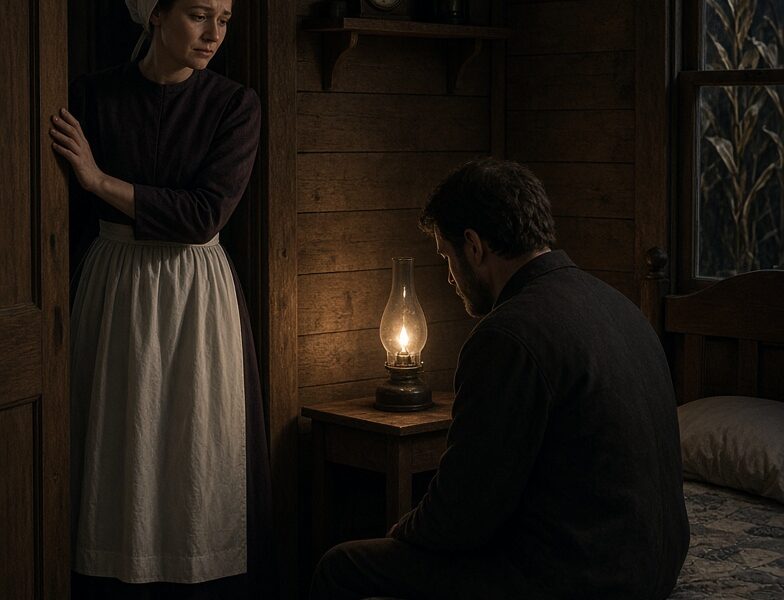
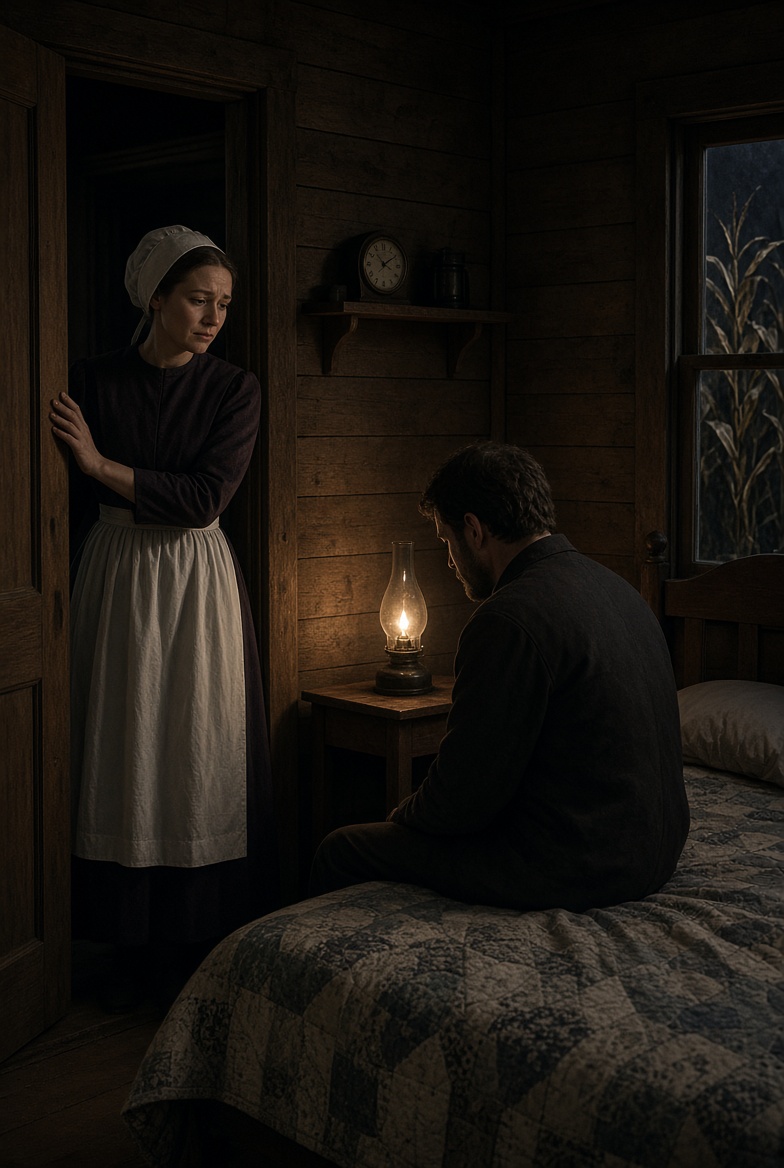
The ticking clock on the shelf sounded louder than it should have that night. It was a little past nine. The stove had gone down to a red glow, and I could hear the wind pressing dry corn leaves against the side of the house. My husband was already in the bedroom when I finished putting away the last dish.
I remember standing in the doorway with my hand still on the frame and saying very quietly, “Please, not tonight.”
I did not shout it. I did not say it to embarrass him. I was tired, sore from a long day, and I needed him to hear me.
What frightened me most was not what happened in that room. It was what happened afterward, because by breakfast the next morning, our bishop already knew I had said no.
My name is Katie. I grew up Old Order Amish, and I share these stories because there are parts of our life that people outside the community rarely see, especially the quiet moments inside a home when faith, marriage, duty, and personal feelings all press against each other at once.
If you have ever had a private moment become everybody else’s concern before you were ready to talk about it, tell me in the comments. I think more people understand that feeling than we admit.
The Day Before
That day had started before five in the morning. It was late October, cold enough that the water in the washbasin made my fingers ache, but not cold enough for snow. I had been helping my mother-in-law put up applesauce the day before, and there were still three bushel baskets of apples under our table because she had sent them home with us.
Before breakfast, I fed the chickens, carried two buckets from the pump, swept the kitchen, and packed food for my husband to take with him. Then I spent most of the afternoon helping a neighbor whose youngest child had been sick.
Nothing dramatic had happened. That is important to say. There was no single disaster that made me exhausted. It was just one of those days when every small task seemed to take something out of me. By supper, my shoulders hurt from carrying water and laundry, and I had a dull ache low in my back.
I remember dropping a spoon while I was setting the table and staring at it on the floor for a second longer than made sense, because bending down to pick it up felt like one more thing.
My husband noticed. “You look tired,” he said.
“I am tired,” I told him.
He nodded, but neither of us said much more. In our house, tiredness was usually treated like weather. You noticed it, you worked through it, and eventually it passed.
We ate bean soup, bread, and apple butter. Afterward, he went to check a loose hinge on the shed door while I washed the bowls. The kitchen was nearly dark by the time I finished. We used one lamp on the table, and the glass chimney had a faint smoky ring around the top because I had trimmed the wick badly that morning. I can still see that lamp when I think about the night.
What I Knew About Marriage
Marriage in the community I grew up in was spoken about mostly in terms of commitment. You learned that husband and wife belonged to each other, that marriage was not built around moods, and that sacrifice mattered. Those ideas were repeated so often that as a girl, I knew them long before I understood what marriage actually felt like from the inside.
Nobody sat me down and gave me a long speech about every private part of marriage. Most things were hinted at. Older women used careful phrases. A mother might say that a wife should be kind to her husband. Someone else might say that marriage required patience. Another woman might tell a bride not to carry every little discomfort into an argument.
The words were gentle, but sometimes gentleness can leave a lot unsaid.
That night, what I wanted was simple. I wanted to sleep.
The Moment in the Doorway
When I stepped into the bedroom, my husband looked at me, and I knew what he was expecting. I stood beside the bed, still wearing my plain dress, and I said, “Please, not tonight.”
For a few seconds, he said nothing. Then he asked, “Are you angry with me?”
“No.”
“Did I do something?”
“No.”
“Then why?”
“Because I am exhausted.”
I thought, “Because my back hurts. Because I have been moving since before sunrise. Because sometimes a person can love somebody and still want to be left alone for one night.”
But what I actually said was, “I just cannot tonight.”
He sat on the edge of the bed and looked at the floor. I could see that he was hurt. And I felt guilty almost immediately. That was the confusing part. I had said what I needed. But instead of feeling relieved, I felt as though I had broken something I could not see.
He did not yell at me. He did not threaten me. He did not touch me after I had asked him not to. I want to be clear about that. The hardest part of that night was not force. It was silence.
He lay down facing the wall. I changed clothes, blew out the lamp, and lay beside him. The room was so cold, I could feel air moving along the floor. We were both awake for a long time.
At one point, I almost apologized. I did not.
The Morning After
The next morning, I woke before he did. I dressed in the dark and went to the kitchen. My first thought was that I would make a good breakfast and the awkwardness would disappear. That was how I handled a lot of things when I was younger. If something felt wrong between people, I looked for a task that could smooth it over.
I mixed pancake batter. I sliced apples into a skillet with cinnamon. I put coffee on. By the time my husband came in, the room smelled warm and sweet.
And for a moment, I thought we had both decided to let the previous night stay private.
He ate quietly. Then he said, “I spoke to my father.”
I stopped pouring coffee. “About what?”
He looked at me and I already knew. “Last night.”
I felt heat rise into my face. “You told your father?”
“I needed advice.”
I set the coffee pot down too hard. A little spilled onto the table. “You needed advice about me saying I was tired?”
He frowned. “It was not only that.”
To me, it was exactly that.
The Weight of Family
His father lived less than half a mile away. He was a quiet man, not cruel, not someone who enjoyed gossip. But he had grown up believing that family problems should be handled within the order of the church. My husband had been taught the same thing. When he felt uncertain, he went upward. First to his father, then sometimes to a minister or bishop.
I had been taught something slightly different. My mother believed a married couple should protect the walls of their home whenever possible. She once told me, “If you open the door for every small quarrel, soon the whole district will be sitting at your kitchen table.”
That was one of the sharpest things she ever said.
By 7:30 that morning, I heard buggy wheels coming up the lane. I looked through the window and saw our bishop step down. My stomach dropped.
I turned toward my husband. “You said you told your father.”
“I did.”
“Then why is he here?”
“My father spoke to him.”
I remember gripping the back of a chair. It was strange how quickly a private sentence spoken in a dark bedroom had traveled. I had said five words—”Please, not tonight.” Before the sun was fully up, those words had gone from my husband to his father, and from his father to the bishop.
The Bishop at the Table
The bishop knocked twice. My husband opened the door. The bishop was in his fifties then, with a beard that had gone gray around the chin and deep lines beside his eyes. He took off his hat when he came inside. He looked at me, then at my husband, and said, “I hear there is some trouble between you.”
I wanted to disappear into the floorboards.
There are people who imagine Amish church leadership as if a bishop is always standing over every household waiting to punish someone. That was not my daily experience. Most of the time the bishop was a man we saw at worship, funerals, weddings, and community matters. He had a farm and a family like everyone else.
But when he stepped into our kitchen that morning, he carried an authority that was hard for me to separate from God, family, marriage, and belonging.
He sat at our table. I poured him coffee because I did not know what else to do. Nobody touched the pancakes.
He asked my husband to explain what had happened. That was the first moment that truly hurt me. I was sitting three feet away, but someone else was telling my story.
My husband said I had been distant. He said I had refused him. He said he did not know whether I was angry or whether something had changed between us. He did not accuse me of anything terrible. In his own way, he sounded worried.
Then the bishop turned to me. “Katie, is that how you remember it?”
I said, “I told him I was tired.”
He waited.
I added, “I worked all day and my back hurt. I did not want to argue. I only wanted to sleep.”
The Question I Had Not Planned
The bishop folded his hands on the table. He asked whether I had been holding resentment against my husband.
“No.”
He asked whether there was someone else influencing me.
“No.”
He asked whether I understood that marriage required generosity from both husband and wife.
“Yes.”
Then I asked him something I had not planned to ask.
“Does generosity mean I am never allowed to say no?”
The room changed after that question. My husband looked at me. The bishop looked down at his hands. Outside, one of the chickens scratched near the porch step. And I remember hearing the dry leaves move under its feet.
The bishop did not answer quickly. Finally, he said, “A marriage should not be built on demands.”
I waited.
He continued, “And it should not be built on withholding affection to punish each other, either.”
“I was not punishing him.”
“I hear you.”
Those three words mattered more to me than I expected.
The Bishop’s Wisdom
He asked my husband whether I had been unwell the day before. My husband admitted I had looked exhausted. The bishop asked whether I often refused affection. My husband said no.
Then the bishop leaned back and sighed. He said, “Then perhaps this should have stayed between the two of you.”
My husband’s face changed, not dramatically, but enough that I could see embarrassment settle in.
The bishop looked at both of us and said, “Not every discomfort needs witnesses.”
That became the line I remembered. Not every discomfort needs witnesses.
It did not solve everything. I wish I could tell you the bishop stood up, gave a perfect speech about privacy and consent, and from that day forward, nobody in our community ever crossed a boundary again. Life is rarely that clean.
He still spoke in the language of duty and reconciliation. He still reminded us that husband and wife should care for each other’s needs. But he also told my husband that bringing family and church leaders into a private marital disappointment could create more damage than the disappointment itself.
Then he turned to me and told me something else. “If you are hurting, say so plainly. Do not make him guess.”
At first, that irritated me. I thought I had been plain. I had said, “Please, not tonight.”
But later, I understood part of what he meant. I had spent years training myself to soften every need until it barely sounded like a need at all. I would say “I am a little tired” when I was exhausted. I would say “Maybe tomorrow” when I meant no. I would say “It is fine” when it was not fine.
I thought being gentle meant making myself easy to ignore. That morning taught me otherwise.
After the Bishop Left
After the bishop left, my husband and I sat at the table without speaking. The coffee had gone cold. The pancakes were stiff at the edges.
He finally said, “I did not mean to shame you.”
“But you did.”
He nodded. That was unusual for us then. We were both young enough to think a disagreement had to end with one person being right and the other one being wrong. But this time he did not defend himself immediately.
He said, “I thought something was wrong with us.”
“Something was wrong. I was tired.”
That almost made him smile, but he stopped himself.
I told him I needed to know that if I said no, he would hear no without turning it into a crisis. He told me he needed to know I would tell him when something deeper was wrong instead of becoming quiet for days.
Both things were fair.
Then I asked him to promise me something. “If we have a problem in this room, talk to me before you talk to your father.”
He thought for a moment. Then he said, “I can do that.”
What Changed
I wish I could say we never involved other people in our marriage again. We did. There were times when we genuinely needed counsel. There were conflicts too large for the two of us to understand alone. But after that morning, there was a difference between seeking help and handing over every private moment for other people to judge.
That difference became important to me as I grew older.
People often ask me whether Amish marriage is strict. The answer depends on what you mean by strict. There are strong expectations. There are traditions that shape how husbands and wives see their roles. There is a community around the marriage, and that can be comforting when life is hard. It can also feel crowded when the problem is deeply personal.
Community can carry you when you cannot carry yourself. Community can also stand too close. Both things can be true.
Privacy Is Not Secrecy
For me, the deeper lesson from that morning was not only about saying no. It was about learning that marriage does not erase personhood. Loving someone does not mean every feeling has to match theirs. Faithfulness does not mean pretending you are never tired, never overwhelmed, never in need of space.
And privacy is not the same as secrecy. That distinction took me years to understand. Secrecy hides things that need light. Privacy protects things that need care.
A husband and wife should not hide cruelty, danger, or serious harm behind the word private. There are times when outside help is necessary, and sometimes urgently necessary. But not every disagreement becomes healthier because more people are invited into it. Sometimes the bravest thing two people can do is stay at the table and speak honestly to each other.
Looking Back
I think back to the girl I was that morning, standing with a coffee pot in her hand while the bishop sat in her kitchen. I remember how ashamed I felt that anyone knew. I remember thinking I had done something wrong simply because my boundary had become public.
Today, I would speak more plainly. I would say, “I love you, and I am still allowed to be tired.” I would say, “If you are worried, ask me.” I would say, “Do not turn my no into a story about whether I love you.”
And I would also ask, “What did that no make you afraid of?”
That last question matters, too. Because my husband was not only disappointed that night—he was afraid. He thought distance had entered our marriage, and he did not know how to name it. He reached for the only structure he trusted, which was his father and the church.
Understanding that did not make the embarrassment disappear, but it helped me see that we were both trying, clumsily, to protect the same marriage from different directions.
What I Understand Now
A strong marriage is not one where nobody ever says no. It is one where no does not become a threat. It is one where concern can become a question before it becomes an accusation. It is one where both people can speak without needing a room full of witnesses to decide what they meant.
Before I go, I also want to tell you that my new book, The Ninth Day, is out now. It is the first book in The Katie Journals, and if you would like to read it, you will find the link in the description. I wrote it for readers who want to stay with these kinds of questions longer than one article allows.
If you want more stories from the parts of Amish life that are usually kept quiet, subscribe and come back for the next one.
And I would really like to know this: When a married couple has a private disagreement, where do you think the line should be between asking for advice and protecting the privacy of the marriage?









