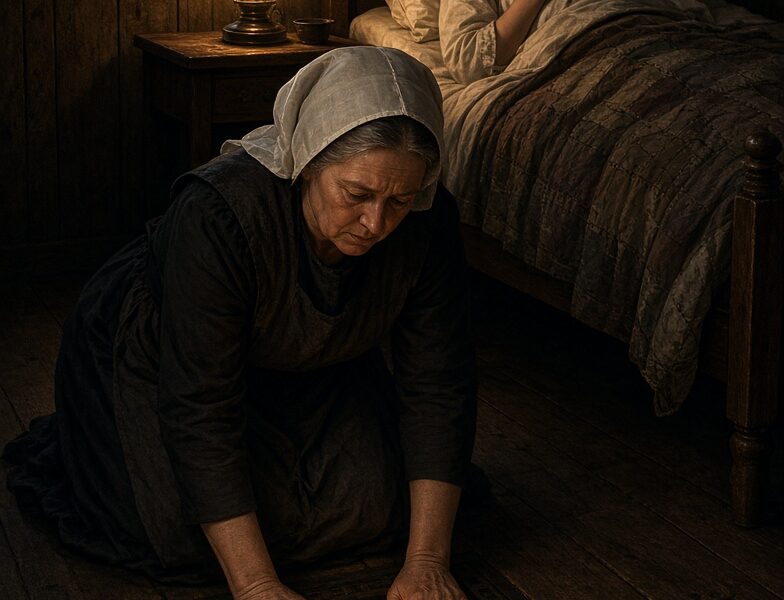
I Knelt on the Iron Grate and Heard the Six Things No Woman Was Ever Meant to Hear
The blue cloth was already soaked through.
I could feel it in my palm, heavy, warm, the way a cloth gets when it has taken everything it can hold.
And I pressed harder anyway, because pressing was the only thing I knew to do.
The room smelled of iron and tallow, and the particular animal smell of a body working past its own limit.
The lantern on the shelf threw orange light across the quilt, across the woman’s face, which had gone the gray-white color that I had learned, over twenty-two years of sitting at these bedsides, to be afraid of.
Her husband was standing in the doorway with his hat still on his head.
He had run in from the barn and had not thought to remove it.
He said, “Is she going to be all right?”
I did not answer him.
I could not answer him honestly, and in that community, you did not say the dishonest thing to a man standing in his own doorway.
So I said nothing.
She was bleeding.
Not the ordinary bleeding that follows a birth, the kind that does not slow, the kind that turns the mattress dark, then the floor beneath it, then the whole room seems to thicken with what is leaving her body.
I had seen it before.
I had seen it six times in twenty-two years.
I had lost two women to it.
I was not going to lose this one.
That night, I made a choice I had been trained my whole life not to make.
And I have not stopped asking myself, every year since I walked out of that settlement, whether the two women I could not save might have lived if someone had told them the truth before it was too late.
This is the answer I found.
I warn you.
I nearly did not survive long enough to find it.
My name is Rachel.
I served as a midwife for more than two decades inside an Old Order Amish settlement in Holmes County, Ohio.
I caught somewhere near three hundred and forty babies in those years.
I attended more deaths than I can count without sitting down first.
This channel, Rachel the Amish Midwife, exists because the stories from those bedsides were never supposed to leave that community.
And I am no longer inside that community.
And I am done keeping their silence.
If you are new here, please subscribe and tap the bell so you do not miss a single story.
Like this video if it is reaching you.
And tell me in the comments where you are watching from tonight.
I read every single one.
Now, let me tell you about the blue cloth and the woman named Hannah.
And the night I learned that the answer the community gave us was not a remedy at all.
It was a way of waiting for us to die quietly.
In that world, a woman is taught from the time she is old enough to understand that the body’s suffering is not separate from the spirit’s instruction.
Illness is not random.
Pain is not meaningless.
There is a reason God permits a thing to happen.
And the job of the woman who is suffering is to receive that reason with humility and wait for it to be revealed.
I do not say this to make the community sound cruel.
It was not always cruel.
In my childhood, that belief felt like a cushion under everything.
The sense that nothing, not even the worst thing, was happening outside God’s attention.
That cushion kept a lot of women standing when they had every reason to fall.
But a belief can be true and weaponized at the same time.
And I watched that same belief in the hands of men who held the authority in our settlement become the reason a woman did not send for help when her body was failing.
The bishop said, and I am quoting him now as plainly as I can, “The midwife’s job is to assist the body in what God has already set in motion, not to interfere.”
I heard that phrase forty times in my first year of training.
I heard it from Miriam Yoder, the older midwife who took me under her teaching, a woman who had caught babies for thirty-one years and had arms like corded rope from the work of it.
I heard it from the deacon’s wife.
I heard it from young mothers who had swallowed it so completely, they offered it back to me like comfort.
What I understand now, and did not understand then, is that phrase did its most dangerous work in the minutes after a baby came out.
Because that is when a woman can bleed to death in twenty minutes if no one stops it.
The official remedy, the one passed from midwife to midwife, from elder to mother, from mother to daughter, was this.
Lie still.
Pray.
Take the herbal tincture.
Keep the baby at the breast to encourage the uterus to contract.
And send for the midwife if the bleeding has not slowed in one hour.
One hour.
I have pressed enough cloth against enough women to know what one hour means when the bleeding will not stop.
I have stood in enough blood to understand, in my body and not just my mind, that an hour is not a remedy.
It is a sentence.
It was February of 1998 when Hannah came into my care for the fourth time.
She was twenty-seven years old, expecting her fourth child, and she had one of those faces that made you feel the room had shifted somehow when she walked in.
Not because she was beautiful in any way that called attention to itself, but because she was entirely present wherever she stood.
Her husband, Eli, was a quiet man who built furniture and spoke in a voice so low you had to lean in to hear him.
And they were the kind of couple that made you believe two people could be genuinely kind to one another for a whole life.
I had caught all three of Hannah’s previous babies without incident.
She was strong, wide-hipped, what the older midwives used to call a good pusher without a shred of embarrassment.
The fourth baby came fast.
Three hours from the first contraction to the boy arriving in my hands.
Eight pounds and two ounces with lungs that could have filled the room.
Hannah laughed before she had even caught her own breath.
Eli, in the doorway, put his face in his hands.
The lamp on the bureau lit all of it yellow and warm.
That was 11:40 in the evening.
By midnight, the cloth was soaked through.
By 12:15, the second cloth had soaked through.
I pressed my hands against Hannah’s abdomen the way Miriam had taught me.
Firm, circular, patient, coaxing the uterus back to its shape.
The uterus was soft, unresponsive.
It had the quality of something that had simply stopped caring, and the cold in the back of my neck was the kind that does not come from temperature.
“Hannah,” I said, “I need you to tell me honestly how you feel.”
“Tired,” she said.
“Just tired.”
“Any dizziness?”
She paused too long.
“A little.”
I looked at Eli in the doorway.
He was watching his wife’s face the way a man watches a fire he is not sure he can contain.
I had no vehicle.
The nearest telephone was at a Mennonite farm three miles up the road.
Getting Hannah to a hospital would require sending Eli on foot to a neighbor, waiting for a call to be made, waiting for someone to come on a February night on unpaved roads.
In this settlement, that sequence took forty-five minutes on a good night.
I pressed harder with the cloth.
I had Hannah put the baby to her breast.
I gave her the tincture, shepherd’s purse and yarrow in water, the same remedy I had been handing women for twenty-two years because it was what I had and what I had been told I needed.
The bleeding slowed at 12:50.
Not stopped.
Slowed.
I stayed until 3:00 in the morning.
I left when I believed, when I made myself believe, that she was stable enough.
Hannah did not die that night, but she was in bed for eleven weeks afterward, too weak to lift her own baby for the first month of his life.
Her sister told me, when I saw her the following spring, that Hannah had never quite recovered the strength she’d had before that birth.
She was tired in a way she hadn’t been before.
Tired in the bones.
Tired that four years of good sleep didn’t touch.
I did not let myself connect those dots for another four years.
If this story is reaching you, take one moment to subscribe and to like this video.
It means more than you know.
Every single one tells me this story matters.
My own fifth baby came in March of 2002.
I was forty-one years old.
I had caught other women’s babies my entire adult life.
I knew every sign.
I had pressed every cloth.
I understood in my hands and my gut and my spine exactly what a hemorrhage looked like from the outside.
I did not know what it looked like from the inside.
My birth was attended by a younger midwife named Dorcas.
A woman I had trained myself.
I watched her from the bed and knew in the way you know things in your body before your mind has words for them that something was wrong at forty minutes postpartum.
The room felt distant.
My hands felt attached to someone else.
The ceiling had a quality I cannot fully describe.
Solid but somehow untrustworthy.
As though it might not hold.
Dorcas pressed the cloth.
She gave me the tincture.
She told me to pray.
I said nothing.
I lay still.
I said nothing.
My husband knelt by the bed.
He held my hand.
He was praying out loud in the old High German, and his voice had the quality of something very certain moving through something very frightened, and I loved him for it and could not tell him that the prayers were not reaching me because I could not get enough air into my lungs to speak.
The bleeding was not stopping.
I know now, in numbers, in the plain medical reality I found only after I left, that I lost somewhere between 1,400 and 1,600 milliliters of blood in those ninety minutes.
A healthy adult woman carries roughly 4,700 milliliters of blood in her body.
I lost a third of mine in a room lit by a single lantern, attended by a woman I had trained, following the protocol I had helped teach for two decades.
I did not die.
I do not fully understand why I did not die.
Dorcas did something right, or my body simply decided, for reasons of its own, to hold on.
The bleeding slowed near the two-hour mark.
I slept for twenty-two hours after that.
For weeks afterward, I told myself the remedy had worked.
I stood in that belief the way you stand in a warm room and refuse to check the temperature outside.
The moment of rupture was not dramatic.
It did not come on a birth night or even in anyone’s house.
It came four months later, on a Tuesday, at my own kitchen table.
A letter arrived from a woman in the settlement whose sister had died six weeks after her seventh delivery.
The bleeding had never fully stopped.
They had prayed.
They had used the tinctures.
They had trusted.
The sister was thirty-four years old.
She left six living children.
I read that letter and felt something in my chest that was not grief and was not anger.
It was quieter than both.
It was the specific sensation of a wall coming down that I had spent years building.
And the light that came through the gap was not warm.
The bleeding will not stop.
I had known.
I had held the cloth and known.
I had stood in blood and known.
And I had done what I was trained to do, what I was trusted to do, what the community told me was enough.
I put the letter on the table.
I went to the shelf where I kept my midwife bag.
I took out the blue cloth, washed, folded, pressed flat, and I held it in my hands for a long time.
The cloth had no answers.
It never had.
It had only been something to press against the thing that was leaving.
I could not do this anymore, not the way I had been doing it.
The change did not happen in one night.
It happened over fourteen months, carefully, the way most true things happen.
I found a Mennonite nurse midwife thirty miles from the settlement who agreed to talk to me.
I drove to her house in a borrowed truck and sat in her kitchen for three hours.
She showed me numbers, studies, survival rates for postpartum hemorrhage with immediate medical intervention versus delayed.
The data was not complicated.
It was plain.
I began to change what I carried in my bag.
I began telling the women I attended, quietly, in the room after the birth, before anyone else was listening, that there were situations in which the telephone at the Mennonite farm needed to be called without waiting.
Without consulting the bishop.
Without asking whether the intervention was appropriate.
When the bleeding will not stop, you call.
The community noticed.
I was not shunned outright.
I was too established for that, too woven in.
But I was moved to the edge of things slowly.
The way water moves a stone.
Not dramatically, just persistently.
Until one day the stone is somewhere else, and no one can say exactly when it moved.
Invitations to births became fewer.
Conversations in the yard ended earlier.
My husband’s silences grew longer in a way that was its own kind of speech.
I left Holmes County in 2009.
My last birth there was in November of 2008.
A girl, seven pounds exactly, born safely, her mother intact.
I walked out of that house with the blue cloth folded in my bag, and I knew with the specific certainty that only comes once that it was the last time I would walk out of that house.
If you want to keep hearing what the midwife was never allowed to say out loud, subscribe and hit the notification bell.
Tell me in the comments if you have ever been told to pray through something that needed a doctor.
I read every single one.
After I left, I spent three years working through what I had witnessed with a therapist in Columbus who specialized in women from high-control religious communities.
She was patient.
She did not rush me.
One afternoon in her office, yellow walls, a rubber plant in the corner that was somehow always alive, she said something I have never forgotten.
She said, “What you’re describing isn’t just trauma. It’s something more specific. The harm didn’t come from what was done to you. It came from what you were made to do, believing it was right, while the right thing was something different.”
She called it moral injury.
Not grief, exactly.
Not trauma, exactly.
Something more precise.
The damage done to a person who is made to act over and over again in ways that violate their own understanding of what is right under the authority of a system they believed in.
You do not simply receive moral injury.
You participate in it fully and faithfully because you have been given no other option and no other framework.
Before she named it, I thought what I carried was guilt.
Specific and personal and mine alone.
After she named it, I understood that what I carried was something that had been placed in my hands by a system, not by my own character.
I had been trusted with life.
I had used that trust to deliver a protocol I now know was insufficient for the situations it failed to prevent.
I did not invent that protocol.
I did not choose it.
I believed in it with my whole body, the same body that had nearly bled out following it.
And still, I have never stopped being sorry.
Not for the community.
For the specific women whose names I know.
For Hannah, who lived but did not fully recover.
For the thirty-four-year-old woman whose letter came on a Tuesday and whose children I will never stop counting, I carry them.
I will carry them for the rest of my life.
I have made a kind of peace with that and I do not expect the peace to feel like relief.
It doesn’t.
It feels like something you learn to walk with.
If you ever lay in a room and were told to be still when your body was telling you something was wrong, I see you.
If you ever held your own fear in your hands and translated it into faith because that was the only language permitted to you, I see you.
If you ever trusted a system completely and the system used that trust against you and you are still trying to figure out how both things can be true at once, that the people who failed you also loved you, I see you.
That is the hardest one, I know.
The community gave me things I still carry and still value.
It gave me the ability to sit with suffering without flinching.
It gave me hands that know what they are doing in a crisis.
It gave me a faith in the presence of something larger than any one person, which I have not surrendered even as I have left behind the structures built around it.
I do not hate what I came from.
Hating it would be too simple and the truth is never that simple.
But the truth also is this.
Women died.
Women were diminished.
Women lay in their own blood and were told to pray and trust and wait and some of them waited too long and the system that told them to wait called it God’s will, and it was not.
It was a failure of knowledge and a failure of courage, and a failure of a community to love its women as well as it loved its certainty.
The bleeding will not stop on its own, not always.
And the moment you know that, the moment you feel it in your hands and admit what you are feeling, is the moment you have to decide what you will do with what you know.
I decided late.
I wish I had decided earlier.
I am telling you now so that you do not have to wait as long as I did.
Subscribe if you are not already here.
Like this video so that other women who need it can find it.
And tell me in the comments what part of this stayed with you.
Tell me your story if you are ready.
The blue cloth is folded in a drawer in my house now.
I kept it.
I think I kept it because throwing it away would have been a kind of erasure.
And the women it touched do not deserve to be erased.
What I carried out of that community, I carry here.
So that what happened in the dark does not stay there.









