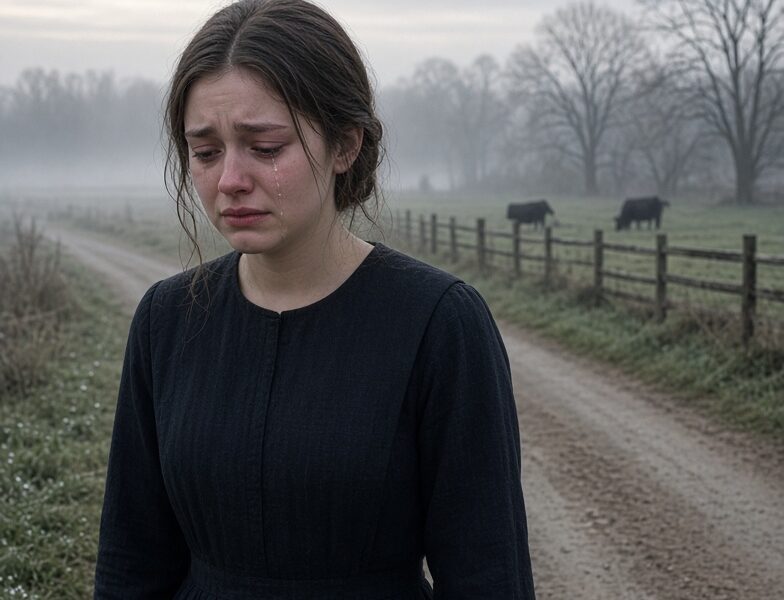
I Couldn’t Stop Crying After My Wedding Night, My Father Told Me to Go Back Inside
The Morning After: An Amish Bride, a Closed Door, and the Question That Changed Everything
The floorboards were cold under my bare feet, and I remember staring at one dark knot in the pine as if I could disappear into it. It was still early—before the sun had properly reached the kitchen windows—and I had been crying so long that my face felt tight and swollen.
I had made it as far as my parents’ house before I lost whatever courage had carried me there.
My father opened the door, looked at me standing on the porch in yesterday’s dress, and asked only one question.
“Does your husband know you are here?”
I could barely answer him. I thought he would pull me inside. I thought he would ask what happened instead.
After a long silence, he told me I needed to go back.
My name is Katie. I grew up Old Order Amish, and I share these stories because there are parts of our lives that are difficult to explain unless you have stood inside them.
If you have ever gone somewhere hoping to be protected and realized the person in front of you was more concerned with what you were supposed to do than with what had happened to you, you will probably understand why that morning has stayed with me.
Less Than One Day Married
I had been married less than one day.
The wedding itself had been beautiful in the plain way ours often are. There were long tables, more food than anyone could finish, the scrape of benches across floors, women carrying bowls in and out of the kitchen, children slipping between adults, and voices that seemed to fill every corner of the house.
I had been nervous all morning, but not unhappy. That is important for me to say. I had wanted marriage. I had wanted a home of my own. I had imagined waking beside the man I married and feeling that a new part of my life had begun.
What I had not understood was how unprepared I was for the first night.
No one had spoken plainly to me about it. There were hints, half sentences, warnings disguised as jokes, and the kind of embarrassed silence that teaches you a subject is important while giving you no useful knowledge about it.
My mother had told me that marriage required patience. An older cousin told me I would understand after the wedding. One woman at church squeezed my hand once and said, “You will be all right if you remember your duty.”
That word stayed with me. Duty. It sounded clean and simple when people said it in daylight.
That night, it did not feel simple at all.
A Night I Remember in Pieces
I do not want to describe private things in a way that turns a painful memory into entertainment. What matters is that I became frightened. I began to cry, and I could not make myself stop. I remember trying to quiet my breathing because the more embarrassed I became, the harder I cried.
My husband was young, too. He was confused, then frustrated, then quiet. Neither of us had been given enough language for what was happening.
There are memories that stay in your mind as one whole picture. That night is not like that for me. It comes back in pieces.
The lamp flame moving slightly when someone shifted. My hands twisting the edge of the blanket. The sound of a buggy passing somewhere on the road long after I thought everyone should have been asleep. The pressure in my chest when I realized I wanted to leave the room.
And the shame more than anything. I remember the shame.
I thought something was wrong with me because I was crying on a night everyone had told me was supposed to make me happy.
Before the Sun Rose
By dawn, I had hardly slept. My husband had finally fallen asleep, and I sat on the edge of the bed listening to his breathing. Outside, I could hear the first faint noises of morning. A door somewhere. A bucket sat down. A rooster far enough away that the sound seemed thin.
I dressed quietly. I did not make a plan. I did not pack anything. I did not even put on the bonnet I had worn the day before.
I only knew that I wanted my mother.
My parents lived a little less than two miles away. I had walked that road hundreds of times growing up. That morning, it felt longer than I remembered. The sky was pale gray, and there was dew along the grass beside the road. My shoes were damp before I reached the first bend.
I cried almost the entire way—not loudly. I was afraid someone might pass me. That is strange to admit now. I was hurt enough to leave my husband’s house before breakfast, but I was still worried about being seen doing it.
By the time I reached my parents’ lane, I had convinced myself that everything would change once I stepped onto the porch. My mother would look at me and know. My father would tell me I could stay. Someone older and wiser would finally explain what I was supposed to do.
The Porch
But my father opened the door first. He was already dressed for work. His suspenders were over his shirt, and he smelled faintly of the barn. I can still picture one hand resting on the door frame while he looked at me.
“Katie,” he said. That was all at first.
I tried to answer, but my voice broke. He stepped outside and pulled the door almost closed behind him. That small movement told me more than I understood at the time. He did not want the house waking up. He did not want my younger siblings hearing. He did not want neighbors—if any were already on the road—seeing a scene on the porch.
He looked past me toward the lane, then back at my face.
“Does your husband know you are here?”
I shook my head.
His expression changed. Not into anger exactly. It became harder.
“I couldn’t stay,” I said.
I expected him to ask why. Instead, he said, “You are married now.”
I remember wiping my face with both hands. I was still crying, which embarrassed him. I could see that even then.
“I know you cannot run home every time something is difficult.”
I told him it was not like that. He asked, “Did he strike you?”
I said, “No.”
That answer decided something for him. He breathed out through his nose and looked toward the road again. Then he gave me the sentence I would remember for years.
“A married woman cannot live with one foot in her father’s house.”
At the time, it sounded like a door closing. Now I understand it differently. I think my father believed he was teaching me how to survive marriage. I think he had been taught that sending a daughter back was a form of strength and that allowing her to stay would make future difficulties worse.
That does not mean I think he was right. It only means I no longer believe he woke that morning wanting to be cruel. He was following a rule he had inherited so completely that he did not stop to ask whether the rule fit the person standing in front of him.
Asking Permission to Come Home
I asked for my mother. He said she was still upstairs. I asked if I could wait. He shook his head.
“Katie, go back before people are awake.”
I cannot explain how small I felt. I was 18 years old, married, and still felt like a child asking permission to come inside my own childhood home.
I stood there another moment, hoping he would change his mind. He did not. So I turned around.
The walk back was worse because now I knew where I was going. I remember reaching the road and hearing the door close behind me. I did not look back.
Halfway to my husband’s house, I stopped near a fence because I could not breathe properly. My face was wet again. A few cows were standing in the pasture, chewing as if the world had not changed at all.
There is something almost insulting about ordinary life continuing when your own mind feels broken open.
The sun rose. A wagon passed. Somebody waved at me. I lifted my hand. That was what I had been trained to do. You answer kindness with kindness. You do not make strangers responsible for your private troubles.
Two Frightened Young People
When I reached the house, my husband was awake. He had been looking for me.
He stood in the kitchen when I came through the door, and the expression on his face was a mixture of fear and anger.
“Where were you?”
I told him. For a moment, he said nothing. Then he sat down at the table. That surprised me. I had expected another argument. Instead, he rubbed both hands over his face and stared at the tabletop.
I stayed near the door. Finally, he asked, “Did you tell them?”
I said, “I tried.”
That was the first time I saw that he was ashamed, too. Not in the same way I was, but he knew the night had gone badly. He knew I had been frightened enough to leave. He also knew what people would think if they found out his new wife had walked home before sunrise.
Two frightened young people were standing in a kitchen, each thinking about what everyone else would say. That was the real problem. Neither of us knew how to talk about what had happened without first passing it through the expectations of our families, our church, and our community.
He poured water into a glass and pushed it toward me. I did not drink it.
We stayed like that for a long time.
“I Didn’t Know You Were That Scared”
Then he said something I did not expect.
“I didn’t know you were that scared.”
I looked at him and said, “I was crying.”
“I know.”
“Then how did you not know?”
He had no answer.
Years later, that question became more important to me than almost anything else from that night. People can see tears and still not understand fear. They can hear the word no and think it means hesitation. They can see someone freeze and mistake silence for agreement.
Sometimes what is obvious to the person experiencing it is not understood by the person standing beside them—especially when both have been raised not to speak plainly about intimate things.
That does not excuse causing fear. It means silence is not wisdom.
We had both been taught silence. So we sat at that table and began awkwardly to say things neither of us had been taught to say. I told him I had felt trapped. He told me he had been terrified of doing something wrong and had responded by trying to act like he already knew what marriage required.
I told him that when I started crying, I needed him to stop and ask me what I needed.
He looked at me for a long moment. Then he said, “I should have.”
There was no dramatic reconciliation. There was no perfect conversation. I did not suddenly feel safe because he said one correct sentence. Trust does not work that way. But something changed—because for the first time since the wedding, one of us had admitted that what happened mattered more than what we had been told was supposed to happen.
That morning, I slept in a chair for a few hours. He worked outside. We barely spoke.
A Mother’s Basket
By afternoon, my mother arrived. I still do not know exactly what my father told her. She came alone with a small basket covered by a cloth. Inside were bread, butter, and a jar of preserves.
That was how my mother often approached difficult things. She brought food first and words second.
She found me washing dishes. She looked at my face once and said, “Come sit.”
I sat. She did not ask for details immediately. She poured tea, waited until my hands stopped shaking, and then asked one question.
“Did you feel safe?”
No one had asked me that. Not my father. Not my husband. Not even me.
I started crying again. My mother moved her chair closer. I told her enough. Not everything. Enough.
She listened. When I finished, she said, “Marriage does not make your fear imaginary.”
That was her one sentence. I have carried it with me ever since.
Taking Fear Seriously
She did not tell me to leave my marriage that day. She did not tell me to stay no matter what. She told me that I was allowed to take my own fear seriously.
For me, that was revolutionary. I had grown up hearing so much about obedience, patience, duty, humility, forgiveness, endurance. Those words can be beautiful. They can also become dangerous when they are used to make someone ignore what their own body is telling them.
My mother understood that more than my father did. Maybe because she had once been an 18-year-old bride, too.
I asked her why she had not warned me. She looked down at her hands. For a long time, she did not answer.
Then she said, “I thought too much knowledge would make you more afraid.”
That answer made me angry—not loudly. I was not someone who shouted at my mother, but inside something hardened.
I said, “Not knowing made me afraid.”
She nodded. “I know that now.”
That may have been the first adult conversation I ever had with my mother—not because I had suddenly become wiser, but because we were finally speaking as two women instead of only as mother and daughter. She admitted she had made a mistake. I admitted I had been too ashamed to ask questions. Between those two admissions was the beginning of something more honest.
Nobody Knew
The days after the wedding were quieter than people probably imagined. There were still chores. Meals still had to be cooked. Laundry still had to be washed. Animals still had to be fed.
No one in the community knew that I had walked nearly four miles that morning—two miles to my parents, two miles back—crying beneath a gray sky.
That is one reason I tell these stories now. So much of a life can happen without anyone outside the house ever seeing it.
For a while, I was angry with my father. I avoided being alone with him. When we visited my parents, I spoke to my mother and siblings and found reasons to be busy if he came near. He knew.
My father was never a man who apologized quickly. Months passed before he mentioned that morning.
The Barn Conversation
It was winter by then. We were in the barn at my parents’ place. I had come to help because one of my brothers was sick. My father was repairing a leather strap at the workbench.
Without looking at me, he said, “Your mother says I should have let you in.”
I kept sweeping. He waited.
I finally said, “She is right.”
That was bold for me. He set the strap down.
“I thought sending you back was the right thing.”
I said, “You didn’t even ask what happened.”
He looked at me then. His face changed in a way I had never seen before. My father was not a man who showed regret easily.
He said, “I was afraid if I opened that door, you would never go back.”
I answered, “Maybe you should have cared more about why I came.”
He looked down at the workbench. That was all.
There was no apology that day. But two weeks later, when we were leaving a Sunday visit, he walked beside me to the buggy. He put his hand on the side rail and said very quietly, “If you ever come home afraid again, I will open the door.”
I believed him. I still wish he had done it the first time.
Both things can be true. Someone can learn. And you can still grieve what they failed to do before they learned.
Different Versions of the Same World
People sometimes imagine strict communities as places where everyone believes exactly the same thing and responds exactly the same way. My experience was never that simple.
My father believed marriage meant sending me back. My mother believed marriage did not erase fear. My husband believed he had to act certain even when he was confused. I believed good women were supposed to endure discomfort without making anyone else uncomfortable.
All four of us were living inside different versions of the same world. That wedding night forced those versions into the open.
I do not tell this story because I think my family was uniquely cruel. I tell it because silence can create cruelty even among people who believe they are doing right.
If you never teach young people how to name fear, consent, boundaries, tenderness, uncertainty, and respect, they will still encounter all of those things. They will simply encounter them without words. And when people do not have words, they often reach for rules.
Rules are easier. Rules tell a father to send his daughter back. Rules tell a bride to stop crying. Rules tell a husband not to admit he is unsure.
But a real human being is always more complicated than a rule.
What Changed
When I look back now, what hurts most is not only that my father told me to go back inside my husband’s house. It is that I believed I had nowhere else to go.
That belief is what changed. Not all at once. Slowly.
I learned that asking for safety is not disobedience. I learned that being married does not cancel your right to be frightened, confused, or uncertain. I learned that tears are not proof of weakness. And I learned that love without honest conversation can become a room where everyone is guessing what the other person is allowed to say.
I wish someone had told me those things before my wedding. Maybe that is part of why I tell them now. I am not trying to give you a sermon or tell you what every marriage should look like. I am only telling you what I know from mine.
On the morning after my wedding, I walked home because I believed my father would know what to do. He sent me back. But later, my mother gave me the question I needed.
Did you feel safe?
That question changed the way I understood everything that followed.
The Question That Matters
And if there is one thing I hope you carry from this story, it is that sometimes the most important question is not what you are supposed to endure. It is whether you feel safe enough to speak the truth about what is happening.
I did not know, at 18, that I was allowed to ask that question of myself. I did not know that my fear was information, not weakness. I did not know that a closed door could be reopened later—by a father who learned, by a husband who listened, by a mother who finally spoke plainly.
But I know it now. And if you are standing on a porch somewhere, hoping someone will open the door—or if you are the one inside the house, deciding whether to open it—I hope you will remember this.
You are allowed to ask whether you feel safe. You are allowed to take the answer seriously.
And sometimes, the most important question is not “What are you supposed to do?” but “What actually happened to you?”
A Question for You
Before I go, I would genuinely like to know something from you.
Was there ever a time when you went to someone for help and they understood only later what you had really been asking?
Maybe you asked for shelter and they heard “drama.” Maybe you asked for rest and they heard “laziness.” Maybe you asked to be believed and they heard “trouble.” Or maybe you were the one who misunderstood someone else—and later, when you finally understood, it changed how you saw everything.
You can answer in the comments, in as much or as little detail as you want. You do not have to explain everything. Sometimes, just knowing somebody else understands is enough.
About This Story
This is one of the stories from The Katie Journals, exploring the quiet, complicated, beautiful, and sometimes difficult parts of Amish life that people rarely see from the road.
My new book, The Ninth Day, is out now. It is the first book in The Katie Journals, and if you would like to read it, you will find the link in the description.
If you want to hear more stories about growing up Amish, marriage, family, faith, and the things we rarely knew how to say out loud, you can subscribe and join me here.









