I Cared for Him 3 Years While His Kids Never Called — The Will Reading Changed Everything
Look who made it.
The saint herself.
Is that car of yours still held together with tape?
“It got me here.”
That dress.
Didn’t you wear it to his birthday five years ago?
“He liked it.”
On a teacher’s salary, I suppose one dress has to last.
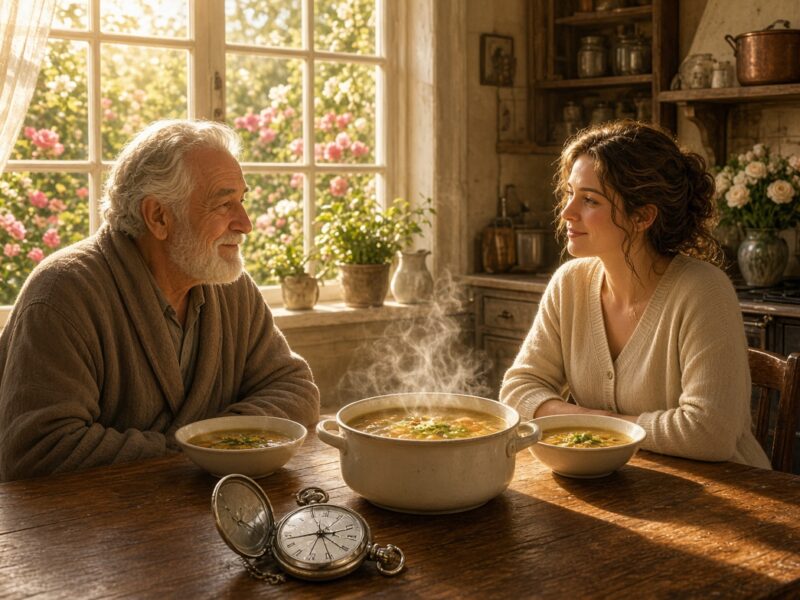
Soup.
You brought soup to a will reading?
“It was his favorite. I made it every Sunday.”
Well, he isn’t hungry anymore.
Three years spoon-feeding an old man.
I hope it paid well.
“It didn’t. I have seen the accounts. She never took a cent.”
Then you are a bigger fool than I thought.
“I didn’t do it for money. I did it because he was alone.”
He had three children.
“He had three phone numbers that never rang.”
Enough.
The lawyer arrives at eight.
Try not to cry on the furniture.
“Come into the kitchen, miss. It’s warm in here.”
He asked for you every morning.
First thing.
“I should have been here that night.”
You were here every other night for three years.
Four years those three never came.
Tonight they got here in an hour.
“Don’t. They lost their father, too.”
You have his heart, you know.
“Thank you all for coming. This is your father’s last will.”
Skip the poetry.
Read the numbers.
“To my eldest son, the mill and every share of Whitlock Mills.”
Finally.
“To my daughter, this house, the land, and the art. To my youngest son, the investment accounts in full.”
That’ll do nicely.
“And to the daughter who stayed—”
Fear you will need a mango.
“It is all I wanted.”
How noble.
And how convenient for the rest of us.
“He set it by hand every night at nine.”
Sell the mill.
Monday.
All three hundred jobs.
“He promised those workers their pensions.”
He is dead.
His promises went with him.
The house lists tomorrow and this junk goes first.
That is his.
He doesn’t even look at it.
Was.
“To the old man. Finally useful. We won’t need a gardener. The buyers will pave it all.”
“I planted those roses with your mother.”
One formality.
Each heir signs to accept the terms tonight.
Give me the pen.
Fastest money I ever made.
You too.
A waiver.
You give up any claim on this estate for one dollar.
“I need a moment. Upstairs.”
Do you take your watch with you?
I noticed it first.
I told him.
I should have said it louder.
Nine o’clock.
He always set it at nine.
“They are calling for you, miss. Sign and be free of them.”
“If I sign, the workers lose everything.”
He always said, “Time tells.”
Trust him one more night.
Well, one dollar.
More than that watch is worth.
“I never wanted his money. Only more of his time.”
Then, by his written instruction, I now open the second envelope.
“What second envelope?”
“The one he told me to open only after every signature was dry. A test.”
You cannot test people from the grave.
“Who said anything about a grave?”
“Daddy?”
Three days.
Not one of you asked where I was resting.
Not one asked to say goodbye.
“Dad.”
Forgive me.
You had to believe it or they never would.
You scared me half to death.
“Only half. I had to go all the way. But I did not do this for a game. For two months someone in this family has been changing my heart pills. She noticed the change first. She was the only one paying attention.”
“I checked every evening. The numbers never added up.”
You think it was one of us.
You had power over his accounts.
You needed him quiet.
“Me? You were here in March with a lawyer and a doctor.”
Let’s all calm down.
“You first. Forty transfers out of the workers’ pension fund, each with my signature. I have not signed a thing since spring.”
The auditors are in your office tonight.
“I was going to put it back.”
And you asked a judge to declare me unfit so you could sell this house while I was still breathing in it.
“It was for your own good.”
“The judge telephoned me. We had a pleasant chat. But neither of you touched my pills.”
Don’t look at me.
“I am the one who never asks for anything.”
“No. You only take.”
Open the watch, sweetheart.
Second drawer of my desk.
Two million dollars due Friday.
And only my signature or my funeral could pay it.
That proves nothing.
“It doesn’t. The fingerprints on the bottle do. And the pharmacy has you on record collecting his refill. Twice.”
“I only wanted him to sleep more. Sign a few papers. I never meant—”
“You never meant for her to count.”
“Sir, you will come with me.”
“Dad, please. I am your son.”
“You are. That is what breaks my heart. The same heart you nearly stopped.”
“What happens to us?”
“The auditors decide your part. I will not lie for you.”
“And the house?”
“The real will was signed a month ago. Everything passes into a family trust. The mill, the house, the land. And she runs it.”
“I can’t. I signed away every claim. For one dollar?”
“To a will that never existed. Keep the dollar. Frame it.”
“She is a school teacher.”
“She is the only one who asked how I was. And never what I had. For you two, a pocket watch each. So you learn what time costs.”
“The mill stays open. Every pension is paid back. And he keeps his garden.”
“Thank you, miss.”
“Sunday dinner is at six. Come when you can come without counting.”
“Why would you still want us there?”
“Because he still has three phone numbers. I would like them to ring.”
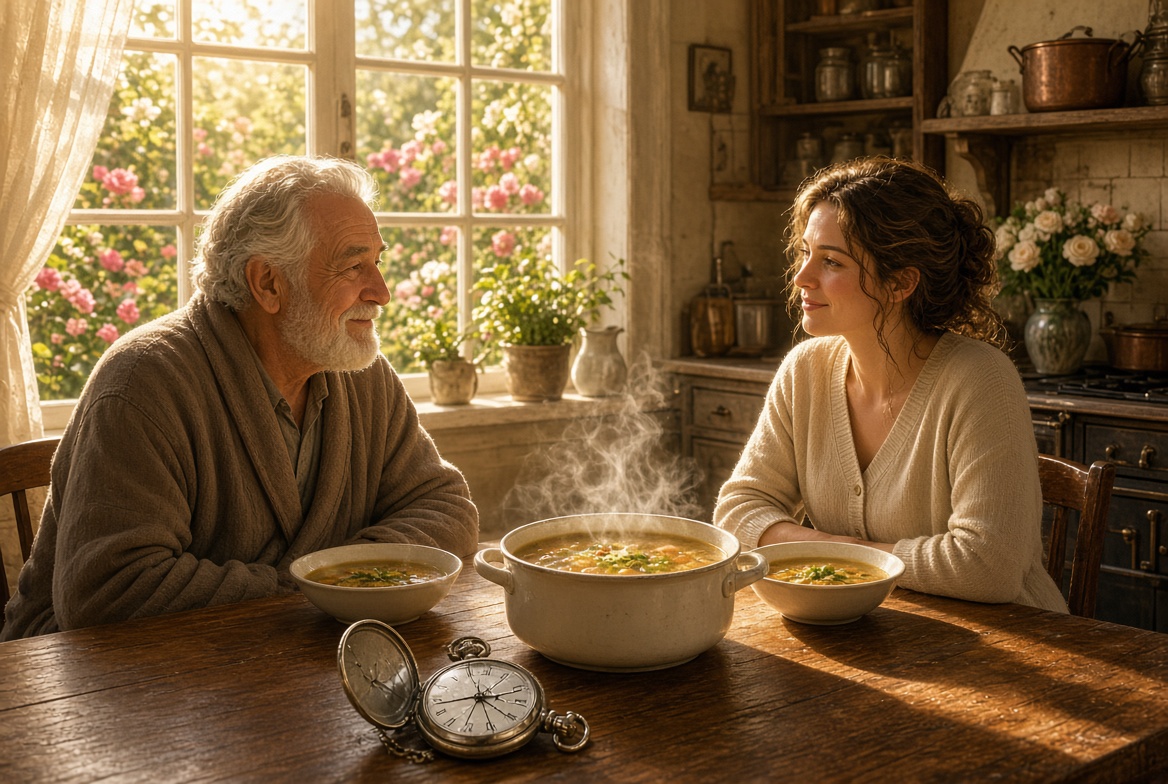
Is that my Sunday soup on a Tuesday?
“You missed three days of meals. Sit.”
Much better than being mourned.
“Never do that to me again.”
“I promise. From now on, I only play dead at chess.”
Answer it.
It is ringing.
First time in four years.
“Hello, sweetheart.”
Time tells.
The rain had stopped by the time the last car pulled out of the driveway.
Maya stood in the kitchen doorway with the pot of soup still warm in her hands and watched the taillights disappear down the long gravel road.
She had been in this house for three years.
She had fed him.
She had bathed him.
She had read to him when his eyes were too tired to focus on the page.
She had learned to tell the difference between the silence of a man who was resting and the silence of a man who was fading.
And she had never once asked him for anything.
Not because she was noble.
Because she had grown up poor enough to understand that asking usually made things worse.
“You should eat something.”
She turned.
The old man was standing in the kitchen doorway, wrapped in the same robe he had worn every morning for as long as she had known him.
“You are supposed to be in bed.”
“I am supposed to be dead, according to my children.”
“That is not funny.”
“It is a little funny.”
“It is not.”
He shuffled to the table and sat down heavily.
She put the soup in front of him.
He looked at it for a long moment.
“You made this every Sunday.”
“I did.”
“Why?”
“Because you liked it.”
“No. Why did you stay?”
She sat down across from him.
“Because you were alone.”
“I had three children.”
“You had three phone numbers that never rang.”
He nodded slowly.
“That is true.”
“Why did you do it?”
“Do what?”
“The funeral. The will. The test.”
He stirred the soup without eating it.
“I needed to know who was changing my pills.”
“You already knew.”
“I suspected. There is a difference.”
“And now?”
“Now I know.”
He looked up at her.
“Two months ago, I noticed the pills looked different. I counted them. The numbers never matched. I started keeping a log. I started watching who came into my room and when.”
“And?”
“And you were the only one who noticed.”
“I noticed because I was here.”
“You noticed because you were paying attention.”
He set the spoon down.
“The others came when there was something to collect. You came when there was nothing.”
“That is not true.”
“It is.”
“There was you.”
He looked at her for a long time.
“Thank you.”
“For what?”
“For not treating me like a wallet.”
She did not answer.
She did not need to.
He reached into his robe pocket and placed a small velvet box on the table.
“What is this?”
“Open it.”
She opened it.
Inside was a watch.
Old.
Silver.
With a cracked face and a worn leather strap.
“This was my father’s watch.”
“I know.”
“He gave it to me the day I opened the mill.”
“He told you time tells.”
He looked up sharply.
“How do you know that?”
“You told me. On the porch. Last summer. You said he gave you the watch and told you time tells. You said you never understood what he meant until your wife died.”
He was quiet for a moment.
“I forgot I told you that.”
“You forget a lot of things. But you remember the important ones.”
He pushed the box toward her.
“I want you to have it.”
“I can’t.”
“You can.”
“It should go to your children.”
“My children have their own watches. They bought them with money they took from my pension fund.”
She looked at the box.
“Why me?”
“Because you were the only one who asked how I was. And never what I had.”
She closed the box.
“Thank you.”
“You are welcome.”
They sat in silence for a while.
The house creaked around them.
The clock on the wall ticked toward midnight.
“I have one more thing to tell you.”
“What?”
“The real will.”
She looked at him.
“There is a real will?”
“There is.”
“Where?”
“In the safe. Behind the painting in my study.”
“What does it say?”
“It says everything passes into a family trust. The mill, the house, the land. And you run it.”
She stared at him.
“I can’t.”
“You can.”
“I am a school teacher.”
“You are the only one who asked how I was. And never what I had.”
“That is not a qualification.”
“It is the only qualification that matters.”
She shook her head.
“I don’t know how to run a mill.”
“You will learn.”
“I don’t know how to manage a trust.”
“You will learn.”
“What if I fail?”
“Then you fail.”
He shrugged.
“Failing is not the worst thing. Not trying is.”
She looked at the watch in her hand.
“I don’t want your money.”
“I know.”
“I never wanted it.”
“I know.”
“Then why?”
“Because you stayed.”
He stood up slowly.
“Sunday dinner is at six. Come when you can come without counting.”
“I don’t understand.”
“You will.”
He walked toward the stairs.
“Goodnight, Maya.”
“Goodnight.”
He stopped at the bottom step.
“One more thing.”
“What?”
“The soup is very good.”
She laughed.
It was the first time she had laughed in three days.
The mill stayed open.
Every pension was paid back.
The three children received a pocket watch each.
And every Sunday at six, the house filled with the smell of soup.
The three phone numbers rang.
Sometimes.
Not always.
But sometimes.
And that was enough.
Because time tells.
And in the end, the only thing that mattered was who had been there when it did.









