
I Begged My Amish Husband for One Night of Rest, He Took Me to My Father Instead
“Please, Just One Night”: An Amish Mother’s Breaking Point and the Father Who Listened
The lamp had burned down low enough that the wick was beginning to smoke, and I remember watching that thin black curl rise toward the ceiling while the baby cried against my shoulder. It was sometime after 2:00 in the morning. I had not slept more than an hour at a time for nearly three weeks.
When my husband came through the bedroom door, I did something I had never done before.
I begged him.
I said, “Please, just one night. I need one night to rest.”
He stood there for a long moment without answering me.
By sunrise, I was sitting beside him in the buggy, wrapped in my dark shawl, and we were on the road to my father’s house.
My name is Katie. I grew up Old Order Amish, and I share these stories because there are parts of our life that are easy to see from the road, and other parts you only understand when you have lived inside them.
If you have ever reached the point where you were so tired you did not recognize yourself anymore, you will understand why this morning has stayed with me.
What I Thought I Knew About Tired
I was 18 when I married—old enough by our standards to know what work was, or at least I believed I knew.
I had helped my mother with babies. I had carried water, scrubbed floors, canned peaches in August heat, washed clothes by hand, weeded gardens until my fingers were black around the nails, and stood over a cook stove long enough to know how tired a body could become.
But I did not understand the tiredness that comes when there is no real end to the day.
Our first child was still very small when that morning happened. He was not sick in any way that frightened us, but he was restless. Some babies settle after feeding and sleep for hours. Mine seemed to wake at every sound.
The floorboard beside the bed creaked. He woke. A horse shifted outside. He woke. I laid him down too quickly. He woke. I laid him down too slowly. Somehow, he woke from that, too.
The Circle Gets Smaller
For the first week, people came to help. My mother brought bread. My sister washed dishes. One of my husband’s aunts came in the afternoon and swept the kitchen without asking.
There was a kind of protection around a new mother—a little circle of women who understood that the first days were not ordinary days.
But that circle gets smaller. People have farms to run, children to tend, wash days, baking days, church Sundays, sick parents, gardens that do not care whether anyone has slept.
By the third week, most mornings looked nearly normal from the outside.
That was the dangerous part.
The table still had to be set. The stove still had to be lit. My husband still needed breakfast before chores. There were shirts to mend and milk pans to wash and a baby who seemed to know the exact moment I closed my eyes.
Measuring Sleep in Minutes
I began measuring sleep in minutes instead of hours. Twenty minutes in the chair. Maybe forty after midnight. Ten with my head against the wall while the baby slept across my lap.
You start making little bargains with yourself.
If he stays asleep until the clock strikes three, I will be all right tomorrow.
If I can close my eyes until the stove needs tending, I will be all right.
If someone takes him after breakfast—just for an hour—I will be all right.
But I was not all right.
I remember dropping a spoon one morning and staring at it on the floor as if I did not know what it was. That frightened me more than I expected. It was only a spoon. I had dropped a hundred spoons in my life. But I stood there with one hand on the table, looking down at it, and I could not make myself bend over.
My husband noticed. He said, “Katie, are you all right?”
I said I was fine.
That answer came quickly because I had practiced it without knowing I was practicing it.
I’m fine. Just tired. The baby was awake a lot. It will pass.
Women before me had done this. My mother had done this. My grandmother had raised eight children. There were women in our church district with six, seven, nine children—women who seemed to move through every day with the same steady hands no matter how much work there was.
So I believed the weakness must be mine.
That is something I understand differently now. When you grow up around capable people, sometimes you learn strength from them. Sometimes you learn how to hide pain from them.
The Night Before
The night before my husband took me to my father, I had already been awake through most of the previous night.
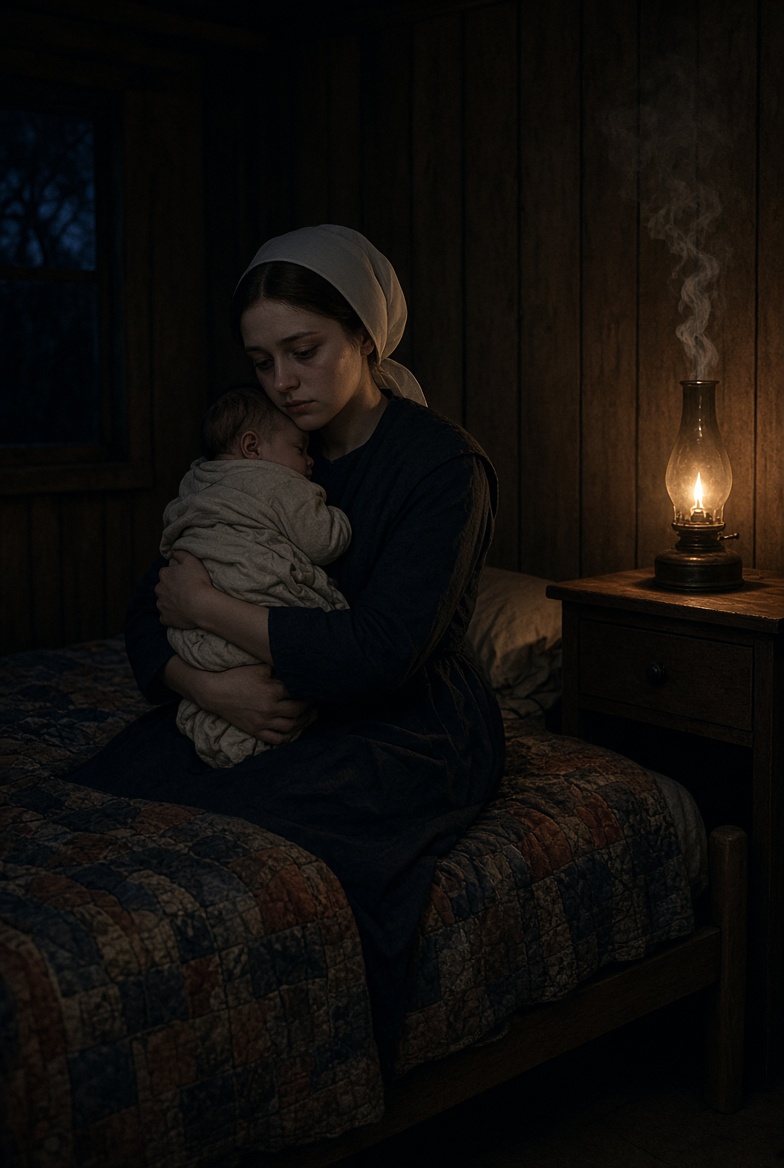
During the day, I tried to rest, but there was bread dough rising near the stove, diapers soaking in a basin, and a neighbor stopped by unexpectedly. I remember smiling while she held the baby and telling her he was doing well.
She said, “You look pale.”
I laughed—not because it was funny, but because I did not know what else to do.
By evening, I felt as though my whole body was humming. Not energy—something closer to the trembling you get after carrying something too heavy for too long.
The baby finally slept around 9. I lay down without changing my dress. I remember thinking, This is it. This is the night.
Then he cried at 10:20. Again near midnight. Again sometime after 1:00.
By the time the clock passed 2, I was sitting on the edge of the bed with him against my shoulder.
My husband had been sleeping in the other room for part of those weeks because he had to be up before dawn for chores. That arrangement made sense when we first decided it. He needed sleep to work safely around horses and equipment.
I agreed. Of course I agreed.
But that night when he came into the room and saw me sitting there, something inside me gave way.
The Sentence I Can Still Hear
I was not dramatic about it. I did not shout. I did not accuse him. That almost makes the memory harder.
I just looked at him and said, “Please take him tonight.”
He looked confused at first.
I said, “Please, just tonight. I need to sleep.”
He told me he had chores in the morning.
I said, “I know.”
He said the baby usually wanted me anyway.
I said, “I know.”
Then I said the sentence I can still hear exactly.
“I am afraid of how tired I am.”
That changed his face. Not enough that he immediately took the baby from me—I want to be truthful about that. He did not suddenly understand everything. He sat down on the wooden chair near the wall. The baby was crying between us.
For maybe a full minute, neither of us said anything.
Then my husband said, “Get dressed warm in the morning.”
I asked him why.
He said, “We’re going to your father.”
What I Thought Would Happen
I thought he meant my mother would help me. That was my first thought. And honestly, relief went through me so quickly I almost cried.
My mother would take the baby. My sisters might help with the washing. Maybe I could lie down in the small back room where I had slept as a girl and sleep until noon.
That was what I pictured.
I had no idea why he was actually taking me there.
We left just after sunrise. It was cold enough that morning for the horse’s breath to show white in front of us. The road was hard from an overnight freeze, and every wheel rut made the buggy shake. I held the baby under a heavy blanket. My husband drove. We barely spoke.
There is a particular silence inside a buggy when two people are upset with each other. The wheels make noise. The harness makes noise. The horse breathes. The seat creaks. But the space between two people can still feel completely silent.
My father’s farm was a little over four miles away. I knew every turn.
At the second turn, I started to feel uneasy. At the third, I asked, “Did you tell Ma’am we were coming?”
He said, “No.”
Then I knew something was wrong.
Arriving at My Father’s Farm
My father was in the barn when we arrived. He came out with a pitchfork still in his hand, and I remember the expression on his face when he saw the three of us. Surprise first, then concern.
My mother came to the porch and took the baby almost immediately. She did not ask permission. She just looked at me and said, “Give him here.”
Those four words nearly broke me.
I handed him over.
My husband told my father he wanted to speak with him. Not with my mother—with my father.
They went into the barn. I stood near the kitchen doorway, feeling like a child, waiting to hear what punishment had been decided.
My mother looked at me. “What happened?”
I said, “I asked him to take the baby for one night.”
She looked toward the barn, then back at me.
“And?”
I told her I was afraid of how tired I was.
My mother did not say anything for a few seconds. Then she put the baby into my youngest sister’s arms, took me by the wrist, and sat me down at the kitchen table.
“Eat Three Bites”
There was oatmeal still warm in the pot. She spooned some into a bowl and put it in front of me.
I told her I was not hungry.
She said, “Eat three bites.”
That was my mother’s line—the one I have remembered all these years. Not pray harder. Not be stronger. Not obey. Eat three bites.
So I did. By the second bite, I started crying—not loudly. Tears just fell into the bowl.
My mother sat across from me while I ate.
After a few minutes, my husband and father came back from the barn. My father’s face was serious. My husband stood beside the door.
I expected my father to tell me I had made too much of things. I expected him to remind me that marriage required sacrifice, that motherhood was tiring, that every woman learned to bear it.
Some of those things would have been true in a certain way. Motherhood is tiring. Marriage does require sacrifice.
But truth can become cruel when it is used without mercy.
My father pulled out the chair across from me. He looked at my husband first, then at me.
He said, “Katie, tell me what you told him.”
So I did.
Telling My Father the Truth
I said I had asked for one night. I said I was forgetting things. I said I had begun to feel afraid when I held the baby while standing because sometimes my knees felt weak.
That was the first time I had admitted that part.
My husband turned toward me. He had not known.
That was partly because he had not asked. It was also partly because I had worked very hard not to let him know.
Both things can be true.
My father asked how much I had been sleeping. I did not know.
He asked my mother. She said, “Look at her.”
That was all.
My father leaned back in his chair and rubbed his beard. Then he told my husband something I never expected.
He said, “You brought her here because you thought I would send her back tougher.”
My husband did not answer.
My father continued, “You married my daughter. You did not hire her.”
I can still see my husband’s face when he heard that. Red first, then pale. No one raised their voice. In our world, the quietest sentences can sometimes carry the most weight.
My husband said he had not meant to be cruel.
My father said, “I believe you.” Then he added, “Cruelty does not always begin with meaning to be cruel.”
The Back Room
My mother stood up then and told me to go lie down.
I hesitated. The baby was in the next room. There were people talking about my marriage at the kitchen table. Every part of me wanted to stay and listen.
My mother pointed toward the back room bed.
I went.
The room looked smaller than I remembered. The quilt on the bed was one my grandmother had pieced—blue squares and faded cream. The same small washstand stood against the wall. There was a crack in the window frame that whistled when the wind blew from the east.
I lay down fully dressed.
For a long time, I could still hear voices through the wall. My father. My husband. My mother once or twice.
Then I stopped hearing anything.
I slept for almost five hours.
Five hours. It felt like waking from another life.
Waking Up
When I came back into the kitchen, my husband was still there. I expected him to be angry. He looked ashamed. There is a difference. Anger wants to defend itself. Shame often does not know where to look.
He told me he had already done the afternoon chores at my father’s place while I slept. My mother had fed the baby once from milk I had left. And when the baby woke again, she had brought him to me.
Then my husband said, “I didn’t know it was that bad.”
I was still too tired to be gentle. I said, “You knew I asked.”
That sentence sat between us. He nodded.
Years later, that is the part I think about most. People often wait for suffering to become undeniable before they believe it deserves help. They wait for someone to collapse, to cry, to get sick, to fail at a task they usually manage.
But sometimes the clearest sign is the simplest one.
Someone asks.
I had asked. Not perfectly. Not early enough. But I had asked.
A Different Arrangement
My husband and I went home that evening with a different arrangement.
For the next week, he took the baby after the evening feeding and kept him with him until midnight unless the baby truly needed me. My mother came twice. My sister came once to do washing.
Nothing miraculous happened. The baby did not suddenly sleep through the night. The chores did not disappear. We were still Amish. There was still work every morning.
But I was no longer carrying every waking hour by myself.
And something else changed. My husband started asking, “How much did you sleep?”
Not “Are you fine?” Those are different questions.
Are you fine? is easy to answer. Yes.
How much did you sleep? requires a number. Three hours. Four hours. Maybe two.
Specific questions make it harder for people to disappear behind politeness.
Old Habits Are Stubborn
I wish I could tell you that from that day forward, I always spoke up when I needed help. I did not. Old habits are stubborn.
There were many times afterward when I waited too long. Times I said yes because I was embarrassed to say no. Times I measured myself against women who seemed stronger. Times I confused endurance with goodness.
But that morning at my father’s table became one of the memories I returned to whenever I felt myself doing it again.
For years, I believed the most important thing my father did was defend me. Now I think the more important thing was that he listened before deciding what lesson I needed. He did not know every detail of my marriage. He did not pretend to. He asked me what happened. Then he believed the answer enough to respond to it.
That sounds simple. It is not always simple—especially in close communities where everyone knows the rules, the roles, the expectations, and what a good husband or good wife is supposed to look like.
Sometimes knowing the role makes it harder to see the person standing inside it.
Seeing My Husband Differently
I also see my husband differently when I remember that day now.
I was angry with him for a long time. Part of me still thinks I had every right to be. He heard his exhausted wife ask for one night of sleep and chose to take me to my father because he thought my father would correct me. That hurt.
But I also watched what he did after my father corrected him instead. He stayed. He listened. He changed the routine. He took responsibility for nights he had previously considered mine.
He did not do it perfectly. Neither did I. But our marriage became more honest because the old arrangement could no longer pretend to be working.
What Rest Really Is
That morning taught me something I still carry.
Rest is not a reward for finishing everything. If you wait until every chore is done, every child is settled, every person is satisfied, every dish is washed, and every expectation has been met, rest may never come.
Sometimes rest has to be treated as necessary before it feels deserved. And asking for it is not a confession of weakness. Sometimes it is the most responsible thing a tired person can do.
I had spent weeks believing that a good mother, a good wife, a good Amish woman, simply endured. I had measured myself against women who seemed to carry everything without breaking. What I did not know was how much they might have been hiding, too—or how many of them had once stood in a dark room at 2:00 in the morning, holding a crying baby, wondering how much longer they could last.
Strength is not the same as silence. Endurance is not the same as erasing yourself. And sometimes the bravest thing a young mother can do is say out loud, “I am afraid of how tired I am.”
The Question I Keep Coming Back To
I asked my husband for one night of sleep. He took me to my father. My father listened. My mother fed me oatmeal and told me to eat three bites. And by the end of that day, something had shifted—not just in the arrangement of our nights, but in the way I understood what it meant to ask for help.
For years, I thought the hardest part of that morning was the asking. Now I think the hardest part is what comes after. Believing that your need is real enough to act on. Trusting that the people who love you can hear the truth without turning it into a verdict about your character. Learning that asking is not the same as failing.
I am still learning that.
But I know this much: I asked. My father listened. My mother fed me. My husband stayed. And five hours of sleep felt like waking from another life.
That was enough to begin again.
A Question for You
Before I go, I would really like to know this from you.
Have you ever asked someone for help and realized later that simply asking was one of the hardest parts?
Maybe you asked for rest and were afraid of what it said about you. Maybe you asked for support and worried it made you weak. Maybe you asked someone to listen and spent hours rehearsing the words before you could say them.
You can answer in the comments—in as much or as little detail as you want. You do not have to explain everything. Sometimes, just knowing somebody else understands is enough.
About This Story
This is one of the stories from The Katie Journals, exploring the quiet, complicated, beautiful, and sometimes difficult parts of Amish life that people rarely see from the road.
My new book, The Ninth Day, is out now. It is the first book in The Katie Journals, and if you would like to read it, you can find the link in the description. I am very grateful to everyone who has already picked up a copy and spent more time in Katie’s world beyond these stories.
If you want to hear more true-to-life stories about growing up Amish, marriage, family, faith, and the things we often kept inside the home, subscribe and come back for the next one.
End of Article









