How Did We Miss This for 500 Years?
This is the School of Athens, Raphael’s greatest masterpiece and one of the most famous frescoes in the history of art. It is packed with dozens of ancient philosophers, mathematicians and scholars. Yet among them hides one mysterious figure whose secret was uncovered only recently.
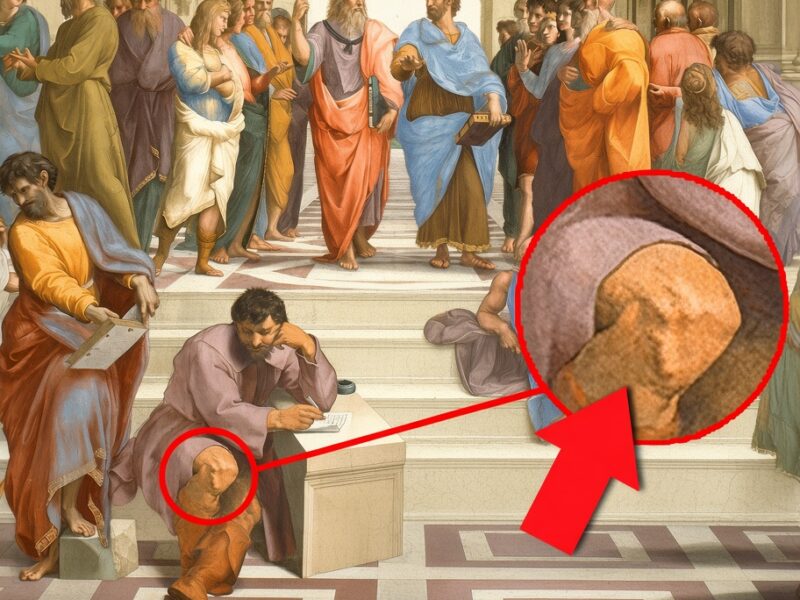
Look at the man sitting thoughtfully on the steps. Originally, he was not supposed to be there at all. In Raphael’s surviving full-scale preparatory cartoon, this figure simply does not exist.
He was added at the very end, when the composition was already nearly complete. Even more surprising, modern research suggests that beneath the guise of an ancient Greek philosopher, Raphael painted his contemporary and greatest rival, Michelangelo. But why would he choose to immortalize him here? And why would one of the Renaissance’s greatest artists alter a masterpiece that was almost finished?
The story begins in 1508, when the 25-year-old Raphael was invited to Rome. Pope Julius II had decided to transform his private apartments in the Vatican Palace. The old decorations would give way to a new artistic program worthy of the Renaissance.
Today, those rooms are known as the Raphael Rooms. Each was dedicated to a different branch of human knowledge. One celebrated theology, another law, another poetry.
The largest wall in the room devoted to philosophy became the School of Athens. Oddly, there is no actual school here. Raphael imagined an ideal gathering of the greatest minds of the ancient world.
Thinkers who lived centuries apart are brought together inside a magnificent classical building. In doing so, Raphael created a symbolic pantheon of human reason.
At the very center stand the two most important figures, Plato and Aristotle. Their gestures speak as loudly as their faces. Plato points upward, a reminder that true reality lies beyond the material world, in eternal and unchanging ideas.
Aristotle, by contrast, extends his hand horizontally toward the earth. For him, knowledge begins with observing nature and understanding the world through experience. Two gestures, two philosophies, two entirely different ways of seeing reality.
Even the books they carry underline the contrast. Plato holds his dialogue Timaeus, devoted to the structure of the universe. Aristotle carries the Nicomachean Ethics, a work about virtue and the proper way to live.
Though the fresco holds dozens of figures, it never feels crowded. The characters are arranged in carefully balanced groups, which gives the whole composition its harmony. Among the 58 figures are easily recognizable philosophers and several unidentified characters, likely included to complete the visual balance.
Rather than examine every one, it helps to focus on the most important. In the lower left corner sits Pythagoras, representing arithmetic. Surrounded by students, he records mathematical principles while one pupil holds up a writing tablet.
Looking over his shoulder is the great Arab philosopher and encyclopedist Averroes. A level above, near Plato, stands Socrates, calmly explaining his ideas to attentive listeners and counting off his arguments on his fingers. Beside them is a figure in armor, widely believed to represent Alexander the Great.
Lying alone across the steps is Diogenes. His relaxed pose reflects his philosophy of rejecting wealth, power and social convention in pursuit of complete inner freedom.
Raphael was never aiming for a historically accurate reconstruction of the ancient world. Instead, he quietly gave several of the philosophers the faces of people from his own time. The most famous example is Plato, whose features unmistakably recall Leonardo da Vinci, with the high forehead, flowing gray beard and thoughtful expression.
The choice was deeply symbolic. Leonardo was widely seen as a man who tried to understand the universe through science, art and philosophy. That made him a fitting stand-in for Plato.
Euclid, who demonstrates a geometric problem with a compass, is widely believed to carry the features of the architect Donato Bramante. Bramante is thought to be the man who introduced the young Raphael to Rome’s artistic circles.
Raphael even painted himself into the scene. On the far right, a young man in a black beret looks straight at the viewer. It is the artist’s self-portrait.
By meeting our eyes, Raphael seems to invite us into this gathering of great minds. He bridges the gap between the ancient world and the Renaissance.
Not every figure can be named with such confidence. Raphael left no written explanations, and the identities of several characters are still debated among art historians. One of them is the man on the steps.
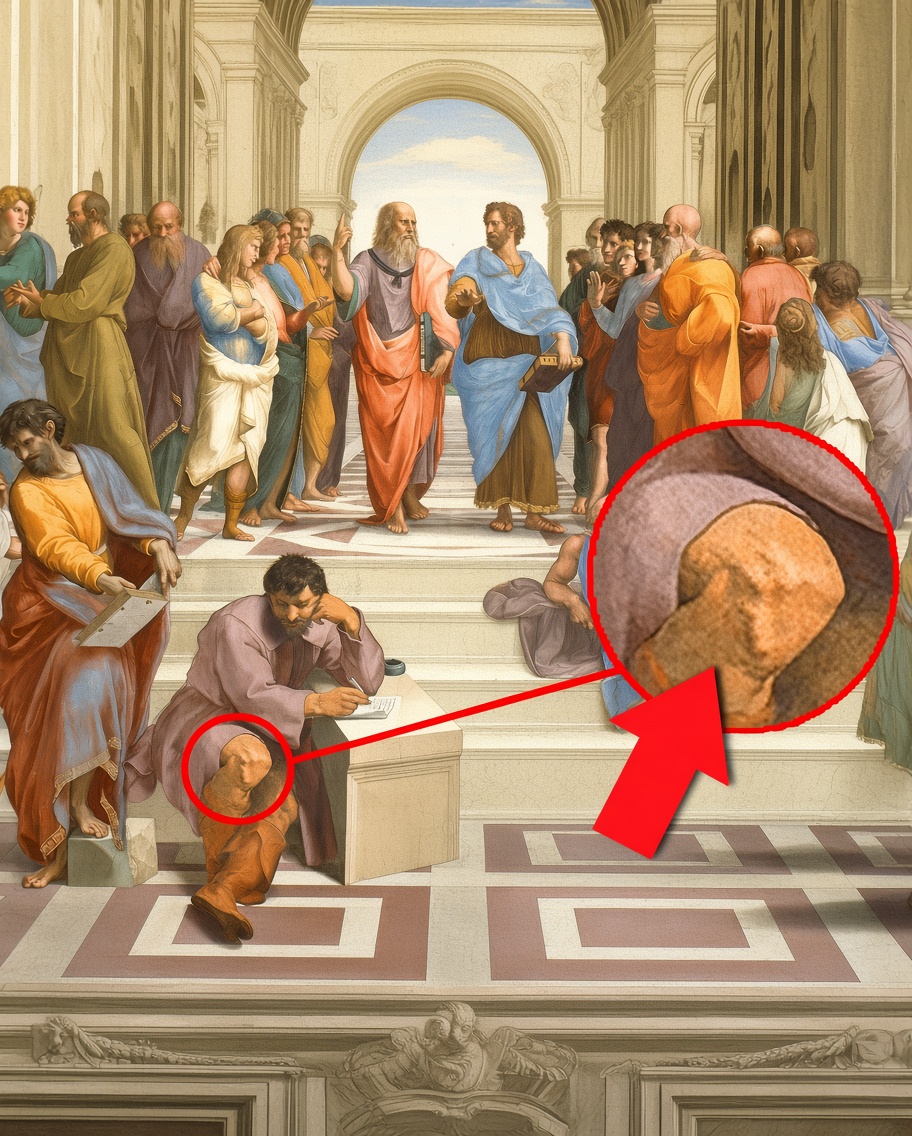
He stands out sharply from everyone else. While conversations unfold all around him, he sits completely alone, resting his head on one hand as he quietly writes. He is identified as Heraclitus, the ancient Greek philosopher best known for the idea that everything is in constant change, and for the saying that no one can step into the same river twice.
Here is the most intriguing part. This character does not appear at all in Raphael’s enormous preparatory cartoon, the full-scale drawing used to transfer the composition onto the wall. The staircase where he sits today was originally empty.
That means he was added to the fresco much later. The technique of fresco painting makes it possible to work out the order in which an artist worked. Each day, the painter could apply only a small section of fresh plaster, just enough to paint before it dried.
These daily sections leave subtle seams that can still be found under microscopic examination. The area containing Heraclitus forms a separate section of plaster. In other words, the figure went in after most of the fresco was already finished.
Raphael cut away part of the hardened plaster on the staircase, laid a fresh layer, and only then painted the seated philosopher. Differences in the color and pattern of the marble floor still reveal the later intervention.
So why take such an extraordinary step? While Raphael painted the School of Athens, Michelangelo Buonarroti was working just beyond the wall on a commission that would change art history forever, the ceiling of the Sistine Chapel. The two men were far from friends.
Michelangelo regarded the younger Raphael with open suspicion. An intense rivalry slowly grew between them as each sought to become the greatest artist of the Renaissance.
At that moment, the Sistine ceiling was still unfinished. Michelangelo guarded his work jealously and rarely let anyone into the chapel before its official unveiling. According to the most widely accepted account, Bramante secretly arranged for Raphael to slip inside while Michelangelo was away.
What Raphael saw reportedly left him speechless. The monumental figures, the dramatic poses and the unprecedented power of the painting made an enormous impression on the young artist. He went back to the School of Athens and made one last addition, the solitary figure of Heraclitus.
But this, the argument goes, was more than a portrait. Raphael deliberately chose a philosopher whose personality matched Michelangelo’s own. Heraclitus had long been known as the weeping philosopher, a solitary thinker who kept his distance from society and devoted himself to contemplation.
Contemporary accounts often describe Michelangelo in strikingly similar terms. They portray him as reserved, severe, uncomfortable at court and happiest when working alone.
Even the clothing seems deliberate. Rather than an idealized Greek robe, Heraclitus wears garments resembling those of Tuscan stone cutters, along with heavy leather boots. According to Michelangelo’s contemporaries, he wore such boots for days at a time and was so devoted to his work that he sometimes slept in them.
Another piece of evidence came only recently, from an unexpected field: medicine. In 2016, a team of Italian physicians studied historical portraits of Michelangelo, hoping to identify the illness that troubled him later in life. They concluded he most likely suffered from osteoarthritis, a degenerative joint disease.
The condition shows in later depictions of the artist, where the joints of his hands look enlarged and deformed. Michelangelo himself often complained in his letters of what he believed was gout, describing severe pain in his legs and joints.
Now look closely at Heraclitus. His feet seem unusually large and swollen inside his boots, with prominent bulging forms. Some researchers believe this may reflect Raphael’s careful observation of Michelangelo’s physical condition.
Still, the detail alone proves nothing. Raphael left no note naming his model, and some scholars remain cautious about reading a portrait into a seated figure of a philosopher. Supporters of the theory counter that the late addition, the personality match, the clothing and the swollen feet point in the same direction.
If the theory is right, Raphael altered a nearly finished fresco to honor the man who had so deeply inspired him. He did not place Michelangelo among painters. He placed him among the greatest philosophers of antiquity, as if acknowledging that his genius went beyond art itself.
The School of Athens looks like a perfect picture of the ancient world. Behind its harmony lies a multitude of secrets. Raphael left a message for future generations, and art historians are still deciphering it today.
Perhaps that is why the fresco remains one of the greatest masterpieces in the history of world art. So how did we miss this for 500 years? What do you think: did Raphael really hide Michelangelo on those steps? Share your thoughts in the comments.









