How did We Miss This For 500 Years?
Did you know there is a piece of music written on a sinner’s backside?
In 2014, Oklahoma university student Amelia Hamrick was studying Hieronymus Bosch’s famous triptych The Garden of Earthly Delights, a monumental work created some 500 years ago. The right panel shows hell and the torment of sinners, who are punished with gigantic musical instruments.
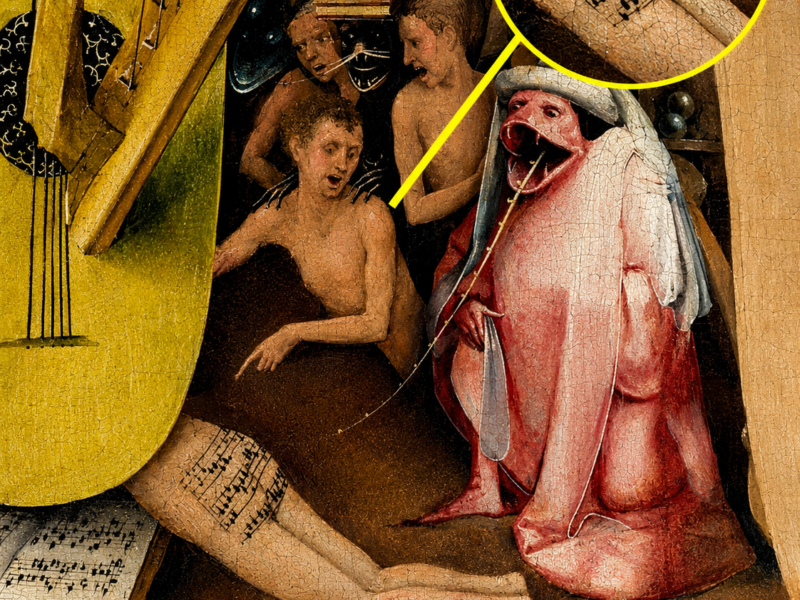
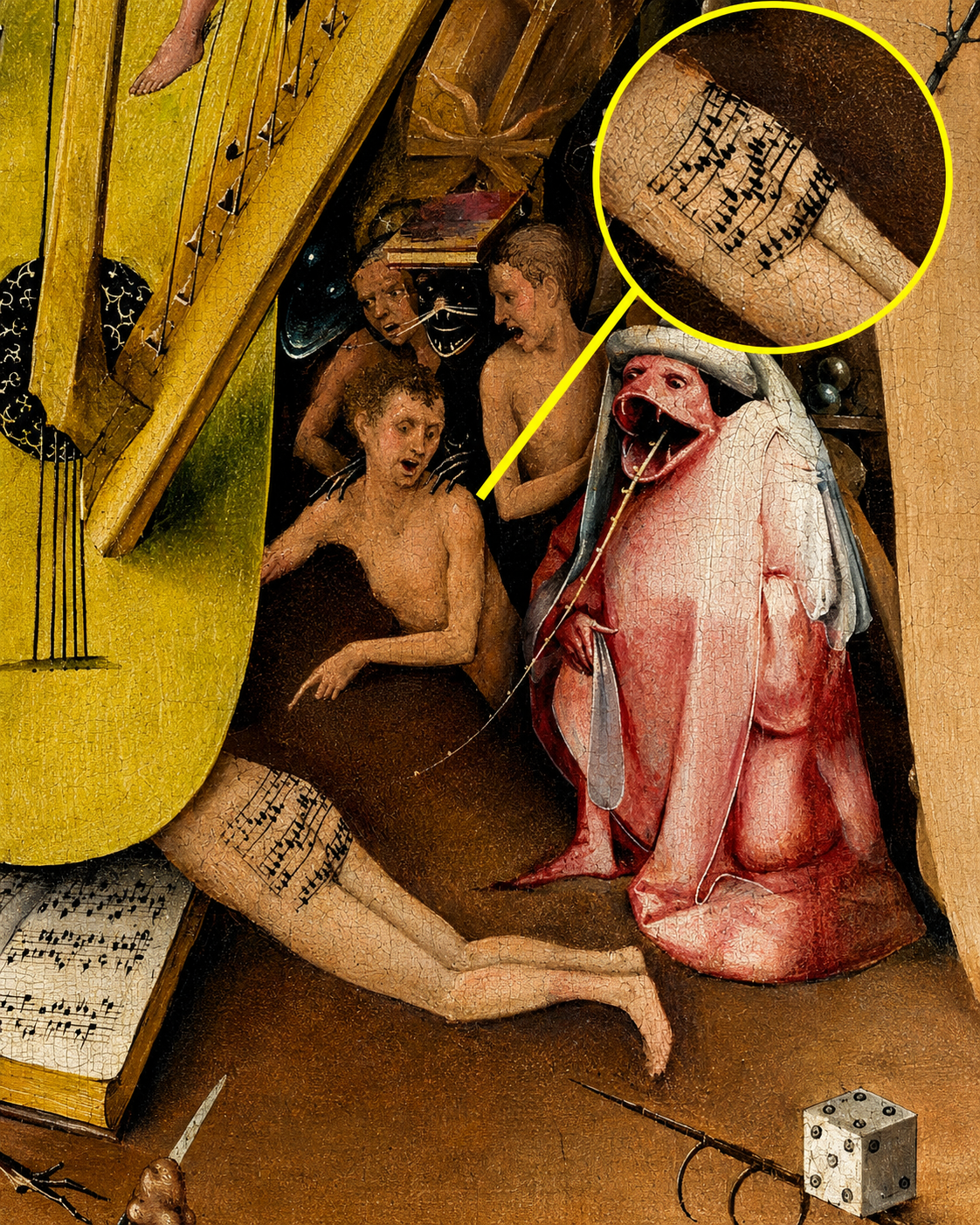
In the left corner of that panel, she spotted an incredible detail. Beneath a giant lute lies a crushed human figure, and notes are painted on his buttocks.
For five centuries, almost no one had paid attention. It might seem like a tiny detail among hundreds of figures, but Hamrick decided to find out whether the music could actually be read.
She deciphered the fragment and wrote down the melody. When she published the result, the discovery caused a sensation online. People could literally hear the music Bosch had hidden on the body of a sinner five centuries earlier.
But what kind of music was it? And why did Bosch choose a backside as the canvas for this melody?
Let’s start at the beginning. The story goes back to around 1510, when Bosch painted a work whose original title has not survived. Today it is known as The Garden of Earthly Delights. Fully opened, it is almost two meters high and about four meters wide.
Several hundred naked people, strange animals and fantastic structures crowd its surface, and there is not a single inscription to explain what the artist meant to say.
Bosch died in 1516, leaving behind neither a diary nor any commentary on his paintings. That is why researchers have been trying to decode the work for more than five centuries.
Every element of this masterpiece is loaded with symbolism that fascinates, disturbs and raises countless questions. The left panel is devoted to paradise and the creation of man. The central panel shows a world of earthly pleasures and sins, where people indulge their senses.
But the right panel is the one that matters here. This is hell.
The theme running through its scenes is purification: the painful, forced removal of everything that ties a person to sin. All around are bizarre machine-like structures that seem designed to process human flesh.
You could study this painting for hours, but one fragment deserves a closer look. On the left side of the panel stand enormous musical instruments, a section often called the “musical hell.”
According to medieval belief, secular music, unlike sacred choral singing, led people into sin. It was thought to awaken sensual desire and pull people away from spiritual life. Those who composed it and those who listened to it, the thinking went, could burn forever.
Bosch pushes that idea to a terrifying extreme. Everything that once gave a person pleasure becomes, in hell, a source of suffering. Music no longer entertains. It torments, and the instruments become enormous tools of torture.
Take a closer look. On the right side of the musical hell, a demon strikes a huge blue drum, and the most frightening part is hidden inside it. A human figure is trapped within its hollow body.
Around the drum, several naked sinners cover their ears, as if trying to escape the unbearable noise. Nearby, another man is forced to play a shawm, his cheeks swollen with effort.
The instrument is blocked from the inside. A human body has been forced into its opening, with only one arm visible and smoke rising around it. The man blowing into the pipe must keep it going endlessly.
Bosch turns ordinary instruments into bizarre torture machines, where a person is no longer simply beside the instrument. He becomes part of it.
Look at the harp. A sinner is trapped between its strings, which cut straight into his flesh. If the demon plucks one, it will not merely sound beside him. The vibration will pass directly through him.
Nearby is a huge lute, with another sinner tied to its curved frame. His body seems to become part of the instrument itself.
But the most interesting thing happens beneath the lute. This is where the crushed sinner with the notes lies. Next to him sits a figure pointing at the score.
On the right is the conductor, a pink monster with the head of a fish. The sinners sing the melody as a choir. Their punishment, apparently, is to perform the same tune over and over for eternity.
So what kind of music was it? Bosch’s musical staff has only four lines instead of the usual five, which suggests an older form of notation used around 500 years ago.
According to Hamrick, she tried to transcribe the notes as accurately as possible into modern notation. It took her half an hour, and that is how the melody emerged.
After the transcription was published, internet users began turning the melody into actual music. Someone even wrote lyrics to match the dark subject of Bosch’s hell and arranged it as a choral piece.
From time to time, music enthusiasts rediscover the tune and offer their own interpretations. And so the notation the artist left among the torments of his musical hell came to life almost five centuries later.
That said, the reading is not beyond argument. Some scholars note that the transcription involves choices, such as how to interpret the four-line staff and the pitches, and that a modern arrangement is not proof of what Bosch himself had in mind.
But why did Bosch place the notes on a backside in the first place? In his paintings, buttocks appear again and again as objects of punishment, mockery and a kind of shorthand for human nature. In Bosch’s world, they become part of a distinctive visual language.
Such images would have been familiar to the painter’s contemporaries. Backsides held a noticeable place in Dutch folklore and medieval moral culture.
There was, for example, a saying that every man prepares the rod for his own backside, meaning that through his own actions a person brings punishment upon himself.
Young girls were also warned that if they stared too long at their reflection in the mirror, they might see the devil’s backside instead of their own face.
For Bosch, then, this part of the body is not merely an element of crude humor. It can become a marker of sin and punishment. A buttock pierced by an arrow, tied up or tormented in some other way serves as a visual reminder that people answer for their own actions.
And that is why notes appearing in this particular place feel so characteristic of Bosch. Even music, depicted among the torments of hell, is tied to the body, to sin and to punishment.
It is details like these that make his art so absorbing. His paintings cannot simply be looked at once and set aside. The longer we look, the more we notice: strange symbols, hidden scenes and details whose meaning is still debated.
Perhaps that is exactly why, five centuries on, The Garden of Earthly Delights keeps fascinating us and raising new questions.
Did Bosch really hide an actual melody here? Supporters of that view point to the deliberate staff and the notes laid out for the choir. Skeptics counter that the marks may be little more than a visual joke, with no particular musical meaning attached.
We may never know exactly what Bosch meant by each of these details. But it is that mystery that keeps drawing us back to his paintings, searching for what has remained hidden right before our eyes.









