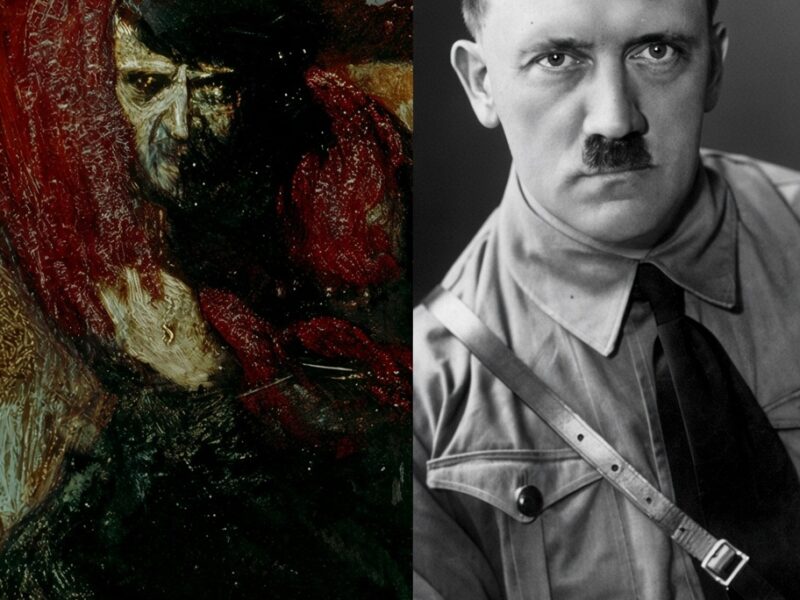
How an 1889 Painting Predicted Hitler’s Arrival
The Wild Hunt is a painting from 1889. It shows an ancient Germanic god of war charging at the head of a ghostly, hellish army. Look closely at his face, though, and a strange question forms.
The fringe, the mustache and the cold, menacing stare all seem oddly familiar. To many viewers, he looks exactly like Adolf Hitler. And the resemblance, as it turns out, is only the tip of the iceberg.
Something else is truly unsettling. The canvas was completed in 1889, the very year the future dictator was born. Was that a coincidence, or did the artist somehow foresee the greatest tragedy of the 20th century?
To untangle the puzzle, it helps to start with what is actually happening in the painting. The artist behind it is Franz von Stuck, a painter whose work lives in a dark and mesmerizing world. Myth and eroticism collide there with the shadowy side of human nature.
Sin, sensuality, demons and ancient Germanic gods were his favorite subjects. His canvases grip viewers with deep, dark colors and a tension that seems to hang in the air. The Wild Hunt is one of his most striking examples.
The subject comes from one of the most terrifying motifs in European folklore. It is the legend of a ghostly procession that races across the night sky, or through dense and remote forests, with a whistle and a thunderous roar. Its approach was announced by bloodcurdling sounds, the frantic barking of dogs and the pounding of hooves.
Behind its leader surged a frenzied crowd of riders, hounds, the souls of the dead and supernatural beings. Sometimes it was a hunt for invisible prey. At other times it was a procession of the dead that could never be stopped.
According to the legend, any traveler who met the Wild Hunt was doomed. The cursed host could carry the unlucky witness away forever. In the best case, the person simply died of terror on the spot.
In popular belief, such an encounter was always tied to the coming of wars, epidemics and great disasters. In German tradition, the leader of the hunt is Wotan, the god of fury and death, patron of war and lord of fallen warriors. Von Stuck made him the central figure of his painting.
The artist created a remarkable sense of unstoppable motion. The right side of the canvas is almost entirely filled by the horse and its rider. Wotan charges toward the viewer as if he is about to leap out of the frame.
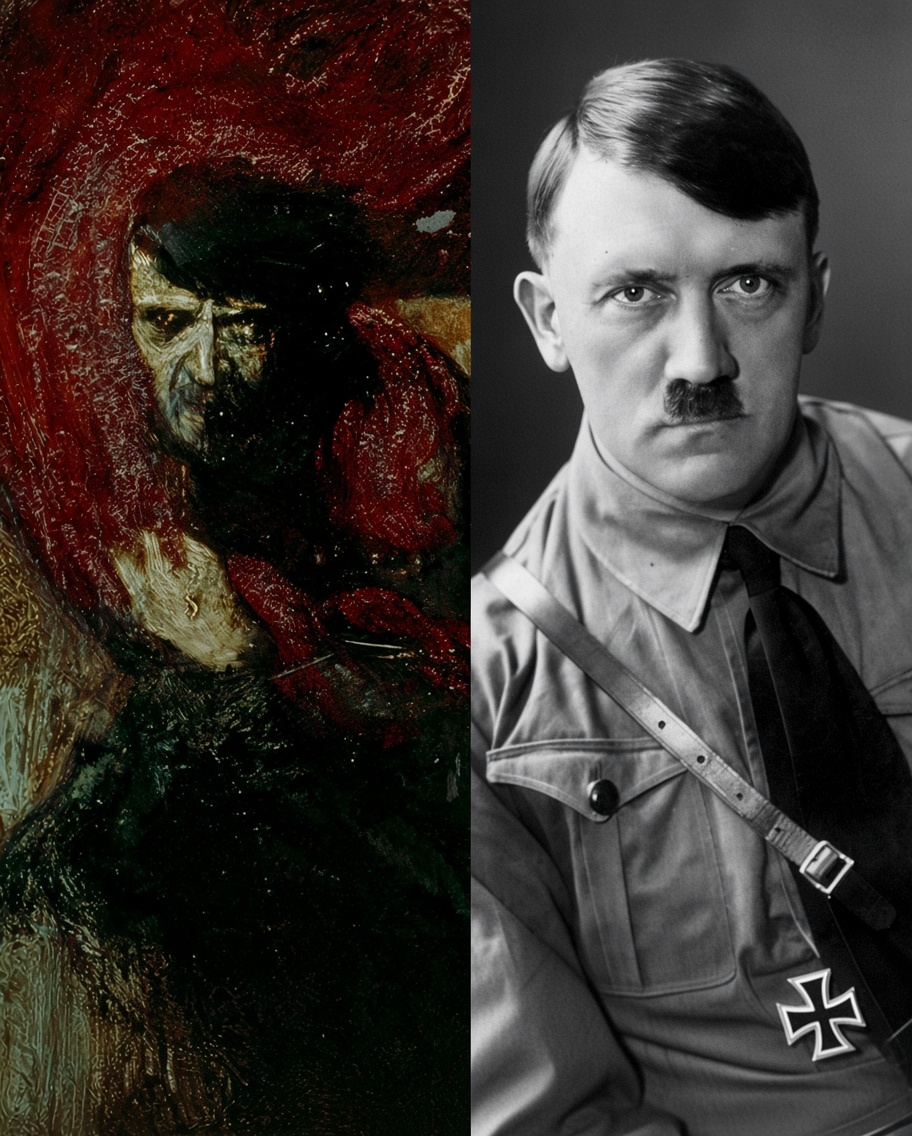
In one hand he holds a scythe. With the other he grips a red cloak that billows in the wind. In the upper left background, a mass of naked bodies, twisted faces with crazed eyes, skulls, riders and horses seems trapped in an eternal scream.
Adolf Hitler was born on April 20, 1889, in Braunau am Inn, a small town in what was then Austria-Hungary. That same year, Stuck painted The Wild Hunt. At first glance, it looks like nothing more than a coincidence.
Artists have always drawn on myths full of gods, demons and monsters. Interest in Germanic mythology was perfectly natural in the late 19th century. When the painting was first shown to the public, critics praised it, but nobody saw anything beyond an impressive work with a mythological theme.
Decades later, the picture began to look different. As the world came to know the face of the politician who would reshape Germany, the resemblance became hard to ignore. The swept-forward hair, the small mustache and an expression of cold determination and menace all invited a fresh look at a canvas painted in the year of his birth.
A work made with no connection to Hitler started to seem like a warning of his arrival. The rider, once an embodiment of mythological forces, now resembles a man whose name became shorthand for dictatorship, war and genocide.
Of course, opinions differ on how convincing the resemblance really is. Mustaches and hairstyles like these were perfectly ordinary at the time. And the human brain tends to recognize familiar features even when none may be there.
But there is another theory, far more intriguing than a simple prediction. What if Hitler himself tried to imitate the figure in the painting? Some researchers believe he saw The Wild Hunt in his youth.
Biographical literature does contain accounts suggesting he greatly admired Franz von Stuck. In his book The Psychopathic God, historian Robert Waite wrote that Hitler was virtually mesmerized by Stuck’s paintings and counted him among his favorite artists.
Hitler was also deeply drawn to Scandinavian and Germanic mythology, and Wotan held a special place in it. He was not merely a god but an archetype of the relentless leader. For a man who built his political image on the promise of a new order rising out of chaos, Wotan may have been more than a myth. He could have been a model to emulate.
One theory holds that Hitler saw the painting when he was about 13, remembered the rider, and later adopted his hairstyle, his mustache and even some of his behavior. It is a compelling story. Yet there is no direct evidence that this particular painting shaped his appearance, and no confirmed statement from Hitler himself claiming he copied the rider.
While studying Stuck’s work, the author of the original account came across a second version of The Wild Hunt, painted in 1899, ten years after the first. In the lower part of that canvas, Medusa the Gorgon can be seen. She looks upward, and her hands form a strange gesture.
Now compare it with archival photographs of Hitler rehearsing his speeches. His stance, his gaze and his gestures, the account argues, bear a striking resemblance to Medusa’s pose. Could such an unusual posture really be a coincidence, or is it evidence that he drew inspiration from the artist’s paintings?
Skeptics would answer that gestures and poses are easy to match after the fact. Nothing in the record confirms that Hitler ever studied this figure. The comparison rests on a visual impression, not on documented proof.
Franz von Stuck died in 1928, five years before Hitler came to power, and never saw what followed. Still, the link between his art and the Nazi regime was tangible enough. Hermann Göring collected several of Stuck’s paintings for his residence.
A portrait of two girls by Stuck was also meant for the grand museum Hitler dreamed of building, a museum that never came to exist. These ties show that the painter’s work was admired in Nazi circles. They do not prove that The Wild Hunt shaped the dictator’s image.
In the 1930s, Carl Jung argued that Wotan was more than a figure from ancient Germanic history. He saw in him a genuine expression of what lay dormant in the German collective unconscious. In Jung’s view, a force that had slept for centuries awoke at that precise moment in history.
Many researchers have noted the chilling parallel between the Nazis’ famous nighttime marches and the imagery of the Wild Hunt. The torches, the drums and the wild roar of the crowds recall that same blind, charging force rushing through the dark. Only now it had been brought to life in the real world.
The Nazis also pursued the revival of the spiritual heritage of the ancient Germanic peoples with real seriousness. Heinrich Himmler, head of the SS, set up an entire department devoted to hunting down objects of mythological and occult significance. The regime wanted to present itself as the rightful heir to an ancient and superior civilization.
Against that backdrop, it is not far-fetched to think that figures like Wotan helped shape the future dictator’s sense of identity. But one question will probably never be answered. Did this particular painting have any direct influence on him at all?
So what is the verdict on Franz von Stuck’s The Wild Hunt? It remains one of the great mysteries at the crossroads of art and history. Was it a mystical premonition, a coincidence, or did a future dictator see his own reflection in the god of fury?
In the end, whether Hitler copied the rider may not be the most important question. Far more disturbing is that a canvas from 1889 seems to capture, with uncanny precision, the spirit of the era that was coming. Chaos, blind destructive force and the cult of a leader who would lead millions into darkness.
So what do you think? Did the future dictator find his inspiration in this painting, or is the human brain simply inventing hidden meanings and prophecies where none exist? Share your thoughts in the comments.









